Young people who regret overeating turn to AI at 2 a.m. as their private weight-loss confidant | 2026 Youth Weight Loss Report
Every young person who is serious about losing weight may have two sides.
During the day, they are a walking calorie calculator: how many calories are in a piece of chicken breast, how heavy a fist-sized portion of rice is, and whether ordering 30% sugar in milk tea counts as making an effort.
Late at night, they are regular visitors to the AI confession room: can they remedy the situation right after eating hot pot, will eating less the next day help, and will a late-night snack make their whole week of workouts go to waste.
Weight loss seems to be a battle against the number on the scale, but in fact it is a process of adapting to real life. Dinner parties, overtime work, food cravings and staying up late all make the rule of "eat more and move less" far less simple than it sounds.
The first week of JD Health's "Easy Weight Loss" competition attracted more than 7 million users to sign up. From their check-in records and AI consultations, we can see that what young people care most about is no longer empty slogans, but more specific questions: how to eat, how to exercise, how to sleep, how to deal with weight fluctuations, and how to restart after falling off track.
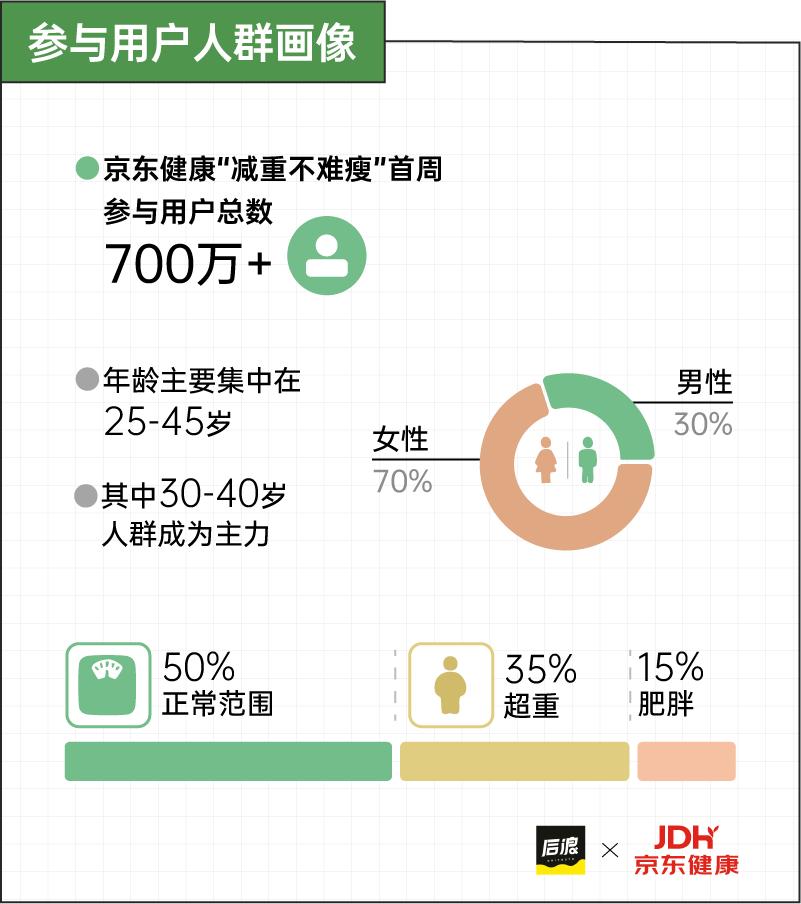

The first hidden skill young people pick up after starting weight loss is often not running, but calculating every calorie.
How many calories are in chicken breast, how heavy a fist-sized portion of rice is, whether 30% sugar milk tea can be regarded as a "compromise for fat loss", and whether hot pot dipping sauce needs to be recorded separately in the account book. They never counted expenses so carefully before, but after starting weight loss, they treat every bite of food as a financial audit.
JD Health data shows that participating users have about 1 million daily consultation queries related to calorie calculation, accounting for 37% of all AI queries about diet health. In other words, for every 3 questions about eating, 1 is a serious inquiry: "How many calories exactly does this meal have?"

The most frequently consulted foods are very representative: full-sugar milk tea, fried chicken and white rice rank top three. What they correspond to is not the simple question of "can I eat it", but more realistic confusion: can I drink milk tea? Can I keep staple food in my diet? Will eating fried chicken make all my previous efforts wasted?
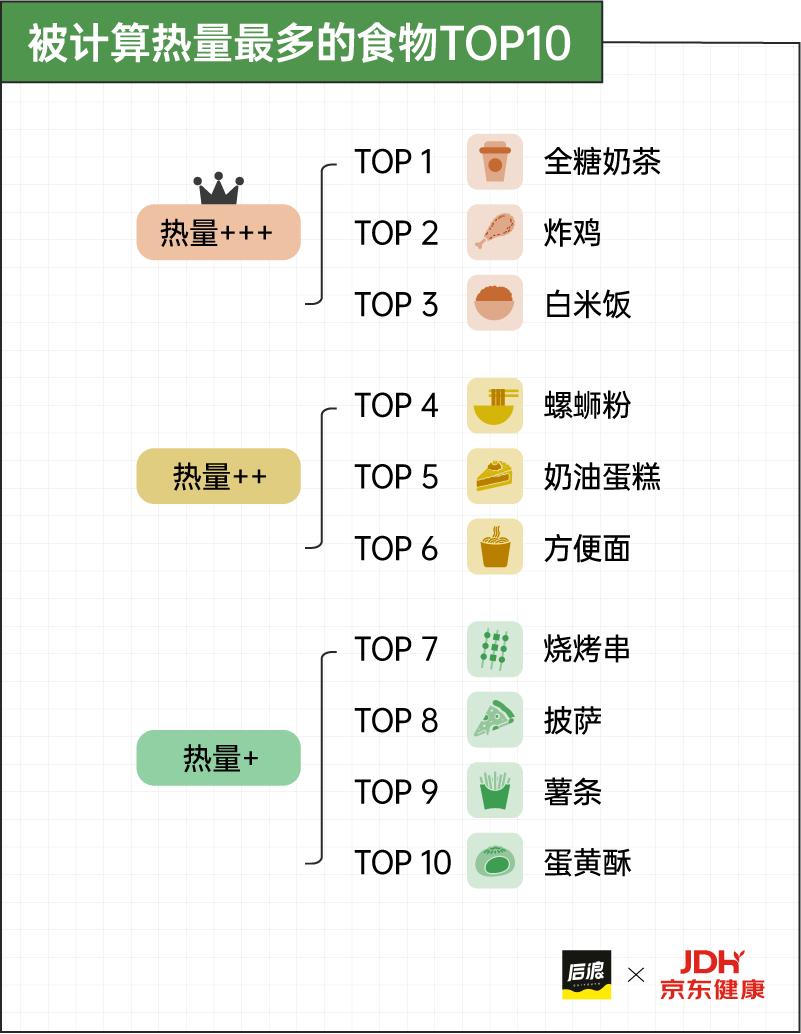
But truly sustainable weight loss does not mean removing all joy from the dining table.
The *Dietary Guidelines for Chinese Residents (2022)* recommends that daily diets should maintain diverse foods and reasonable collocation, with more than 12 kinds of food per day on average and more than 25 kinds per week. Adults are recommended to intake 200-300g of cereals per day, including 50-150g of whole grains and mixed beans. The guidelines also recommend that adults consume no more than 5g of salt per day, 25-30g of cooking oil, and added sugar had better be controlled below 25g.
This means that you do not have to completely cut off staple food during weight loss. Compared with completely refusing carbohydrates, a more practical method is: replace part of refined staple food with whole grains, mixed beans and potatoes; replace full-sugar drinks with low-sugar or sugar-free options; change fried food from "daily option" to "occasional reward".
JD Health data also finds that among AI diet consultations from young people aged 18-35, queries related to carb control total about 1.87 million times per month, accounting for 27% of all diet consultations. Nearly 60% of these queries come from users who have been controlling carb intake for more than a week. Many of them do not ask casually before starting weight loss, but have persisted for a period of time and find their craving for carbohydrates becomes more and more specific.

Southern users miss white rice, Luosifen, rice noodles and rice vermicelli most; northern users find it harder to give up steamed buns, hand-rolled noodles and dumplings. Weight loss can change your recipe, but there is no need to completely deny the "staple food preference" you have developed since childhood.
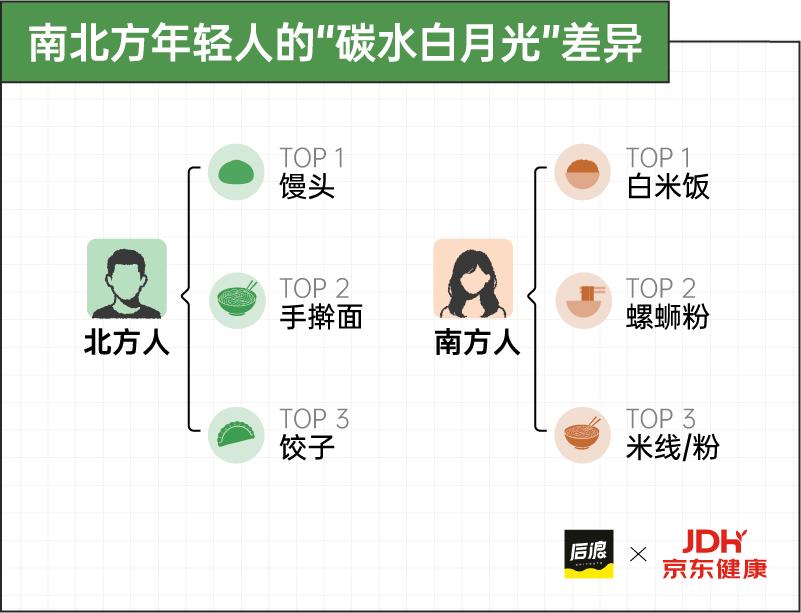
A more suitable way for ordinary people is to reserve a reasonable position for carbohydrates: leave a fist-sized portion of staple food for each meal, prioritize the mix of refined and coarse grains; if you want to drink milk tea that day, choose less sugar, fewer toppings and a small cup; if you want to eat fried chicken, make the next meal lighter instead of punishing yourself with extreme dieting.
Weight loss does not mean you can never enjoy every bite, but to set boundaries for your pleasure.

After many young people start losing weight, their body becomes a real-time market quotation system.
They weigh themselves on an empty stomach in the morning, weigh themselves after going to the toilet, and weigh themselves secretly after eating. If the weight drops by 0.1 jin, the day is a bull market; if it rises by 0.3 jin, they immediately enter the review mode of "is it all over".
In addition to body weight, body fat rate, step count and blood glucose curve are gradually added to their observation list. In the past they decided what to wear according to the weather forecast, now they decide what to eat today according to their body data.
JD Health data shows that as of August 4, more than 2.7 million users have lost over 3 jin; the first batch of users who completed the challenge lost 5.2 jin on average. The competition also provides CGM continuous blood glucose monitoring for eligible new users, and many people begin to observe the blood glucose response after different foods enter their bodies.
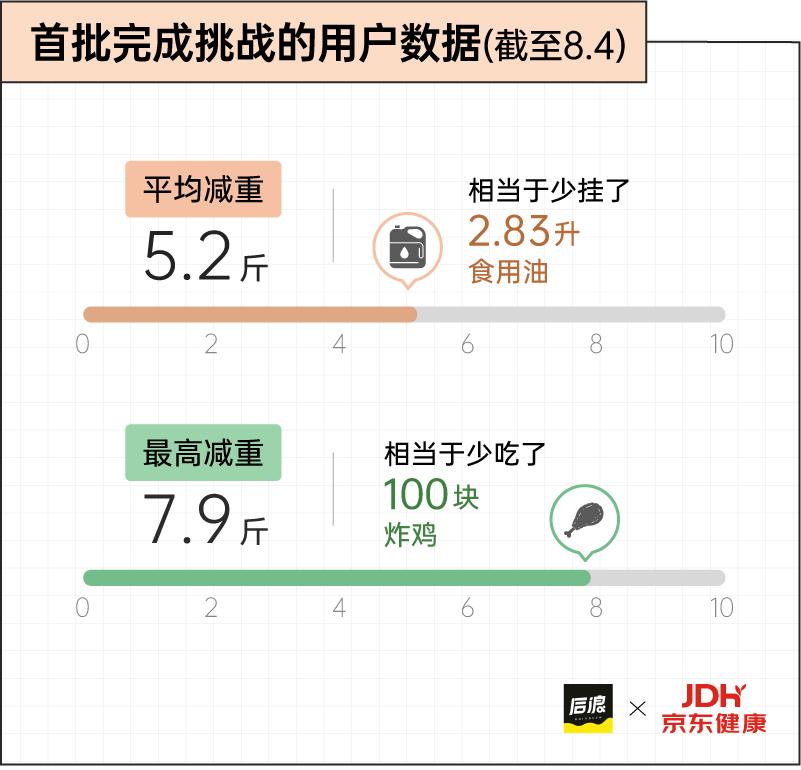
Among the carbohydrates that users are most concerned about that cause rapid blood sugar rise, "white rice", "corn" and "watermelon" rank top three. Behind these questions, young people are actually shifting from "losing weight by feeling" to understanding their bodies more carefully.

However, the purpose of data is not to create anxiety, but to help people see the overall trend.
In China's adult BMI standard, 18.5≤BMI<24.0 is normal weight, 24.0≤BMI<28.0 is overweight, and BMI≥28.0 is obese. But BMI cannot reflect the full state of the body, and indicators such as waist circumference, body fat rate, muscle mass, blood glucose and blood lipids also need to be considered together.
Therefore, the weight scale is not a judge, but more like a navigation system. It can indicate the direction, but you do not have to declare failure just because of a single fluctuation.
It is more recommended to weigh under fixed conditions: for example, 2 to 3 times a week, after getting up in the morning, before eating, and after emptying your bowels; focus on the weekly trend instead of weighing repeatedly within one day. The weight change within a day may come from water intake, salt intake, defecation, menstrual period or muscle water storage after exercise, which does not necessarily mean you have gained weight.
The same goes for continuous blood glucose monitors, body fat scales and step trackers. Their significance is not to make you led by numbers every day, but to help you find out earlier which foods are more suitable for you and what rhythm is easier to stick to.
People who really know how to use data will not make themselves anxious by staring at numbers all day, but learn to use data to avoid detours.

When many people start losing weight, they think exercise must be extremely intense.
On the first day, they run until they doubt life; the next day their whole body aches; on the third day they start making excuses: I'm too busy today, the weather is too hot, my knee is uncomfortable, I will definitely make it up tomorrow.
But many young people in the JD Health competition have explored a gentler way to get started: take care of yourself like raising a puppy.
Eat on time, go for a walk, eat less high-sugar and high-salt food, and go to bed earlier at night. It does not sound like an intense fat loss plan, but more like basic daily life operations. But for many people who sit for long periods, have irregular diets and chaotic work and rest schedules, doing these things well is already taking good care of their bodies.
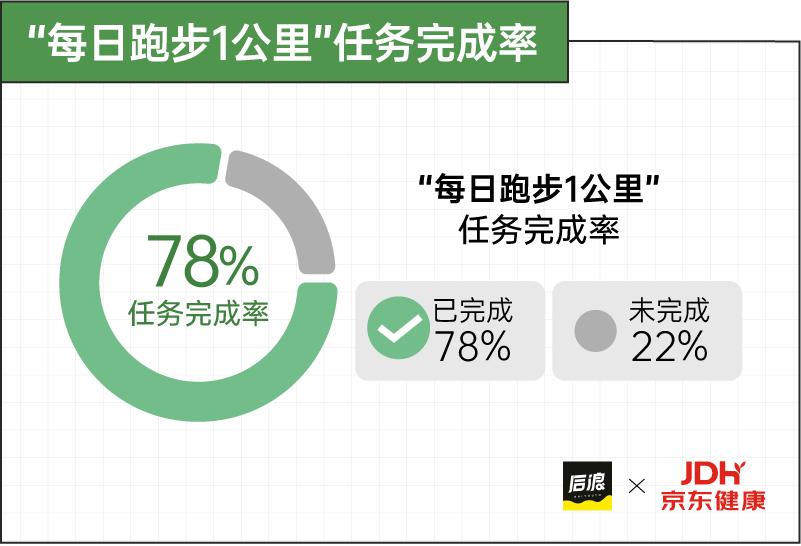
JD Health data shows that 48% of participants can stick to regular check-ins for three meals a day; the completion rate of the "run 1km per day" task reaches 78%.
In terms of step count, 52% of participating users have an average daily step count of 6000-10000, 28% of people take less than 6000 steps per day, and 17% of people can steadily walk 10000-30000 steps.
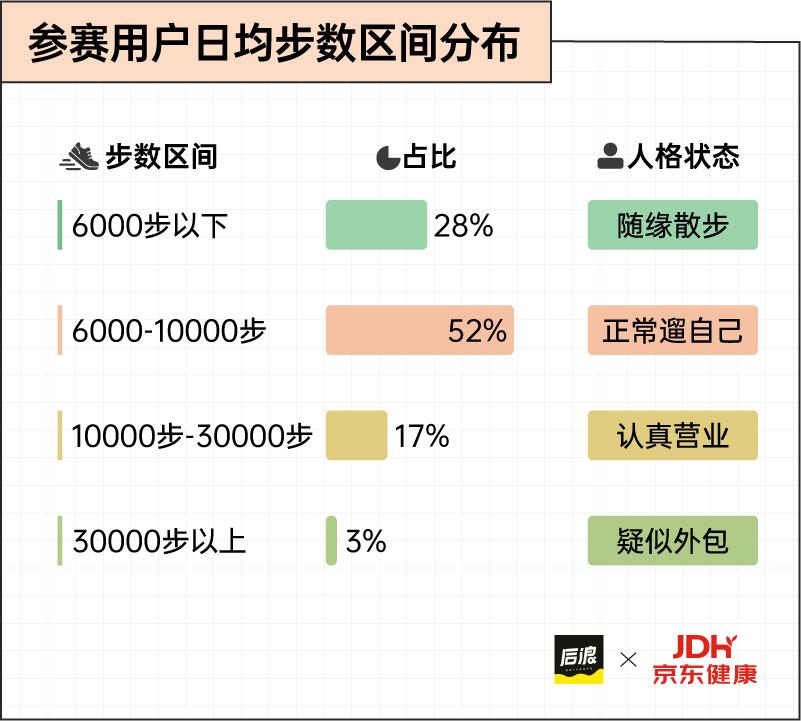
That means most people's weight loss does not start with high-intensity training, but with "move a little more today".
The *Dietary Guidelines for Chinese Residents (2022)* recommends that people of all ages should do physical activity every day; adults should do at least 150 minutes of moderate-intensity physical activity accumulatively for 5 days a week, take 6000 active steps per day on average, do resistance training 2-3 times a week, reduce sedentary time, and stand up to move once per hour.
This is a more realistic starting point for ordinary people.
If you barely exercise at ordinary times, you can start with a 10-15 minute walk after meals; if you can steadily walk 6000 steps a day, you can add 2-3 times of fast walking, cycling, swimming or jogging every week; if you want a tighter body shape, do not only do aerobic exercise, you can add resistance training such as squats, push-ups and resistance band workouts.
You do not have to "go all out" for exercise at the very beginning. For sedentary office workers, sitting one hour less, taking a few more steps after meals, and exercising regularly every week is more meaningful than occasional high-intensity overdraw.
After all, the most important thing for weight loss exercise is not how intense you are on the first day, but whether you are willing to keep going on the 30th day.

Young people in the daytime are executors of weight loss plans; young people at night are regulars of the AI confession room.
During the day they ask: "How to cook chicken breast to avoid it being dry?"
At night they