No more waiting! A blind person took matters into his own hands and built a guide robot.
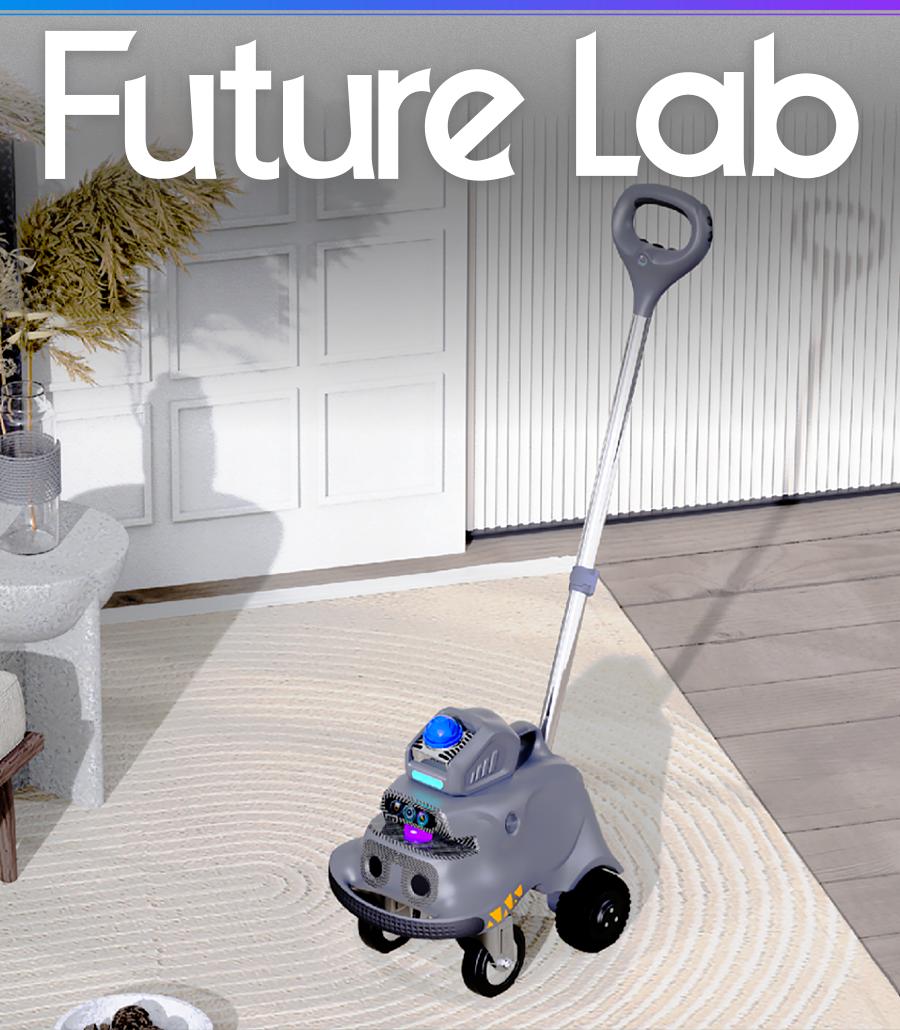
How can a person with visual impairment gain the freedom to travel independently?

Interview | Liu Sijie, Li Jiaxing
Text | Liu Sijie
Editor | Zhang Wei
Cover Source | AI Look official website
In the interview room of the Global Artificial Intelligence Conference, two voices rang out at the same time.
While Zhu Qingyi, a person with visual impairment, was telling the "Future Human Lab" about his serial entrepreneurial experiences, another calm female voice with a slight mechanical tone said:
"Facing south, the distance is about 1.4 meters".
"There are double switches on the gray wall on the left, and the floor is covered with gray carpet".
The female voice came from a mechanical device next to Zhu Qingyi, which looked like a miniaturized space probe. The cameras, radars and multiple sensors on it are working, scanning the surrounding environment, converting data into voice and broadcasting it sentence by sentence.
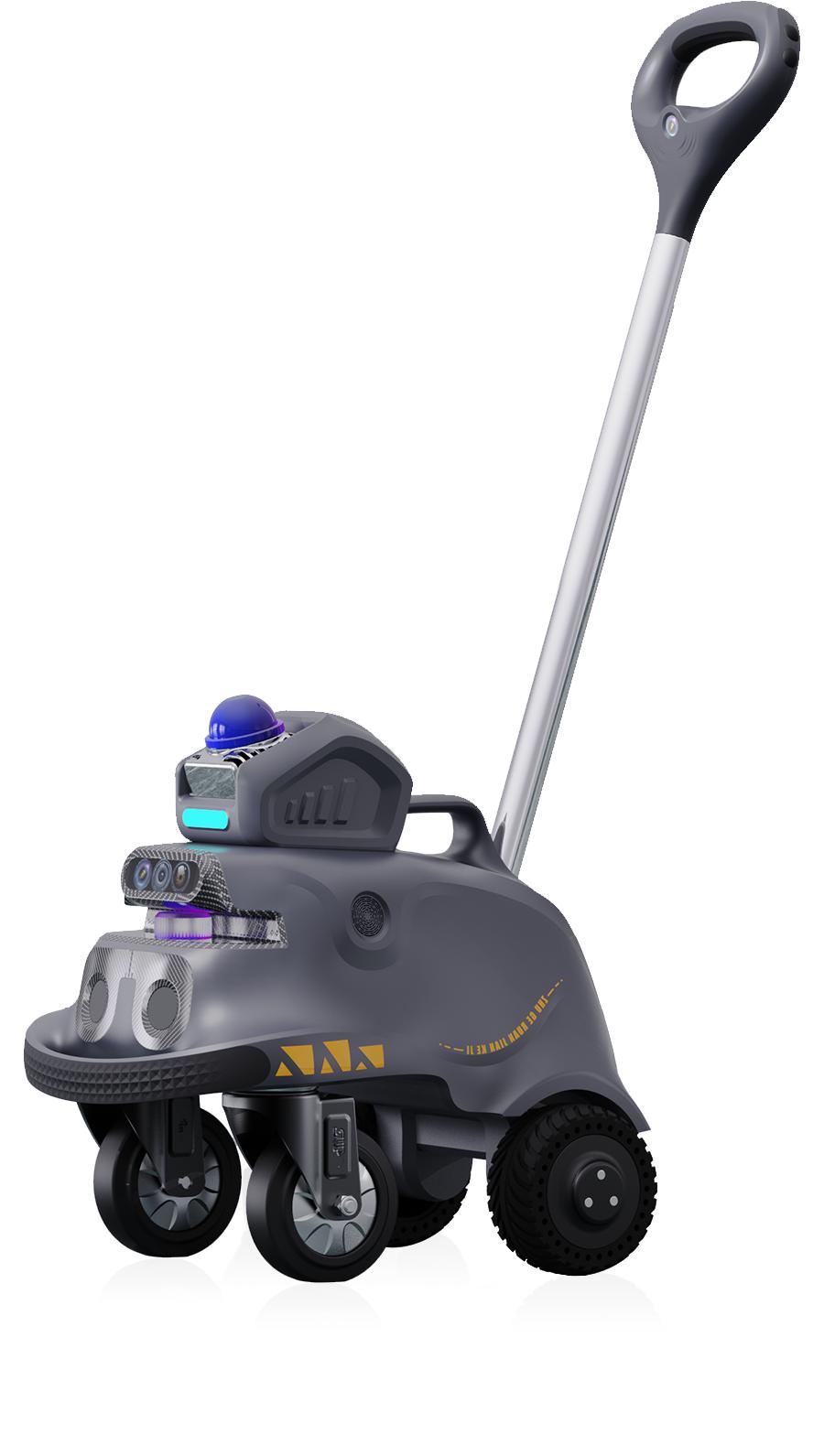
AI Look Robot
This is a guide robot for the blind produced by Zhuge Robot Team founded by Zhu Qingyi, named AI Look. It has taken six years from the project initiation to today. It is specially designed for people with visual impairment to help them avoid obstacles, navigate...
When Zhu Qingyi launched this project, what he faced was not a market opportunity, but a problem that had troubled him for decades: How can a person with visual impairment gain the freedom to travel independently?
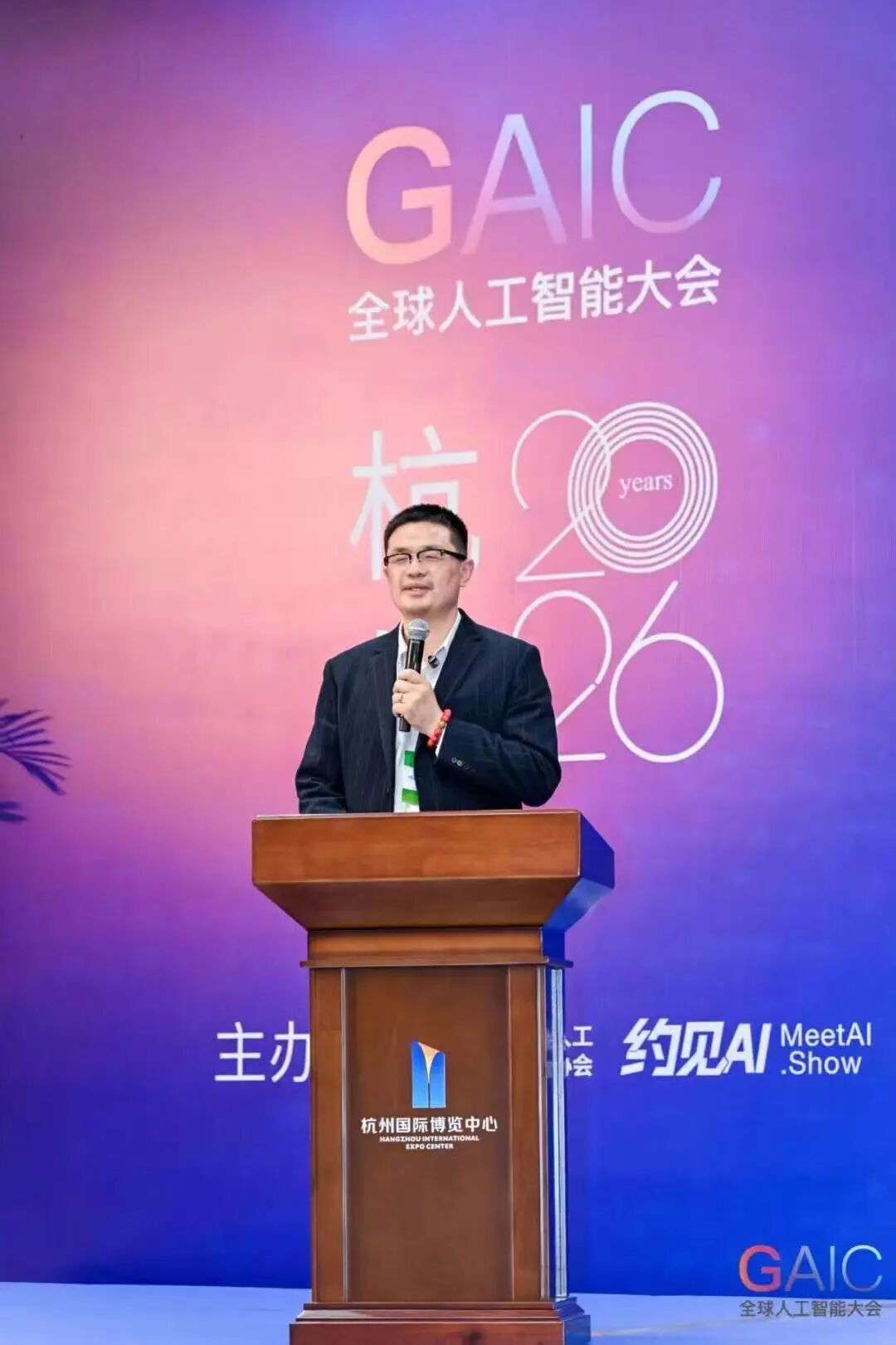
Zhu Qingyi speaking at the Global Artificial Intelligence Conference

The Biggest Trouble Caused by Visual Impairment
For people with visual impairment like Zhu Qingyi, the inconvenience brought by inability to see is embedded in every aspect of life.
This is a world built for people with normal vision. The tactile paving is painted in bright yellow, although people who really need to use it cannot see it. Most websites do not consider that blind people will visit them. Texts are made into pictures for aesthetic purposes, buttons are not added with description labels, and screen reading software cannot read out the content, only repeating the word "link". The products for the blind in the government procurement catalogue are distributed in batches, but they are piled up in corners because they are not easy to use...
The regret of not being able to see often appears in daily life and will not disappear or fade away over time. Sometimes when going out with colleagues and friends, someone says the scenery is so beautiful. Zhu Qingyi can feel the temperature of the wind blowing across his face, smell the smell in the air, and hear the sounds made by people and small animals, but "he just can't see". What stings him even more is that he "can't see what his son looks like".
People will say to him "Your son is really handsome". Zhu Qingyi wants to know what his son looks like. He touches his son's facial features with his hands, and he can feel the approximate height of his son's nose, but he can never construct an image of his son's appearance in his mind.
There is a clear "dividing line" in Zhu Qingyi's life.
When he was studying, he got excellent grades in science subjects. Like most children, his ideal at that time was to be admitted to a university and learn his favorite major. After he turned 15, a disease changed everything. After a fever, he was diagnosed with retinitis pigmentosa, and his vision began to decline irreversibly. At the age of 18, he could no longer read ordinary books and could only study in a school for the blind. After graduating in 1998, like most people with visual impairment, he became a masseur.
He once opened a massage parlor in his hometown in Shandong, with nearly 50 employees at its peak. He was willing to delve into skills and had excellent massage techniques, and he created half of the store's revenue himself. "I earned a lot of money", and the money was packed in his pocket in stacks with folded paper bags.
At the end of 2000, Zhu Qingyi spent 7999 yuan to buy his first computer in his life. At that time, dial-up access was still required for the Internet, and it cost several yuan per minute.
With the help of the screen reading software on the computer, Zhu Qingyi downloaded programming books from the Internet to teach himself. He not only learned coding, but also applied for domain names and web hosting. In 2001, he built an accessibility website specially for the blind, which facilitated people with visual impairment to download books, audio and video materials.
Creating a website by himself is a completely different experience from giving massages to others, but they have something in common: massaging others can relieve pain and cure diseases, and building a website is also to "treat" the visually impaired group like him. Although this kind of treatment cannot restore the vision of the visually impaired, it extends the boundary that was once restricted by "inability to see".
Since he taught himself programming, Zhu Qingyi has been on the road of technological entrepreneurship. In 2009, he closed his massage parlor and established a software technology company in his hometown Shandong. Over the years, he led his team to develop accessibility exam systems for the blind, music teaching software for the blind, distance teaching platforms for the blind, smart campus systems for special education, and also undertook the creation of accessibility websites for local disabled persons' federations and universities...
These projects have one thing in common: the demands are all discovered from his own life predicaments.
He couldn't see the verification code on the website, so he developed an accessible QR code recognition system; blind students had inconvenient exams, so he developed an accessible exam system; he wanted to learn music but couldn't find a suitable way, so he developed music teaching software.
He himself is also the first user of these products.
The most troublesome thing for him is that his inability to see prevents him from traveling independently.
Around 2010, with the decline of his vision, Zhu Qingyi could no longer go out independently. He had to be accompanied by family members, friends or colleagues to go out.
Zhu Qingyi told me that because he cannot travel independently, the biggest restriction for him is "relying on others and troubling others". Now several fixed colleagues take him out. On weekends, everyone has their own arrangements. At this time, when he wants to go out, he feels more that he is troubling others. Most of the time, when he needs to go to the company to work overtime on weekends, he will not call his assistant, but choose to take a taxi by himself.
Most of the time, Zhu Qingyi kept a calm state when talking to me, but when I asked the question "Do blind people seldom go out", Zhu Qingyi directly refuted me, saying that it was a "lie", and then asked me in return "Just like a person with paralyzed legs says he doesn't like walking, would you believe it?"
Zhu Qingyi is a strong-willed person. He doesn't like to use a white cane when going out. He told me that most blind people don't like to go out with a white cane. In the eyes of blind people, a white cane is a label. Taking it out to travel is telling others that they are blind.
He wants to travel independently and also wants to tear off the label of "blind person".
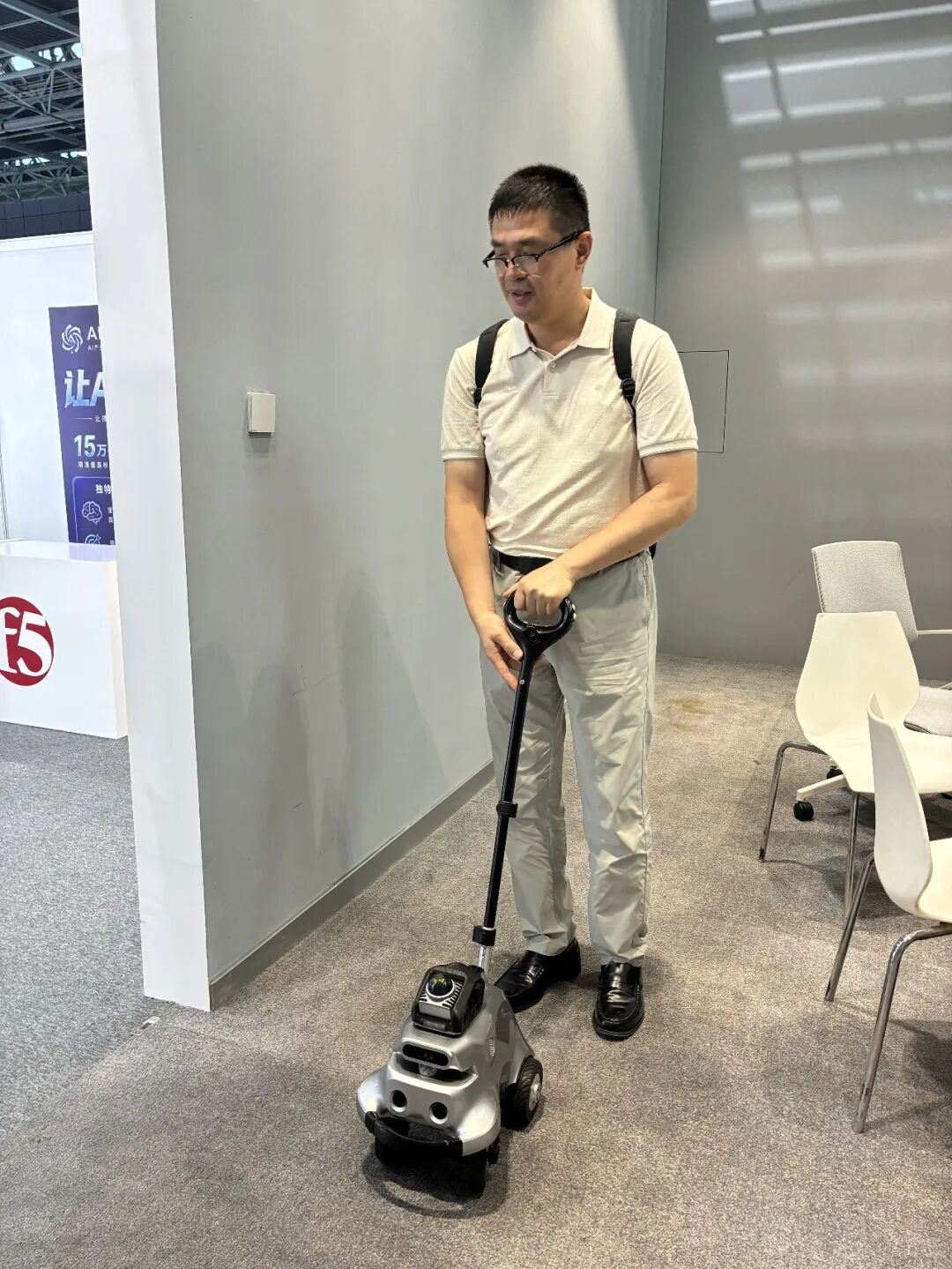
Zhu Qingyi using AI Look

Tired of waiting endlessly for usable products, just make it by yourself
He once pinned his hopes on technology, but felt disappointed and frustrated again and again.
Ten years ago, he still had the idea of "making blind people really see" through technology, but after studying technologies such as brain-computer interface and electronic eyes, he realized that this is a goal that is difficult to achieve in the short term.
If independent travel cannot be achieved through "restoring vision", it can be realized through various "guide products for the blind".
Over the years, Zhu Qingyi has tried almost all guide products for the blind on the market.
Wearable devices worn on the chest, sensor devices tied to trouser pockets, and products that look like flashlights held in hand to avoid obstacles, but the use effects are not satisfactory. "I still don't know what the obstacle is? Is it a tree, a chair or a cat? Even if it tells me there is an obstacle, I still dare not move forward."
Zhu Qingyi feels that over the years, he has suffered a lot from endless "waiting", waiting for others to make usable products for the visually impaired group to solve the travel problem. But in fact, most people who produce products for the blind are people with normal vision, and they cannot fully insight into the pain points and needs of people with visual impairment.
But he can do it himself. He is a person with visual impairment, and he knows what this group needs. If it is really not possible, he has a group of visually impaired friends who can all serve as product managers.
In 2020, Zhu Qingyi attended the preparatory meeting for the 14th Five-Year Work Plan of China Disabled Persons' Federation, where everyone was talking about robots.
At that time, the company was also developing an accessible smart campus system, and one of its subsidiary projects was to add a "virtual robot" that could automatically answer questions to the APP, which made him feel that artificial intelligence technology has indeed developed to a certain level, and it is feasible to make a robot to guide the blind.
After the meeting, Zhu Qingyi returned to the company and launched the "guide robot for the blind" project. The time was ripe. Since no team on the market had produced a product that satisfied him, he decided to make it by himself.
At first, the internal team of the company imagined the product form as a "guide dog", but this idea was quickly rejected. They bought a mechanical dog for testing. The official said it had a long battery life, but after running continuously for less than an hour, it ran out of power. The fuselage weighs about 40 jin, which is impossible for blind people to carry, and it is easy to fall when going up and down steps. So the mechanical dog solution was abandoned.
The first real product made was extremely crude. The chassis was a mobile tray of an ordinary computer host, with universal wheels. On top was a carton with several holes dug, and various sensors bought online were glued to the holes one by one, and then a push handle was installed.
It could not lead people to walk automatically. People could only push it to move, check the data returned by the sensors while pushing, and judge whether it could "understand" what was in front of it. At that time, there were only two people in the R&D team: Zhu Qingyi and a young man who had developed Android apps and majored in Internet of Things. The two of them searched for sensors one by one online, bought them back, disassembled and installed them, and pushed the carton to walk around the office.
But this is also the most fulfilling moment for Zhu Qingyi in the whole process of developing the robot. Starting from these two people, the team has gradually expanded to more than 50 people now. The product has been iterated for more than ten generations in the laboratory, from initially only being able to "recognize that there is an object in front" to gradually being able to avoid obstacles automatically, lead people to walk, and plan routes.
Of course, there were many pitfalls in this process. The fuselage itself is a whole magnetic field. At first, the 4G IoT card was installed at the bottom of the fuselage, but there was no signal as soon as it entered the room or the car. After checking for a long time, it was found that the signal was interfered by the magnetic field. Finally, the problem was solved by moving the card to the top of the handle. The chip has strong computing power and generates heat quickly, which can make the shell of the machine burn to more than 150 degrees Celsius. However, to dissipate heat, vents need to be reserved, and the vents will make the machine not waterproof. This contradiction of "needing both heat dissipation and waterproof performance" was later solved by their self-developed design, and a patent was also applied for.
It is through this step-by-step exploration that AI Look was finally developed. At present, the total number of pre-orders is about 1200 units, and the first mass production plan is to deliver 2000 to 3000 units in September.
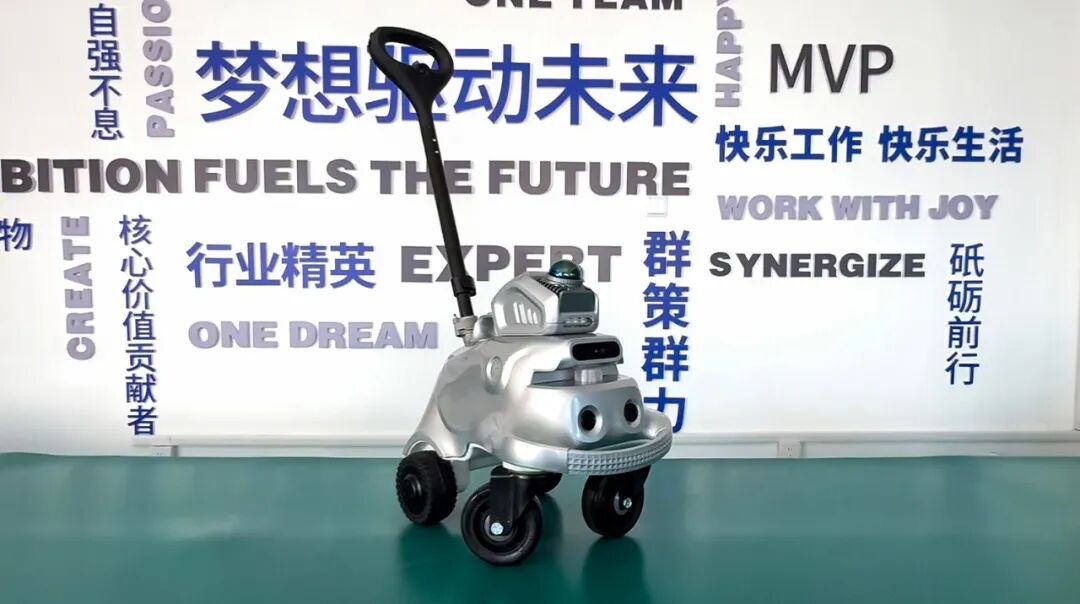
AI Look Robot
I asked Zhu Qingyi, when the product is in the hands of people with visual impairment, what is the smallest need you want to help them solve. Zhu Qingyi replied that it is not a small need, but a big need, "Go out for a walk independently, and then be able to come back home."
The following is the technical implementation part about AI Look