With Midea committing 3.1 billion yuan and Haier 2.8 billion yuan, why are leading home appliance giants collectively placing big bets on JD Omni-Channel Super Brand Day?
The home appliance industry has just gone through a tough first half year.
According to the aggregated data from AVC, from January to June 2026, the total retail sales of the home appliance market reached 425 billion yuan, down 9.9% year on year, with retail sales of all categories shrinking across the board.
Yet in the same six months, there is another set of figures moving in the opposite direction.
In April, Hisense's first omni-channel Super Brand Day on JD recorded a 212% year-on-year increase in transaction value within 96 hours; in May, Midea's 6-day omni-channel Super Brand Day achieved a transaction value of 3.1 billion yuan, while TCL's Super Brand Day saw a 108% year-on-year sales growth at offline JD Home Appliance stores; in June, Haier's omni-channel Super Brand Day hit a transaction value of 2.8 billion yuan; in July, GREE's Super Brand Day saw its omni-channel transaction value exceed 930 million yuan.
Several home appliance enterprises with mature channel systems and strong brand resources have made the same choice. They have no lack of sales channels, nor the ability to independently organize marketing activities.
But why, at a stage when it is increasingly difficult to achieve growth in the home appliance industry, are these leading brands still willing to concentrate their core products and marketing resources on the same platform IP?
The answer may not lie in another big promotion launched by JD, but in the fact that the Super Brand Day itself has undergone changes.
01. Beyond Demand, the Real Problem of Stock Game
The home appliance industry has long relied on node-based business. Whether online platforms or offline hypermarkets, they gather traffic through large promotions and store anniversaries, with brands offering concentrated concessions. When traffic is sufficient, higher investment can bring larger transaction volume, and channel friction is easily covered by growth.
After entering the stock stage, even tiny differences will be refracted and amplified.
Home appliances have low purchase frequency and a long decision-making chain, involving experience, distribution, installation and after-sales services in addition to prices. The embedding effect of refrigerators, the picture quality of TVs, and the installation schemes of air conditioners can hardly be fully explained by a single online page, and the final transaction may occur at either the online end or the offline end.
High-end orientation and structural upgrading further amplify the importance of offline channels. Data shows that in the first half of the year, the retail sales of 144Hz and higher high-refresh color TVs increased by 8% year on year online and 44% offline; coffee machines increased by 6% online and 65% offline. Products with higher unit price and more emphasis on experience require more display, explanation and interaction to complete value persuasion.
However, brand operation systems often operate separately along different channels. Online teams focus on traffic, conversion and platform rankings, while offline teams focus on store footfall, regional prices and shopping guide output. With different budgets, product assortments and assessment targets, a national marketing activity is easily split into several partial actions after reaching the terminals.
Similar problems exist in marketing resources. Event copyrights, celebrity endorsements, new product launches and co-branded IPs are usually split into multiple platforms and channels. Each place gets a certain amount of exposure, but it is difficult for content dissemination, product experience and sales support to form a complete closed loop.
What brands are really lacking is no longer just traffic. What they need more is an operation mechanism that can reduce channel loss and reorganize scattered resources.
02. What Exactly Does Omni-Channel Need?
"Omni-channel" is by no means a new concept in the retail industry.
Many brands have realized the closed loop in the conceptual sense by enabling online coupon collection and offline verification, or connecting store inventory to e-commerce pages. This kind of linkage solves the problem of where consumers enter from, but rarely touches on targets, product assortments and resource allocation. It can solve the problem of channel bearing, but cannot go further to find the core entry that can truly reach transaction conversion.
JD's transformation of the Super Brand Day is carried out in this gap.
In the past, the main position of JD Super Brand Day was focused on online channels. Brands provided products, promotional benefits and marketing budgets, while the platform provided event venues, traffic and content exposure. In 2026, JD integrated its offline networks including JD MALL, JD Electrical Appliance City Stores, JD Home Appliance Stores and Five Star Electrical Appliances into the event as a whole, expanding the Super Brand Day from an online marketing node to a synchronized online and offline sales campaign.
Underpinning this campaign is the offline network laid by JD Home Appliance & Home over many years. At present, JD has nearly 30,000 JD MALL, JD Electrical Appliance City Stores and JD Home Appliance Stores across the country, achieving full coverage from core business districts in first-tier cities to counties, towns and villages. In 2025, JD also built nearly 1,000 "brand co-branded stores" with brands such as Midea, Haier and Hisense, focusing on sinking markets such as towns and townships.
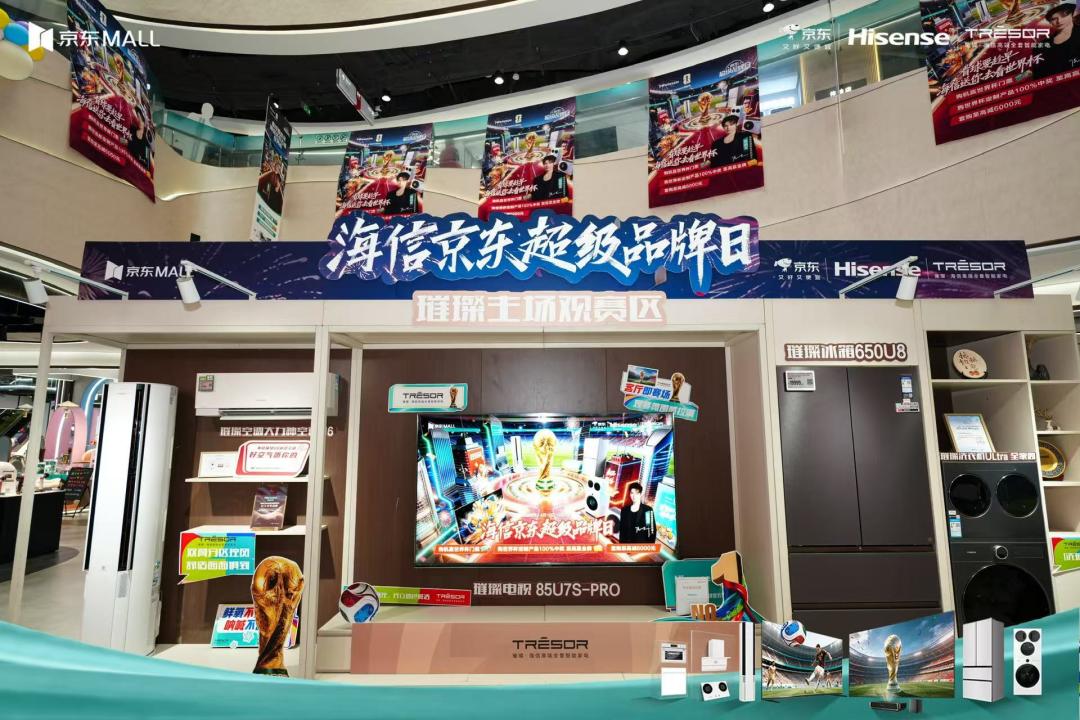
Hisense JD Super Brand Day Offline Event
For brands, this means that the reach radius of a single event can for the first time cover offline consumers that were previously out of reach of online marketing, especially those in county and township markets who are used to making purchase decisions by visiting physical stores.
As a result, a new operation mode of linkage between brands and platforms has emerged. The growth needs of different brands and categories are supported by the omni-channel ecosystem aggregated by JD Super Brand Day, forming a subtle joint force for operation.
The cashing efficiency of brand marketing resources has been greatly improved. JD Omni-Channel Super Brand Day provides another way to use these resources: concentrate investment in one session, and realize conversion through JD's online and offline channels at the same time.
There are many practices of this application in the events, and the gameplay varies from one to another.
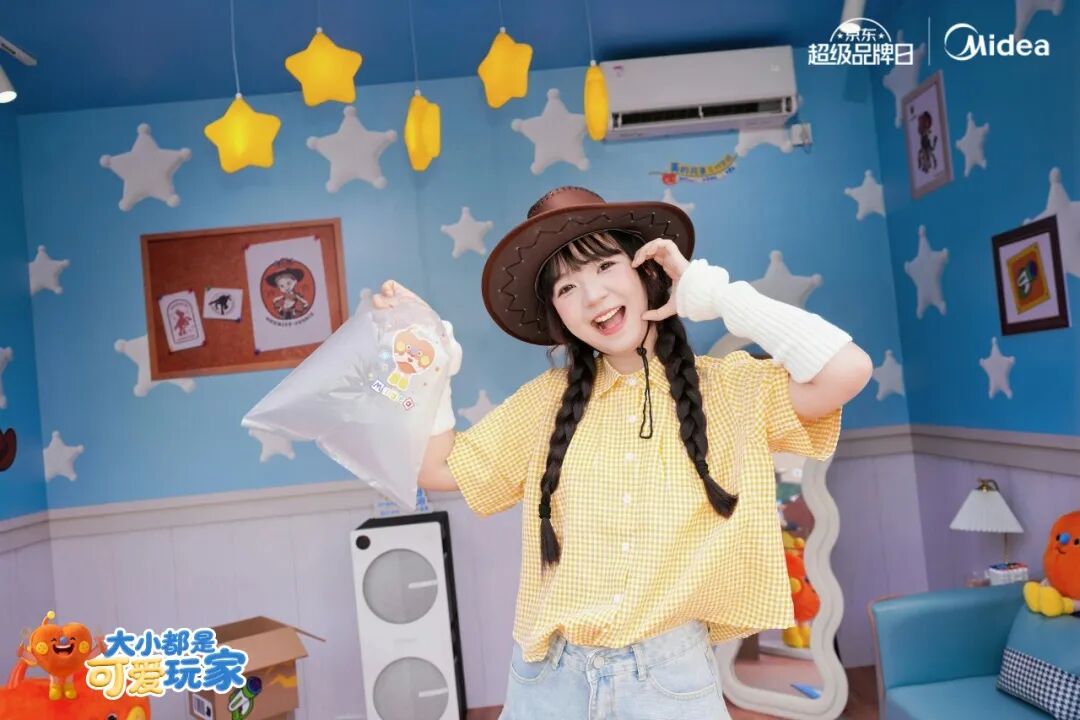
Midea JD Super Brand Day Offline Pop-up Event
Hisense invested World Cup themes, ticket lottery benefits and Neo Hou's offline activities into the Super Brand Day. Midea cooperated with the *Toy Story 5* IP to launch pop-up activities and live broadcasts at JD MALL South Third Ring Road Store in Beijing.
While TCL invited Robert Pires to the Guangzhou JD MALL to participate in the event, Haier invited Liverpool legend Robbie Fowler to hold a special live broadcast. GREE placed the live broadcast of Yang Jiulang from De Yun She in the JD MALL at Beijing South Third Ring Road, attracting more than 200,000 views and driving online sales of nearly 60 million yuan.
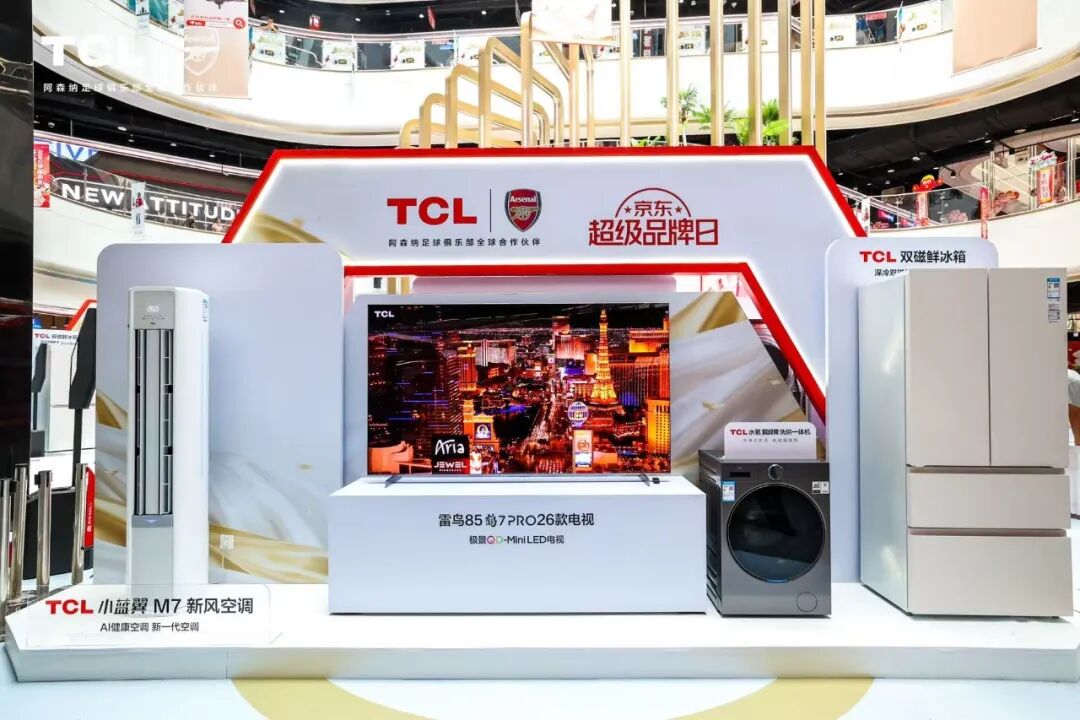
TCL JD Super Brand Day Offline Event
Pop-up activities, star player meetups, celebrity appearances and scenario-based displays allow consumers to go a step further from "seeing advertisements" to arriving at the scene. JD MALL is not only an experience space for high-unit-price home appliances, but also a position for joint brand marketing and content production, and the venue itself is an amplifier of brand resources.
The generation of public attention and the occurrence of transactions are compressed into the same link. Online attention can be connected to product experience in JD's terminal ecosystem, and then the main site and stores can continue to support transactions.
In addition to sufficient coverage breadth, JD Super Brand Day has achieved the precision of different channels operating at the same rhythm.
During TCL's Super Brand Day, 4,000 stores in the JD system completed the arrangement of event materials, 14,000 in-store electronic screens participated in the communication, and more than 1,000 live broadcasts and 3,800 single-store promotions were launched. Five Star Electrical Appliances continuously introduced local consumers to stores through map platforms, content marketing, community group buying meetings and private domain communities. During Midea's Super Brand Day, JD Home Appliance Stores launched more than 1,500 events, with a total of 2,000 live broadcasts.
Brands determine marketing themes and invest in products, IP and content resources, while JD Super Brand Day converts platform-level solutions into display, interaction and sales actions in stores of different regions, thus reducing the cost for brands to coordinate various channels of JD separately.
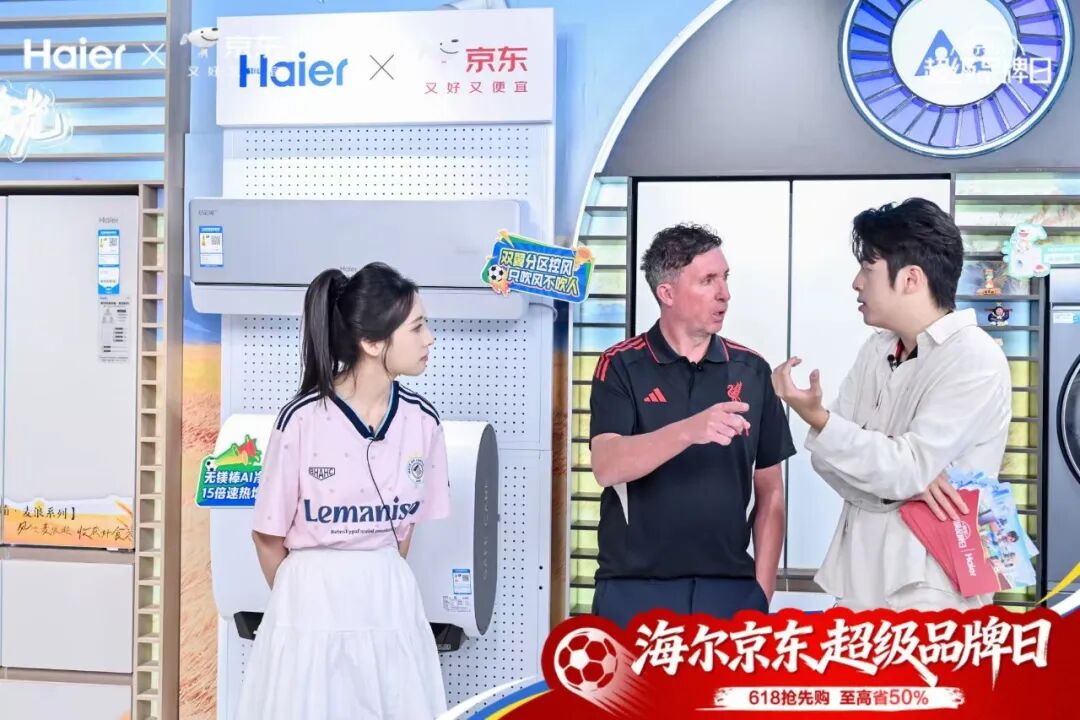
Haier JD Super Brand Day Offline Live Studio
This precision is also reflected in the unification of goods and prices. For example, Haier adopted the global distribution method of "one product, eight terminals" in cooperation with JD Super Brand Day, while Midea connected different terminals with exclusive products and unified benefits. No matter which method is adopted, consumers can get a unified event experience whether they enter from online or physical stores.
In addition, there is the unification of services and performance. For example, TCL authorized JD to provide 100% free delivery and installation service for 100-inch TVs to customers' homes, which is a key factor for TCL's products to gain user praise and maintain stable sales. The unification of performance benefits, especially for products like 10-inch large screens, the certainty of delivery and installation is part of the reason for transaction.
It can be seen that after JD Super Brand Day completed the omni-channel evolution, brands have gained the opportunity to access the national offline network, reach more consumers and meet complex home appliance demands; JD has transformed its long-accumulated capabilities in stores, content, traffic and services into a set of omni-channel operation capabilities that can be called by brands.
03. A Long-term Business
The high growth of a single event is easily affected by the intensity of concessions, resource input and the base number of the same period, and what is really valuable for observation is its replicability.
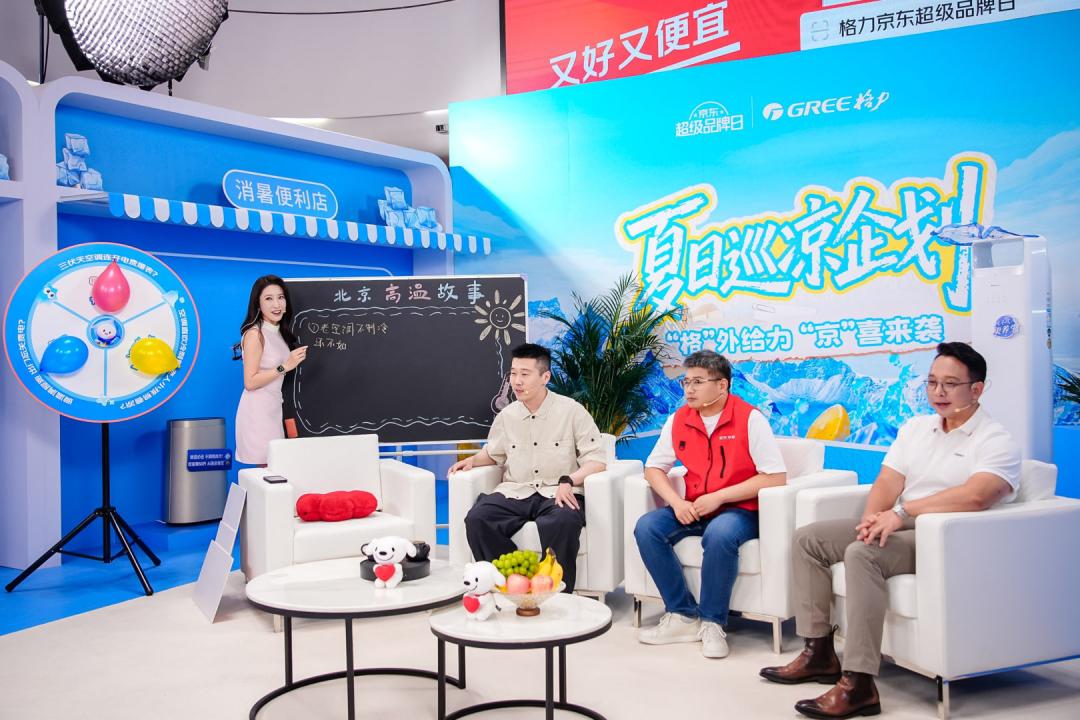
GREE JD Super Brand Day Offline Live Studio
From Hisense's trial in April to GREE's event in July, the model has been replicated six times in four consecutive months, covering five brands and all home appliance categories including TVs, air conditioners, refrigerators, washing machines, kitchen appliances, etc., with nodes distributed around the 618 shopping festival and the peak summer sales season. The model has been proven effective for different brands, categories and time points, indicating that the growth is more from the stable output of the mechanism itself.
What can better illustrate the problem than the total volume is the distribution of various channels. According to JD data, during Midea's event, the retail target achievement rate of the main site was 139%, that of JD stores was 178%, and that of Five Star Electrical Appliances was 214%, with the completion degree of the two offline ends higher than that of the main site; during GREE's event, JD's online transaction value increased by 60% year on year, Five Star Electrical Appliances increased by 117%, JD stores increased by 72%, with all three ends rising; TCL's Five Star Electrical Appliances recorded a 311% year-on-year growth.
When several channels grow at the same time, and the offline channels grow even more, it proves that the brand's growth comes from incremental volume, rather than transfer of traffic between channels.
It is more noteworthy that the high growth rate of dozens or hundreds of percent does not mean a small base. Midea's 3.1 billion yuan, Haier's 2.8 billion yuan, and GREE's 930 million yuan are not achieved through shortcuts. Behind these figures are in-depth product assortments, dense terminal coverage, strong performance capabilities and high organizational efficiency, which are achieved against the backdrop of a 9.9% decline in the overall market and fierce competition.
In a down half-year period, the absolute value can better illustrate the thickness of channels than the growth rate.
The continuous participation of leading brands is also changing the cooperation mode between platforms and brands. In the past, platform promotions were more like a resource swap. In the new model, brands invest in celebrities, events, new products and regional resources, while the platform mobilizes the main site, stores, live broadcasts, private domain and performance systems, and supports the results with combined calibers. The cooperation extends from the marketing department to sales, channels, products and terminal operations.
This relationship also has institutional support. In February this year, JD signed a 2026 strategic cooperation agreement with Midea, Haier, Hisense and TCL, clarifying the strategic target of 180 billion yuan in omni-channel sales on JD's online and offline platforms for all parties.
The roles of both sides have changed. The platform and brands have evolved from supply and sales and traffic transactions to business cooperation that sets targets jointly, invests resources jointly and undertakes results jointly.
Statements from the brands have confirmed this change and recognition.
A relevant person in charge of Midea said that since the in-depth cooperation in 2013, JD has always been Midea's most stable online and offline sales platform. The two sides have not only jointly created many best-selling products with sales exceeding one million units, but also continuously improved service experience and innovated marketing gameplay.
Haier said that many new products exclusively launched on JD successively in 2025 have become phenomenal hits in the industry, and JD has provided "certainty" support for brands to build new product awareness.
The word "certainty" comes from the brands. Leading brands are willing to invest continuously, which shows that what they are purchasing is not just an exposure window, but also the certainty of channel coordination, terminal mobilization and business results. JD Super Brand Day is exactly the execution unit and acceptance site of this certainty.
In a year when input and output are generally difficult to predict, this may be the most scarce value that the platform can provide. More importantly, this value will not return to zero as the event ends.
For brands, a Super Brand Day can not only complete new product launch, hit product creation and high-end product promotion, but also verify the product assortment structure and market feedback. The product awareness, store visits and new users brought by the event can continue to be used in subsequent operations.
The proven resource allocation and cooperation mode can also be applied to the next new product launch, industry promotion or peak season marketing. As the number of cooperation increases, the running-in cost of both sides in product assortment, rights and interests, content and channel coordination continues to decrease, and the path for core resources to be converted into sales results will become clearer.
Therefore, Super Brand Day has begun to move beyond the scope of one-time promotion projects. It is not only a node for brands to create sales outbreaks at different stages, but also gradually becomes a long-term growth tool for leading brands to operate their omni-channel business on JD, drive the growth of new products and high-end products, and precipitate user assets.
Conclusion
Stock competition does not mean there is no demand in the home appliance market