Is a game with hundreds of thousands of active online players actually an AI-produced knockoff?
On a boring night, I stumbled across a video of a new game: a group of white little figures running all over the map, players can paint their own bodies to mimic walls, floors and various objects, hide themselves into the environment, and wait for the other team of players to come and find them. The gameplay is simple and oddly addictive, and I was immediately hooked. I scrolled through the entire comment section and finally found the game's name — "Super Chameleon".
I excitedly opened Steam, typed in "Super Chameleon", and only one game in the search results matched the name, so I bought it directly.
But after playing for a while, I felt more and more that something was wrong: why did it feel not the same thing as what I saw in the video? Only after checking did I realize that I had bought a counterfeit copy by mistake.
The original work in the video is actually called MECCHA CHAMELEON. Chinese players call it "Super Chameleon", but its official name on Steam has always been in English. The later counterfeit SCRIBBLE HUNT directly changed its simplified Chinese name to "Super Chameleon".
I searched for the game using the Chinese name that everyone uses, and then fell right into the trap dug by the knockoff game with pinpoint accuracy.
What's even more absurd is that after finding the original work and scrolling down, I found another counterfeit that replaced the white little figures with animals right behind it.
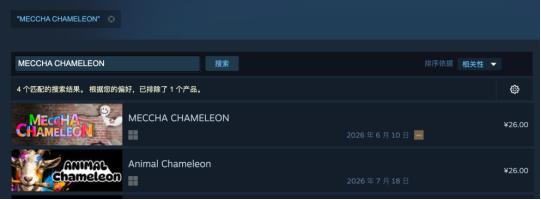
A counterfeit that even appeared right in front of the original game
Following this lead to dig deeper, the counterfeit that launched on Steam was even considered a latecomer.
MECCHA CHAMELEON was launched on June 9, while the Paint And SEEK! project on Roblox was created as early as April 2. However, on June 21, only 12 days after the original work went live, its page suddenly changed to the current gameplay of "paint yourself, blend into the environment, and evade seekers", and the tags even directly showed "Meccha" and "Chameleon".
In other words, an already launched game chose to keep the old shell but completely change the core, discarded all its previous game content, and directly copied MECCHA CHAMELEON to make new content. What a clever move of "backdoor listing".
Less than a month after its launch, MECCHA CHAMELEON sold more than 15 million copies, with a peak concurrent player count of 340,000 and a book revenue of nearly 600 million RMB. However, by mid-July, the concurrent player count of the original work had dropped from its peak of 340,000 to around 50,000, while the total number of players on several Roblox counterfeits reached 150,000 to 200,000 at the same time, once nearly 4 times that of the original game.
The gaming industry has long been alert to this kind of speed.
In October 2025, John Buckley, head of publishing at Pocketpair, the developer of Palworld, said in an interview with Game Developer:
"I think in the next two or three years, we will enter a very strange period — which has actually gradually begun on Steam now — a large number of low-quality games made by AI will emerge.
This problem has plagued other game stores for a long time, and Steam has resisted it very well in the past. But now it has also come to Steam, this wave is coming."
This year, after Pickmon, a game that stitches together elements from Palworld, Pokémon and The Legend of Zelda: Breath of the Wild, appeared, well-known game media GamesRadar+ directly commented: "I don't know if it was made by AI, but it reeks of AI-generated garbage."
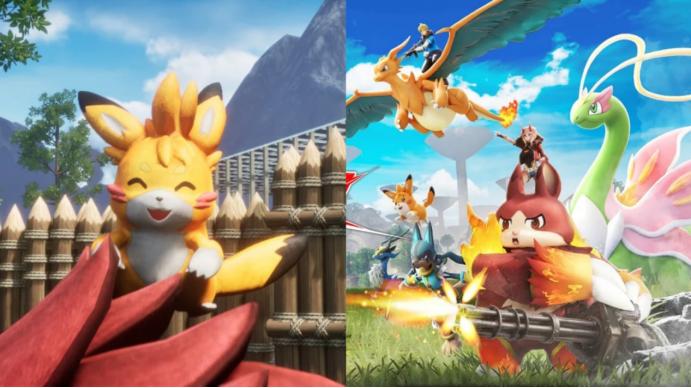
GamesRadar+ commented that Pickmon "reeks of AI-generated garbage"
Game developers have a more direct perception of this kind of counterfeiting speed.
Nick Kaman, co-founder of Aggro Crab, the developer of PEAK, said that knockoff games have existed in this industry for decades, but AI has pushed the speed forward by a huge margin:
"Making knockoff games manually is one thing, directly using AI to make them as fast and convenient as possible is another."
He said that now some people have made cheap AI counterfeits of PEAK and are selling them everywhere for profit.
AI: Name whichever game you want to copy
AI is already very common in game development.
On July 13, 2026, Sulka Haro, a gaming industry professional, released an independent data analysis titled Three years of AI on Steam. He sorted out 53,597 games launched from July 2023 to July 2026, and counted the proportion of games that used generative AI in different years based on the "AI Generated Content Disclosure" information on the store page.
In 2024, this proportion was only 10.9%; it rose to 19.9% in 2025, and by 2026, it has reached 30.8%, which means nearly 1 in every 3 new games has disclosed the use of generative AI.
Moreover, this number may even underestimate the popularity of AI in game development. Steam only requires developers to report AI-generated content that will eventually appear in the game. Using AI purely to assist in writing code and improve development efficiency does not necessarily need to be disclosed. In addition, although Steam requires developers to report AI-generated content facing players in the game, it currently mainly relies on self-reporting by developers and pre-launch review, so the actual proportion of games using AI is likely to be even higher.
For knockoff games, AI tools are particularly useful. Writing code, building UI, creating character and scene assets, animations, translation, debugging, and fixing bugs, almost every link can involve AI participation.
In the past, when a single person wanted to make a complete game, they would easily get stuck at a certain link they were not good at. For example, a programmer may not be good at art creation, and a painter may not be able to handle online connection, physics systems and various bugs. Now one person equipped with several AI tools can complete the work that used to require the cooperation of multiple people such as programmers and artists.
What's even more exaggerated is that AI has compressed the time of "remaking an existing game from scratch" to the minute level.
Some people used Cursor, Codex and image models together to quickly make a knockoff version of Street Fighter; for games with simpler rules such as Flappy Bird and Minesweeper, it only takes a few minutes.
With one prompt, AI can quickly produce a playable version. In the past, even the simplest counterfeiting had to take time to do bit by bit, but now the production time is counted in minutes.
This speed is no longer limited to small games and technical demonstrations.
Firefield, launched in 2026, is clearly developed following the path of Diablo. A 45-year-old developer with no previous programming experience relied mainly on Claude Code, spent only 3 months to complete about 120,000 lines of code, and even made the game engine and map editor by himself.
Another game Codex Mortis, which imitates the gameplay of Vampire Survivors, was also developed by an individual with the help of AI, and the Steam version was completed in about 3 months.

Fire Field, an action RPG with obvious Diablo style. The developer had no previous programming experience, and mainly relied on Claude Code to finish the game in about 3 months.
When knockoff games meet AI, it's like adding fuel to the fire.
From the initial idea to the final breakout success, original games need to spend a lot of time testing gameplay, modifying designs, and also bear the risk that players may not accept the game at all.
Counterfeiters skip all these steps. The hit original game has already proven the gameplay that players like and the game mechanisms that can become popular. When the answer is already in front of them, all imitators need to do is to make a similar version as soon as possible. With the help of AI, the production process itself can be accelerated a lot, and many tasks that used to require developers to polish slowly can now be directly handed over to tools.
So AI is almost a ready-made helper for knockoff games.
The original game is responsible for testing out the creative ideas and market demand, AI is responsible for making the game, and the most important problem left for counterfeiters becomes: which one to copy?
The ancient era of slow and steady game counterfeiting
Making a counterfeit version in a few minutes with one prompt is already very exaggerated. But before the emergence of AI, knockoff games have also been racing against time all along.
It should be noted that there are more than one counterfeit manufacturers. When a game suddenly becomes popular, whoever copies faster will have a better chance to ride on the original game's popularity, or even just get a share of the remaining traffic is good enough.
So over the years, people who make knockoff games have been trying to do less work and go faster.
When the copyright rules were not so perfect, the most convenient way was of course to directly use existing resources. The name, characters, screenshots and promotional images of the original game can be modified and reused.
Those with a little bit of conscience would find existing code and templates, change the name and replace a set of assets on it, and then re-launch the game. There are also some games that are simply ported to another platform: if it was popular on PC, they would quickly make a mobile version; if it was popular on Steam, they would make a similar version on Roblox.
"Reskinning" is also one of the most common methods.
The gameplay and program framework of the game are basically unchanged, only the characters, visuals and names are replaced. After Flappy Bird became a hit in 2014, a large number of imitators quickly appeared in the app stores. The bird was replaced with fish, pigs, unicorns, and the obstacles could also be changed to different looks, but the gameplay remained exactly the same. Those who are more careful would rewrite the code and remake the assets by themselves, only taking the most core gameplay.
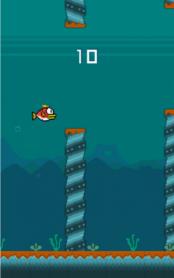
Counterfeit product Flappy Fish. Even this fish can hardly be called original, it is basically the "closed-mouth version" of the flying fish from Super Mario.
But speed has always been a very important indicator for knockoff games. If you copy fast enough, you can even take over the name and popularity of the original game. The once viral 2048 is a counterfeit that succeeded in doing exactly that.
The team of Threes! spent 14 months polishing the game, while the author of 2048 only used one weekend to make a version with very similar gameplay. 2048 was launched almost immediately riding on the rising popularity brought by Threes!, and it was free and playable directly in web browsers, with a much lower dissemination threshold than the original game. Within a few weeks, 2048 attracted more than 23 million players. In the end, many people only remembered 2048, and did not even know that Threes! was the original game with that set of gameplay.
But the speed of 2048 was only a rare case at that time. The game itself was not complicated, with simple visuals, simple rules and simple systems. Even so, it still took a whole weekend to make a similar version. For slightly more complex games, the time and technical thresholds would rise immediately. Just making the game playable requires the cooperation of different roles such as programmers and artists, and repeated testing and bug fixing are needed after the production is done.
So in the past, although many knockoff games looked crude, they still had to maintain a team behind them. For example, Voodoo, a mobile game company that was often criticized for quickly imitating popular gameplay, already had about 80 employees by 2017.
For multiplayer games such as R.E.P.O. and PEAK, counterfeiting is even more troublesome. In addition to the gameplay, you also need to make maps, character animations, props, online connection functions and various other systems. The more complex the original game is, the longer it usually takes for imitators to make a playable version.
There are even some people who can't even wait to finish the game before launching. As soon as the original game gains some popularity, they will directly take the name, icon, screenshots and promotional images to piece together a seemingly decent store page. When players pay and download the game, they find that there is barely any gameplay content inside, only a few wallpapers.
Therefore, before the emergence of AI, knockoff games had already saved many unnecessary steps to grab market share faster. But as long as you wanted to make a truly playable game, the development threshold could never be bypassed, and the production speed could hardly be increased any further.
After the emergence of AI, the most time-consuming development link has also been greatly accelerated.
From "following the trend" to "overtaking and stealing business"
In March this year, indie game developer Freya Holmér posted a 50-second game prototype video on social platforms. This was a new game she was developing, with gameplay similar to "rotatable Tetris": the entire board keeps rotating, and players need to continue to arrange the blocks according to the new direction.
Holmér was just like many other indie developers, sharing what she was working on recently. But just a few days after the video was posted, at least 4 AI counterfeit versions had already appeared.
The creator of one of them, Rotris, later admitted that he finished making the game in about one day. Some other counterfeits were even directly launched on the app stores. At that time, Holmér's own original game was not even finished yet.
