The talent show is staging a comeback, and none of the contestants this time are real people.
In 2026, the most viral new content in the short video track has emerged.
Fengwang Technology recently found when retrieving social media information that a new form of interactive short drama has appeared on Douyin. Take *Starlight 108* as an example. According to the released content, it features 108 girls competing on the same stage, with content advanced through profile photos, initial stage performances, public show duels, fan voting and other forms, and only 9 contestants can finally debut as a group. It sounds like a copy of *Produce 101*, but the difference is that none of these 108 contestants are real people, all are AI-generated.
The AI talent show *12-Star Trainee Competition*, which also went viral this month, has accumulated 250 million topic views on Douyin in just one month, and its official main account has gained 540,000 new followers.
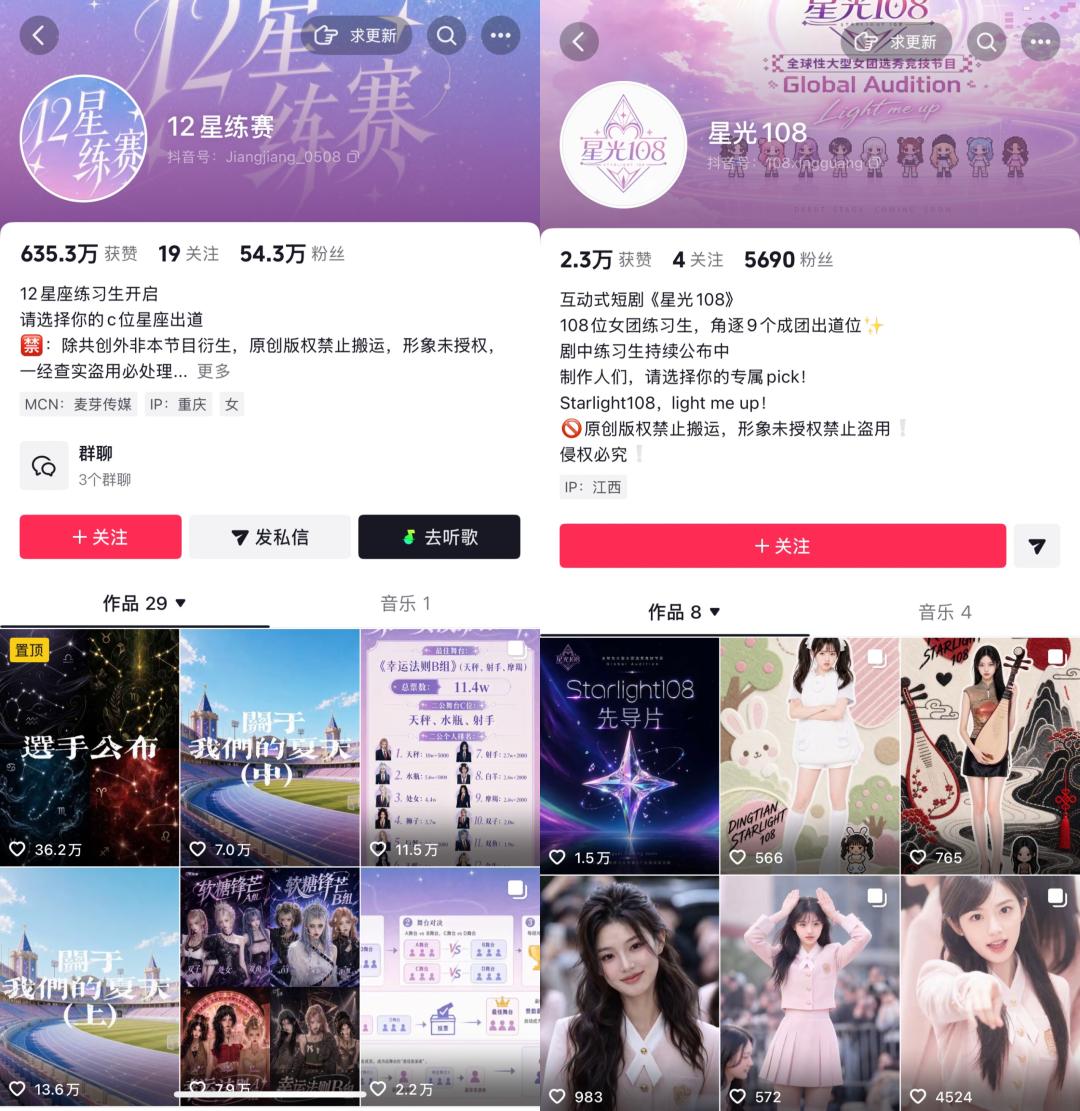
This batch of new content is also called the landmark product of "AI talent shows" by netizens. Their script settings follow the exact same formula as traditional talent shows, and the final lineup of AI contestants is determined by the number of votes from netizens. In just a few days, fan support clubs have emerged in the comment section, and netizens are enthusiastically picking their favorite characters.
Whether it is the generated official profile photo or the offline fan-taken candid shot, they are almost identical to the leaked on-set photos from past real-person talent shows. At present, the profile photos of the virtual artists are still being updated.
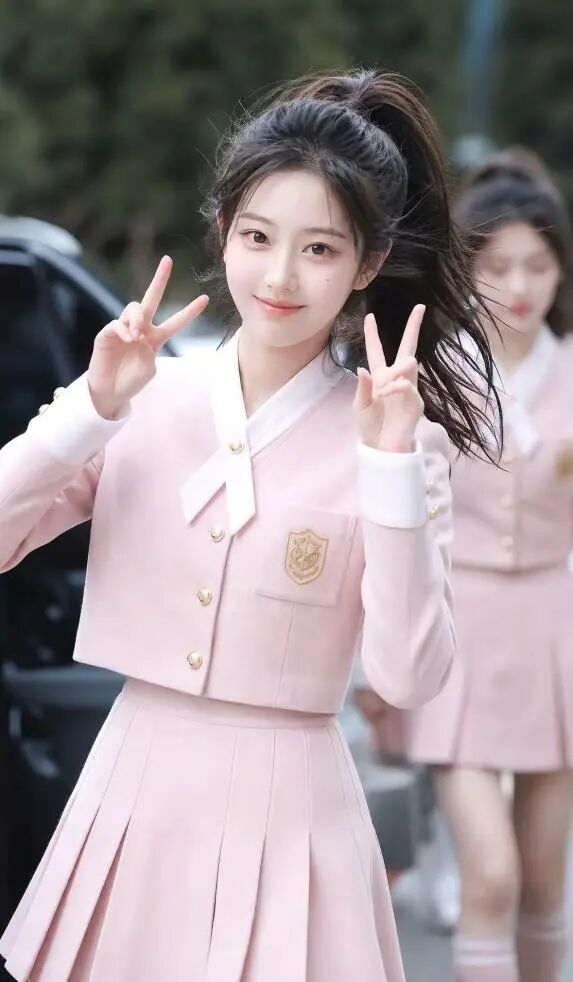
Three months ago, audiences were still complaining that AI actors "look awkward" and "are too fake"; three months later, AI talent shows have topped Weibo's hot search list, attracted a huge audience, and netizens are exclaiming "what a refreshing surprise". What changes have taken place for AI actors during this period? How do AI idols debut and operate?
Idols that never collapse, the capital has waited far too long for them
"Chasing AI idols brings no pressure, and you never have to worry about their public image collapsing." This is one of the most common comments in the comment section of *Starlight 108*. If "never collapsing" is the magic weapon for *Starlight 108* to attract audiences, its extreme cost-effectiveness is the real leverage that disrupts the entire industry.
How high is the cost of real-person talent shows? Venues, mentors, long rehearsal cycles, while the personal images, singing and dancing stages, and promotional materials of AI contestants are all generated by AI. A production team of only a few people can complete the whole process, which greatly reduces production costs.
AI idols can do 24-hour live broadcasts, produce a large number of stage videos, never suffer from emotional burnout, and will never be involved in negative news. More importantly, the marginal cost of AI idols is close to zero. Once an AI character is generated, it can be used infinitely, reused in unlimited scenarios, and realize unlimited commercial monetization.
For the AI variety shows that have already achieved commercial success on the market, commercial order revenue accounts for more than 80% at the highest proportion. Take *12-Star Trainee Competition* as an example, just one month after its launch, the number of followers of its official Douyin account has reached 543,000. Netizens are enthusiastically voting for their favorite contestants in the comment section, and the more likes a contestant gets, the higher the probability of them debuting.
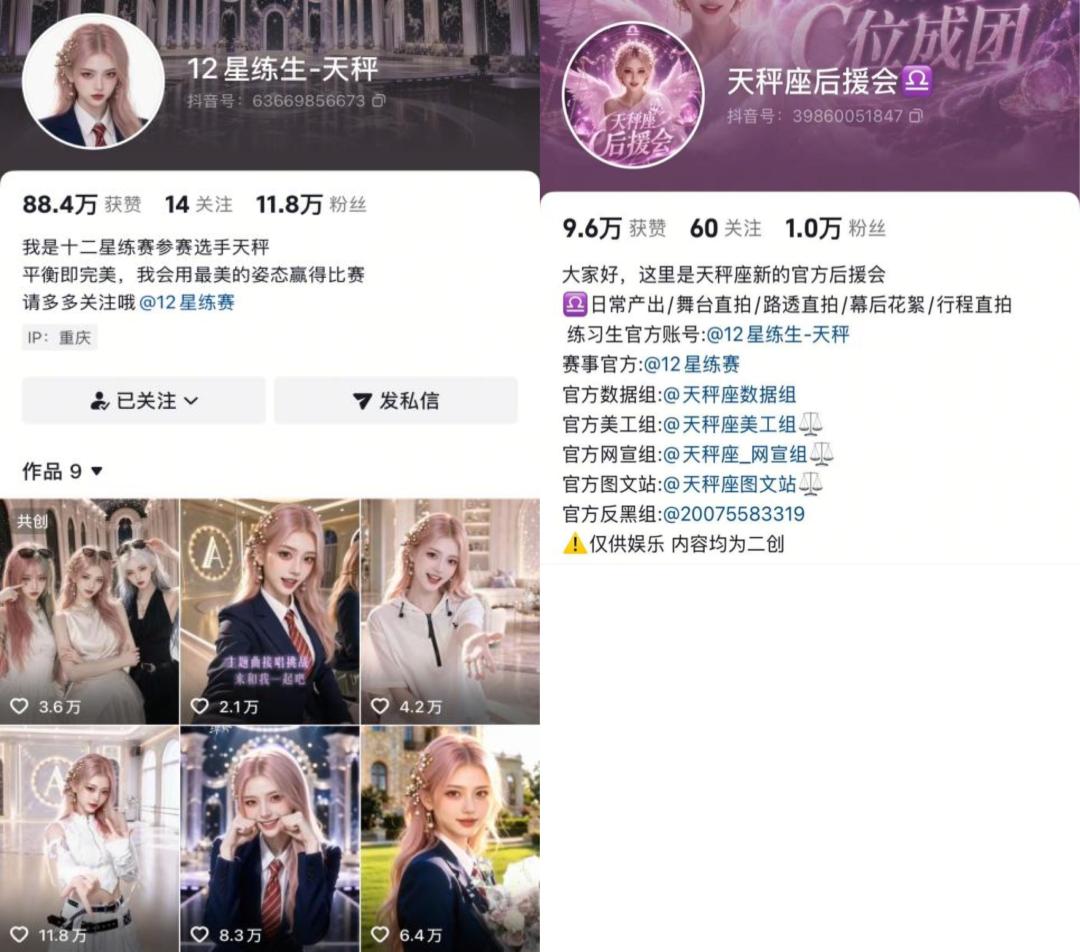
Up to now, "12-Star Trainee - Libra" ranks first in popularity, and its personal Douyin account has more than 110,000 followers. As fans are creating a large number of derivative works, there are 7 accounts related to "Libra", whose scale is no less than that of real-person idols. From data tracking teams to anti-harassment teams, netizens are sparing no effort to boost the popularity of their favorite "idol sister".
Fengwang Technology found that this is already a nearly mature industrial chain. In addition to producing content on Douyin, *12-Star Trainee Competition* has also released its official theme song *Chasing the Light to Debut* on Qishui Music, aiming to build personal IP value for its contestants. This variety show is almost no different from real-person variety shows in terms of production process, competition system and fan support, but its production cost has been greatly reduced.
Not only that, in just one month, *12-Star Trainee Competition* has already started monetizing, and the signed commercial partners include brands such as Haoshi Bread and Starlight L SUV.
The behind-the-scenes promoter of *12-Star Trainee Competition* is Chongqing-based Maiya Media, which has always been a top-tier MCN on the Douyin platform. In the early years, it focused on signing real-person artists, but in recent years, it has quickly transformed to sign AI influencers, and its signed virtual talents include the director of the recently popular AI drama *Huo Qubing*.
AI creation has brought new sweet gains to Maiya Media. AI is no longer just a tool to reduce production costs, but an IP asset that can continuously generate value.
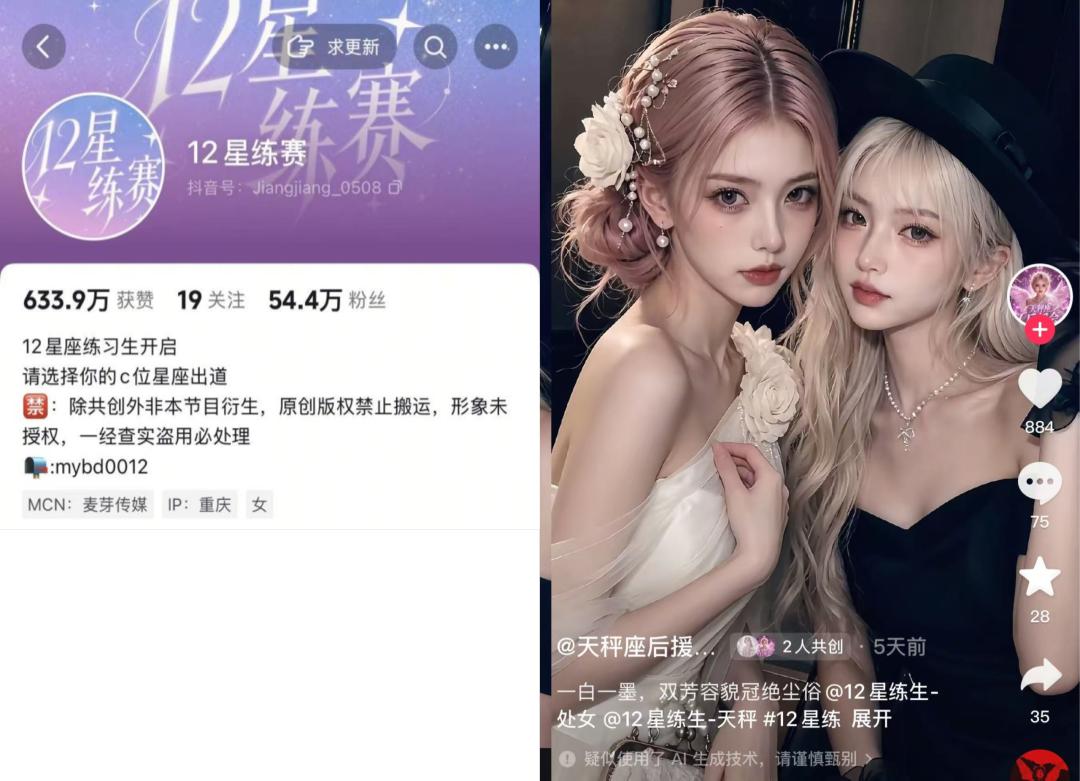
The behind-the-scenes operating party can "raise idols" at extremely low costs, and then continuously monetize through fan voting, brand naming, and business cooperation. Real-person idols need to share revenue with their agencies, while all the income of AI idols goes to the production party.
At the same time, the AI short drama *The Laid-off Girl* has also received a lot of attention on Douyin. The story is based on the real experience of the creator "Feifeifei", and the plot has aroused strong empathy from netizens, quickly becoming a smash hit. The production cost of each episode of this drama is only more than 10,000 yuan, but it has achieved 220 million views. After going viral, the heroine Fang Taozi started posting life-style vlogs on Douyin, following the trending topics on the platform, and quickly gained more than 417,000 followers. Netizens exclaimed that "they can't tell whether she is a real person or an AI".
Netizens not only urged the creator to update more episodes online, but also started to ship the characters in the drama. Many brands have already smelled the business opportunity: Controllable, stable, and never-failing virtual idols are nearly ideal partners for commercial endorsements.
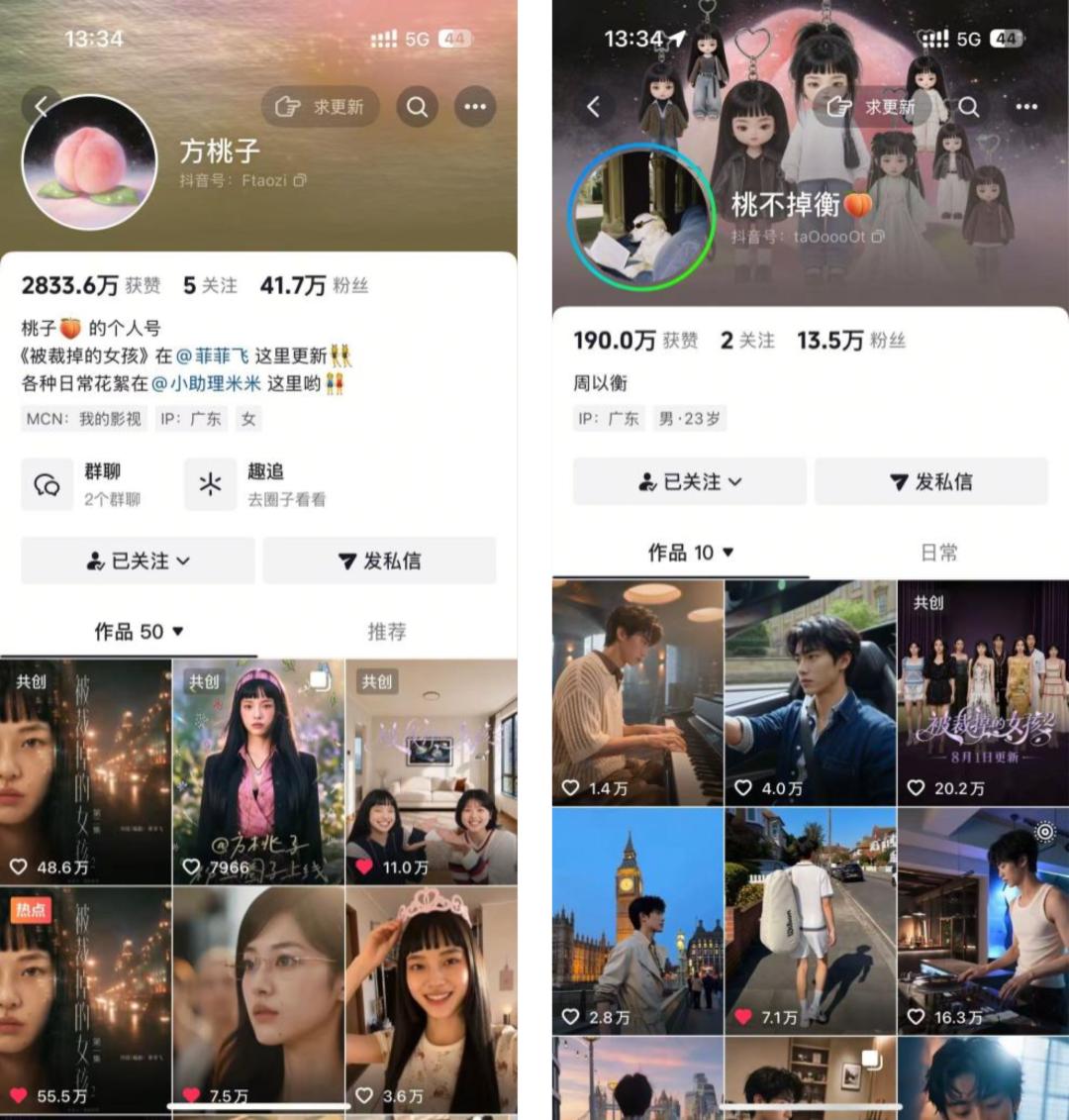
Recently, the heroine Fang Taozi placed an advertisement for a contact lens product in her newly released video, officially starting to take commercial orders. This also surprised many netizens: "Can AI actors also take on advertising jobs?"
Fengwang Technology randomly surveyed some netizens about this phenomenon: "I don't have the urge to buy it after watching the video, after all, products like contact lenses still need real people to test them out" "Although the video says the contact lenses are very comfortable to wear, I don't think it's convincing at all. An AI doesn't have real experience, how can it possibly convince others to buy it?"
According to data from Xingtu, the advertising quotation for Fang Taozi is very high: a 1-20 second video is quoted at 168,000 yuan, a 21-60 second video at 208,000 yuan, and a 60-second advertisement at 258,000 yuan — this quotation has already surpassed a large number of real-person internet celebrities with tens of millions of followers.
The core logic for platform influencers to take commercial orders lies in data and traffic: the higher the traffic of an IP account, the higher its commercial value in the market. The fact that AI actors have started to take brand endorsements has verified this logic — AI actors can create the highest value at the lowest cost.
*The Laid-off Girl* is not an isolated case. Another viral AI short drama *Deep Love Invades the Rest of Your Life* has also derived personal IPs. The main characters including Duan Yan, Rong Jiqiao and Ji Chuan have all opened personal accounts on social platforms.

Although AI actors have the advantage of never having their public image collapse, and their strong sense of interaction does meet the endorsement needs of brands, the debut of AI idols is bound to generate personal IP value. But whether this business opportunity can last long depends on whether audiences will continue to support it in the future.
AI talent shows seem to perfectly solve the long-standing pain points of the real-person idol industry, and sound like a paradise for star chasing? But at first glance, the 108 contestants look almost the same, and lack memorable features. Some netizens raised a thought-provoking question: "Is this talent show a competition to see who looks more like AI?" Other netizens commented sharply: "If AI wants to debut, let AI do the voting then."
Faced with these controversies, why do platforms still want to launch the AI talent show model? Why do these "identical-looking" AI characters make people invest their real emotions?
Can AI carry real emotional narratives?
The most touching core of talent shows has never been the perfect stage, but the uncertainty. Audiences are watching the script of counterattacking all the way, the growth narrative of sweat and tears, and they enjoy the sense of satisfaction brought by "idol development". But all the personalities, experiences and specialties of AI contestants are scripts preset in the background.
Even so, real emotional voting and comment controlling still appear in the comment section. What do AI contestants rely on to achieve this?
The answer may be that audiences did not suddenly accept AI. Whether it is short dramas or variety shows, the supply of real-person content is drying up, and audiences are already tired of the same old content. Massive AI content is flooding the market, and audiences are being pushed forward by the trend.
AI talent show is a new model, but it is not a new demand that appears out of nowhere. The launch logic of virtual idols in the past is basically consistent with that of AI variety shows. Audiences investing emotions in AI contestants is essentially not a recognition of technology, but more like finding emotional sustenance as a second-best choice in a highly homogenized content market, and the audience will enjoy the sense of companionship brought by the 24/7 availability of AI idols.
From "The Twelve Constellations Determine Your Shelter" to the current *12-Star Trainee Competition* and *MBTI Personality Debut Battle*, AI creation has more and more gameplay methods. Everyone clearly knows that these contents are made by AI, but why are people getting more and more addicted to watching them?
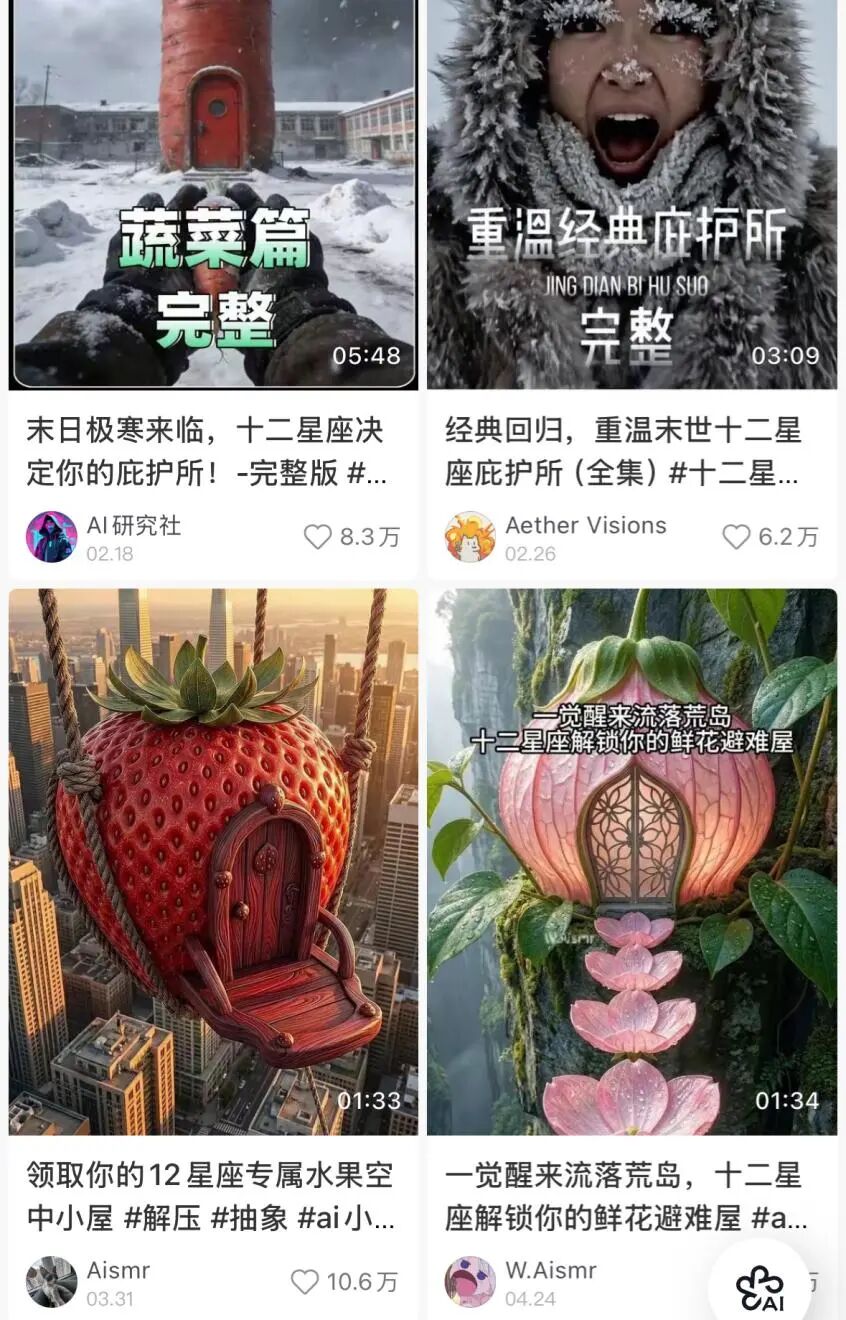
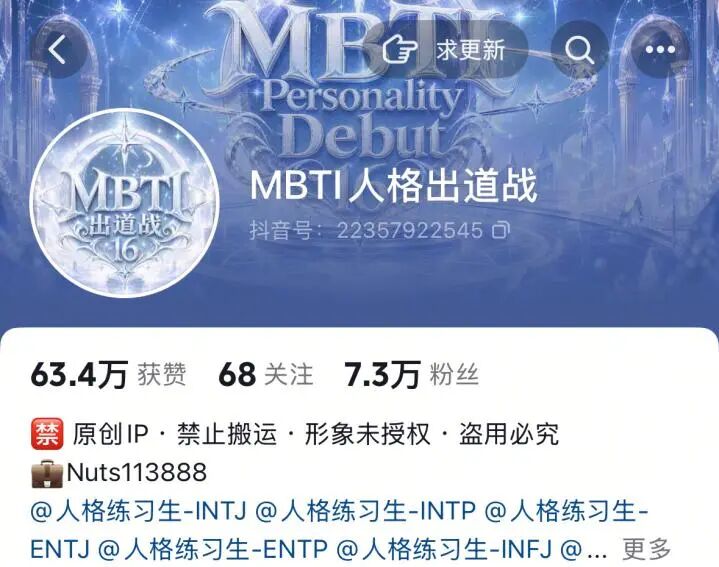
It can be found that these videos are tagged with "identity attributes". "Constellations and MBTI" are highly discussed topics by themselves. The unreal abstract feeling of the videos combined with interactive experience makes netizens start to "follow the fun". AI itself provides bold and creative ideas, and its relaxing videos with immersive interactive experience naturally attract audiences in the market.
Clearly, the market has given the answer — Audiences' rejection of virtual codes has given way in front of "good-looking content".
*Starlight 108* is not an isolated case, but after the freshness fades, can the perfect appearance alone retain the public's emotions for a long time? This is the ultimate proposition that all AI idol projects must answer.
At present, netizens have different views on this matter: "For me, AI has replaced real people in just one week. AI is so nice, all the idols are handsome and beautiful, why should I go to the Chinese entertainment industry to watch those ugly kids of capitalists" "At first I thought AI modeling looks better than real people, but after watching for a while, I found they all have the same few faces, and many productions are not delicate enough, so I went back to watch real-person content again".
The talent show model relies on the support of the audience, which is inevitably related to voting for idols and producing peripheral materials, which requires strong fan support to achieve. In this regard, some netizens told Fengwang Technology that at present, they will only give likes to the virtual idols they like, and will not pay to vote for them. Some other netizens said: "I will not chase AI idols, they are just a bunch of codes, it's better to chase real people." It can be seen that the willingness to pay for related commercial content is still not high enough.
There are generally two trends in current public opinion: some views believe that AI idols will quickly replace real-person talent shows; others directly judge that AI talent shows are just a short-lived traffic gimmick.
It must be admitted that the completion of AI production is getting higher and higher, and the market development is always moving forward. But a more rational judgment is: AI talent shows will not eliminate real-person entertainment, but open up a parallel track.
Real-person idols carry real emotions, flesh and blood, and vitality, which cannot be replicated by algorithms; AI idols are good at completing highly repetitive content production, presenting more creative ideas, and bringing new visual experiences to audiences. The two are not in a substitute relationship, but two different product forms in the market.
Is "getting huge profits with a small investment" real?
AI is penetrating every link of the cultural entertainment and creative industry at an unprecedented speed.
But this AI carnival