AI has overturned an 80-year-old mathematical conjecture, and the Fields Medal laureate stayed up all night, thinking he was about to be eliminated.
In the past three months, AI has achieved three feats in the mathematics community that no one has managed to accomplish for decades.
In May, an unreleased internal model from OpenAI disproved the unit distance conjecture proposed by Paul Erdős in 1946.
This problem has remained unsolved for a full 80 years. Noga Alon from Princeton described it as "probably the most famous problem in discrete geometry".
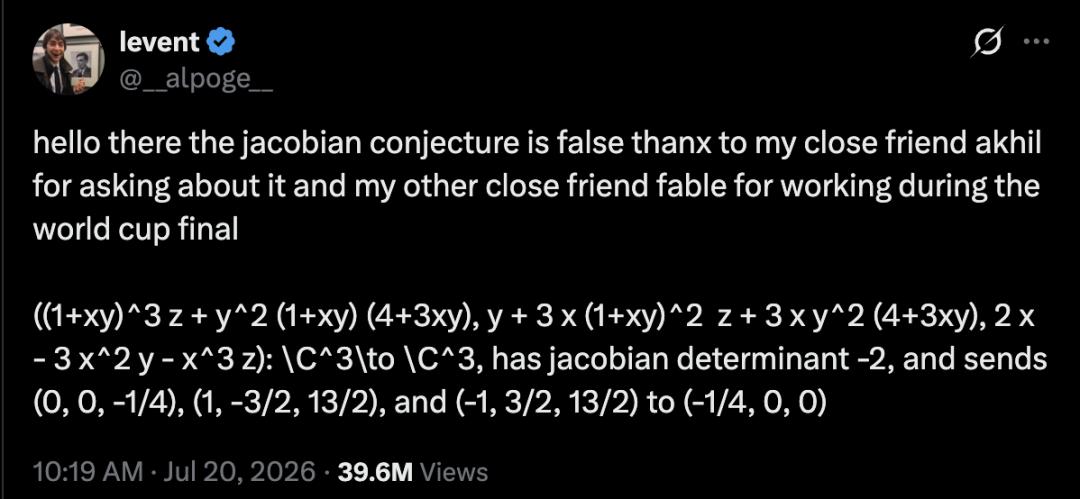
In July, Anthropic researcher Levent Alpöge posted on X that Claude Fable had found a counterexample to the Jacobian conjecture in high dimensions.
In August, OpenAI publicly released ten breakthroughs of its internal Astra version in mathematics and theoretical computer science, covering fields from high-dimensional sphere packing, group theory to lattice cryptography.
The total tokens consumed to generate these results cost roughly 2,000 USD when calculated at Sol's API pricing.
Even more notably, in less than 24 hours, Levent announced that he had reproduced 5 out of these 10 breakthroughs using the publicly available Fable model.
Is mathematics about to be completely solved by AI?
On the afternoon when Fields Medal laureate Timothy Gowers first heard that the unit distance conjecture had been disproved by AI, the first thought that popped into his mind was: Oh no, are mathematicians going to be obsolete soon?
He spent the entire rest of the night readjusting his worldview.
It was not until the next morning that he realized the model had disproved the conjecture rather than proving it, and he finally breathed a huge sigh of relief.
AI Breaks Through Multiple "No-Man's Lands", While Over 20 Mathematicians Remain Calm
With the expectation that mathematicians would be extremely anxious, Kai Williams, a reporter from Understanding AI, interviewed more than 20 mathematicians in person at the ICM Congress in Philadelphia.
To his great surprise, many of them are optimistic, at least in the short term.
Many of these mathematicians have already integrated AI into their daily research, but they use it quite cautiously.
Neckrasov, a PhD student at Brandeis University, spends 200 USD per month on Codex to search literature, fill gaps in proofs, and review his own paper drafts.
But he has an unbreakable rule: even if he asks AI to prove something, he must have the full picture of the entire project in his mind before starting work. AI only helps him implement his ideas faster, instead of thinking for him.
Another mathematician, Castillo-Ramirez, used ChatGPT to construct a cellular automaton instance that meets special conditions, which is only one piece of the puzzle in his larger project.
Deng Yu, who just won this year's Fields Medal, believes that AI will assist mathematicians rather than replace them:
In the future, mathematicians may propose new theories and new frameworks, while AI handles those technical details. AI will become more powerful, but by then, we will redefine what technical details mean.
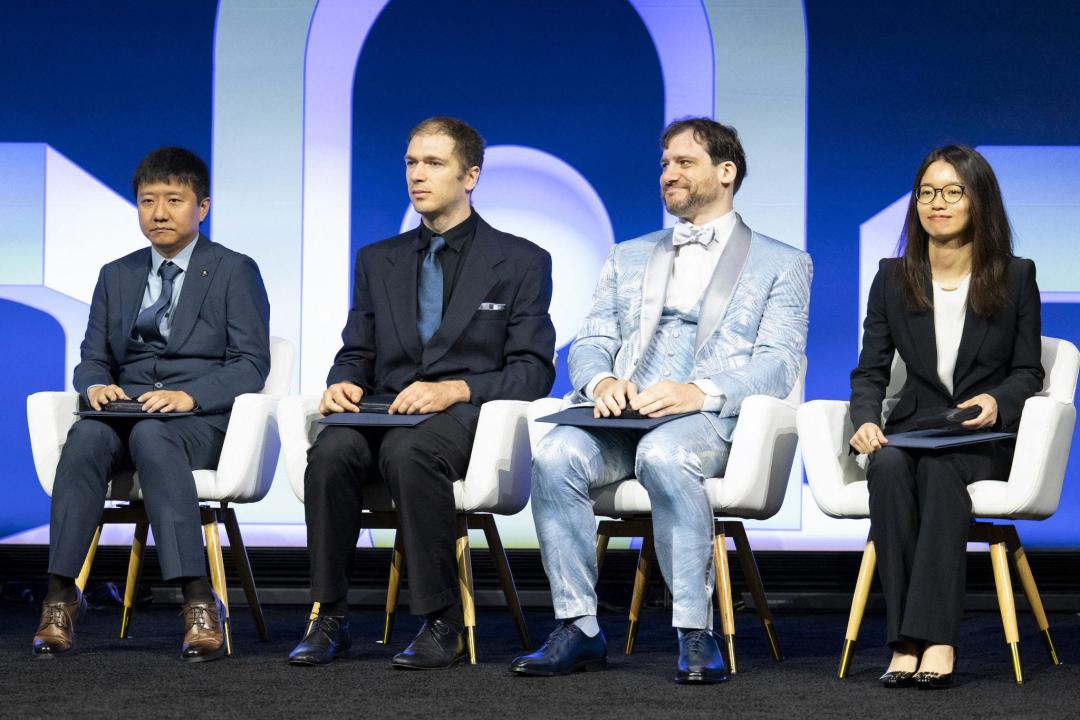
On July 23, 2026 in Philadelphia, the four Fields Medal winners of this year appeared on the same stage. From left to right are Deng Yu, John Pardon, Jacob Tsimerman and Wang Hong. Deng Yu believes that AI will assist mathematicians rather than replace them.
Mathematicians are actually very familiar with this logic.
After the advent of calculators, mental arithmetic is no longer regarded as "research"; after proof assistants became mature, part of the verification work was also handed over to machines.
Every time machines take over a new field of work, humans move one step further to the areas that machines cannot reach yet.
Following this line of reasoning, if AI stays at its current level, the fundamental framework of mathematics as a discipline will not change.
Humans only need to step back to the areas where AI is not good at, come up with new ideas, and then use AI to accelerate those repetitive tasks.
In this case, there is no need to fear AI.
Because at the moment, it is just a faster shovel.
But the problem is that AI will most likely not stay at its current level.
Greg Burnham, who specializes in capability evaluation at Epoch AI, reminded: Many people talk about AI and tend to only focus on "what it can do now", without thinking about where the trajectory of its capabilities will lead.
AI may hit a wall and never be able to create completely new theories; or it may continue to climb with the expansion of training scale and produce truly original mathematics. Based on current evidence, neither possibility can be ruled out.
There is a piece of data that is hard to refute.
On May 28 this year, an independent evaluation called First Proof tested 4 AI systems with 10 unreleased research-level new problems under controlled conditions, and experts reviewed the results according to correctness and expression quality.
The results showed that 7 out of the 10 problems were solved by at least one system to a publishable level.
Mathematics Enters the Era of "Proof Surplus"
How capable is AI at doing mathematics exactly?
On July 24, Terence Tao gave a public speech at the ICM Congress.
The audience was full of peers, waiting for him to answer the question that everyone was asking: Can AI do mathematics after all?
Terence Tao redirected the question to "what the mathematics community should preserve".
He first assumed that AI would soon be able to complete a considerable part of research-level mathematical work, then split the "life cycle" of a mathematical achievement into six steps:
Generate the proof, verify its correctness, write it clearly, publish it formally, get it understood by peers, and finally canonize it, include it in textbooks, and make it a settled conclusion in this field.
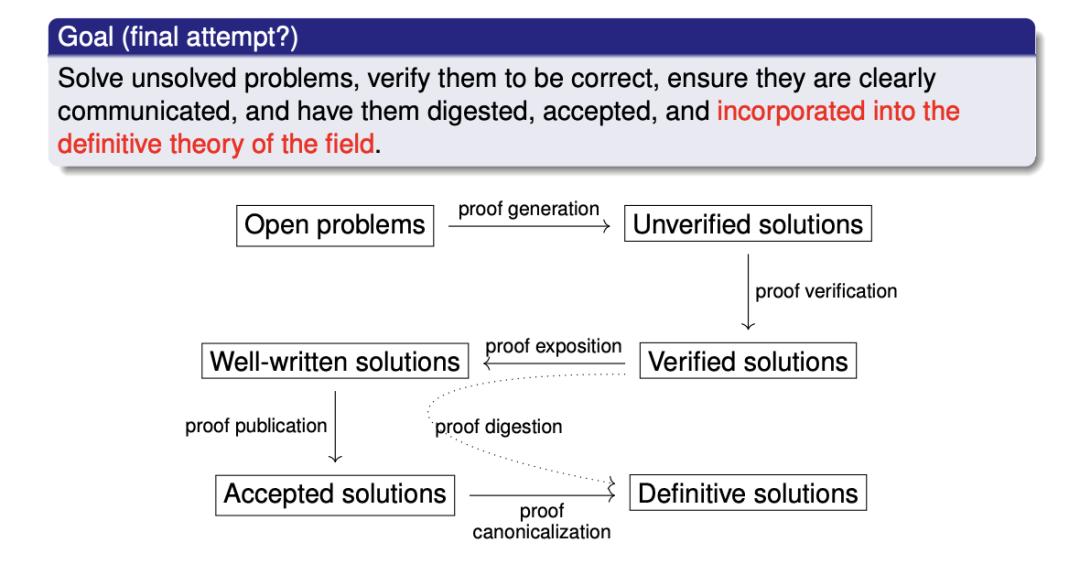
For a problem to evolve from an "open question" to a "settled conclusion", it needs to go through six stages: generation, verification, interpretation, publication, digestion and canonization. AI only significantly speeds up the first two stages.
Among these six steps, the two that AI can accelerate instantly are the first two. The remaining four steps are slow and extremely dependent on humans.
This is where the imbalance emerges.
Terence Tao said that we are already very, very close to a scenario where a major result is proven and verified to be correct, but no one can understand or explain it.
Terence Tao calls this "proof indigestion".
Dozens of AI-generated proofs have already been piled up on erdosproblems.com, many of which are probably correct, but no expert is willing to step forward to verify and endorse them one by one.
Terence Tao named this transformation: Mathematics is moving from the era of "proof scarcity" to the era of "proof surplus".
What Is Left After the Surplus
Terence Tao's speech is essentially forcing everyone to return to a more fundamental question: What is the purpose of mathematicians doing research after all?
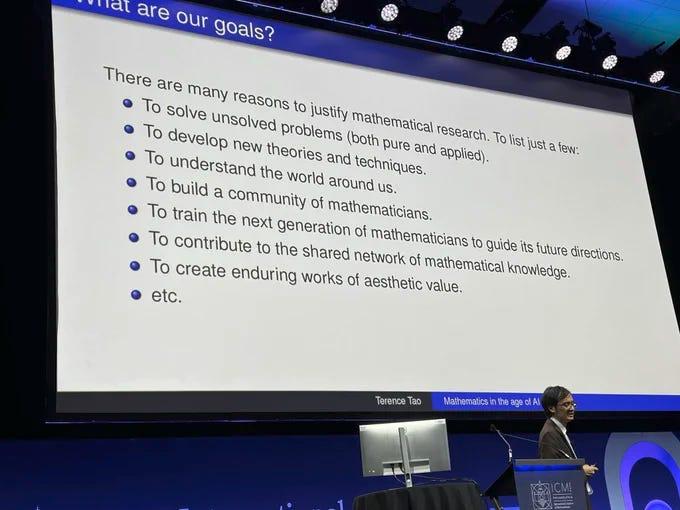
At the ICM Congress in July, Terence Tao listed multiple reasons for mathematicians to do research on stage, which are far more than just "solving problems".
He listed a series of goals on stage: solving difficult problems, building new theories, understanding the world, maintaining a community of mathematicians, cultivating the next generation, adding bricks and mortar to human knowledge network, creating works with aesthetic value...
In the past, these goals were consistent.
Solving a difficult problem often helped build the corresponding theory and unite the community at the same time.
Therefore, everyone tacitly only focused on "solving problems" and took it as a substitute for all other goals.
But what AI is good at is exactly this one single goal.
Once everyone rushes to "solve more problems and be the first to get results", other goals will be left behind.
Terence Tao also mentioned Goodhart's law: When a measure becomes a target, it ceases to be a good measure.
Two mathematicians offered two completely opposite visions of what comes after the surplus.
Gowers is the pessimistic one.
He worries that mathematical literature will expand wildly, but no group of people truly share a common understanding of it. Most mathematics will become like those old papers that no one reads today, lying in piles of papers from decades ago.
This is not an alarmist story. Similar things have really happened in the history of mathematics.
Thurston once mentioned an experience in his early years:
At that time, he proved a series of elegant theorems in the field of foliation structure in one go, but he proved them so fast and could not clearly explain the ideas behind them. As a result, his peers withdrew one after another, and the entire subfield collapsed.
He later realized: "I used to think that what people wanted was answers. That's only part of the story. Compared with knowledge, what people want more is personal understanding."
This is the risk: if AI proves a bunch of important results in a way that humans cannot understand, what motivation will people have to dig deeper into mathematics?
If young people have no meaningful work to do, this craft cannot be passed down, and humans will gradually forget the theories they already understood.
Daniel Litt from the University of Toronto stands on the optimistic side.
He imagined an extreme library that contains proofs of every theorem, and is equipped with guides that can lead you to the answers and explain them clearly to you.
What will mathematicians do in such a library?
Litt said they will be excited out of their minds, then start working immediately, asking all the questions they have held back for a long time:
How to prove the Riemann hypothesis? How to prove the Hodge conjecture? And how to prove that conjecture he has been obsessed with for years?
The amount of work to do has not decreased at all, and it is far from over.
At the end of the day, "getting the answer" is only one of the many goals of mathematics.
What AI has changed is which values we should pursue, but it has not changed why humans started doing mathematics in the first place.
Mathematician David Bessis believes that mathematicians cannot continue to do mathematics in the old way, and something new will definitely emerge.
Although he does not know what this new thing will look like, he is certain that humans will always keep doing something very similar to mathematics.
We still want to understand the world, we still want to understand mathematics.
Answers can be in surplus, but human understanding never will be.
References:
https://www.understandingai.org/p/mathematicians-are-grappling-with
https://teorth.github.io/tao-web/slides/age-of-ai-icm-2026.pdf
This article is from the WeChat official account "AI Era", author: ASI Revelation; editor: Yuan Yu, authorized for release by 36Kr.