Zhao Qi took hold of Doubao's steering wheel.
At ByteDance's all-hands meeting this year, Zhao Qi, the overall head of the Doubao product line, officially entered the public spotlight.
At the meeting, Zhao Qi stated that the large language model boasts huge market potential, so he does not worry about economic returns, but revenue still remains a critical metric.
Apart from Zhao Qi, the core senior executives attending the meeting include Liang Rubo, Shou Zi Chew, Bob (in charge of the e-commerce business), Zhao Xiuying (in charge of commercialization), and Tan Dai (in charge of the Creativity Service Platform).
Just a week ago, ByteDance issued an internal notice announcing the full integration of the Feishu product team into Doubao to form a new Doubao product team. After this adjustment, Xie Xin, CEO of Feishu, began to report directly to Zhao Qi, the head of the Doubao product line.
This is ByteDance's largest organizational restructuring of its To B business since the company adopted the divisional operation model in 2021.
However, compared with the architectural adjustment itself, the person standing at the core of this reshuffle — Zhao Qi — deserves far more attention.
He is the architect of ByteDance's growth system. The growth middle platform that supported Douyin's expansion from tens of millions of daily active users to the 100-million-level scale was fully developed under his leadership, and he reported directly to Zhang Yiming at that time.
Meanwhile, Zhao Qi is also the gatekeeper of ByteDance's commercialization. In 2021, when the former head of the Pangle advertising platform left his post, he took over the responsibility at a critical juncture, and successfully stabilized the revenue foundation of ByteDance's advertising business against the backdrop of the overall contraction of the education and training industry.
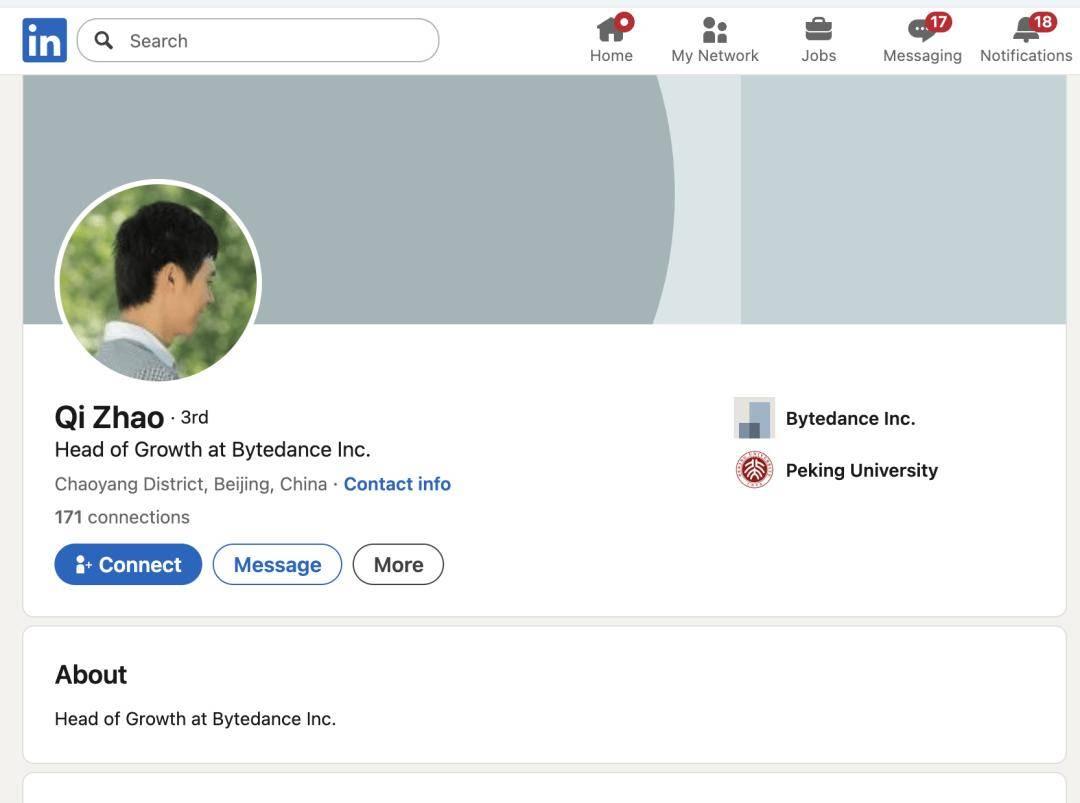
In September 2025, Zhao Qi transferred from the HR system to the front line of product management, officially taking full charge of Doubao. Within one year, Doubao's monthly active users surged from less than 100 million to 382 million. Since joining ByteDance, Zhao Qi has never suffered a single defeat in his career.
Now that Feishu has been merged into Doubao, Zhao Qi is once again pushed to the forefront of the business. This time, he is facing a brand-new battlefield in the B-end market.
All of Zhao Qi's achievements, both before and after he joined ByteDance, are in the C-end market. He is experienced in serving ordinary users and driving business growth through scale expansion.
But Feishu targets enterprise customers. In the B-end market, the core competition focuses on customer success, contract renewal rate and customized services, rather than DAU growth which Zhao Qi is good at.
More importantly, the AI office track no longer allows slow trial and error. Tencent's WorkBuddy is personally supervised by Pony Ma, while Alibaba's Qwen Office is backed by DingTalk's massive enterprise customer base. The three tech giants almost made the same strategic choice in the same summer: integrate their scattered AI product lines and focus on the office scenario.
Whether ByteDance can win this tough battle in the AI office sector largely depends on whether Zhao Qi can successfully replicate his C-end growth myth in the B-end market.
1
But if you look through Zhao Qi's resume, you will find a rather "unconventional" career path.
Zhao Qi graduated from the Department of Computer Science of Peking University, where he completed his undergraduate, master's and doctoral studies. But after obtaining his doctorate, he did not engage in academic research or coding work. Instead, he joined Douban, the gathering place for Chinese internet literary youth at that time, and worked as a product manager.
After leaving Douban, Zhao Qi joined Wandoujia. The founder of Wandoujia, also a top talent from Peking University named Wang Junyu, was committed to application distribution business. Zhao Qi served as product director at Wandoujia, witnessing the entire process of traffic migration from PC terminals to mobile terminals.
Later, he joined the "Chelaile" (Real-time Bus) platform and served as product director.
The founder and CEO of this product is Shao Lingshuang, who also graduated from the Department of Computer Science of Peking University. The company was established in 2010, and its mobile APP was officially launched in Wuhan in 2012.
Chelaile is now the largest real-time public transport platform in China. By the end of 2025, it had accumulated 334 million registered users, more than 30 million monthly active users, covered 488 cities across the country, and has been listed on the Hong Kong Stock Exchange.
With Zhao Qi's participation, the number of users of "Chelaile" reached the 10-million level at that time.
In 2017, Zhao Qi joined ByteDance, immediately joined the growth middle platform, and soon became the person in charge of the department.
What is a middle platform? To put it simply, the middle platform extracts capabilities that all business lines need from various departments and centralizes them together. The business departments that directly face market competition are called front ends. They can directly obtain the required capabilities from the middle platform, instead of building a complete set of supporting systems from scratch for each independent business.
Products including Toutiao, Douyin and Hongguo all reuse the same set of growth systems, without the need to compete for budgets or build separate teams on their own.
This concept was first put forward by Alibaba in 2015, called "large middle platform, small front end". Later, large technology companies including Tencent, Meituan and ByteDance all adopted this model, though each company has different names and specific implementation rules for it.
Zhao Qi was in charge of this middle platform, holding the largest advertising investment budget in the whole company, so he was internally nicknamed "the person who spends the most money in China's internet industry".
According to estimates from third-party data institutions such as QuestMobile, Douyin only had about 30 million daily active users by the end of 2017.
After Zhao Qi took office, according to official data from Douyin, its daily active users soared to 70 million during the 2018 Spring Festival, exceeded 150 million in the middle of that year, reached 250 million in early 2019, broke through 400 million at the end of 2019, and hit 600 million daily active users in 2020.
August 2021 was a turning point. At that time, Xu Yujie, the former head of the Pangle advertising platform, left his post, and Zhao Qi took over the business at a critical moment.
Pangle is one of ByteDance's core commercial products, which operates as an advertising intermediary platform where merchants place advertising funds and platform traffic is distributed to cooperative publishers.
At that time, the K12 education advertising market shrank sharply, the entire education and training industry disappeared almost overnight, while K12 was exactly one of Pangle's largest advertisers. That meant right after he took over the business, the biggest revenue contributor was gone.
In the past, Pangle mostly followed the logic of "selling traffic", selling as many ad slots as the available traffic could support. But after Zhao Qi took over, he calculated every ad slot, every display and every click with precise data, and pushed the eCPM (effective cost per thousand impressions) to the highest possible level.
Growth means spending money to acquire users, while monetization means earning advertising revenue by selling traffic. Essentially, both are processes of matching supply and demand.
As a result, Zhao Qi not only stabilized the business, but also expanded its scale to a much larger level.
2
However, at that time, Pangle already occupied 55% of China's advertising intermediary market, larger than the sum of all other competing brands in the market. The truly noteworthy time point is October 2022.
ByteDance carried out a major adjustment, transferring Zhao Qi to the group's human resources system.
There was a general background at that time: ByteDance's strategic focus had begun to shift to the AI sector. The large language model track was booming, teams including Flow and Seed were recruiting new members at an extremely fast pace, their business scale expanded rapidly, but the corresponding management system completely failed to keep up with the development speed.
Zhang Yiming urgently needed a trusted person who understood business operations and growth logic to sort out ByteDance's AI business line, and Zhao Qi was the most suitable candidate.
When he first joined the HR system, he managed ByteDance's Management Research Institute for a period of time. This was a marginal department dedicated to providing strategic suggestions for the management and conducting management strategy research. To put it plainly, this arrangement was to let him get familiar with the operation rules of the HR system, before he officially took over the HR work for the entire AI business line.
He reported to Hua Wei, the head of group human resources, and was in charge of human resources work for the AI business line, covering three major sectors: Spring, Seed and Data.
Spring is ByteDance's AI product department, which includes two sub-departments Flow and Ocean. AI products including Doubao, Jimeng and Maoxiang all belong to the Flow team. Seed is ByteDance's large language model team, responsible for underlying model R&D. Data is the data system department.
Zhao Qi is not a traditional HR who only knows how to read resumes and calculate salaries. He not only understands business, knows what kind of talents and organizational structure are most efficient for each business direction, but also knows how to allocate resources, prioritize projects and set reasonable assessment indicators.
Zhao Qi standardized all indicators and made them fully transparent, eliminating the old situation where the loudest team could get the most resources.
Another key measure he took was to concentrate resources on core projects, gathering the computing power, data and talents scattered in various teams to support key projects, instead of letting each team work independently.
There is another very important job that Zhao Qi is responsible for: recruiting top talents.
After the large language model boom, the whole industry was competing for high-quality AI talents. Zhao Qi led his team to map out the entire AI industry talent landscape through technical tracking. He clearly knew which person was working on what direction, what their capability level was, and whether they were willing to join ByteDance. ByteDance recruited a large number of top talents from Google, OpenAI and major universities in those years, and Zhao Qi made great contributions to these recruitment results.
On September 24, 2025, Zhao Qi officially transferred from the HR department to the Spring product department, took full charge of the Doubao product line, and reported directly to Zhu Jun (Alex), ByteDance's Vice President of Products. The original heads of Doubao's PC end, mobile end and model strategy product line all began to report to Zhao Qi.
At the same time, Tong Yao, the original head of Feishu product, began to report to Zhao Qi in a dotted line manner. At that time, the collaboration between Doubao and Feishu had been promoted to an explicit strategic level.
The year after Zhao Qi took over Doubao was his "outbreak period".
He fully applied ByteDance's classic strategy of "centralizing resources, iterating rapidly, and scaling up before optimizing". All the high-quality features verified by other products in the Flow team were integrated into Doubao as much as possible. The product advanced at full speed from its early version, and was iterated to version 4.0.
There is no need to elaborate on its growth performance, as the core data kept soaring.
By the end of 2025, Doubao had 226 million monthly active users. By June 2026, data from QuestMobile showed that Doubao's monthly active users had surged to 382 million.
Nowadays, the number of monthly active users of Doubao alone is larger than the sum of the second and third largest AI products in the market.
Looking back, at the beginning of 2025 before Zhao Qi took over, Doubao's monthly active users were less than 100 million. In a year and a half, the figure has nearly quadrupled.
3
After Feishu was merged into Doubao, a new challenge emerged in front of Zhao Qi.
Looking through his full resume, he barely had any practical experience in the B-end market. From Douban to Wandoujia, from Chelaile to the Douyin growth middle platform, from Pangle to Doubao, all of Zhao Qi's achievements are in the C-end market, serving ordinary users and relying on scale and growth to drive business development.
But the new Feishu, which is jokingly called "Doubao Office" by netizens, is a completely B-end oriented product. Targeting enterprise customers, it pursues efficiency, security, customization and high contract renewal rate, rather than DAU and monthly active user growth.
What's worse, the AI office track has moved from the warm-up stage of "independent trial and error" to the "semi-final" stage of fierce competition.
At Tencent, WorkBuddy has achieved explosive growth.
On March 9, 2026, Tencent officially launched WorkBuddy, its desktop AI office agent. In the month of release, its monthly PC-side visits reached 8.85 million. By June, the figure exceeded 20.97 million, growing 2.4 times within three months. Data from Analysys showed that WorkBuddy's total visits in June exceeded the sum of the second and third place products in the segment.
Pony Ma personally supervises this project. According to people familiar with the matter, Pony Ma almost never misses WorkBuddy's product meetings, and Tencent is promoting the project as a "super project". In Tencent Holdings' Q1 2026 financial report, Pony Ma highlighted WorkBuddy, and stated that he believes it is "currently the most widely used efficiency AI Agent service in China".
Alibaba is also making great efforts in this track.
On July 27, 2026, Qwen Office was officially launched. Only 46 days after taking office as the new CEO, Chen Yusen integrated three of Alibaba's AI Agent products: QoderWork, Wukong and MuleRun, into one single product. Its development strategy is to combine AI capabilities with office scenarios, relying on DingTalk's large base of enterprise customers to expand its market share.
The three companies made the same decision in the same summer: integrate their scattered AI product lines into one single product, and focus on the office scenario.
Zhao Qi is standing at this critical strategic node of ByteDance. The fact that Feishu CEO Xie Xin reports to him means that he needs to tightly combine "AI capabilities" and "office scenarios", which is essentially the same logic he used when building the Doubao product.
The only difference is that he used to operate in the C-end market, and now he is facing the B-end market. Zhao Qi has an almost unbeaten track record in the C-end market, but the B-end market follows a completely different set of rules.
C-end growth relies on traffic, advertising investment and viral fission. Users can sign up today and leave tomorrow if the product experience is not good enough. As long as the customer acquisition speed is higher than the user churn rate, the user scale will keep growing.
The B-end market is totally different. Enterprise customers have a long decision-making cycle: they may use the product for a 3-month trial, go through a 6-month procurement process, and only renew the contract after one year of use. The B-end business does not rely on DAU, but on customer success, contract renewal rate and ARPU value.
No matter how fast your user growth is, if you cannot retain customers, all your efforts will be meaningless.
More importantly, you cannot win the B-end market only by excellent product strength. The reason why Feishu has been struggling in the B-end market over the years is not that its product quality is poor. Feishu's experience in documents, spreadsheets and online meetings is widely recognized in the industry. The problem is that even if you make the product extremely user-friendly, enterprise customers will take a large number of factors into consideration when making procurement decisions.
Feishu has always been an office collaboration tool. Even with an AI label added, it is only a "nice-to-have" additional feature, and does not really change the underlying logic of office software.
The current merger with Doubao is to make AI the core of the product, and turn the office software part into an enabling component. In the past, AI was added as a patch to Feishu, but now full office capabilities are built on top of the AI foundation.
ByteDance hopes to achieve curve overtaking in this track through this redefinition of the product.
The steering wheel is now in Zhao Qi's hands. It remains to be seen whether Zhao Qi can cross over from the C-end market