Leading player in the dental 3D printing sector steps into the consumer-grade product track, with the total crowdfunding amount exceeding 70 million yuan | Global Insight
Author | Zhang Ziyi
Editor | Yuan Silai
Editor's Note: As overseas expansion has increasingly become the core strategy of Chinese companies, how to compete in the global market has become an extremely professional topic. Amid the evolution of globalization, many Chinese brands have already stood at the forefront. In view of this, 36Kr Hard Krypton has specially launched the "Insight Global" column to explore the cutting-edge direction and era opportunities of Chinese brands' overseas development from the perspective of brand growth and changes, so as to provide references and inspiration for overseas practitioners and the industry.
This is the 63rd issue of our column. HeyGears started from the digital dental market, and gradually built full-stack capabilities covering equipment, materials, algorithms, software and services through continuous product adjustment and technology iteration. Now, the company has set its sights on consumer-grade UV 3D printing, hoping to bring the technology and product capabilities polished in the professional market to a wider range of global users. This is also a re-exploration of the company's business boundary after years of development since its establishment.
Over the past few years, Gui Peiyan, Founder and CEO of HeyGears, has talked most about "teeth". The dentures and orthodontic models used by you and your family are very likely to be the products of HeyGears' photocuring 3D printing.
With its dental business alone, HeyGears occupies more than 60% of the domestic market share in dental laboratories. "If there is a problem with our production line, dental hospitals across the country will be out of stock," Gui Peiyan joked to Hard Krypton.
Gui Peiyan's ambition is obviously not limited to being an invisible champion in a niche track. Not long ago, HeyGears released its product on Kickstarter for the first time, launching the crowdfunding of G1X, the world's first desktop full-color 3D+UV printer. The crowdfunding amount on the first day was nearly 50 million yuan (about 7.22 million US dollars). G1X can provide a one-stop full-color creation solution for fields such as personalized DIY, miniature model and figure making, arts and crafts cultural and creative design, industrial design and teaching aids.
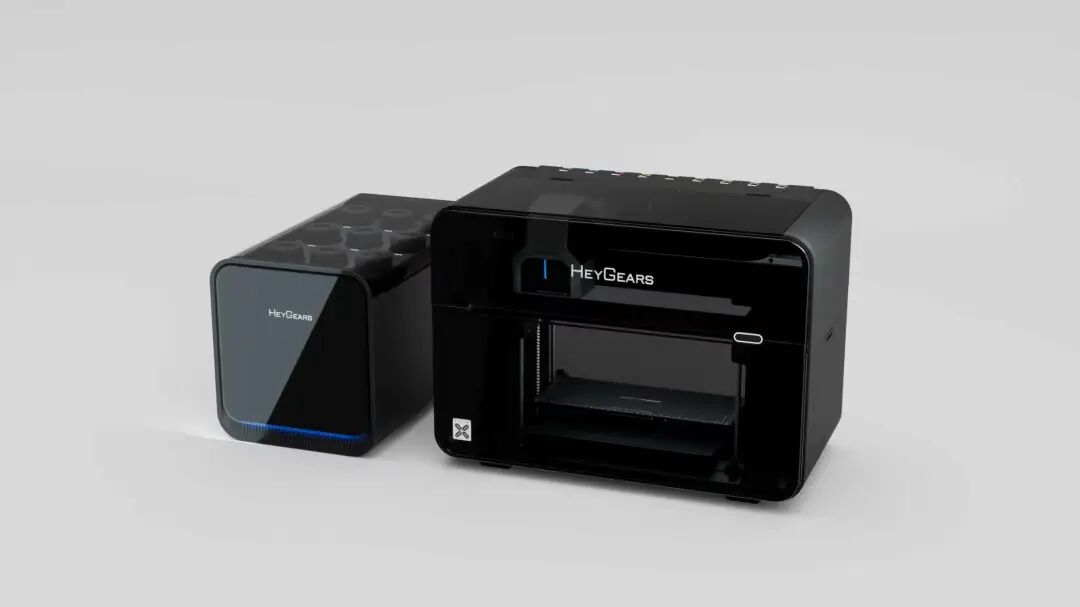
(Source of image: Enterprise)
G1X has nothing to do with dentistry and no longer serves dental laboratories and hospitals. HeyGears tries to recombine the capabilities accumulated in the past in photocuring equipment, materials, software and complex professional scenarios into new products, and attempts to enter a consumer market with more scattered users, more direct competition and more unpredictable trends.
Gui Peiyan is a very sharp person. Before Apple launched TWS, he wanted to design and manufacture wireless Bluetooth headsets with 3D printing. After his first venture failed, he started to produce 3D printers, seized the window of digital transformation in the dental industry, and quickly expanded the global market. Today, after Bambu Lab has pushed 3D printing to a more mass market, the application boundary of 3D printing is constantly explored and expanded, and Gui Peiyan wants to step out of the comfort zone.
Compared with the technology itself, what Gui Peiyan cares more about is whether 3D printing can eventually become a product that people really use.
"The place where 3D printing can really bring happiness to everyone must be presented to everyone in the form of some kind of product. You don't need to realize that it is made by 3D printing, and I don't need you to realize that either," Gui Peiyan told Hard Krypton.
01 Dentistry is not the end, but a technology training ground
Gui Peiyan is a very traditional type of entrepreneur. When he was a junior in college, he took his classmates to suspend his studies in the United States and returned to China to start a business. At that time, Apple's TWS had not been released, and he wanted to use 3D printing to manufacture similar wireless headsets.
Soon, Gui Peiyan's first venture ended in failure. He misjudged the maturity of 3D printing manufacturing at that time and could not deliver products normally. After Apple released AirPods, their small workshop completely lost its room for survival.
"It's really unreliable for students to start a business. They have passion but no ability to implement production and manufacturing," Gui Peiyan admitted. Later, he made some money by doing 3D printing for others to barely keep the company running.
In 2018, Gui Peiyan got tired of the business of being a 3D printing OEM. He felt that HeyGears was like a prototype factory, arguing with customers every day about "reducing the price from 5 cents to 3 cents". He wanted to find a market suitable for 3D printing applications with more premium space.
The next year, Gui Peiyan accidentally went to the South China Dental Exhibition. He saw the venue with fancy decoration, models at many booths, and people coming and going with MacBook... "It is obviously an industry with strong profitability, they have high willingness to pay, and photocuring 3D printing has a very high degree of matching with their products."
The high willingness to pay in the dental industry is only the stepping stone. What Gui Peiyan really values is the popularization and explosion of intraoral scanners in China.
Intraoral scanner (referred to as "IOS") is one of the core hardware of modern digital dentistry. It directly collects 3D color data of teeth, gums, mucosa and occlusal relationship in the patient's mouth through an optical scanning lens.
Around 2018, China's local digital dental supply chain exploded, many domestic enterprises conquered the optical 3D reconstruction algorithm and micro optical system, and the price of IOS dropped significantly.
IOS and 3D printing naturally form a closed loop of digital workflow. The former collects digital models, while the latter prints digital models into entities.
It was a very subtle point in time. The digital transformation of dental laboratories and hospitals was still in its infancy, their trust in domestic machines was not sufficient, and relevant manufacturers in the industrial chain were still hesitating.
HeyGears began to focus on developing photocuring 3D printers suitable for the dental industry.
"IOS is a completely irreversible trend," Gui Peiyan told Hard Krypton. "Under this trend, enterprises must have first-mover advantage. At that time, I thought there was still a distance for 3D printing to be applied to dentistry, and you needed a polishing period of half a year to a year. In such a fierce competition, what you can do is iterate at a high speed to outperform all competitors."
In order to seize the window period, HeyGears experienced nearly half a year of crazy R&D. Gui Peiyan can't remember how many times the product was iterated. At the peak, they had more than 100 distribution warehouses, tested various process schemes, and developed software without restrictions. The problems of early machines shrank from the initial 200 to 30, then to more than a dozen...
During this period, HeyGears fought on multiple fronts. In the past, the software and consumables of HeyGears' 3D printers came from overseas manufacturers. When the self-developed software was not ready, overseas manufacturers stopped their software service. In order to sign orders, HeyGears' technical staff went door to door to help customers do slicing and data processing, and barely got through the gap period.
In addition to machines, they are also developing consumables synchronously. The price of overseas consumables is also very expensive - 2000 yuan per kilogram. Many domestic manufacturers entered the industry to compete with HeyGears, and the price of consumables became a competitive disadvantage. HeyGears set up a material R&D team, and after several years of efforts, more than 90% of the consumables are self-developed.
Today, HeyGears is one of the very few photocuring 3D printing enterprises in China that has opened up the closed industrial chain loop of "optical system, hardware equipment, resin consumables, supporting software and core algorithms". It occupies more than 60% of the domestic market share in dental laboratories, ranking first. At the same time, its overseas revenue share has exceeded 60%, making it the enterprise with the highest market share of Chinese dental 3D printing products in North America.
But looking back, Gui Peiyan doesn't have much to brag about. The business war is cruel, "We were forced to develop software and materials. They just wanted to survive, so they kept forcing themselves to build a deeper moat."
02 Find and verify the second growth curve
How to replicate the successful experience in the dental industry to the C-end track is a new challenge.
Around 2022, Gui Peiyan saw that the consumer-grade 3D market began to grow, but he could hardly convince himself to participate in it immediately.
"I think it's more like a toy that can only be played by yourself and can't be used for production. We still want to encourage more people to turn 3D printing into a tool to make money and a way of commercialization," Gui Peiyan told Hard Krypton.
The application scenario of 3D printing is the business context that HeyGears has always attached importance to. However, they also realized that it is difficult to find a track with the same scale as the dental industry, so they must make more popular products to cover more small tracks.
Bambu Lab's unstoppable and rapid growth in the consumer-grade 3D printing industry has obviously given a hint to all 3D printing enterprises - the C-end has huge market potential and imagination space.
The consumer-grade 3D printing market must be penetrated, even if HeyGears is one step late.
In 2023, HeyGears launched the Reflex series for individual creators and small and medium-sized studios. Different from professional equipment such as dental equipment, the Reflex series pays more attention to cost, ease of use and popularity.
HeyGears uses its self-developed second-generation LCD photocuring technology on the Reflex series products. The new technology is close to the DLP technology level in terms of material compatibility and printing performance, breaking the limitation that LCD equipment is difficult to adapt to high-performance resin materials, while retaining the advantage of lower cost of the LCD solution.
Gui Peiyan admitted that there were problems with the positioning and pricing of the Reflex series products. They wanted to serve consumer users, but the pricing could only serve the top group of people at the pyramid. "We used to do B-end business, and it was really a bit difficult to adapt when we turned to the C-end."
The Reflex series products made HeyGears re-understand the consumer market: it needs more affordable prices, clearer target users, and a team specially formed to serve C-end users.
Last year, Anker Innovations' eufy Make UV printer added a new category to the Maker track. HeyGears also got inspiration from the implementation of Anker Innovations' products of this generation, which led to the birth of G1X.
G1X actually has technical accumulation. The full-color 3D printing technology it uses has been pre-researched inside HeyGears for many years. The underlying technology of full-color 3D printing is Material Jetting technology, which has very high requirements for nozzles, materials and control systems, and the cost of equipment and use is also very high.
Over the past years, full-color 3D printing has always been the exclusive capability of industrial flagship equipment, which usually sells for more than 45,000 US dollars, weighs more than 140kg, and occupies more space than a double-door refrigerator.
The consumer-grade 3D printing industry mainly applies the FDM route and the photocuring route, and the material jetting route is hardly involved.
Photocuring 3D printing is also the main technical route that HeyGears is known for and uses to open up the market, but HeyGears is not satisfied with it.
"Many enterprises will have path dependence. After succeeding in one place, they will want to do better on the original basis, which is OK. But you must also have part of the ability to make new innovations and make something that no one has seen before. This is what we recognize," Gui Peiyan said.
In 2022, HeyGears began to develop the Color Print technology reserve. The first-generation CP01 at the Formnext exhibition in Frankfurt in 2024, and the multi-material integrated dentures released at the MMF exhibition in Chicago in 2026 are all commercial applications of its full-color 3D printing technology.
At the interview site, Hard Krypton saw many products printed by G1X, including phone cases, miniature models, figures and keyboard caps. They look delicate in texture, excellent in color reproduction, no horizontal lines, and it is really difficult to see that they are made by a 3D printer.
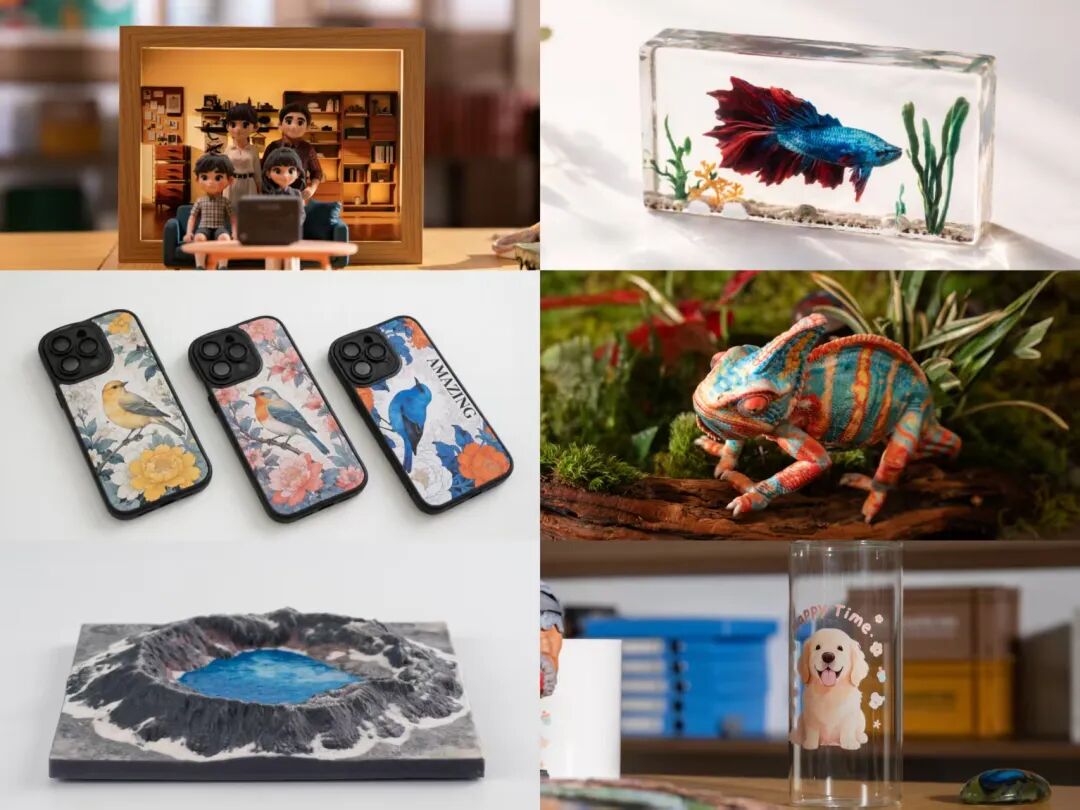
(Source of image: Enterprise)
HeyGears introduces that G1X can easily switch between three ink systems: UV 3D Resin, UV Ink and water-soluble AQ Ink. In addition to high-precision full-color 3D printing, it can be extended to multi-color plane printing, three-dimensional surface texture printing and fabric transfer film printing.
In terms of consumables prices, thanks to HeyGears' years of self-developed consumables support, the pricing of G1X UV3D resin consumables system is only 1/3 to 1/2 of that of similar consumer products, which greatly reduces the actual use cost.
In Gui Peiyan's plan, the initial target users of G1X are studios and professional creators who rely on 3D printing for commercial realization; in the medium and long term, HeyGears hopes to reduce the price of the whole machine to less than 5000 yuan through supply chain optimization and other means, and fully enter the mass household consumer market.
In Gui Peiyan's view, this is also what makes HeyGears different from other enterprises. Many enterprises will wait for the highway to be built before making cars, but they choose to take hoes to pave the road themselves.
After more than ten years of entrepreneurship, Gui Peiyan has long abandoned illusions. He doesn't like to tell stories, and rarely acts on impulse. "You need to find your own weaknesses, recruit good people, do the right things, be more patient sometimes, and make better judgments on basic issues."