Five groups of players have all joined the fray, and the full-scale battle for the super entry point of AI office has officially kicked off.
In the late summer of 2026, China's AI office track is witnessing a silent, transformative upheaval. In just two weeks, four internet giants — Tencent, Alibaba, ByteDance and Baidu — have simultaneously pressed the integration button. Previously scattered, competing AI office projects within the groups have been rapidly consolidated, resources centralized, and products merged. Together with WPS Comate officially released by Kingsoft Office in mid-July, all five leading players have completed their lineup adjustments within an extremely short period of time.
This is no ordinary product iteration, but a battle for the enterprise productivity entry point over the next decade.
Ten years ago, DingTalk and WeCom successively kicked off the era of the collaborative office track, followed by the entry of Feishu, pushing the industry into a "three-way rivalry" phase. Ten years later, AI agents have crossed the usability threshold, and the core contradiction of the office battlefield has shifted from "how to collaborate efficiently" to "how to let AI handle work for people". Everyone understands that whoever secures the next-generation office entry point will hold the initiative in the B-end productivity market.
A hegemonic competition centered on AI office agents has fully broken out, and the industry window period may be shorter than everyone expects.
The Battle for Entry Points
First, let's look at the intensive moves of the giants:
On July 20, Tencent adjusted the relevant businesses of the QClaw Product Center to the 6th Cloud Product Division, bringing it under the same management system as WorkBuddy.
On July 30, ByteDance integrated the Feishu and Doubao product teams to form a new "Doubao Product Team", with former Feishu head Xie Xin now reporting to Zhao Qi, head of Doubao.
On August 3, Alibaba integrated three products — QoderWork, MuleRun and Wukong — into "Qianwen Office" and officially launched public beta testing.
On August 4, Baidu initiated the team integration of its internal office agent dodo and Baidu Dazi, with all dodo R&D personnel and resources fully merged into Baidu Dazi.
Within half a month, the four major tech firms almost synchronously completed the centralized consolidation of their AI office product lines. Six months ago, they were still encouraging internal independent exploration and rapid trial and error; six months later, they began to concentrate resources, merge products, and shift to full-scale breakthroughs.
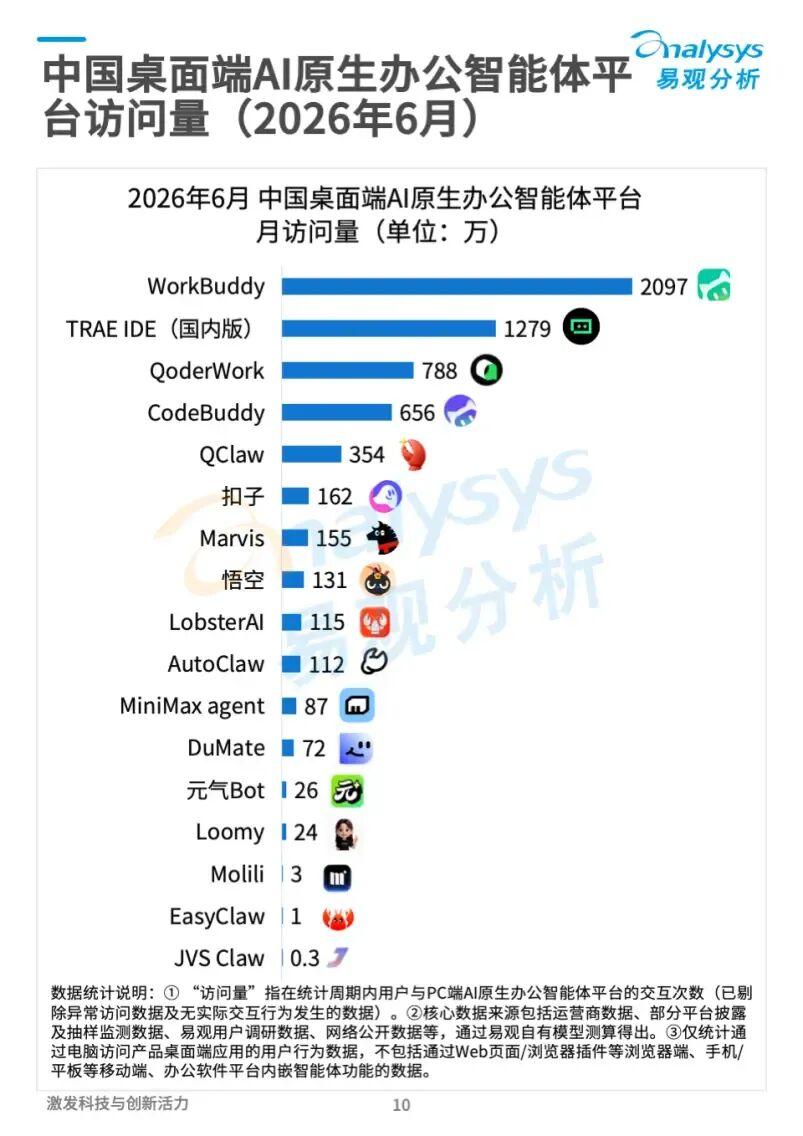
Why did the giants suddenly accelerate this shift? This set of data may explain the situation: according to the "2026 Q2 China Office Agent Platform Market Insight" report released by Analysys, in June 2026, the total monthly visits of 17 mainstream desktop-side AI-native office agents under statistics exceeded 60 million. Back in March, this figure was only around 20 million. Tripling in three months — AI office agents are evolving from users' "novelty toys" to "daily production tools".
Source: Analysys
In fact, AI office is not a new concept. Over the past few years, almost all office software has added AI sidebars that can write copy, generate summaries and create PPTs. But essentially, these functions still follow the paradigm of "humans operate tools while AI assists", and have not broken out of the "co-pilot" framework.
The real change took place at the beginning of this year. The OpenClaw open-source project popularized the desktop agent form: users give instructions in natural language, and AI can independently operate the computer, call software and complete entire tasks. In the same period, Claude Code reached an annualized revenue of 1 billion US dollars in only half a year, verifying the feasibility of the "pay for task completion" business model.
After the programming scenario was validated, capabilities quickly spilled over to the general office scenario, instantly unlocking huge market imagination. For major tech firms, C-end general large models consumed massive computing power over the past year, yet a stable profit model was never established. The office scenario, with its triple attributes of high frequency, high stickiness and high willingness to pay, will become a larger track for agents after AI programming.
User demands are also changing. Compared with "AI being able to answer questions", people care more about "whether AI can finish the entire task". From sorting out materials and generating reports to interfacing with systems and initiating approvals, users expect agents to take over complete workflows, rather than only output a paragraph of text.
More importantly, the industry has basically reached a consensus: the entry point of office software is migrating. Previously, employees open documents, IM tools or email first when starting work; in the future, employees may open the agent first, and let AI call various tools after clarifying the goals. When AI agents become the first stop after employees turn on their computers, traditional DingTalk, Feishu and WeCom will retreat from the entry point to the background, becoming capability modules called by AI. The transfer of entry points also means redistribution of power, and no company is willing to fall behind.
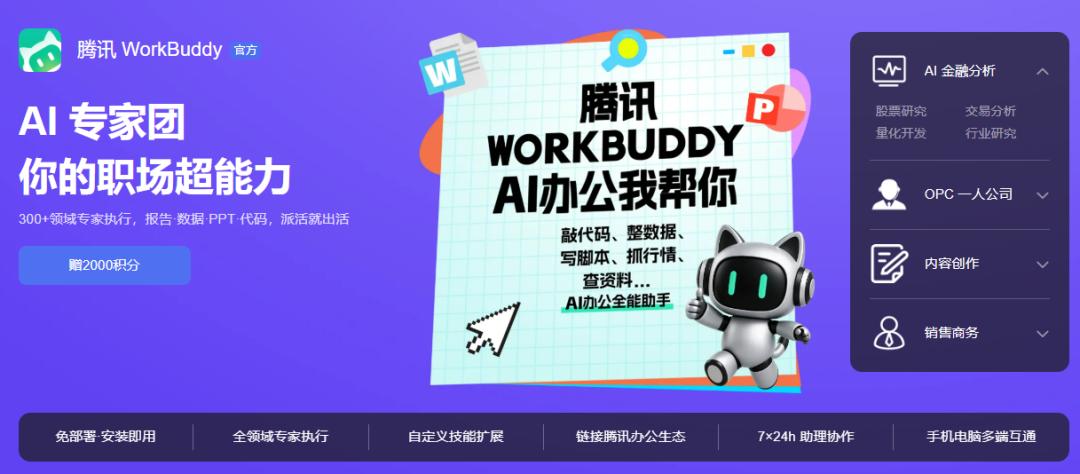
Tencent took the lead in seizing the "market share" advantage. In its first quarter 2026 earnings announcement, Tencent stated that in terms of daily active accounts, WorkBuddy has become the most widely used productivity AI agent service in China.
Source: WorkBuddy
Data from Analysys also shows that the monthly visits of WorkBuddy rose from 8.85 million at its March launch to 20.97 million in June, a more than 100% increase, exceeding the sum of ByteDance's domestic TRAEIDE version (12.79 million) in second place and Alibaba's QoderWork (7.88 million) in third place.
In addition, the total traffic of four Tencent products alone reaches 32.62 million, accounting for more than half of the entire market. Adding ByteDance's 14.41 million and Alibaba's 9.19 million, the three companies together occupy over 90% of the market share, leaving less than 10% of the market for other players.
Data disclosed in Citi's research report is even more striking: WorkBuddy's cross-platform monthly active users have reached 20 million, with daily active users exceeding 13 million, and user stickiness is at a high industry level. Some views suggest that WorkBuddy is likely to become Tencent's third major strategic product following QQ and WeChat.
Tencent's first-mover advantage undoubtedly puts pressure on other major tech firms, but leading does not mean the final outcome. The industry generally believes that the AI office track is still in a very early stage, far from reaching the final conclusion, and everyone has a chance to overtake on a curve.
Five Players, Different Strategies
After the gap in traffic is widened, the cost-effectiveness of the horse-racing mechanism drops rapidly — it was effective in the chaotic period of the industry, covering more possibilities with the minimum cost; but once the market direction is clear, scattered investment turns into internal friction. Thus, a rare large-scale organizational adjustment followed. The integration paths of several companies are different, reflecting their distinct organizational genes and understanding of AI office.
Tencent: Multiple Front-end Entry Points, Unified Back-end Management
Tencent is the earliest starter in this competition. As early as March this year, WorkBuddy officially launched public beta, focusing on deployment-free, easy-to-use desktop agents. After downloading and installing it, users can use natural language to let AI process local files, generate office documents, and operate browsers. At that time, Tencent had already decided to fully bet on office agent products, and gradually tilted resources to WorkBuddy. Tencent internally defines it as a "super project", and even Ma Huateng pays close attention to product progress, never missing WorkBuddy product meetings.
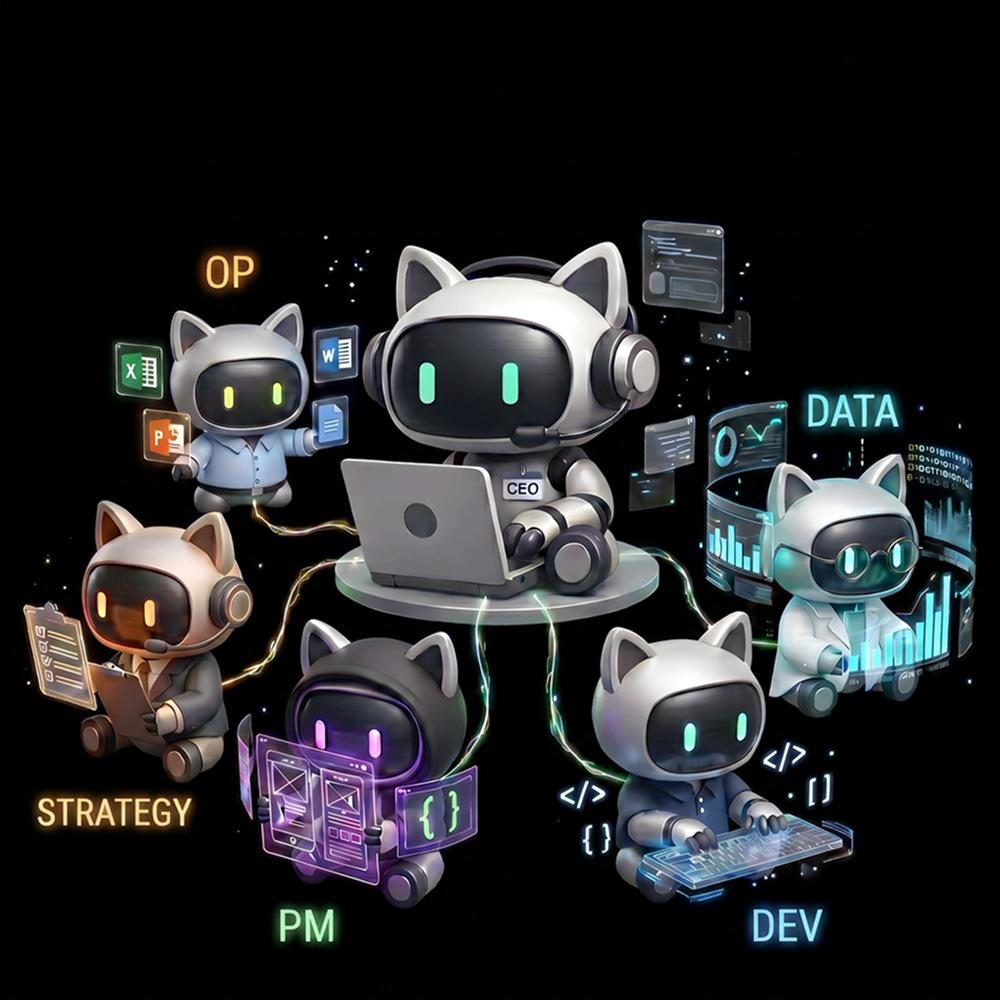
On July 20, Tencent announced that part of the businesses and teams of the QClaw Product Center will be merged into the WorkBuddy system, led by Liu Yi, Vice President of Tencent Cloud. It is worth noting that the two products still maintain independent operations: QClaw is more of a personal assistant, built based on the open-source OpenClaw, emphasizing local operation and WeChat remote recall; WorkBuddy is positioned as a full-scenario AI office workstation, covering daily office work, code development, design creativity and other fields.
Source: WorkBuddy
Tencent's logic is: retain multiple entry points at the front end, concentrate resources at the back end, and unify and reuse model access, skill ecosystem, security capabilities and cloud resources at the back end. In this regard, Liu Yi said, "For all agent products, we are also comprehensively and uniformly evaluating user scenarios and value."
Alibaba: "Three-in-One" Bet on AI Office
Alibaba's path has undergone a very obvious shift. Before that, Alibaba simultaneously promoted three Agent products internally: Wukong, QoderWork and MuleRun, corresponding to enterprise collaboration, desktop office and cloud-side agent respectively, which is a typical internal horse-racing mode.
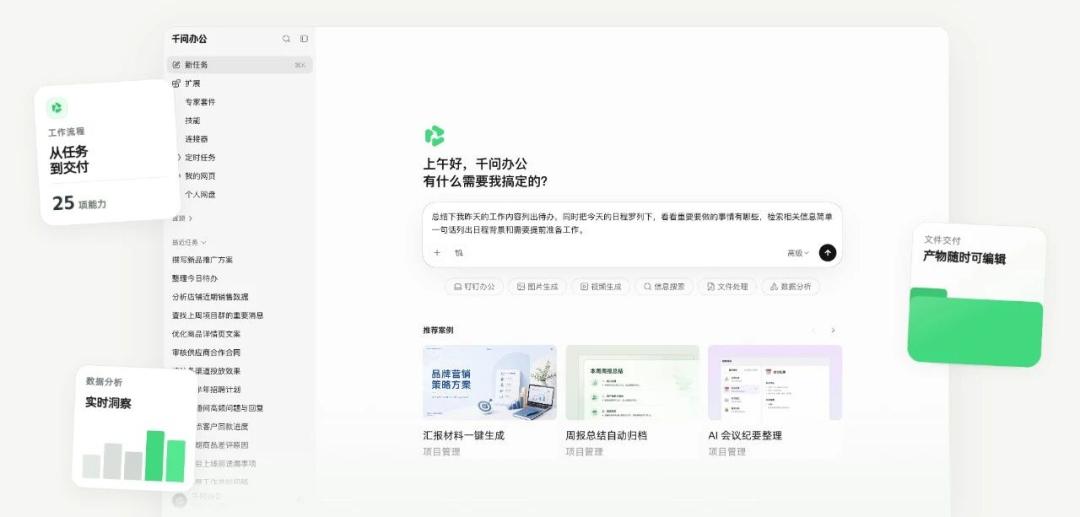
After the management change of DingTalk in June, Alibaba quickly ended the horse-racing state, directly merged the three products into "Qianwen Office", positioned as an AI productivity platform for enterprise organizations, led by newly appointed DingTalk CEO Chen Yusen, with senior group executives including Wu Yongming personally participating in key meetings. It is reported that Alibaba has internally regarded "AI office" as one of the company's strategic directions in the AI field, and Qianwen Office, as the core implementation carrier of AI office, has become one of the most critical strategic-level products within the company.
Source: Qianwen Office
Putting all three teams and three technical routes into the enterprise-level market, Alibaba's adjustment intensity is undoubtedly the greatest, but internal assessment is relatively pragmatic. An article from Huxiu mentioned that Qianwen Office does not assess user count and monthly active users in the short term, prioritizing polishing product experience and enterprise scenario implementation solutions.
ByteDance: Feishu Steps Back, Doubao Steps Forward
ByteDance's integration is the most thorough and iconic. Feishu, a business that ByteDance has polished for ten years with annual revenue exceeding 3 billion yuan, is split into two parts: the product team is merged into Doubao, under the unified management of Doubao head Zhao Qi, with former Feishu head Xie Xin now reporting to Zhao Qi; the sales, marketing and customer service teams are merged into Volcano Engine to form a new "Creativity Service Platform".
This means that Feishu, once regarded as ByteDance's To B hope, has retreated to a scenario entry point in the AI era, while Doubao has become the real "brain". The core logic of this adjustment is to let AI take the lead, and collaborative tools become the implementation scenario of AI capabilities.
Before that, Aily, the agent product strongly promoted by Feishu, had poor commercial performance, while Doubao, although having hundreds of millions of C-end users, never managed to deeply enter the office scenario. After the integration, Doubao's large model capabilities can directly reuse Feishu's enterprise scenarios and customer resources, forming the synergy of "model + scenario".
ByteDance's advantages are obvious: Doubao has strong C-end traffic, Feishu has outstanding reputation among high-end enterprise customers, and Volcano Engine provides computing power and MaaS service support. Its challenge lies in how to quickly complete the running-in of products and teams, and transform the potential energy of organizational adjustment into actual market share.
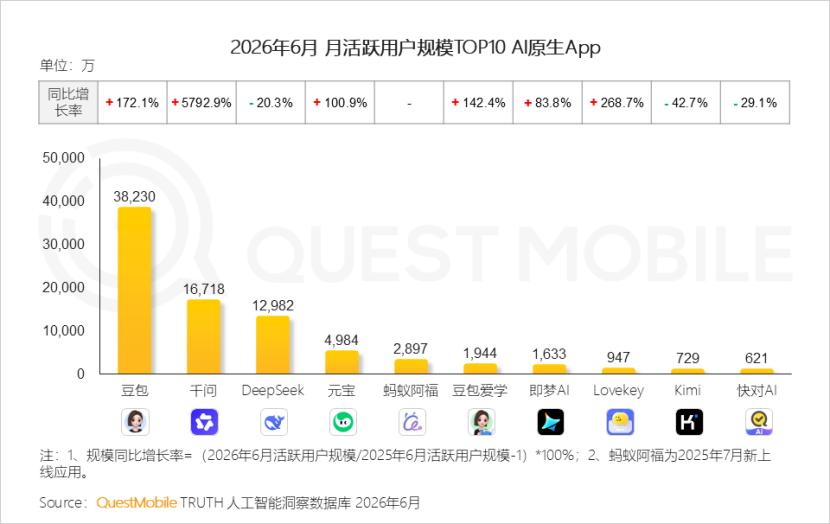
Source: QuestMobile
Baidu: Internal and External Unification, "Dazi" Steps onto the Stage
Baidu also started the integration of dodo and Baidu Dazi in early August. dodo is an office agent that Baidu has used internally for a long time, and Baidu Dazi is a professional office agent platform launched externally in March this year. After the merger, Baidu Dazi will become a unified office Agent product that serves internal office, personal productivity and enterprise collaboration at the same time.
Baidu's differentiated advantage lies in its information retrieval capability. Relying on years of accumulated search technology, Baidu Dazi has higher accuracy and fewer hallucinations in scenarios such as material sorting and industry research. At the same time, it also has built-in full ecological capabilities of Baidu Search, Netdisk, Maps, Baike and other products, forming a complete tool chain.
Baidu Dazi also has excellent performance in agent evaluations: it has successively topped two authoritative evaluation lists, PinchBench and DeepResearch Bench, with task completion rate exceeding similar products from Anthropic and OpenAI. In the recently released "2026 China AI Agent Best Application Practices" by Frost & Sullivan and LeadLeo Research Institute, Baidu Dazi was selected into the "Top 10 Most Practical Agents".

Source: Baidu Cloud
Baidu Dazi's promotion pace is also very steady: according to official data, from its launch on March 22 to July 10, the average daily number of queries on Baidu Dazi surged 20 times; in July, it launched the enterprise version and the Dazi Alliance, starting to expand the B-end market; in early August, it merged dodo, exporting internally verified capabilities to external customers. It does not pursue the fastest user growth rate, but enters the office market relying on technical stability and its search genes.
Kingsoft Office: Document-Native, the "Only Opportunity"
Kingsoft Office is a special player in this melee, following the path of "extending outward from the document kernel". On July 15, Kingsoft Office upgraded WPS365 and launched WPS Comate, an AI office Agent for organizations, positioned as an organizational-level AI office entry point, organizational-level human-computer interaction platform and AI enterprise infrastructure, focusing on the concept of "enterprise brain".
