When AI can answer everything, what remains for platforms like Zhihu?
Nowadays, more and more people no longer open search engines or knowledge communities when encountering problems, but directly click on the AI dialog box. This change in habits has completely overturned the traffic landscape of China's Internet.
According to QuestMobile data, In June 2026, the combined monthly active users of Doubao, Qianwen, and DeepSeek have approached 700 million; the average monthly usage frequency per user of AI-native APPs is as high as 92.7 times, which means that the average user opens AI applications more than three times a day, and using AI has become a daily routine.
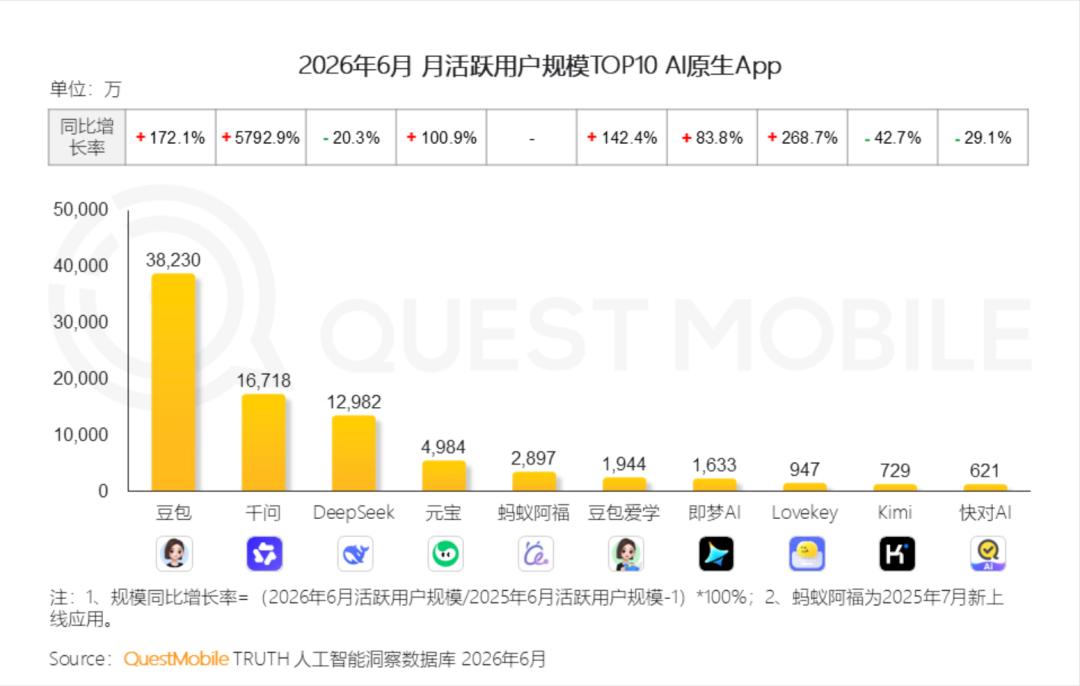
Source: QuestMobile
Correspondingly, knowledge content communities represented by Zhihu are experiencing continuous decline.
Zhihu's MAU dropped from the peak of 101.3 million in 2022 to 81.4 million in the fourth quarter of 2024, and it stopped disclosing this indicator separately since 2025. The average monthly number of subscribed members also dropped from 14.1 million in the fourth quarter of 2024 to 12.2 million in the fourth quarter of 2025. Although there was a slight rebound to 13.1 million in the first quarter of 2026, nearly 1 million paying users were still lost.
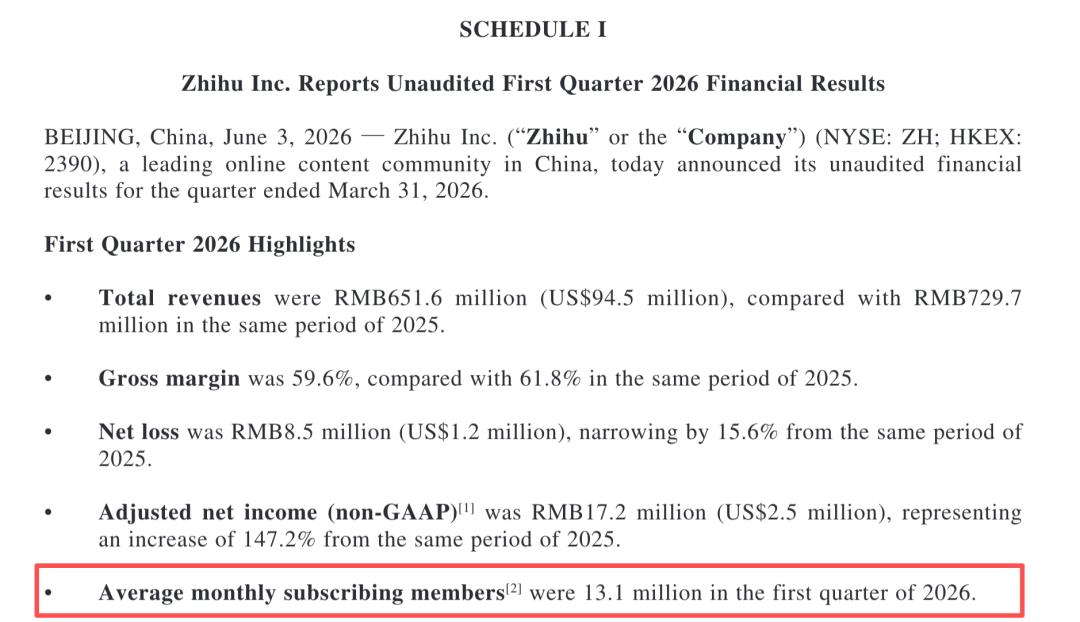
Source: Zhihu 2026 Q1 Financial Report
At the same time, the user pool of traditional search engines is also shrinking at an accelerated pace. According to the 57th Statistical Report on Internet Development in China released by CNNIC: As of December 2025, the scale of search engine users in China has dropped to 782 million, and the penetration rate has plummeted from 79.2% in the previous year to 69.5%, losing nearly 100 million users in just one year.
When users want AI to give answers directly, are unwilling to search, and no longer compare posts, what kind of impact will the knowledge communities that rely on question and answer face? Let's follow "TopKlout" to find out!
The Dilemma of Knowledge Platforms
The decline in Zhihu's traffic did not happen overnight. As early as when "Thanks for the invitation, just got off the plane" and "Zhihu full of jokes" were widely teased, content hydration had slowly eroded the professional foundation of the platform.
A large number of low-quality story posts and emotional venting have occupied the original space for in-depth discussions. While old users are lost, new users also find it difficult to establish a sense of identity. The emergence of AI only amplifies this long-accumulated anxiety, and does not create problems out of thin air.
Long before AI was widely popularized, high-quality content on Zhihu has always been the focus of reprinting on social media, a large amount of content has been screenshot, reprinted, and rewritten to Weibo, Xiaohongshu, and WeChat Official Accounts, but the platform has no way to stop it.
Nowadays, AI is grabbing and learning these content non-stop day and night, and knowledge communities can't even hold the line against content reprinting, because AI does not directly copy content, but re-generates new content after digesting the original information.
In addition, many enthusiastic replies are often based only on personal experience, which is neither systematic nor necessarily objective. The answers given by AI have comprehensively surpassed the impromptu replies of the vast majority of ordinary users, so the substitution at the content level is inevitable.
Although not all content will be covered by AI, the quality of a large number of daily answers is indeed inferior to that of AI, which is quite fatal for communities that rely on content to support advertising and subscription business.
Human Users Once Served as a Barrier, But No Longer Necessarily
Many people will refute that in knowledge communities like Zhihu, there are still a large number of real people producing high-quality content, which AI can never replicate. This view sounds reasonable, but it does not solve the problem.
Indeed, many industry experts and people who have experienced events first-hand have unique experience, on-site perception, and non-consensus judgment that AI will never have, but the in-depth insights accumulated by industry experts and the rare anecdotes shared by first-hand experiencers all have a common feature: the output is too low.
How many valuable clinical notes can a senior doctor write in a year? How many exclusive on-site observations can an overseas war correspondent provide? How much of this content will be posted on Q&A communities like Zhihu?
Such supply is indeed precious, but it is difficult to support an Internet platform that requires massive content to maintain activity and commercialization. Zhihu receives tens of thousands of questions every day, but high-quality real-person answers may only account for a very small proportion, and most of them are common-sense Q&A that can be easily covered by AI.
In addition to content supply, a bigger problem is that as long as real people stay in the knowledge community to answer questions and leave text, their content will be grabbed and learned by AI, which in turn becomes the raw material for AI output. The exclusive knowledge base accumulated by the platform over many years is almost an undefended public resource in front of AI.
In this cycle where real people produce content and AI grabs content, community platforms can neither retain user traffic nor maintain the exclusivity of content.
The result is that the scale of users continues to shrink, and the traffic of the platform declines, which leads to fewer available advertising slots, lower advertising revenue, and the simultaneous depreciation of the commercial value of paid members and communities. The overall operation of the platform slides into an irreversible downward spiral.
Real-person content is indeed a barrier, but it cannot resist the continuous impact of AI.
AI Is Not Perfect, But Its Imperfection Is Not Fatal
In addition to real-person content, many people think that "AI is not accurate", and they prefer to trust the results they searched by themselves. This view is also correct, but it still does not solve the problem.
AI does make mistakes, many answers lack reliable sources, and even hallucinations occur, but this only means that AI is not developed well enough, and cannot prove that knowledge communities are more useful than AI.
Because most of the time the answers given by AI are not that outrageous. Even if there are errors, a considerable number of users will find them through common sense or secondary queries.
Conversely, the content that people search in browsers and knowledge communities may also be full of errors. A highly upvoted answer may be a rumor spread by mistake, and a professional article may also carry biased private views.
For most problems in daily life, the answers of AI are not necessarily worse than the impromptu replies of an ordinary real person. In truly professional and sophisticated fields, people who are proficient in using AI mostly have mastered the methods of using multiple AI tools for cross-verification.
Therefore, in the dimension of accuracy, high-quality real-person content is indeed scarce, but it is untenable to take it as the defense line for knowledge communities to fight against AI. Trust is an experience gap that has not yet been filled by AI, but it cannot become the moat of knowledge communities.
With AI gradually introducing citation tracing, expert certification and multi-source comparison, the speed at which this gap is filled may be faster than the speed of the community's self-innovation.
AI Is Shaking the Traffic Logic of the Entire Internet
At this point, we will find that the impact of AI is not only limited to knowledge communities such as Zhihu and Knowledge Planet, but it has shaken the traffic distribution model that the entire Internet has followed for more than 20 years. As long as the entrances are related to search or problem solving, the traffic is declining simultaneously, and general search engines are also having a hard time.
In addition to the significant decline in the scale of search engine users mentioned at the beginning of the article, QuestMobile data also shows that as of May 2026, the per capita usage times and usage duration of traditional search engines have decreased by 19.1% and 13.5% year-on-year respectively.
The reason is not complicated, that is, AI answers faster, more directly, and more labor-saving.
In the past, when a user raised a question, he needed to search, browse titles, click links, read and digest. Each link was a traffic entrance for search engines or content websites, which brought opportunities for exposure, ad display, retention and conversion. There are too many distractions on this road, including bidding ads, pop-up ads, and various invalid links... Users need to spend energy to distinguish the true from the false.
Now, users directly ask AI a question and get an integrated answer, without leaving the current dialog box at all. The information acquisition chain is compressed into one step, and all intermediate traffic entrances are no longer needed.
When the production, distribution and acquisition of knowledge can bypass the intermediate platforms, neither knowledge communities nor search engines are necessary nodes on the knowledge map.
Every time AI iterates its answering capabilities, such platforms will lose a layer of value. In the face of new technologies, the knowledge intermediary model has all failed, and the bridges that were once necessary to pass can now be bypassed at will.
This is not a strategic mistake of any company, but the entire category has been hit at its very foundation.
Human Beings Still Need Communication and Discussion
At the end of the writing, does it mean that knowledge communities and search platforms have completely lost their value? Not necessarily.
Although AI is becoming more and more powerful, "TopKlout" always believes that the more flooded AI content is, the more precious high-quality professional real-person content and multi-party discussions will be.
AI is good at giving answers, but what people need is far more than answers. People need discussions, collisions of multiple perspectives, and exchanges of different opinions.
For example, there are numerous AI communities on Zhihu, where a large number of front-line AI practitioners and researchers share cutting-edge trends; Deng Yu, the winner of the Fields Medal in 2026, had long been deeply involved in the mathematics section of Zhihu in his early years, and his Zhihu homepage was swiped by netizens all over the Internet after he won the award.
This kind of community atmosphere based on real social connections and professional accumulation that spans time cannot be replicated by AI.
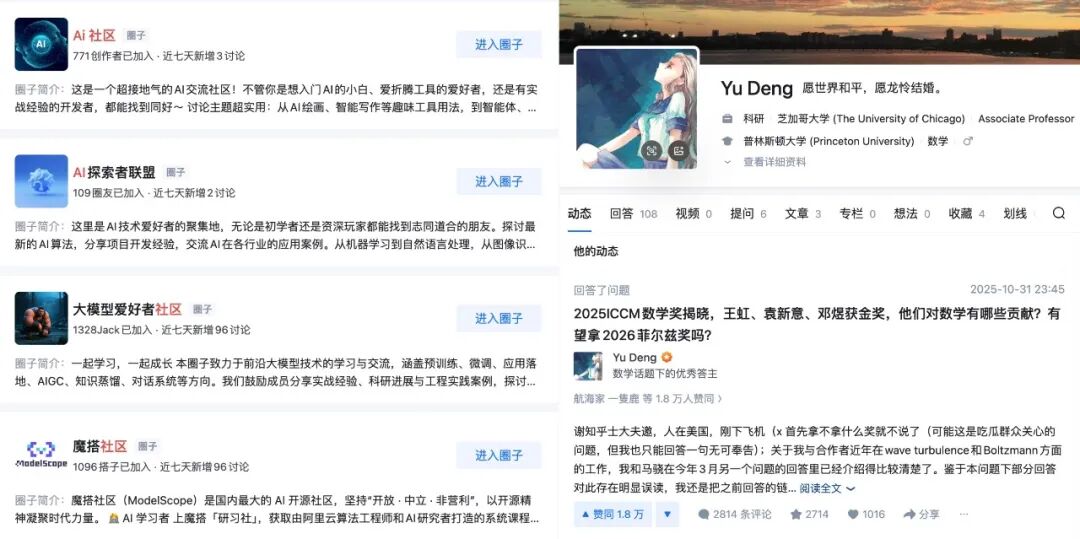
Source: Zhihu
There can be countless AI assistants now, but there is only one Zhihu. Perhaps, the supply of real-person Q&A will become less and less in the future, but the rarer it is, the more precious it becomes.
China's Internet has never lacked small but beautiful survival samples, such as Douban and Zhihu. They do not necessarily need to become traffic giants, nor do they need to win the daily active user competition. As long as they hold their own corner and provide irreplaceable value for the "minority" who need it, it is actually enough.
What do you think of the impact on knowledge communities under the AI boom? Talk to us in the comment section!
This article is from the WeChat Official Account "TopKlout" (ID: TopKlout), author: Xiao Song, published with authorization from 36Kr.