36Kr Exclusive | Securing orders from leading consumer electronics clients, this ultra-high precision metal 3D printing company has completed its Pre-A round of financing
Source: Enterprise
This article contains approximately 2600 words, and a reading time of 6 minutes is recommended
Author | Ou Xue
Editor | Yuan Silai
36Kr has learned that Suzhou Dewu Technology Co., Ltd. (hereinafter referred to as "Dewu Technology") has recently completed a Pre-A round of financing of tens of millions of yuan. This round is jointly invested by Jinsha River United Capital and Jintou Zhiyuan. The funds will be mainly used for iterative R&D of ultra-high-precision SLM equipment, expansion of printing service production lines and market expansion.
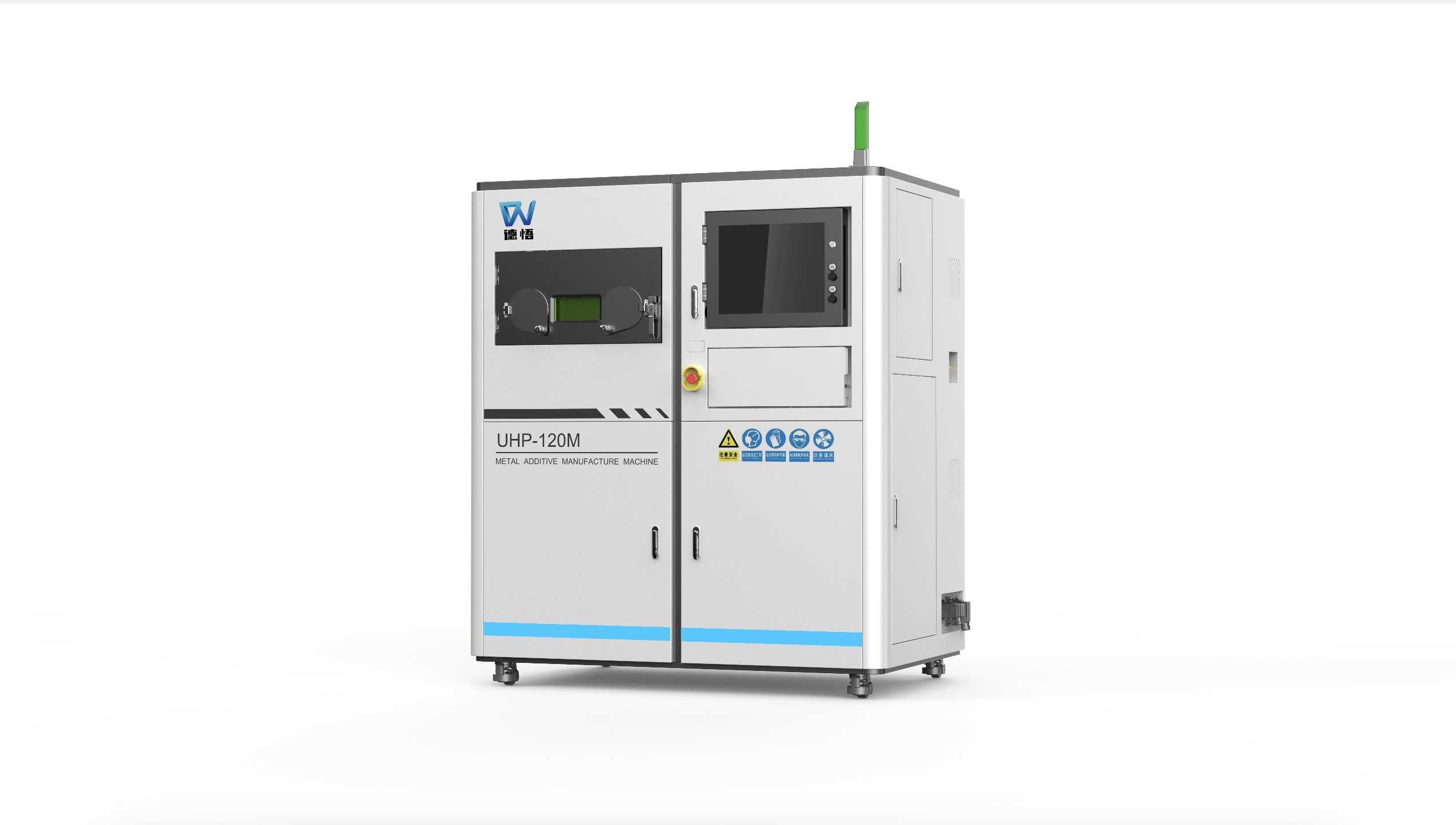
Founded in Suzhou in May 2024, Dewu Technology focuses on the R&D, production, sales and printing services of ultra-high-precision metal 3D printing SLM (Selective Laser Melting) equipment, and is one of the few companies in China that has mastered the core technology of micron-level metal additive manufacturing.
At present, the company's business covers equipment R&D, AI + design services and printing services, providing high-precision manufacturing solutions for complex tiny metal parts for consumer electronics, medical devices, aerospace and other industries.
The core founding team of Dewu Technology covers the whole chain from R&D to commercialization in terms of academic and professional background: core team members come from well-known universities such as Shanghai Jiao Tong University, Northwestern Polytechnical University, University of British Columbia, and RWTH Aachen University, with multiple technical and industrial backgrounds in metal additive equipment and processes, AI for Science (software simulation, autonomous parameter optimization, etc.) and investment institutions. The chief scientist is a doctor from RWTH Aachen University, who has been deeply engaged in additive equipment and material development for many years. The whole team has multidisciplinary technical capabilities in materials, mechanics, hydrodynamics, machine learning and other fields, as well as multi-dimensional commercial experience.
36Kr understands that traditional metal 3D printing has long faced bottlenecks in precision, surface roughness and post-processing cost, making it difficult to meet the mass manufacturing requirements of precision parts.
At present, the ultra-high-precision SLM equipment independently developed by Dewu Technology controls the forming tolerance within ±10 microns, the minimum surface roughness Ra value can reach 1 micron, and it can form extremely thin structures with a wall thickness of only 30 microns.
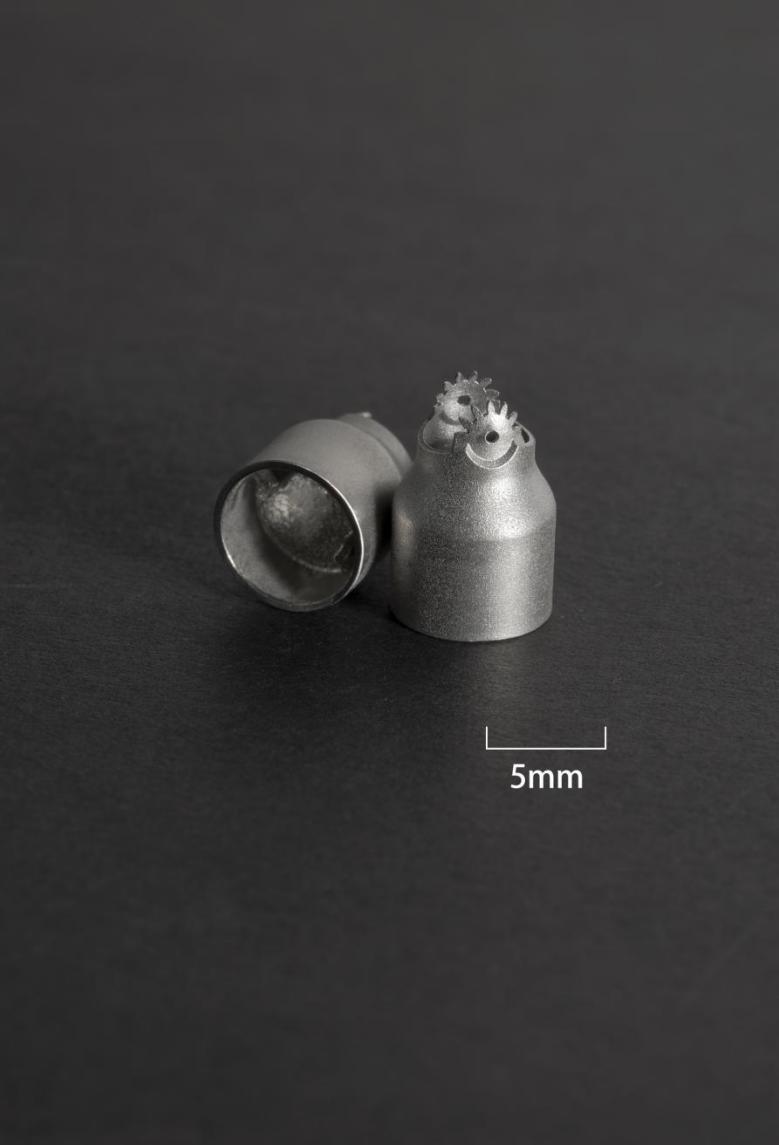
Functional components for medical devices (Source: Enterprise)
This technical advantage is particularly obvious at the cost end. Wang Zhou, the founder of the company, introduced to 36Kr that due to insufficient precision of conventional 3D printing, the printed parts are often only "blanks", which require a large number of post-processing procedures such as CNC grinding and polishing, and the post-processing cost usually accounts for about 70% of the total cost. Dewu's high-precision printing directly makes the surface finish close to the finished product standard, compressing the post-processing cost to 10%-20%, and the overall cost is 30%-40% lower than the traditional solution.
"Customers ultimately calculate the full-chain cost. The printing cost of some parts we produce is slightly higher than that of ordinary printing, but the money saved in post-processing is far greater than this price difference," Wang Zhou said.
At present, the company has completed multiple iterations of equipment, independently developed a technical system including core modules such as ultra-high-precision process control for fine structures, small-spot optical path system, and flat-field wind field design for small-particle-size powder, and has applied for more than 30 related patents at home and abroad.
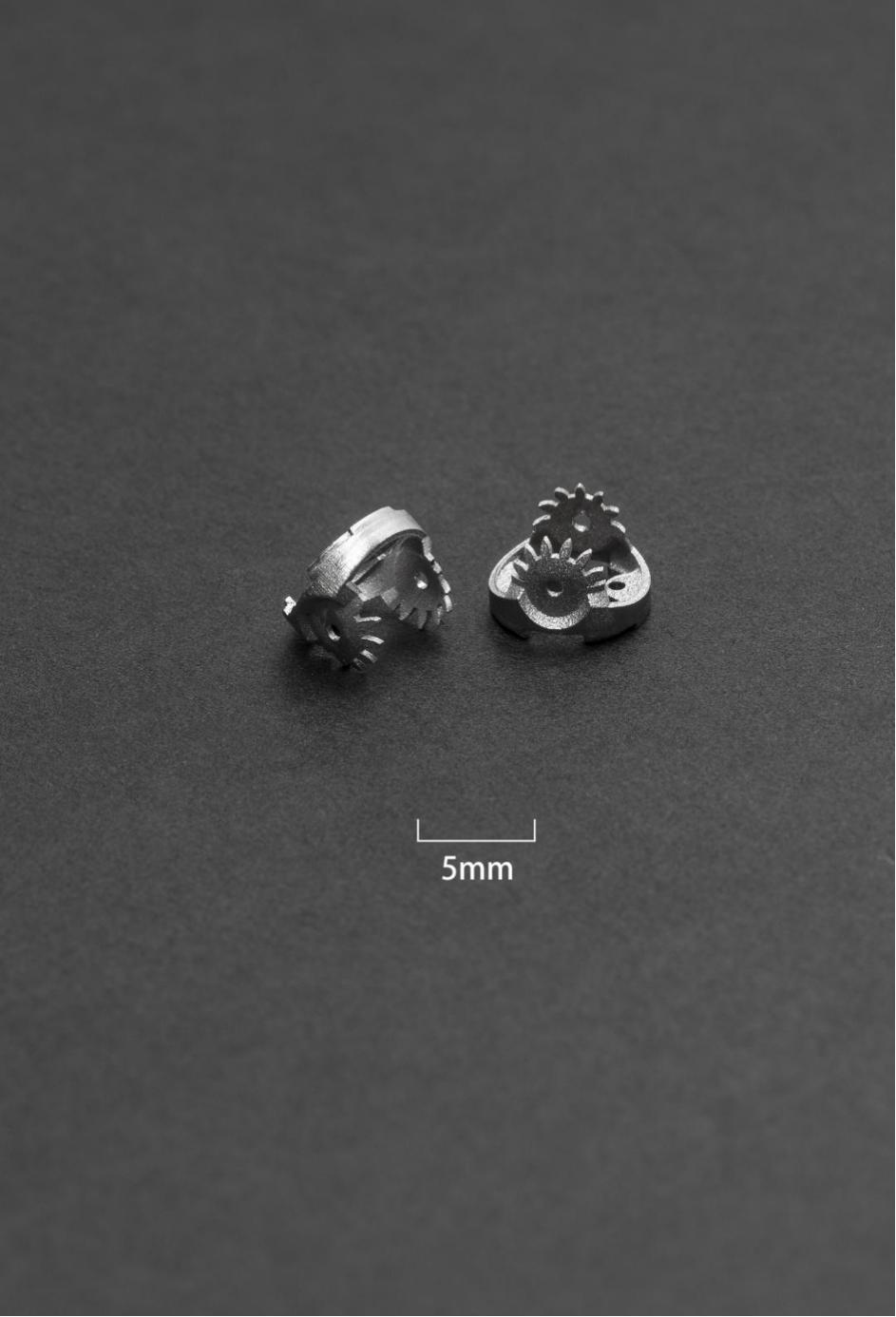
Functional components for medical devices (Source: Enterprise)
From the perspective of application scenarios, Dewu Technology initially took aerospace as the entry point, and gradually expanded to the medical device field. However, since the second half of 2025, the demand from consumer electronics customers has begun to explode intensively.
"Overseas leading consumer electronics customers have fully turned to lightweight and complex structures in the design of smart wearable devices. The demand for micro-metal precision parts for watches, rings, smart glasses and other products has suddenly increased," Wang Zhou judged that the R&D cycle of consumer electronics is usually 3-5 years. At present, these projects are in the middle and late stages of design verification, and will enter the mass production stage in the next 1-2 years, so the related demand will also increase greatly.
In terms of customers, Dewu Technology has established cooperative relations with many listed enterprises in China's Apple supply chain, commercial aerospace research institutes, Suzhou National Laboratory, Shanghai Jiao Tong University, Northwestern Polytechnical University, leading medical device manufacturers, etc. Among them, Wang Zhou revealed that the company has carried out cooperation with many overseas and domestic leading consumer electronics brands.
The company plans to increase the number of self-owned equipment to 20-30 units from 2026 to 2027, and the medium and long-term target is 60-80 units. In addition, the company plans to simultaneously promote overseas layout in the Japanese, South Korean and European markets.
The following is the edited conversation between 36Kr and Wang Zhou, the founder of the company:
36Kr: What is the core difference between Dewu's technical route and the mainstream metal 3D printing on the market?
Wang Zhou: The core difference is not whether it can be printed, but "how many procedures are still needed after printing". The post-processing cost of parts printed by traditional SLM accounts for 70%, and we have reduced this proportion to 10%-20%. The key to achieving this is that our equipment is optimized around "direct output of finished products" from spot control, powder laying layer thickness to wind field design, instead of only pursuing forming size or printing speed. When the surface finish reaches Ra ≤ 1.5μm, many medical and consumer electronic parts can be used directly without post-processing.
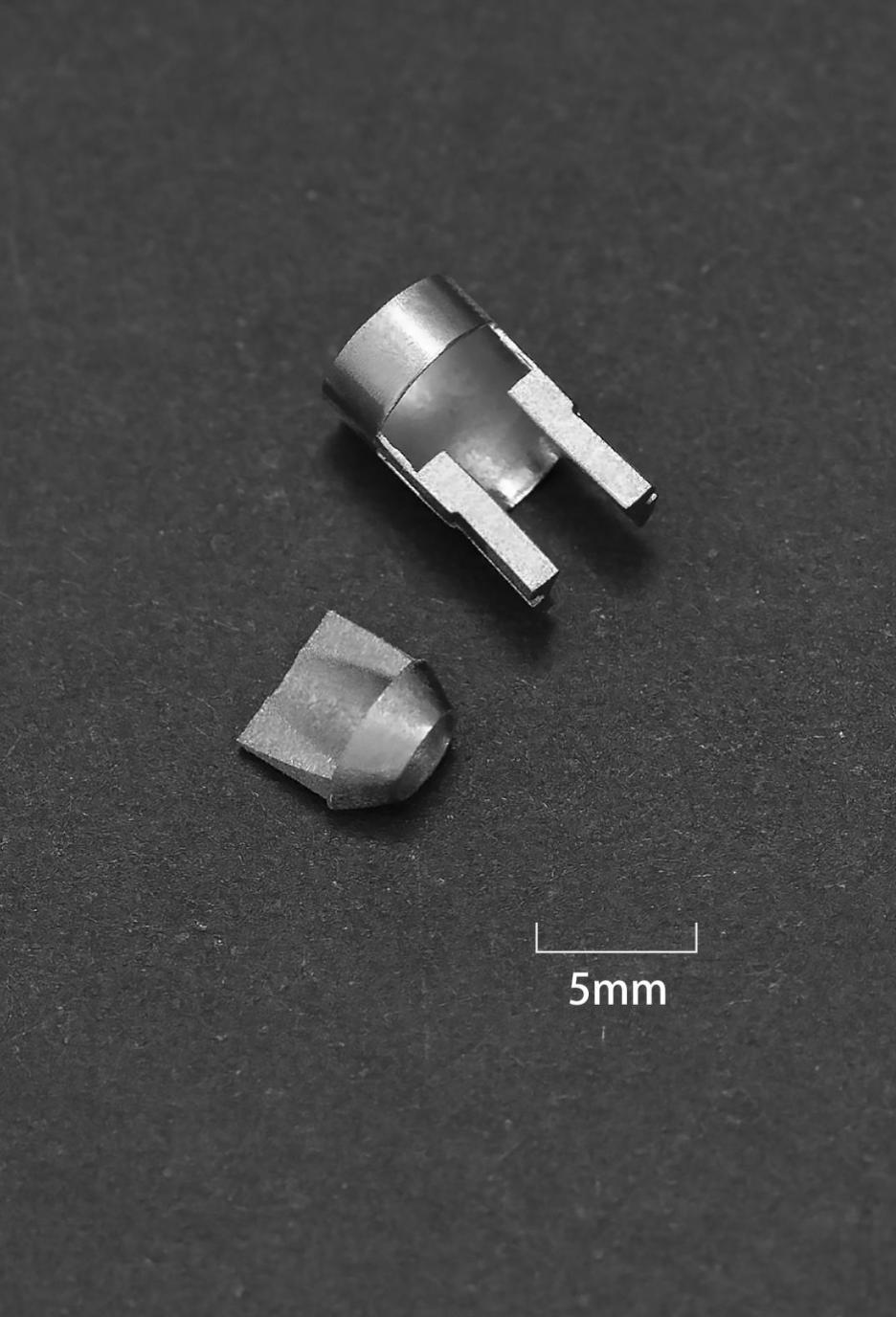
Functional components for medical devices (Source: Enterprise)
36Kr: Compared with aerospace and medical treatment, what is the difference in customer decision-making logic for consumer electronics?
Wang Zhou: Aerospace customers pursue "whether it can be made", medical customers value "whether it can pass the certification", and consumer electronics customers only focus on one thing — "whether the comprehensive cost per unit can be reduced". The volume of consumer electronics is so large that it is extremely price-sensitive. Our technical route is naturally suitable for consumer electronics, because the cost saved in post-processing is real. This is also why overseas leading consumer electronics customers have come to us intensively since the second half of last year. Their design end has moved towards ultra-high-precision structures, and traditional 3D printing cannot meet the requirements, which we can just support.
36Kr: How can high-precision technology be truly transformed into quantifiable cost advantages for customers?
Wang Zhou: The cost accounting should cover the whole chain, not just the printing link. For a part printed by traditional 3D printing, the printing cost accounts for 30% and the post-processing cost accounts for 70%. Our printing cost may be slightly higher than that of ordinary 3D printing because of high equipment precision and long printing time, but we have reduced the post-processing proportion from 70% to 10%-20%.
Take a part worth 100 yuan as an example. The ordinary solution is 30 yuan for printing plus 70 yuan for post-processing, while our solution may be 40 yuan for printing plus 15 yuan for post-processing, with a comprehensive cost of 55 yuan, saving 45% for customers. Moreover, as consumer electronics enters mass production, multi-laser large-format equipment will further reduce the printing cost, and this advantage will continue to expand. Customers do not ultimately buy a piece of equipment, but a solution that can be delivered in mass production.
Investor Views:
Jinsha River United Capital said: Micron-level metal 3D printing is a strategic expansion direction of metal additive manufacturing after years of development. The micron-level printing precision achieved by Dewu Technology surpasses the limit of the traditional MIM process, opening up new manufacturing possibilities at small scales. At the same time, this technology can achieve extremely high surface finish, greatly reduce subsequent machining processes, and achieve breakthroughs in both precision and cost dimensions.
At present, Dewu's core technology has been applied and verified in batches in the medical and aerospace fields, and it is on the eve of volume expansion in the 3C consumer electronics field. The pursuit of lightweight and intensive smart wearable devices is a long-term trend, and the application prospect of this technology is highly expected.
We believe that the design freedom of 3D printing, combined with the micro-nano scale precision manufacturing capability, has significant advantages in the field of complex precision structural parts, and is expected to become an essential link in high-end manufacturing in the future. With the continuous iteration of technology and the continuous expansion of downstream applications, a positive cycle of technological breakthrough and scenario expansion will be formed, opening up a broader market space.
Jintou Zhiyuan said: At present, the domestic metal additive manufacturing track has a significant differentiation trend. Most manufacturers focus on the competition in the general-purpose equipment track. The ultra-precision micron-level forming technology belongs to a scarce differentiated innovation direction in the industry, and it is also the core breakthrough point for domestic high-end micro-precision parts to break through the overseas process monopoly.
Traditional processing methods and mainstream ordinary-precision 3D printing equipment on the market can hardly meet the three requirements of micro complex structure forming, low roughness and low-cost mass production at the same time. Dewu independently develops a complete process system with extremely small spot and ultra-thin layer thickness, forming a complete self-developed closed loop from optical path, powder laying system to supporting process software. It can form high-precision micro parts in one step, greatly reduce subsequent finishing processes, and form a unique technical barrier in comprehensive production efficiency and finished product yield.
We believe that medium and large size component manufacturing and micro-scale precision printing are two parallel development routes of metal additive manufacturing, which are complementary rather than alternative, and each has a broad market. Dewu cuts into the high-precision printing segment with a complete solution integrating equipment, process and supporting services, and is expected to become a leader in domestic ultra-precision metal 3D printing.