Behind the Withdrawal of the Lawsuit Over 280 Million Yuan in Old Debts: STO Express's Mid-game Battle
A half-year-long lawsuit quietly came to an end, and a 3 billion-yuan convertible bond financing was abruptly halted. STO Express, whose performance has doubled, is now standing at the intersection of historical burdens and compliance storms.
On August 3, 2026, a lawsuit that had dragged on for half a year ended without fanfare.
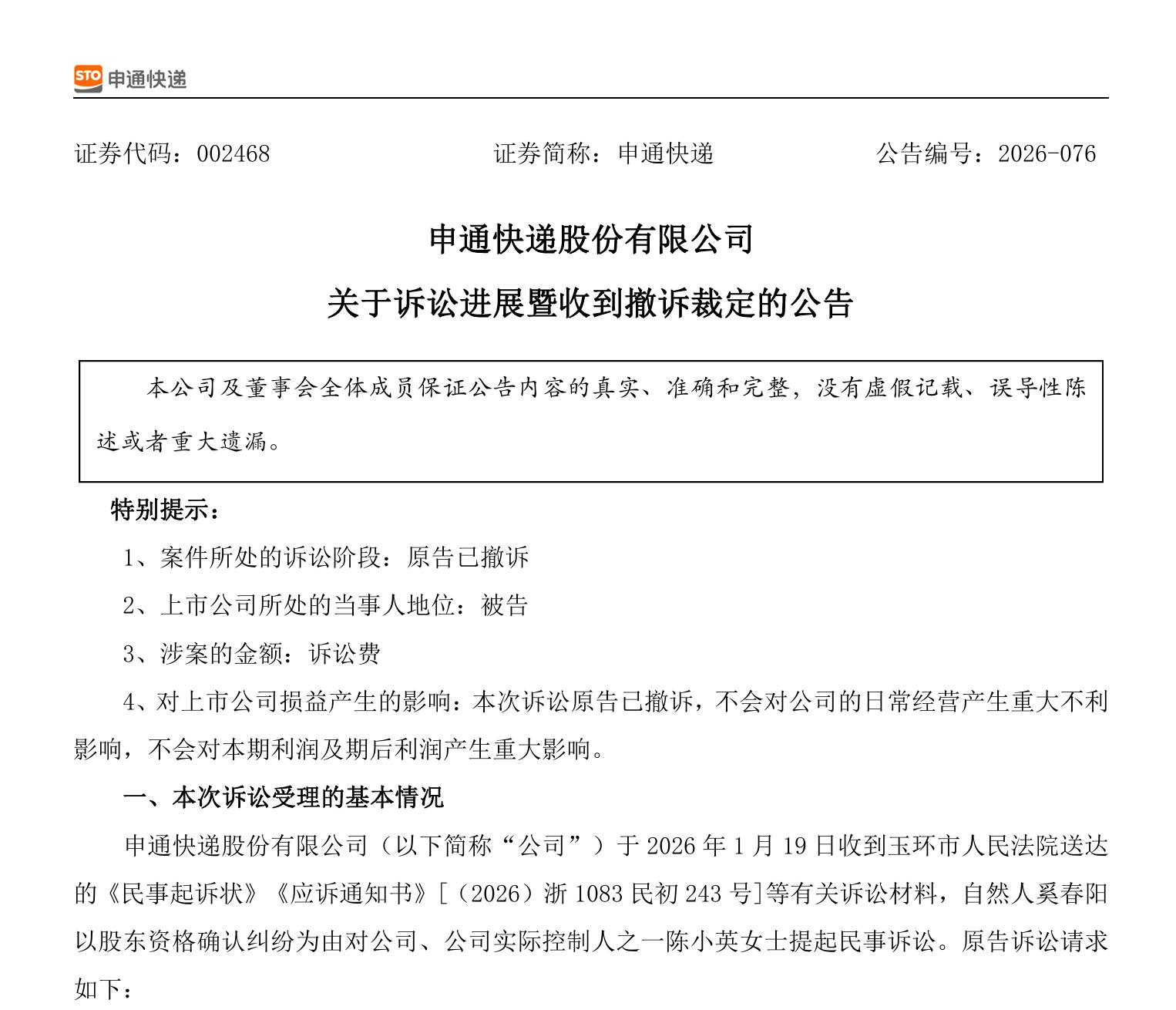
The plaintiff Xi Chunyang, the ex-husband of Chen Xiaoying, founder of STO Express, voluntarily filed a motion with the court to withdraw the lawsuit. What he originally sought was 20,284,200 shares of STO Express registered under Chen Xiaoying's name, which were worth about 284 million yuan at the market price at that time. The court approved the withdrawal, marking a procedural end to this equity ownership dispute.
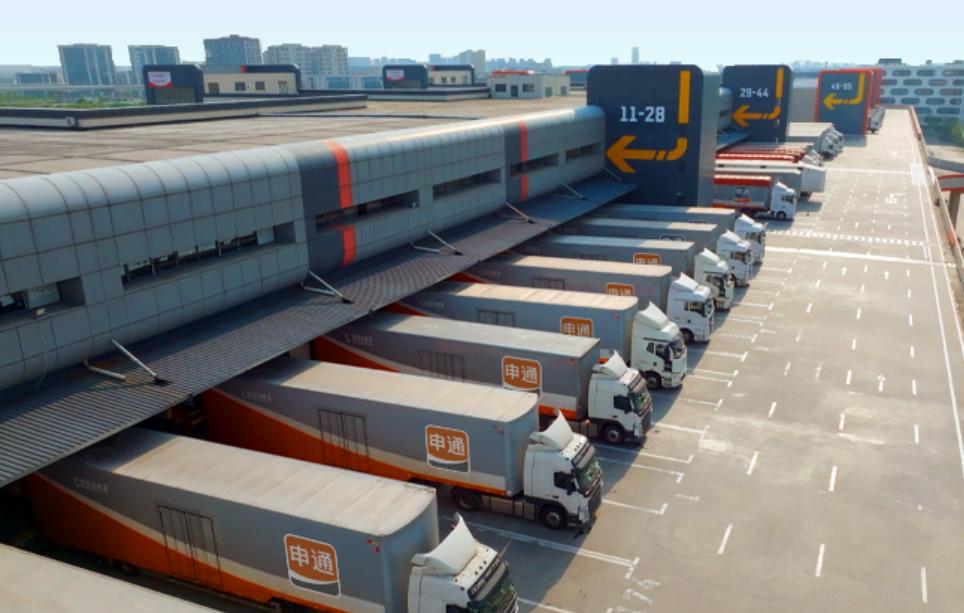
But the word "end" is not entirely accurate. The withdrawal of the lawsuit only means the end of this litigation procedure, and does not mean Xi Chunyang has given up his substantive rights.
A man who used to drive for the owner of STO Express in his early years, rose to a high position after the owner's death, married the proprietress, got divorced less than a year into the marriage, suddenly filed a lawsuit 13 years after the divorce to claim 280 million yuan of property, and then abruptly withdrew the suit half a year later. The drama of this story is enough to make a TV series.
What is even more coincidental is the timing. The day after the withdrawal announcement was released, the State Post Bureau announced that it had launched a filed investigation into STO Express. On the same day, STO announced that it would withdraw its application for convertible bonds, which had been planned for nearly five months and was intended to raise no more than 30 billion yuan.
The 280 million-yuan old account of the founders has just been withdrawn, and the 30 billion-yuan future financing has been suspended again.
The Tonglu Faction and "Three Links and One Reach"
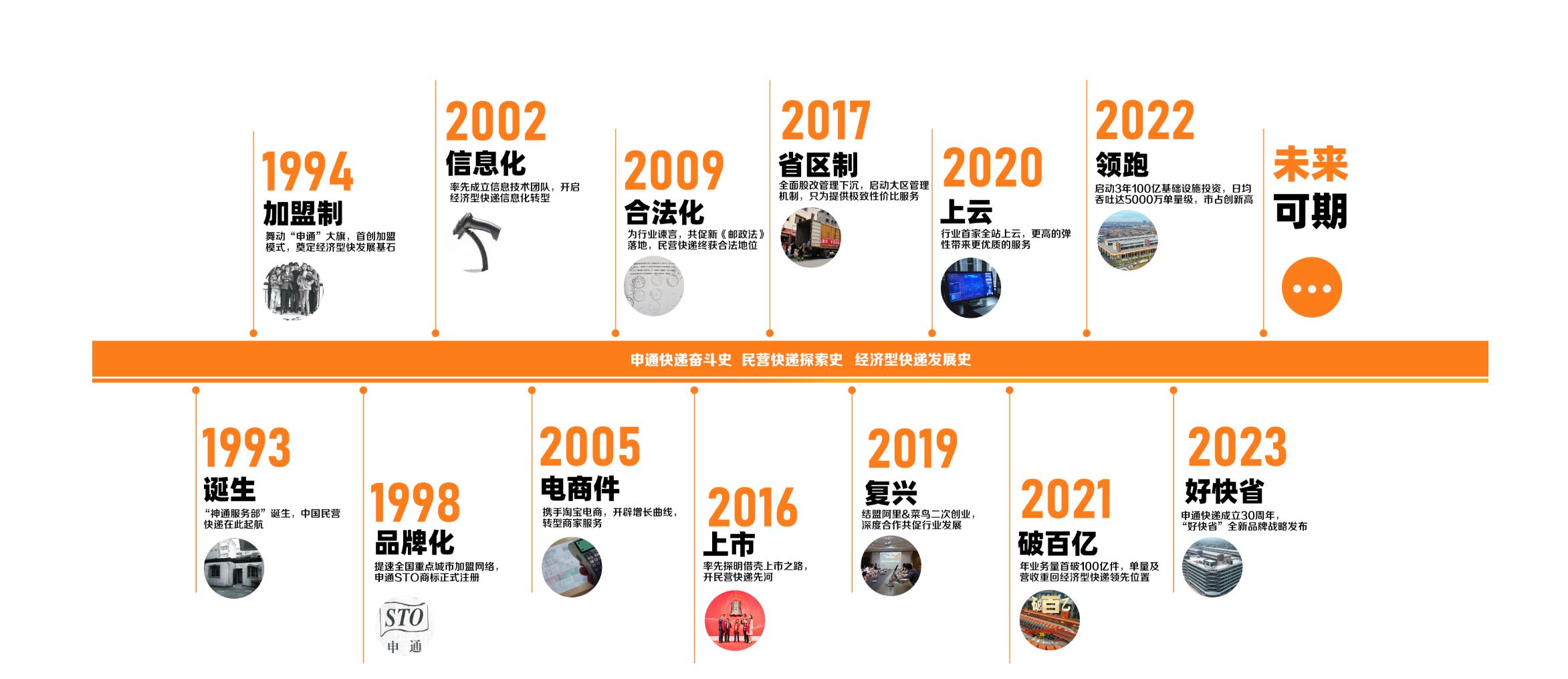
Let's turn the clock back to 1993.
In that year, Chen Xiaoying and her husband Nie Tengfei, along with others, founded Shentong Industrial in Shanghai, the predecessor of STO Express. Nie Tengfei was later called the originator of China's private express delivery industry, not because he was exceptionally capable, but because he was indeed the first to eat the crab. At that time, Xi Chunyang's role was very simple: Nie Tengfei's full-time driver and assistant.
In 1998, Nie Tengfei died in a car accident. Nie Tengfei's death was like knocking over the first domino. In the following two or three years, the core backbones of STO left one after another to set up their own businesses: Nie Tengyun, Nie Tengfei's younger brother, founded YTO Express in 1999; Sang Xuebing, head of a branch, introduced Lai Maisong, a fellow native of Tonglu, to the industry, and they jointly founded ZTO Express in 2002; Xu Jianrong, a fellow townsman, established Huitong Express.
With STO Express itself included, the pattern of "Three Links and One Reach" was thus formed.
All the founders came from the same county in Zhejiang Province — Tonglu. Blood ties, geographical connections, and master-apprentice relationships wove a tight net, blurring the boundaries between enterprises, families, and relatives and friends. It is no exaggeration to call STO the Huangpu Military Academy of China's express delivery industry.
From the perspective of Node Finance, this kind of crude entrepreneurship model was a huge advantage in the early stage of the industry. When the country only had tens of billions of express parcels a year, the competition logic was extremely simple: the one who could recruit franchisees faster, open more outlets, and seize e-commerce parcels at lower prices would win. The franchise system was loose enough to support rapid expansion, and STO ran across the whole country relying on this model.
But today, the overall landscape has completely changed.
In 2025, the national express delivery business volume reached 1989.5 billion parcels, and the total industry revenue was about 1.5 trillion yuan. The five companies, namely ZTO, YTO, STO, YUNDA, and J&T Express, took up most of the market share.
In terms of the ranking competition, the gap between the companies is not large, and the fluctuation of a single quarter may lead to a reshuffle of positions.
From the perspective of Node Finance, the current competition dimensions of the express delivery industry have also changed. In the early stage, the competition focused on parcel volume, price, and outlet density, while now it focuses on service experience, network stability, work safety, and couriers' rights and interests. Against this backdrop, STO submitted an impressive performance forecast.
From a loss of 900 million yuan to a net profit of 1.4 billion yuan, what did STO do right?
Let's start with a counterintuitive fact: STO's performance in the past two years has been quite outstanding.
In 2021, STO suffered a loss of 909 million yuan, with its market share dropping to 10.23%, making it the most embarrassed one among the "Three Links and One Reach". But since then, it has been catching up all the way. Its net profit in 2024 was 1.04 billion yuan, a year-on-year increase of 205%. In 2025, its revenue reached 55.586 billion yuan, with a net profit of 1.369 billion yuan. In the first half of 2026, its estimated net profit is between 950 million yuan and 1.06 billion yuan, more than doubling year on year.
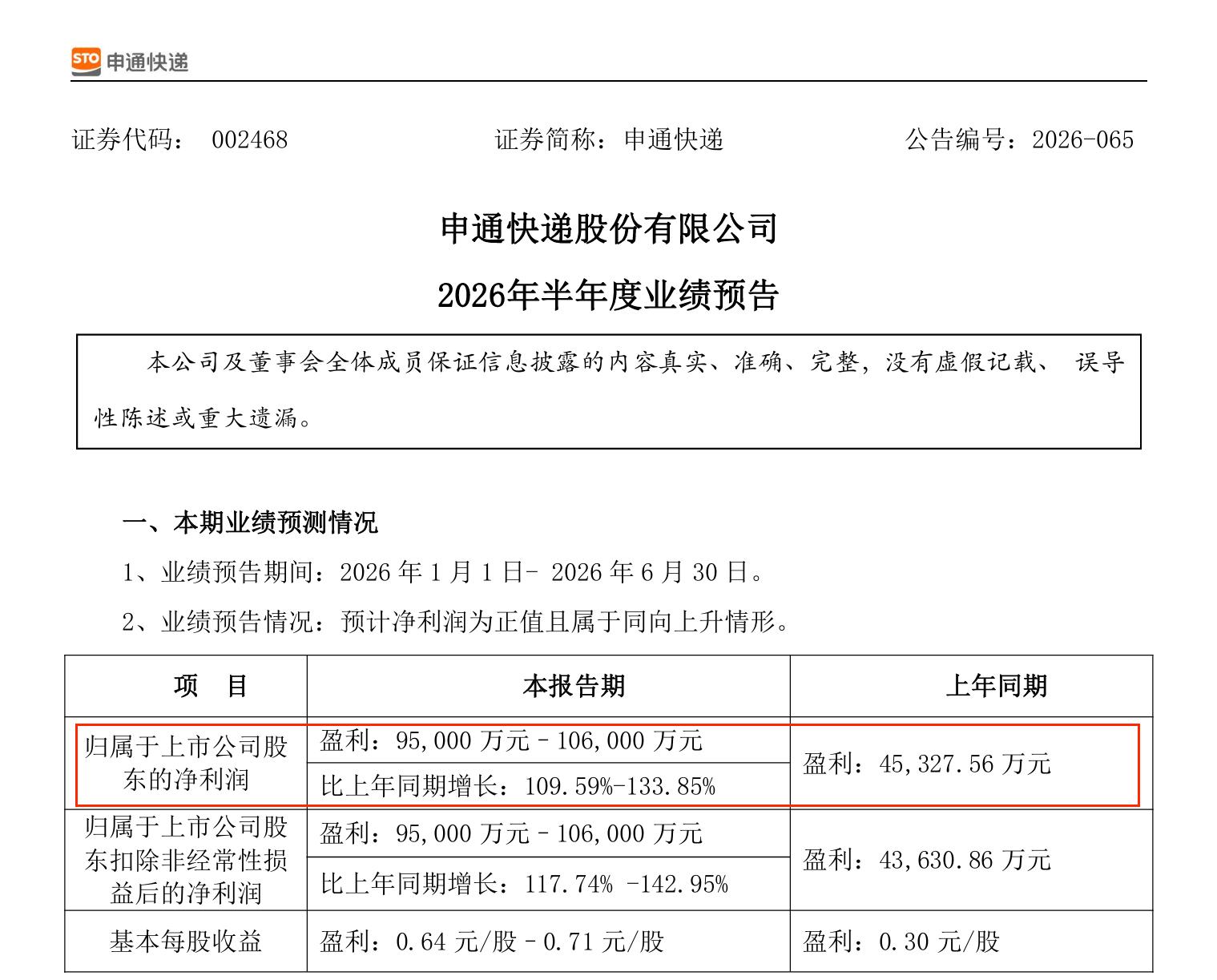
How did a company that was still losing money three years ago suddenly achieve doubled growth?
The first reason is the change in the overall industry environment.
Since 2025, regulatory authorities have continued to rectify the "involution-style" competition, and the price in the express delivery industry has finally returned to rationality. The entire industry no longer engages in endless price wars, and the revenue per parcel has stabilized and rebounded, which is the common foundation for the profit improvement of all Yuantong-series enterprises. In the first half of 2026, the total combined net profit of YTO, YUNDA, and STO is expected to exceed 4.955 billion yuan, and their non-net profit from core operations is higher than the net profit attributable to shareholders — the profits are generated from their main business, not supported by asset sales or government subsidies.
The second reason is STO's own moves.
In 2025, STO acquired Danniao Logistics for 362 million yuan to build a dual-network collaborative model of "franchise + direct sales". The "half-day delivery" coverage of Danniao has expanded to 40 cities, with a pick-up and sign-off punctuality rate of over 98%. From the perspective of Node Finance, this move fills the gap that STO has lacked for a long time, that is, the control over end-point performance. The common problem of the franchise system is that the headquarters cannot fully manage the outlets at the bottom. Danniao's direct sales network is equivalent to installing a set of capillaries that STO can directly command.
The third factor is the ecological empowerment from Alibaba. After Chen Xiaoying and her brother sold their shares to Alibaba for 14.6 billion yuan in 2019, STO has actually become part of Alibaba's logistics landscape. The stable inflow of e-commerce parcel traffic from Alibaba, coupled with the digital intelligent empowerment from Cainiao, has substantially improved STO's cost control per parcel and operational efficiency.
However, despite the good-looking performance, hidden dangers have not been eliminated.
The Halt of 30 Billion Yuan Financing and the Safety Storm
The day after the lawsuit withdrawal announcement, on August 4, the State Post Bureau announced that it had launched a filed investigation into STO Express. The reason is: since the beginning of this year, enterprises operating under the "STO Express" trademark have had frequent safety accidents and hidden dangers have been detected for many times. STO's headquarters is accused of lacking management over work safety of relevant enterprises and failing to implement unified safety management in accordance with regulations.
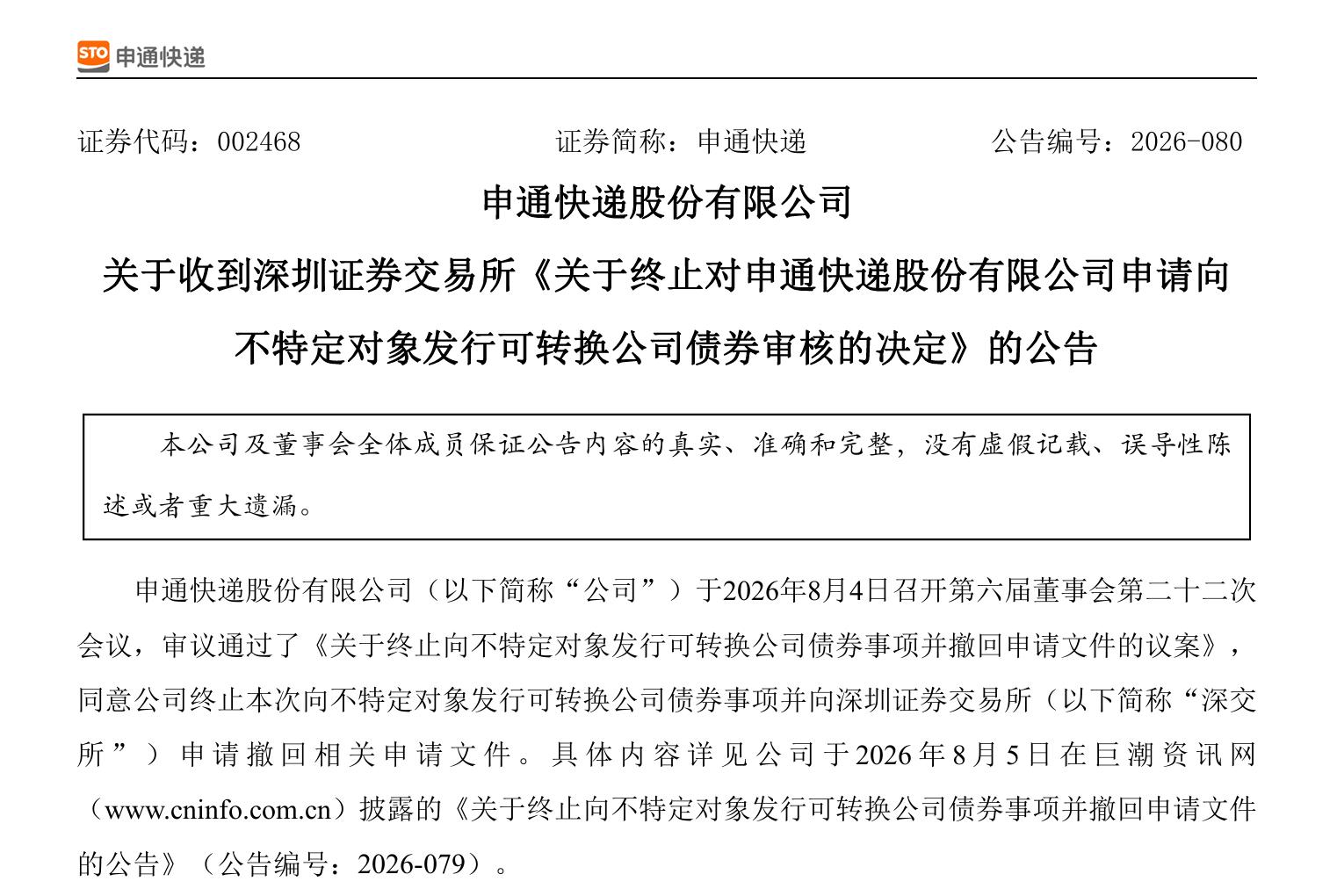
On the same day, STO announced that it would withdraw its application for convertible bonds, which had been planned for nearly five months and was intended to raise no more than 30 billion yuan.
What does the 30 billion yuan mean? It is the money STO invests in the future — used to expand production capacity, upgrade digital intelligence, and make up for the shortcomings of end-point operations. The suspension of this fund means that STO's medium and long-term strategic rhythm has been disrupted.
Industry insiders analyze that administrative penalties are usually aimed at specific violations. If it does not touch the red line of major illegal acts, in theory, it will not directly constitute an obstacle to issuance. However, "filed investigation" is different — it means that the regulatory authority has doubts about systematic risks or deep-seated compliance issues. Before the investigation conclusion is released, the review procedure cannot proceed.
STO being filed for investigation is not an isolated case.
In June 2026, J&T Express was filed for investigation by the State Post Bureau for the same problem; in March 2025, YUNDA's headquarters was also filed for investigation for similar problems; enterprises such as ZTO and YTO have been punished by local postal administrative departments for many times in recent years for end-point safety hazards and illegal delivery. The regulatory logic has been upgraded from "punishing outlets" to "pursuing the responsibility of headquarters" — in the past, the outlet that caused the accident would be punished, but now, the headquarters of the brand involved will be held accountable.
From the perspective of Node Finance, this transformation directly targets the vital weakness of the franchise system. Under the franchise system, the relationship between the headquarters and franchisees is a loose contractual relationship. The headquarters collects franchise fees and management fees, but the boundary of safety responsibility in daily operations is blurred. The regulatory requirement for the headquarters to implement "unified safety management" is equivalent to requiring STO to take overall responsibility for the work safety behaviors of tens of thousands of end outlets. For a franchise network that started with a "loose" management style, this is a structural challenge.
Let's go back to the 280 million-yuan lawsuit.
Xi Chunyang withdrew the lawsuit, but the old accounts have not been completely settled. What this lawsuit reveals is not just the property dispute between two people, but the historical legacy problem of the entire "Tonglu Faction" entrepreneurship model — enterprises, families, and relative networks are deeply intertwined. The equity distribution in the early years relied on personal relationships and trust, not legal documents. The faster the business develops, the more old hidden dangers are buried. This divorce lawsuit spanning 14 years may be just one of them.
The halt of the 30 billion yuan financing reveals the other side: the "looseness" of the franchise system in the stage of scale expansion has become a shortcoming in the stage of compliance governance. STO, which relied on the franchise system to expand across the country in the early years, may pay the price today because the network is not managed strictly enough — losing financing capacity, losing expansion rhythm, and losing the trust of regulatory authorities.
Interestingly, these two events happened almost at the same time. On the one hand, the historical hidden danger of family property rights broke out in the form of litigation and ended hastily, on the other hand, the compliance requirements of modern enterprise governance came head-on in the form of filed investigation. One looks backward and the other looks forward, but they point to the same root cause: STO's transformation from crude entrepreneurship to a standardized market is far from complete.
The doubled performance growth is certainly worthy of recognition. But when the impressive data is put together with long-term compliance hidden dangers, contradictions arise — the profits earned are real money, but the network under management is still the same "loose" network as in the past.
The real mid-game battle for STO is not to compete with YUNDA for market share, but to race against its 30 years of historical burdens. The 280 million-yuan old account can be withdrawn, and the 30 billion yuan financing can be suspended, but how to achieve high-quality development is still a threshold that STO has to cross.
The legend of Chen Xiaoying, who grew from a printing factory worker to a "express queen", has come to an end. She cashed out 14.6 billion yuan and left the scene, leaving a huge franchise empire to the capital market and professional managers. However, STO still has many remaining problems, which are not only the problems of this express enterprise, but also the challenges of the entire industry.