Is Tencent adopting the "horse racing" model or building an "Agent factory"?
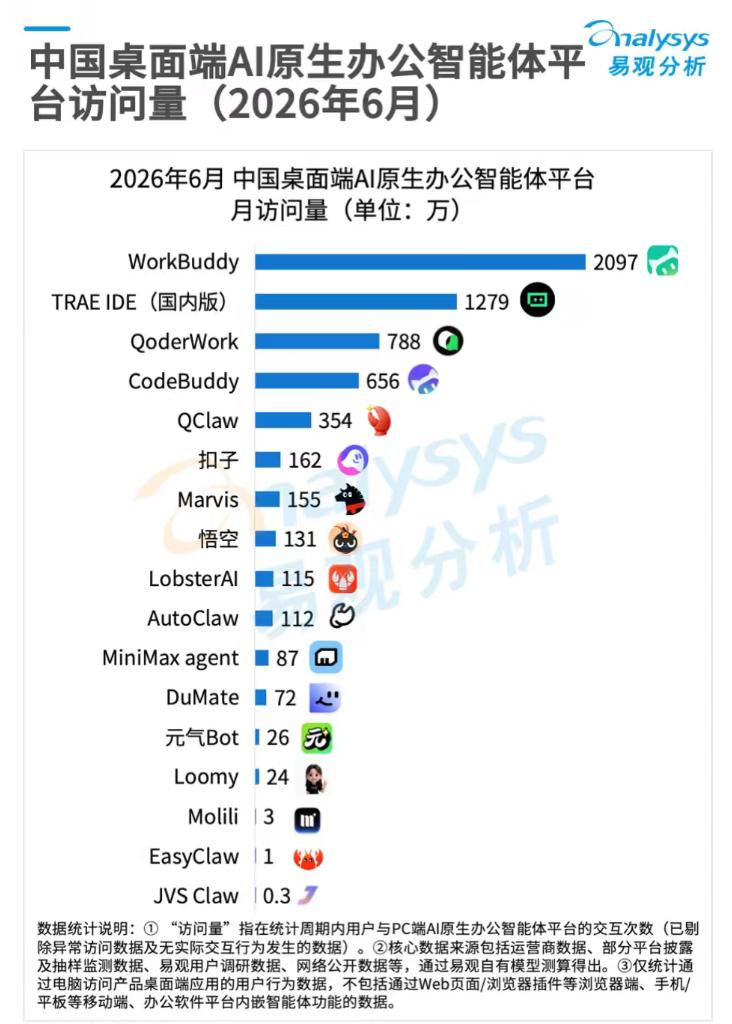
Recently, a list released by Analysys presents a rather special competitive landscape in China's desktop Agent market.
In June 2026, the total visits of 17 desktop AI-native office intelligent agents exceeded 60 million. Among them, WorkBuddy ranked first with 20.97 million visits, whose volume even surpassed the sum of the second and third places.
It is more noteworthy that Tencent has more than one product entering the top 10. CodeBuddy, QClaw and Marvis are also at the forefront of the list. They are not simple copies of the same product, but are oriented to different scenarios such as software R&D, local computer tasks and operating system-level interaction respectively.
A few months ago, companies were still competing fiercely around the Chatbot entrance. Before the smoke of gunpowder cleared, the focus of competition has quickly shifted to Agent.
ByteDance is gathering Agent capabilities to high-frequency entrances such as Doubao and Feishu. Alibaba is working to integrate a number of office Agents and adjust relevant organizations simultaneously. Both companies are trying to improve R&D efficiency by centralizing entrances and streamlining product boundaries.
Different from ByteDance and Alibaba, Tencent's Agents have not fully moved to a single entrance. WorkBuddy has achieved phased leadership in the office intelligent agent market, while CodeBuddy, QClaw and Marvis continue to develop in their corresponding task scenarios.
This is reminiscent of the "horse racing" mechanism commonly used by Tencent.
The premise of "horse racing" is that multiple products compete for the same entrance around the same demand. If Agent is not a single category but a basic product form in the AI era, then its entry into scenarios such as R&D and office respectively is not necessarily repeated investment, but more like a reshaping of experience in different scenarios.
What is really worth asking is: In what way is Tencent producing Agents?
1. How does a programming Agent grow into a product family?
In Tencent's AI ecosystem, an Agent product lineage named "Buddy" is gradually taking shape.
The original meaning of Buddy is "partner", which was originally just a product suffix in the name of CodeBuddy. In 2023, CodeBuddy, an AI code assistant, was launched in the form of IDE and began to be promoted and used inside Tencent. In the early stage, it mainly undertook auxiliary tasks such as code completion, technical Q&A and error diagnosis.
With the successive access of the software development intelligent agent Craft, as well as capabilities such as MCP, CLI, Skills and Agent SDK, CodeBuddy has been able to read projects, disassemble tasks, call tools, perform operations and verify results. It has gradually moved from "helping developers write code" to "independently completing R&D tasks".
What has been precipitated in this process is not only the code generation capability, but also a set of reusable Agent execution frameworks.
The reason why programming becomes the starting point is not accidental. Code libraries, terminals and testing systems provide Agent with an operable, feedback-enabled and verifiable environment; the code itself can be used to create new tools and workflows.
Therefore, Coding Agent can not only complete R&D tasks, but also participate in the production of other software and even other Agents.
Anthropic renamed Claude Code SDK to Claude Agent SDK, which follows a similar logic: the tool system, Agent Loop and context management mechanism that drive coding products can already be migrated to non-programming tasks such as research, content processing and personal assistants. The subsequently launched Cowork further brings similar execution methods into knowledge work.
The emergence of WorkBuddy verifies that the same migration is also taking place inside Tencent.
Tencent launched the WorkBuddy project in the fourth quarter of 2025 and officially released it in March 2026. According to the relevant person in charge of Tencent Cloud, the initial internal test version of WorkBuddy was built by a product manager with the help of CodeBuddy and the intelligent agent SDK over a weekend.
The significance of this detail lies not only in the development speed. CodeBuddy not only provides the execution capabilities that WorkBuddy depends on, but also directly participates in the production process of this product.
WorkBuddy retains the task orchestration, tool invocation and execution mechanisms precipitated by CodeBuddy, and then reorganizes Skills, tool interfaces and product interactions around office tasks. A programming Agent has thus grown into an office Agent.
This means that the common execution framework can not only be separated from the code environment, but also significantly reduce the cost of producing the next Agent.
Since then, this migration method has quickly become standardized.
DataBuddy, released in May 2026, is called by Tencent "the third member of the Buddy family". It inherits the Harness of WorkBuddy at the bottom layer, then injects Tencent Cloud's accumulated professional experience in the field of big data through Skills, and connects to business systems such as WeData and DLC, thus gaining capabilities in data analysis, data governance and data warehouse engineering.
From CodeBuddy to WorkBuddy, and then to DataBuddy, Tencent has gradually formed a set of formulas for producing vertical Agents:
Vertical Agent = General Harness + Professional Skills + Industry Knowledge + Business System + Delivery Interface
Harness is responsible for understanding tasks and organizing execution, Skills provide professional processes and judgment rules, and business systems enable Agents to take real actions.
The unit replicated by Buddy has also changed from a specific function to a complete set of post capabilities.
LearnBuddy, released in June, continues this idea. As "the first industry application of the Buddy family", it is built on the framework homologous to WorkBuddy, and then adds educational knowledge, scientific research Skills, multi-agent collaboration and long-term memory, so as to enter the scenarios of teaching, learning and scientific research.
This production method is not limited to products named Buddy.
Miora, a creative design intelligent agent created by the CodeBuddy and WorkBuddy teams, shares the underlying architecture with the two, and adds professional sub-agents for image, video, 3D and UI design, as well as Skills for creative work.
"AI Voyager+" is based on the WorkBuddy intelligent agent platform, superimposed with professional corpora of seven countries and 22 expert agents, forming a set of solutions for enterprises to expand overseas.
As a result, Buddy is no longer just a product suffix. It is becoming a product line in Tencent's Agent factory.
2. How do the model, cloud and application network make Tencent's "Agent Factory" operate?
However, a replicable product line is not enough to form a complete production system.
A more important change is that the verified capabilities in Buddy products are moving out of specific products, entering Tencent Cloud, and connecting with Tencent's existing application network.
The most direct signal is WorkBuddy Managed Agents. It is also built based on WorkBuddy Harness, encapsulates the task orchestration, memory and execution capabilities originally serving WorkBuddy into cloud services, and then combines with Tencent Cloud's computing power, sandbox, security and governance capabilities. Agents created by enterprise customers based on this can also be directly distributed to the WorkBuddy workspace.
This changes the original relationship between WorkBuddy and Tencent Cloud.
In the past, WorkBuddy was a product built on cloud infrastructure. Now, its Agent kernel verified in real scenarios is extracted again, becoming a public capability that other Agents can reuse.
The cloud generates products, and products feed back to the cloud. Tencent's Agent production system is gradually taking shape in such a cycle.
Tencent Cloud itself is also reorganizing around Agents.
In March 2026, Tencent Cloud released the full panorama of Agent products for the first time, integrating the originally scattered models, infrastructure, skills, applications and security capabilities into the same system. TokenHub uniformly accesses Hunyuan and third-party models, Agent Runtime provides a dedicated operating environment, and ADP (Tencent Cloud Agent Development Platform) covers the development, connection, operation and governance of Agents.
In this system, the model becomes an intelligently supplied option that Agents can flexibly choose, Runtime carries the execution of specific tasks, and the development platform further organizes knowledge, tools and business systems into available applications.
Two interconnected production paths have thus been formed inside Tencent.
One, represented by Buddy, encapsulates public capabilities into Agents that users can directly use; the other, represented by Agent Runtime, Managed Agents and ADP, transforms the Agent capabilities accumulated in products into infrastructure that enterprises and developers can call.
The former continuously brings real tasks and product feedback, while the latter continuously reduces the production and operation cost of new Agents. The two together form an "application-infrastructure" flywheel.
Looking at the whole industry, this is similar to Microsoft's idea of connecting enterprise tasks by relying on Copilot, Microsoft 365 and cloud platforms. But Tencent's realistic starting point is still different:
Microsoft has a highly unified productivity suite and enterprise software system; what Tencent faces is a huge product network with numerous entrances, which belong to different scenarios.
Therefore, Tencent did not simply replace all applications with one AI entrance, but tried to build a shared layer of Agent execution capabilities, so that originally independent products can gradually become components that Agents can understand, call and combine.
Tencent's original office and content products have also begun to become spaces where Agents understand tasks, call tools and deliver results.
Agent Suite takes WorkBuddy as the hub of the workbench, and connects Tencent Docs, Tencent Cloud Drive and Tencent LEXI through One ID. The "human-machine dual-writing" function launched by Tencent Docs is connected to the unified Agent kernel of WorkBuddy. AI no longer stays on the periphery of the editor to provide Q&A and suggestions, but directly enters the production process of documents, PPTs and spreadsheets.
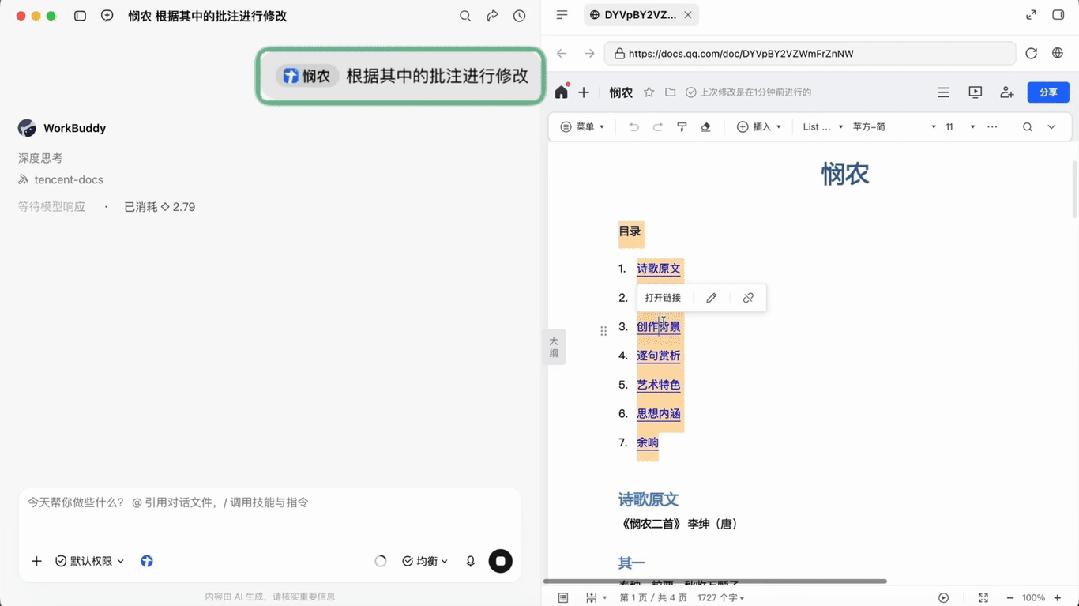
Schematic diagram of WorkBuddy's "human-machine dual-writing" function
Tencent Meeting, Tencent Cloud Drive and Tencent LEXI have also begun to enter the same task chain: the meeting generates discussion content and task information, WorkBuddy is responsible for subsequent execution, documents carry collaborative results, the cloud drive stores content assets, and LEXI then precipitates them into organizational knowledge.
Originally relatively independent office products have begun to re-divide their work around "how tasks are completed".
The roles of these products have also changed accordingly. Meeting minutes and project materials can become the context for Agents to understand tasks; document, search and storage capabilities can become tools called by Agents; office software itself becomes the interface for users to review, modify and receive results.
The software that Tencent previously provided to users separately is being transformed into capabilities that Agents can read, call and combine.
Similar connections also appear outside the Buddy system.
In June 2026, Yuanbao accessed the ima public knowledge base. Tencent Docs and WeChat Read are responsible for inputting content, ima undertakes knowledge precipitation and retrieval, Yuanbao can call the professional content in it, and WorkBuddy participates in data sorting and subsequent execution. The content and knowledge that were previously scattered in different applications have begun to flow with each other.
So far, a production cycle has taken shape.
Represented by Buddy is the product line, Tencent Cloud is the production base, and the application network is responsible for sending Agents into specific tasks. The three are connected to each other, jointly outlining the basic outline of Tencent's Agent factory.
3. Competition among large manufacturers for Agents begins to rely on competition in production systems
Agent is still in a stage of rapid change in product form. The competition at this stage is first a speed race for exploration efficiency.
What determines competitiveness is not only the ability to launch a successful product, but also the ability to verify different scenarios in parallel at low cost, quickly transform model and tool capabilities into products, and continuously adjust according to real usage feedback.
In the past six months, ByteDance has not launched a large number of independent Agents, but concentrated relevant capabilities into a few high-frequency entrances for iteration.
Doubao has expanded from a chat assistant to task mode and professional version subscription, constantly adjusting its interaction mode and task boundary; Feishu embeds Agents in existing scenarios such as group chats, multidimensional spreadsheets and enterprise knowledge. For ByteDance, Agent exploration mostly takes place inside the main product, and the basic unit of experimentation is new modes, functions and workflows.
Alibaba has launched relatively few independent products, and the recent focus is to further converge from the product architecture and organizational architecture.
QoderWork, MuleRun and Wukong have been integrated into Wenxin Office. This integration not only compresses redundant product and organizational boundaries, but also tries to make office Agents further connect to DingTalk and the commercial services within the Alibaba system.
Tencent has taken another approach.
It does not integrate all Agent capabilities into WorkBuddy, WeChat or Yuanbao, but focuses on building public capabilities such as model access, operating environment, task execution and security governance through Buddy AI, Agent Runtime, ADP and TokenHub; at the same time, businesses such as Tencent Docs and Tencent Meeting are still exploring the combination of Agents and their respective scenarios.
As a result, Tencent has formed a structure of "centralized base capabilities and decentralized scenario applications".
The unified base can reduce redundant construction and lower the startup cost of new Agents; teams scattered in various businesses can use the users, data and processes they master to improve the hit rate for specific scenarios.
If ByteDance in the mobile Internet era built a centralized "App Factory" by sharing algorithms, traffic distribution and growth systems, then Tencent is organizing a more decentralized Agent Factory.
The former replicates a complete product mechanism from content supply, user acquisition to commercialization; the latter replicates Agent execution capabilities such as Harness, Runtime and Skills. As for what problems specific products solve and how they are delivered, they are still defined by different business teams in their respective scenarios.
This difference also stems from the particularity of Agent itself.
Apps usually have relatively complete product boundaries, while Agents need to read business context, call tools and enter real processes. Data permissions, professional rules and delivery standards in different scenarios are difficult to be uniformly specified by a central team.
Therefore, the Agent factory can centrally build underlying capabilities, but must leave scenario exploration to the position closest to users.
What will be the final outcome of the Agent era? Will a super entrance absorb all scenarios, or will a group of professional Agents reorganize the software ecosystem?
Martin Lau, President of Tencent, compared the development of Agents to the evolution of the Internet at Tencent's Q1 2026 earnings call.
In the early days of the Internet, browsers and search engines used to act as strong entrances, but with the increase in the number of services, websites, applications and mobile products continued to differentiate. The large model market has shown similar characteristics. Different models are good at dialogue, coding and multimodal tasks respectively, open source and closed source models coexist for a long time, and a single model is not enough to meet all needs.
Agent may further strengthen this differentiation. Different companies and applications can have their own Agents, and Agents can select models, read files, call tools and connect business systems according to specific tasks.
What Tencent is betting on now is not necessarily a certain definite Agent form, but a set of mechanisms that can continuously generate, verify and screen products.
All martial arts in the world are invincible only by speed. When the answer is not clear, the speed of finding the answer becomes particularly important.
This article is from WeChat official account"Deep Flow Institute", author: Jiang Feng, published with authorization from 36Kr.