With a single subscription allotment at 75,000 yuan and a total valuation of 60.9 billion yuan, are institutional investors all scrambling to grab stakes in Unitree Robotics?
Yesterday, our group was still discussing Unitree Robotics' "Would you subscribe for a new share that costs 52,000 yuan?" Today the answer is out: it's not 52,000 yuan, but 75,400 yuan.
The latest issue price is out today, which is 150.80 yuan per share, with a valuation of 60.9 billion yuan and over-raised funds of 1.9 billion yuan. Institutions have pushed the price up by 45% from the estimated price.
The list below shows new shares with the highest single-subscription payment amount in the history of A-shares, which is essentially a fossil record of popular tracks.
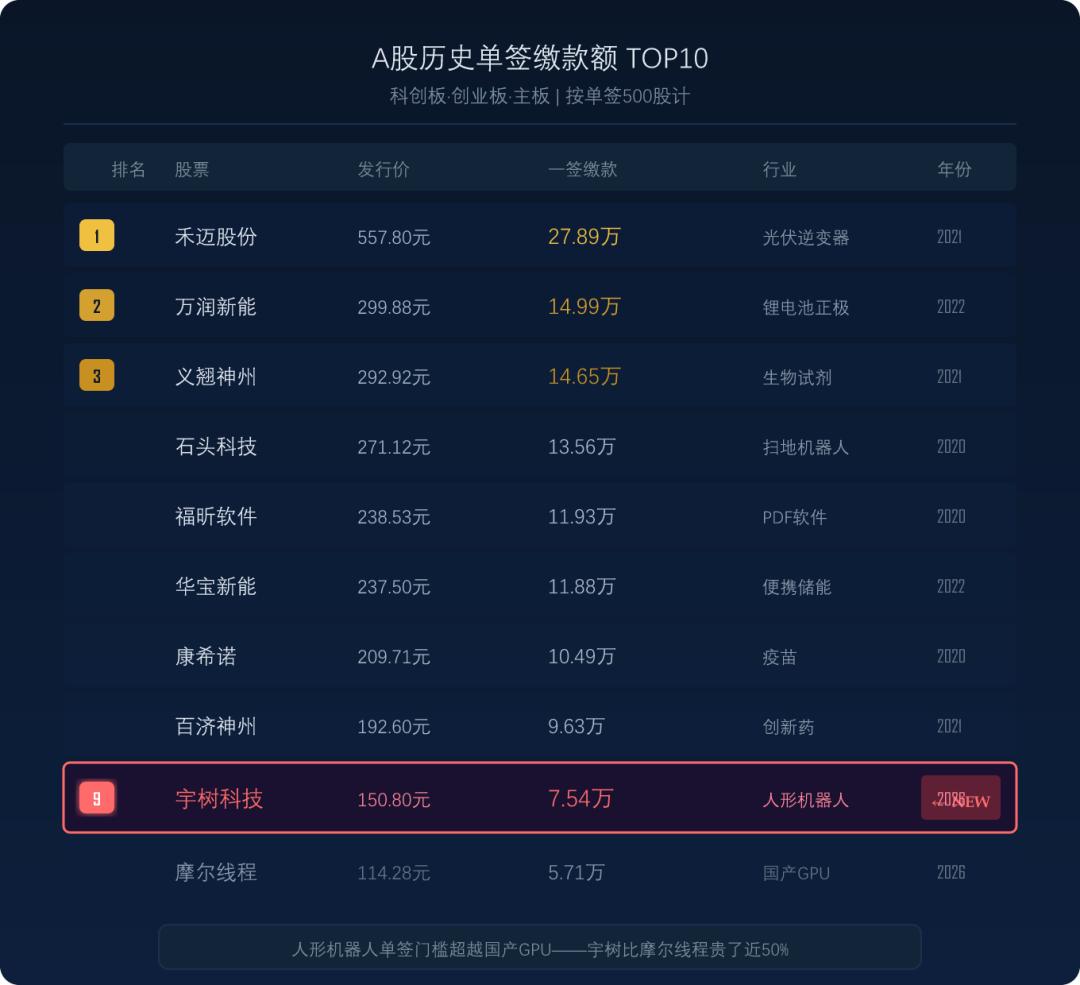
The companies on the list in 2020 are in the fields of sweeping robots, PDF software, and vaccines. In 2021, they are photovoltaic inverters, biological reagents, and innovative drugs. In 2022, they are lithium battery cathode materials and portable energy storage. The industry that appears on this list every year is the craziest belief of the A-share market that year.
In 2026, two new names are squeezed into the list: the 9th place is Unitree Robotics for humanoid robots, and the 10th place is Moore Threads for domestic GPUs.
The era of photovoltaics is over. The era of lithium batteries is over. The era of vaccines is over. In 2026, the most expensive ticket in the A-share market is marked with three words: humanoid robot.
This 75,400 yuan is not the cost of new share subscription. It is a vote of the times cast by the A-share market with real money. So why are humanoid robots worth this ticket? Let's break down five sets of figures to answer the questions one by one.
The first set of figures: 6 trillion
This is not the market value of Unitree. This is the market ceiling of the humanoid robot industry.
RBC Capital predicts that the global humanoid robot market will reach 9 trillion US dollars by 2050, of which the Chinese market accounts for more than 60%.
Goldman Sachs estimates that global shipments will reach 1.4 million units in 2035, with a market size of 38 billion to 152 billion US dollars.
Morgan Stanley is more aggressive, putting the figure at 322 billion US dollars in 2035.
According to Elon Musk, the market is worth 30 trillion US dollars, which is "the largest single technology market in human history." Of course, Musk often makes exaggerated remarks.
You may think these figures are too large and too far away. We can look at the forecasts of institutions. Morgan Stanley has raised its 2026 China shipment forecast twice: from 28,000 units at the beginning of the year to 50,000 units. It is estimated to reach 446,000 units in 2030, with a five-year compound annual growth rate of 106%.
Deutsche Bank gave a similar judgment: the global shipment will be close to 50,000 units in 2026, of which 40,000 units are from China.
What does 50,000 units mean? The global shipment was only 13,000 units in 2025. It quadruples in one year.
The second set of figures: 90% and +210%
Who is producing the world's humanoid robots?
In the first quarter of 2026, Chinese enterprises contributed 90% of the global shipment.
Up to now, Chinese enterprises have launched more than 300 humanoid robots, accounting for more than half of the global total. In the first quarter of 2026, China's robot exports increased by 210% year-on-year.
Behind this is China's unique supply chain advantages, with mature industrial chains of lithium batteries, micro motors and precision reducers. For a full set of Unitree G1 humanoid robot, the self-developing rate of core components exceeds 90%, and the cost of key parts such as motors, reducers and encoders is reduced to one third of that of imported parts.
U.S. companies cannot do this.
The current manufacturing cost of Tesla Optimus is between 50,000 and 100,000 US dollars, and its target selling price is 20,000 to 30,000 US dollars, while Unitree G1 has already achieved this target price (16,000 US dollars). The selling price of Figure AI's Figure 03 exceeds 50,000 US dollars, while the starting price of Unitree R1 Air is only 29,900 yuan.
It is not a technology gap, but a supply chain gap.
The third set of figures: 600,000 yuan, 99,000 yuan, 29,900 yuan
This is the price curve of Unitree Robotics' humanoid robots over the past three years.
In 2023, the first full-size humanoid robot H1 was priced at nearly 600,000 yuan. In 2024, the G1 was launched at 99,000 yuan. In 2026, the R1 Air was priced at 29,900 yuan.
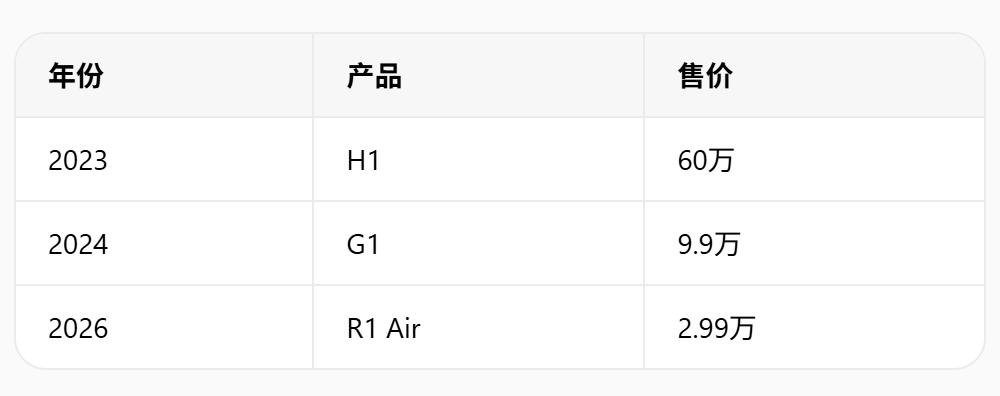
In three years, the price has been cut by 95%.
But what about the gross profit margin? In 2025, Unitree's overall gross profit margin was 60.27%. Its non-recurring net profit was 591 million yuan, and the non-recurring net profit margin was 34.77%.
A hardware company has launched a price war that even pushes prices below the cost line, yet its gross profit margin remains above 60% — this does not rely on a low-price strategy, but on full-stack self-development.
Unitree manufactures its own motors, reducers, LiDARs, and dexterous hands. The cost of purchasing external components only accounts for 14% to 18% of the total cost.
So it is wrong to simply regard it as a robot seller. This is a company that "develops and manufactures all key parts on its own, and assembles them into robots to sell to you as an extra step."
This model has been verified once in the quadruped robot market. From 2023 to 2025, Unitree's cumulative shipment of quadruped robots reached 33,000 units, with a global market share of about 60%, and the unit cost was halved from 22,300 yuan to 12,100 yuan.
The humanoid robot business is the second cycle of this flywheel.
The fourth set of figures: 57.7 billion yuan
This is the total investment in China's embodied intelligence sector as of May 2026, which has exceeded the total amount for the whole year of 2025.
According to data from IT Juzi, there were 218 investment events, with more than 10 individual financing events of 1 billion yuan or more. More than 70% of the financing flowed to enterprises at Series B and later stages.
Capital is concentrating on leading companies. Cao Wei, partner of BlueRun Ventures, judged that: "New entrants that develop general humanoid robot bodies can hardly get favor from capital. Once leading companies complete IPOs, second- and third-tier enterprises will face huge valuation pressure. They either become leaders, or be eliminated by history."
Unitree's this IPO is the first realization of this judgment.
In the strategic placement list, three parties, namely the National Social Security Fund, DeepSeek, and China National Petroleum Corporation, appear at the same time. The Social Security Fund represents national long-term capital, DeepSeek represents AI industrial capital, and CNPC represents traditional industry giants. It is no coincidence that these three types of capital bet on the same company at the same time.
They are not betting on Unitree alone. They are betting that the entire humanoid robot track will produce the No.1 player in China.
The fifth set of figures: 219 times
This figure must be mentioned separately. Because it is not only the sum of the above four sets of figures, but also the biggest risk of the whole thing.
Unitree's issuance P/E ratio is 219.23 times. The average P/E ratio of the same industry is 38.56 times.
It is 5.7 times higher.
What is the market using to price Unitree? It is not the 591 million yuan non-recurring profit in 2025, but the 446,000 units of shipment in 2030, the 1.4 million units of global market in 2035, and the possibility of "what if the 30 trillion US dollars market that Musk talked about is real?"
Is it dangerous? Yes, it is dangerous.
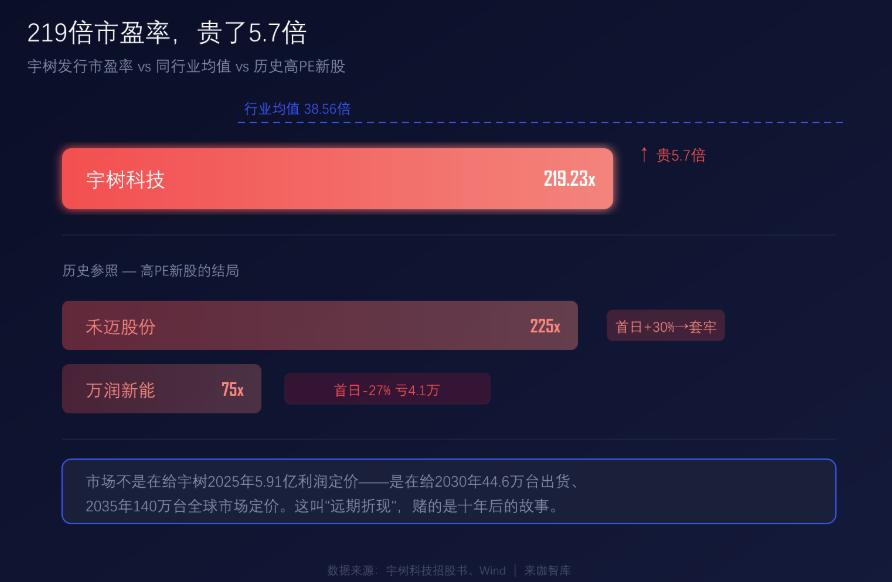
But the 219x P/E ratio can also be interpreted from another perspective: When everyone is valuing a company based on P/E ratio, it means the market does not fully believe in this story yet.
Real big opportunities are never measured by P/E ratio. In 2019, Tesla was still making losses, but its market value had already surpassed Ford. In 2020, BYD's non-recurring net profit was 2.9 billion yuan, and its market value once exceeded 1 trillion yuan. Looking back, the reason why people did not buy at that time was not that the valuation was too high, but that they did not dare to believe it.
The position where humanoid robots stand now is exactly the position where electric vehicles stood in 2019.
Whether you can understand the humanoid robot track is a major judgment.
Let's break it down:
Short term (2026-2027): 50,000 units of shipment, mass production of 10,000-unit level, Unitree's IPO, and the wave of IPOs of leading enterprises, which is the first capital pricing of "from 0 to 1". The fluctuation will be very large.
Medium term (2028-2030): 446,000 units of shipment, landing in real manufacturing scenarios, cost reduced to below 20,000 US dollars, which is the "from 1 to 10" stage. At this stage, the real winner will emerge.
Long term (2030-2035): 1.4 million to 2.6 million units of shipment, trillion-level market. By then, today's debate on whether 219x P/E ratio is too expensive will be just like the debate on whether BYD's 80x P/E ratio is too expensive in 2020.
What you spend 75,400 yuan on a new share of Unitree today is essentially betting on three things:
1. Can China's supply chain cost advantage continue to expand in mass production of 10,000-unit, 100,000-unit and 1 million-unit levels;
2. Can the path for humanoid robots to evolve from "scientific research toys" to "factory workers" be realized;
3. Can Unitree hold the first place amid the siege of Tesla, Figure AI, Agibot and UBTECH?
No one can guarantee these three things. But some facts are certain: Unitree is the only company in this track that has both full-stack self-development capabilities and has achieved 10,000-unit level mass production.
What the capital market fears most is not overvaluation, but missing out.
This article is from the WeChat Official Account "Laika Insight" (ID: laikazk), written by AA, and authorized to be released by 36Kr.