Private investment in the first half of 2026: the growth rate in the second quarter declined month by month, with the manufacturing sector registering the smallest decline.
In the first half of 2026, private investment fell by 8.5%, further widening the decline compared with last year (a 6.4% drop). Excluding real estate development investment, private investment decreased by 4.9%. Supported by the large-scale equipment upgrading policy, private investment in the manufacturing sector only dropped by 3.2%, and private investment in the secondary industry only decreased by 3.3%, both significantly lower than the decline of national investment.
Since April, the growth rate of national fixed asset investment has been declining month by month. The growth rates of state-owned investment and private investment have basically declined synchronously, with the growth rate of state-owned investment declining more significantly. The growth rates of budgetary funds and bonds supporting state-owned investment have also decreased synchronously. It is speculated that the reason for the slowdown in investment growth may be that the economic growth rate in the first quarter (5.0%) was higher than the full-year target (4.5%-5.0%), and the disturbance from the external environment was obvious. The macro-control has deliberately slowed down the pace of investment, which not only sets aside funds to support local governments in deleveraging, but also leaves room for investment to support economic growth when the subsequent net export or consumption growth slows down.
Although the growth rate of fixed asset investment has declined, the decline in the growth rate of net exports is even larger. Therefore, the contribution rate of net exports to economic growth decreased in the first half of the year, while consumption continued to remain in a sluggish state, and its contribution to economic growth also decreased slightly. Instead, the contribution rate of investment to economic growth rose to nearly 40%.
Net Exports Declined, Investment Passively Supported Nearly 40% of Economic Growth
In the first half of 2026, national fixed asset investment (excluding rural households) reached 22.637 trillion yuan, down 5.7% year on year. Due to the 1.5% increase in PPI, after deducting the impact of price factors, the year-on-year decline of national fixed asset investment is even larger. In the first half of the year, gross capital formation drove GDP growth by 1.7 percentage points, contributing about 37% to economic growth, an increase of more than 20 percentage points over last year.
The total retail sales of consumer goods increased by 1.3% year on year. Due to the 1.0% year-on-year increase in CPI, the actual growth rate of total retail sales of consumer goods is even lower, with almost no growth, far lower than the actual GDP growth rate (4.7%). Considering the total retail sales of consumer goods and services including services, the year-on-year growth rate was 2.7%, which is also far lower than the GDP growth rate. In the first half of the year, final consumption expenditure drove GDP growth by 2.1 percentage points, contributing about 45% to economic growth, a decrease of about 7 percentage points over the previous year.
The total import and export of goods reached 25.4686 trillion yuan, up 16.9% year on year. Among them, exports amounted to 14.7314 trillion yuan, up 13.4%; imports reached 10.7372 trillion yuan, up 22.1%. Affected by the substantial growth of import growth, net exports showed negative growth, down 4.7% year on year. In the first half of the year, net exports of goods and services drove GDP growth by 0.8 percentage points, contributing about 17% to economic growth, a decrease of more than 15 percentage points over last year.
Growth Rates of Private Investment and State-owned Investment Declined Month by Month Since April
In the first half of 2026, private fixed asset investment fell by 8.5% year on year, fixed asset investment of Hong Kong, Macao and Taiwan enterprises decreased by 7.9%, fixed asset investment of foreign enterprises dropped by 4.7%, and state-owned investment decreased by 2.3%. The actual funds in place for fixed asset investment fell by 10.0% in the first half of this year, but funds from bonds increased significantly by 19.1%, which is an important support for the growth rate of state-owned investment still being much higher than that of private investment.
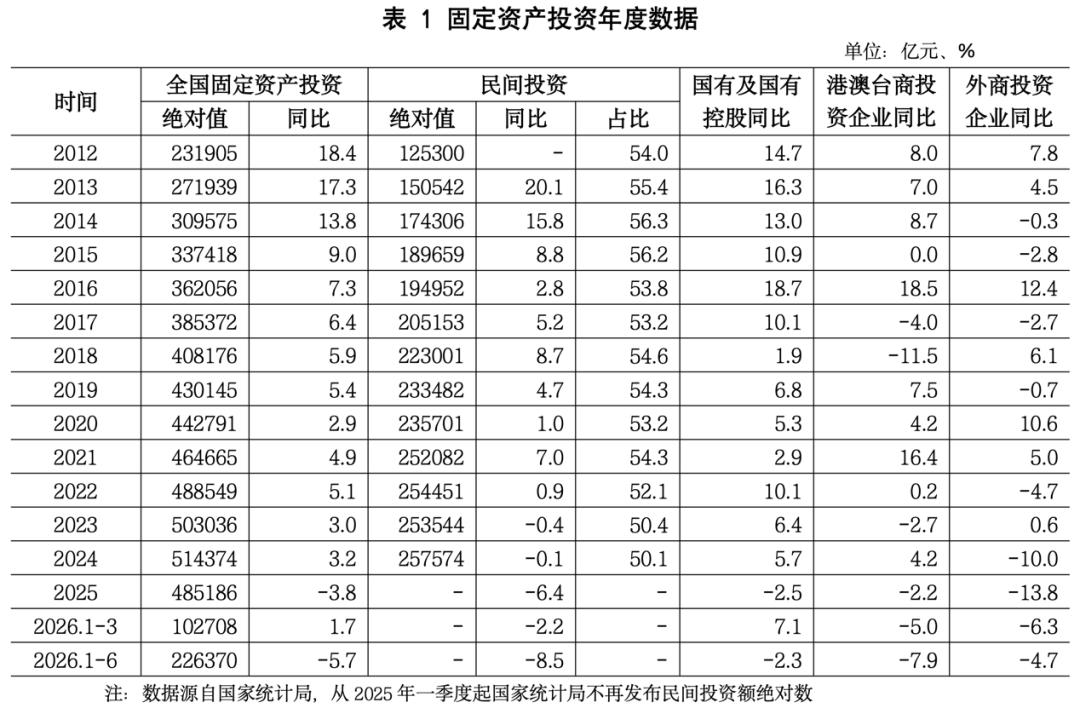
By region, investment in the eastern region decreased by 7.5% year on year, and real estate development investment fell by 18.2%; investment in the central region decreased by 4.9%, and real estate development investment dropped by 18.7%; investment in the western region fell by 8.0%, and real estate development investment decreased by 15.3%; investment in the northeast region dropped by 22.9%, and real estate development investment fell by 31.7%.
Since April, the growth rate of fixed asset investment has started to decline. The growth rate of private investment dropped from -2.2% in Jan-Mar to -8.5% in Jan-Jun, down 6.3 percentage points; the growth rate of real estate development investment fell from -11.2% to -18.0%, down 6.8 percentage points; the national investment growth rate dropped from 1.7% to -5.7%, down 7.4 percentage points; the growth rate of state-owned investment fell from 7.1% to -2.3%, down 9.4 percentage points; the growth rate of Hong Kong, Macao and Taiwan investment dropped from -5.0% to -7.9%, down 2.9 percentage points; the growth rate of foreign investment rose by 1.6 percentage points, from -6.3% to -4.7%. The state-owned sector, which accounts for the largest proportion of national fixed asset investment, has the fastest decline in investment growth rate, which is the main factor for the slowdown in investment growth. It is estimated that the macro-control has deliberately slowed down the investment pace of the state-owned sector.
The change in the growth rate of actual funds in place for fixed asset investment can indirectly verify the speculation that the month-by-month slowdown of fixed asset investment growth since April this year is a deliberate move of macro-control. As one of the most important fund sources supporting state-owned sector investment, the year-on-year growth rate of state budget funds and bonds has dropped significantly since April. Among them, the growth rate of state budget funds fell from 2.5% in Jan-Mar to -8.8% in Jan-Jun, down 11.3 percentage points; the growth rate of bonds dropped from 40.0% in Jan-Mar to 19.1% in Jan-Jun, down 20.9 percentage points.
Supported by Large-scale Equipment Upgrading Policy, Private Investment in Manufacturing Has the Smallest Decline
By industry, investment in the primary industry reached 460 billion yuan, up 0.9% year on year, while private investment in the primary industry fell by 9.0%; investment in the secondary industry reached 8.312 trillion yuan, down 1.1%, while private investment in the secondary industry decreased by 3.3%; investment in the tertiary industry reached 13.8649 trillion yuan, down 8.4%, while private investment in the tertiary industry dropped by 12.8%.
In the first half of the year, national real estate development investment reached 3.8074 trillion yuan, down 18.0% year on year. Among them, residential investment amounted to 2.93 trillion yuan, down 17.8%. The ratio of real estate development investment to national fixed asset investment has dropped from 30% at the peak to 16.8%. Excluding real estate development investment, national fixed asset investment fell by 2.7%, and private investment decreased by 4.9%.
The large-scale equipment upgrading policy has promoted investment in equipment purchase to maintain a good growth momentum. In the first half of the year, investment in the purchase of equipment, tools and appliances increased by 8.1% year on year, driving the total investment to grow by 1.3 percentage points; accounting for 18.2% of the total investment, 2.3 percentage points higher than the same period of the previous year. Benefiting from this, manufacturing investment only fell by 1.2%, equipment manufacturing investment bucked the trend and increased by 1.7%, and private investment in manufacturing decreased by 3.2%, all of which are much lower than the decline of national investment.
Among all major sectors of the manufacturing industry, private investment in the manufacturing of railway, ship, aerospace and other transportation equipment increased by 16.9%, private investment in the manufacturing of general equipment rose by 1.8%, and private investment in the manufacturing of computer, communication and other electronic equipment increased by 1.7%.
In the first half of the year, infrastructure investment (including the production and supply of electricity, heat, gas and water) decreased by 2.4% year on year, of which investment in the production and supply of electricity, heat, gas and water fell by 2.7%, and private investment in the production and supply of electricity, heat, gas and water decreased by 3.5%.
(The author is a senior researcher at Beijing Dacheng Enterprise Research Institute)
This article is from the WeChat official account "Economic Observer", written by Liu Guizhe, and published with authorization from 36Kr.