Don't let co-managed funds turn into blind boxes
Over the past six months, Ge Lan, Liu Yanchun and Zhang Kun, the three once top star public offering active equity fund managers, have successively announced adjustments to the funds under their management, which to a large extent marks the official ebb of the previous generation of star fund managers.
In April, Ge Lan stepped down from the last non-medical industry themed fund under her management, refocusing her investment vision on the medical field that she excels at.
If this kind of focus to some extent shows that fund managers face difficulties in expanding their capability circles even on large platforms, the subsequent announcements of additional fund managers for the funds managed by Liu Yanchun and Zhang Kun indicate that in the context of public offering funds, strictly staying within the capability circle is not necessarily a long-term solution.
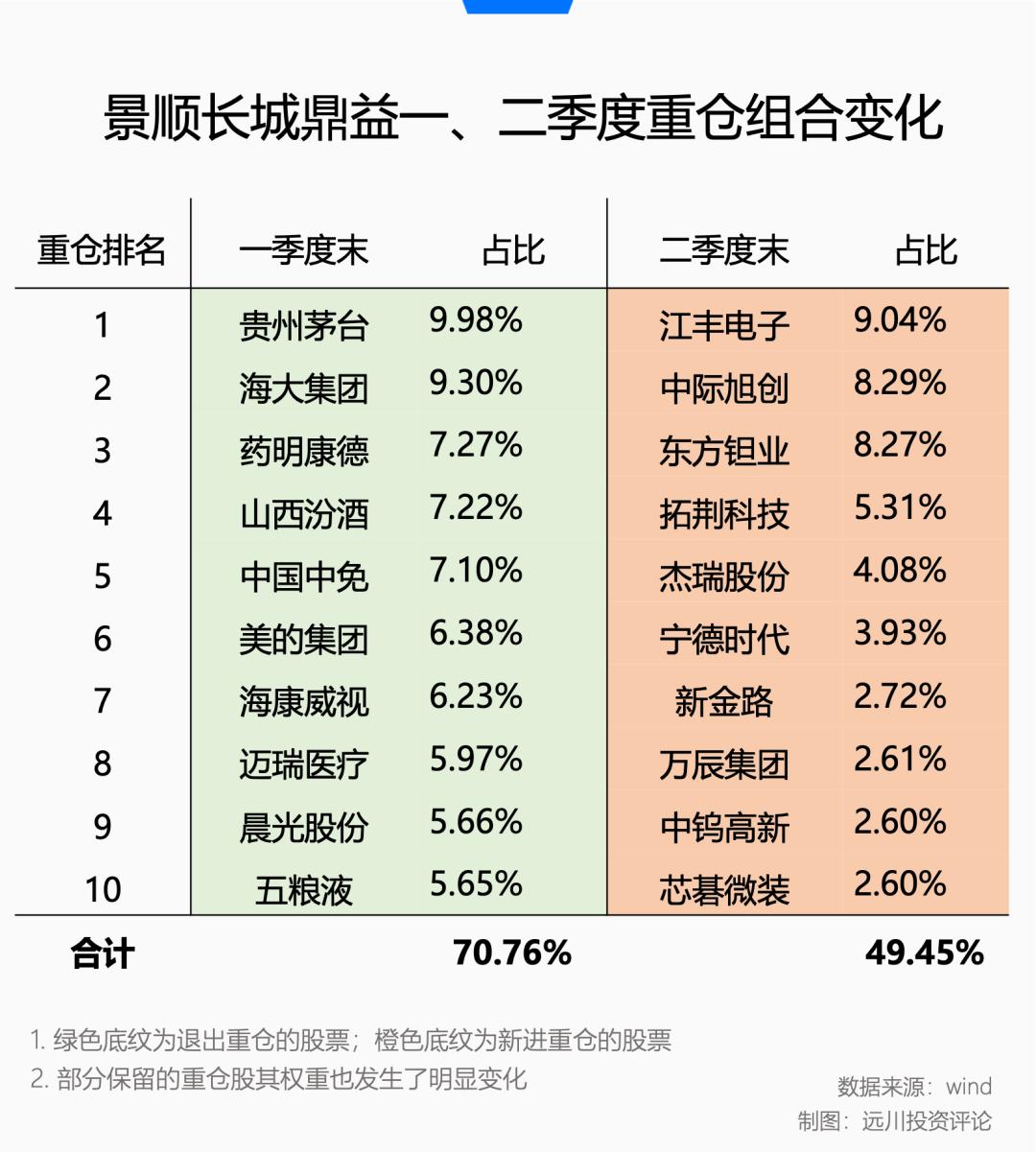
In May, the four products managed by Liu Yanchun successively added new fund managers. The most representative Invesco Great Wall Dingyi, shortly after Ke Haidong joined for co-management, completed an almost complete reshuffle, with its heavy position portfolio fully shifting from the large consumption sector that it stuck to in the first quarter to the pan-technology sector by the end of the second quarter.
At the end of June, the only fund managed independently by Zhang Kun was E Fund Asia Select, while most of his other products also adopted the multi-fund manager co-management mode. For E Fund Blue Chip Select, the largest product under his management, after adding He Yicheng and Yang Siliang as co-managers, the concentration of positions in liquor, internet and pharmaceutical sectors decreased significantly, while the presence of the AI industry chain in the portfolio rose notably.
Speaking of which, the three top star fund managers are all public offering stars whose management scale once reached the 100 billion level, but they have all been somewhat helpless in the past few years.
Under the gaze of millions of people, they obviously will not casually go out to participate in those lively "Las Vegas-style research trips", but even if they only want to stick to their own familiar business, they cannot control how long they can hold the steering wheel in their own hands.
Facing the remaining hundreds of billions of management scale, and the general environment where it is no longer as easy to raise funds for active equity products as before, distributing money to more fund managers has become an increasingly common phenomenon in the industry. In particular, multi-fund manager co-management has become a common practice for the industry to transform existing large-scale products.
However, the fate of a fund certainly depends on the efforts of the fund managers, but also has to take the historical process into account.
The July storm in the capital market is like a huge karmic retribution, which abruptly advances the reform effects that should have been tested and evaluated over time.
The July Storm
The global AI market correction in July was a textbook-level "lesson for all market participants", and no one across the Pacific Rim was spared.
Leopold, the 24-year-old "AI prophet" in Silicon Valley, made a 439% profit in half a year, but after his leveraged position was liquidated, he was forced to sell his $16 billion position to the veteran Ken Griffin, and the whole process took less than a month; in South Korea, after the hasty launch of individual stock ETFs triggered a chain reaction in the deleveraging market, the current plot has advanced to the stage of holding relevant civil servants accountable.
However, these can be regarded as the same source of profit and loss: they first built a towering building, and then witnessed its collapse. In the unescapable deep correction of the A-share tech bull market, there are even more stories of worse luck.
After experiencing the exciting second quarter, the Sci-Tech Innovation 50 Index immediately fell by 25.90% in July, posting the largest monthly drop on record. The ChiNext Index also reversed from a 7.55% rise to a 23% fall, with its pullback second only to the circuit breaker period in January 2016.
Especially in mid-July, the correction intensified, overlapping with the intensive disclosure window of the second quarterly reports of public offering funds. Fund investors received the heavy position portfolio that kept performing well in the last quarter with one hand, and swiped the fund net value that was plummeting sharply with the other.
Several major funds that had just undergone personnel changes had not yet fully taken over the management, when their net value curves turned 180 degrees.
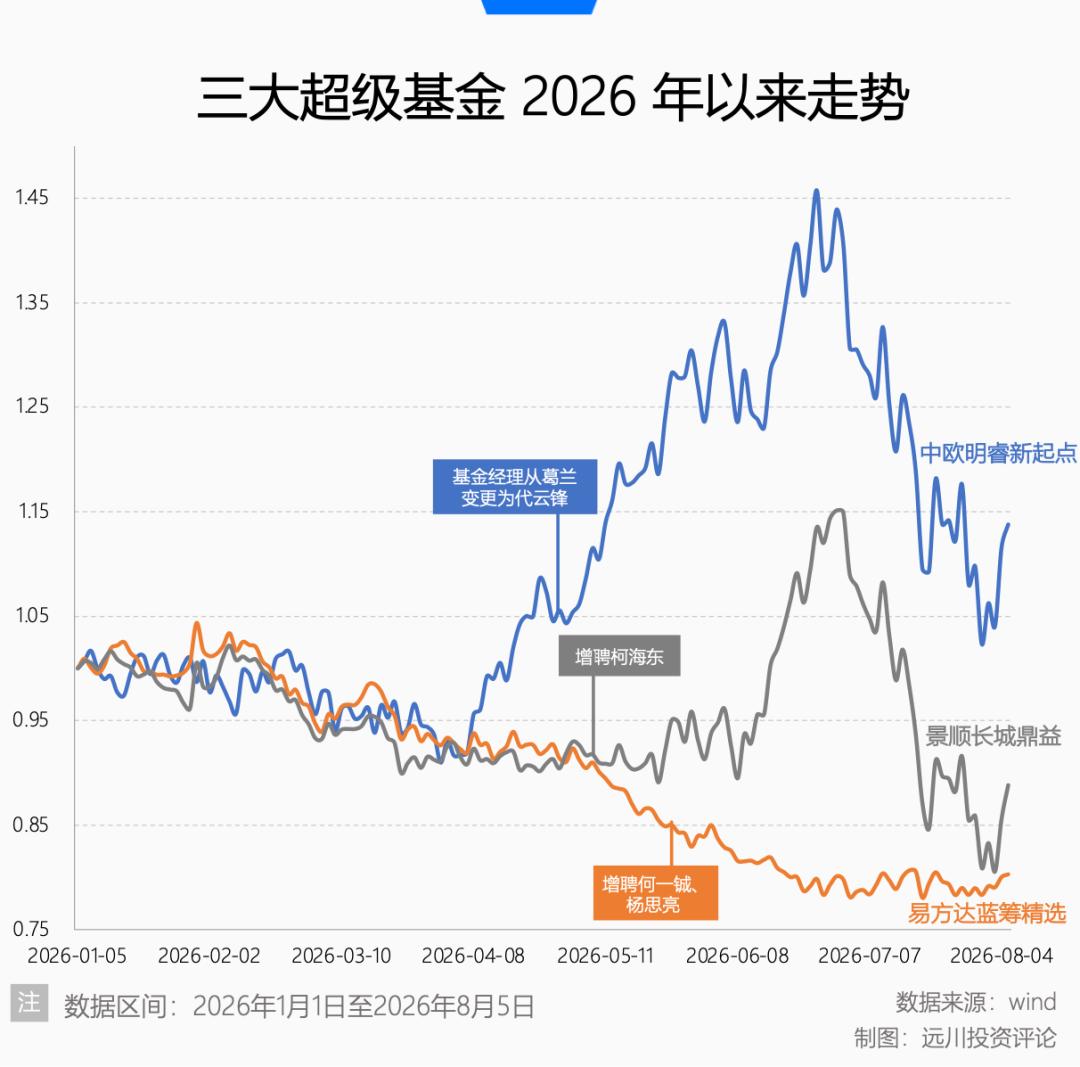
The pullback of China Europe Smart New Start is very clear.
Dai Yunfeng is a fund manager with a background in the technology industry after all. After taking over this fund whose portfolio allocation was already biased towards technology manufacturing, he further continued his idea of industrial allocation and increased the proportion of technology assets in the portfolio. Although this led to a 26% pullback of the net value in one month, the fund still maintained a positive return for the year because it had earned profits from this round of tech rally earlier.
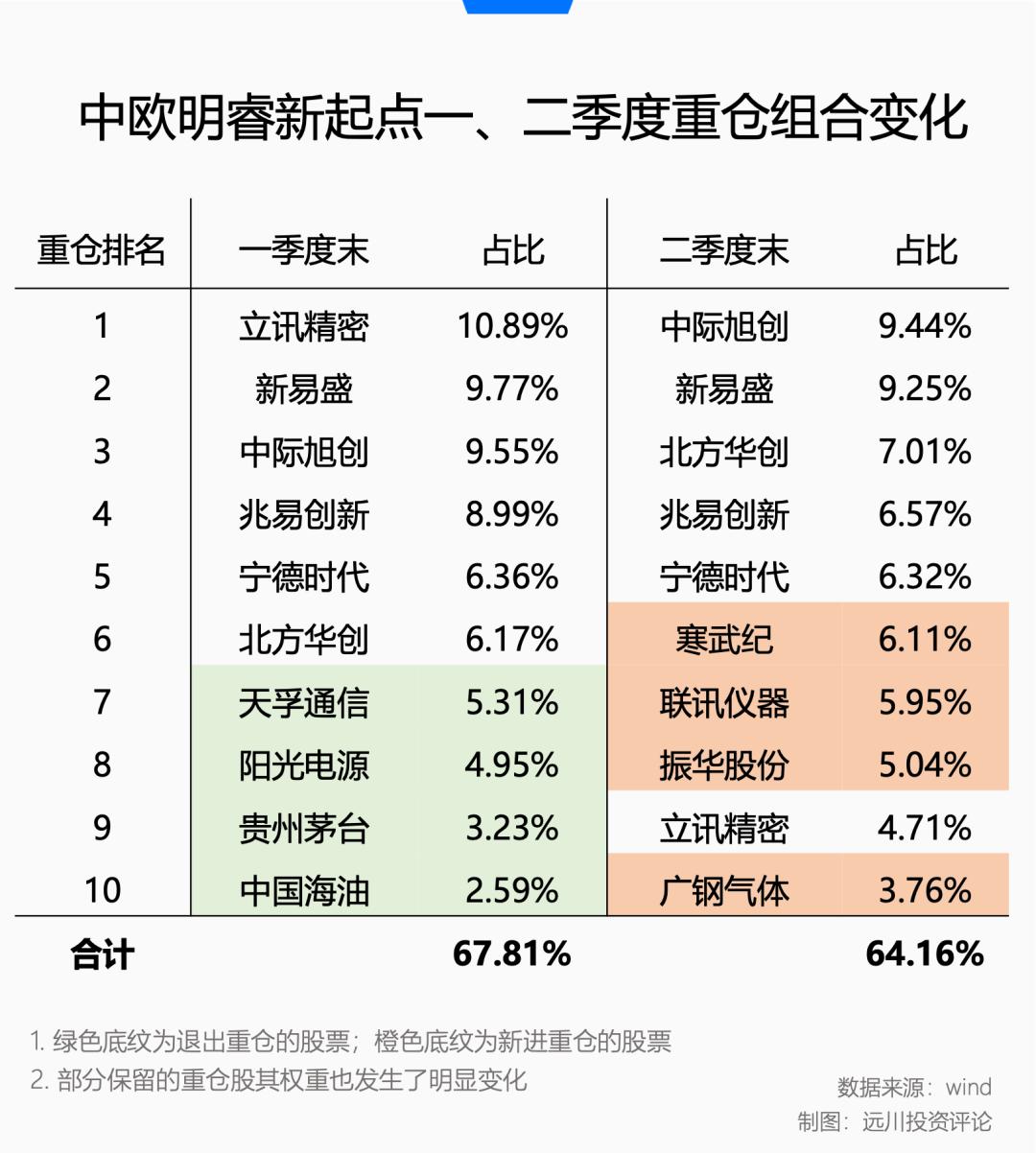
The Invesco Great Wall Dingyi, which switched its investment track halfway, is in a rather indescribable situation.
After adding Ke Haidong with a technology background as co-manager, the heavy position portfolio of Invesco Great Wall Dingyi was completely reshuffled. It once recovered the pullback of more than the past two months in one go in June. But the good times did not last long. In July, the fund immediately entered a free fall along with the correction of tech stocks, not only falling 27.65% in a single month and drawing a very sharp downward curve, but also its net value once hit a new low since the "9·24" market.
In just two months, a hesitation of the holders turned out to be nothing but empty joy.
The situation of E Fund Blue Chip Select is more complicated.
Compared with the turmoil of the first two funds in the July tech storm, E Fund Blue Chip Select only fell 1% in July, which seemed quite calm by contrast. But under the calm net value fluctuation, undercurrents are surging.
Judging from the changes in the second quarter, although E Fund Blue Chip Select retained the allocation of liquor, consumer, internet and pharmaceutical sectors, the long-term favorite stocks of Zhang Kun saw a visible sharp drop in concentration. Meanwhile, the allocation of electronics, communications, public utilities, transportation and non-ferrous metal sectors increased, and companies not typical of Zhang Kun's past holdings such as SMIC and Dongshan Precision entered the top ten heavy position portfolio for the first time.
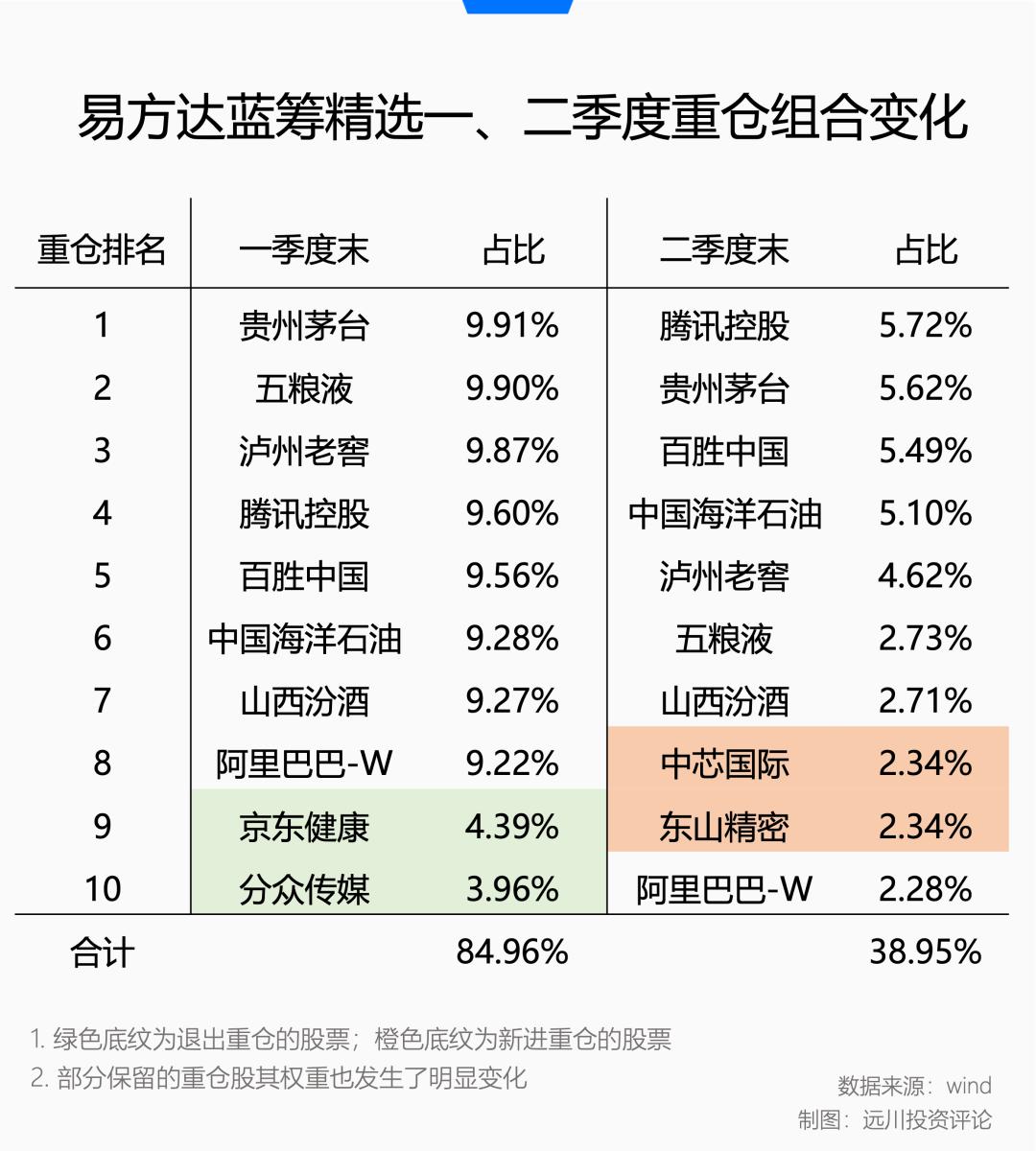
As a result, E Fund Blue Chip Select has also entered a stage that is difficult to define.
Questions from holders have frequently appeared on social media: To what extent does Zhang Kun still have decision-making power over the entire portfolio? Who makes the final decision on the newly added technology positions? Do the three fund managers discuss together and manage separately, or divide responsibilities by industry? Is the ratio of consumption to technology a long-term framework, or a temporary portfolio in the early stage of co-management?
Volatility or non-volatility is only temporary. The real important issue is that when an active equity fund has permanently changed its decision-making structure, fund investors have the right to know what exactly they are holding now.
The key point is that this is not only a problem faced by E Fund Blue Chip Select.
The Blind Box of Co-management
The extreme market in July may not be suitable for drawing a final conclusion on this round of fund manager changes, but it has to a large extent exposed that there are too many unspecified details in the process of public offering active equity funds transforming from "individual star building" to "team platformization".
According to Wind data as of August 5, after merging different share classes, among the 14,399 open-end public offering funds in the whole market, 3,686 funds are managed by two or more fund managers, accounting for more than a quarter.
It can be seen that buying a "co-management product" in public offering funds is no longer a small probability event. But even for co-management, the internal decision-making structure can be vastly different.
It can be a senior mentor leading a junior apprentice, where the new member is mainly responsible for research tracking and auxiliary trading; it can also be a mode where fund managers divide work by industry or asset class, each taking charge of their own part; it can also be a mode where all managers make top-down position allocation judgments together, and then execute trading operations respectively.
In addition, there are some more subtle situations. For example, the old fund manager only stays on the management list temporarily, waiting for an unspecified handover to complete before officially announcing his resignation — for example, Zhao Yi co-managed the fund with his successor for 139 days before leaving, Qiu Dongrong for 68 days, and Gao Nan for only 45 days. By 2026, the last additional appointment of Ren Xiangdong was only 9 days before his departure.
But no matter what the situation is, in the fund announcement, they are often expressed in the same way: the fund adds a new fund manager, who will co-manage the fund with the original fund manager.
From the perspective of industry development, this logic is not difficult to understand.
Relying on the traffic of one star fund manager can easily lead to partial out-of-control of management scale, and also easily create huge single-point risks when personnel leave or investment style fails. Assigning macro, consumer, technology and cyclical research to different people, or making stock and bond teams perform their respective duties, so that fund managers can cooperate in their own capability circles, can theoretically guarantee the lower limit of a fund's performance.
But the problem is that fund investors can often see the complete employment history of the newly added fund manager, and analyze his capability circle and investment style. However, what impact multi-person co-management will have on the subsequent investment management of the fund is often a blind box with completely asymmetric information.
If the management is divided by industry, how to determine the weight of different industries and how to make dynamic adjustments; if it is collective decision-making, who holds the final vote when several fund managers have disagreements is very important; if the co-management is to prepare for the departure of the original manager, then the holders are actually facing a huge change without sufficient information.
These ambiguous areas are where the co-management mode is most likely to trigger disputes.
When the decision-making mechanism of a fund changes, what the holders often get is only a single additional appointment announcement. As for who dominates the portfolio, how to distribute permissions, whether the original strategy continues, and whether the risk-return characteristics of the product have completely changed, these issues are often impossible to prove or falsify.
When the industry has reached the stage of co-management, fund companies hope that investors will shift from "trusting star fund managers" to "trusting strategies and team building", so as to keep the management scale on the platform.
This transfer of trust is conditional. What is tested is not the personal ability of the fund manager, but the governance ability and external communication level of the fund company.
Ideally, a strong public offering platform should also provide more information for fund investors, and at least clearly answer: Why implement co-management? How is co-management specifically implemented?
But in the real world, fund companies often regard these key details as internal investment research processes, or even organizational secrets, and there are always compliance rules and regulations restricting these information from being fully disclosed to the outside world.
As a result, in the eyes of holders, when the number of fund managers increases from one to three or even five, but there is no sufficient information disclosure to help them redefine and understand the characteristics of the fund, the co-management fund itself becomes a super blind box with uncertain performance attribution, possible style drift, and potential manager departure risk.
Epilogue
Co-management funds are not a monster to be feared.
When public offering funds bid farewell to the era of expanding scale by relying on star traffic, and move from personalized capability to platform-based investment research, co-management is almost an inevitable trend.
It is just that team-based management has also changed the competition mode of public offering active equity funds.
The past star fund manager mode had many problems, and its success or failure was attributed to a relatively clear but simple and crude logic: if the performance is excellent, the manager is a god; if the net value drops sharply, the manager is incompetent.
Just like tennis matches, for every ball Zheng Qinwen hits, no matter the impact of injury or coach, the audience only cares about her own competitive state and the final result, and the applause and boos all fall on her alone.
After adopting co-management, the active equity arena has turned into a football field.
It is difficult to attribute the win or loss to a single factor: sometimes the striker wastes opportunities, sometimes the midfield loses control, sometimes the coach arranges the wrong formation, sometimes the team lacks running-in, and sometimes the referee is not fair enough.
The difference is that for football fans, a football match is open and transparent, but fund announcements usually only announce the list of players. As for who is the coach arranging the formation, whether the tactic is to park the bus for extreme defense or let even the goalkeeper join the all-in attack, the audience has no way to know.
All of this makes the co-management funds, which are already difficult to attribute, become more ambiguous and unrecognizable.
De-starring does not mean de-responsibility. How the team system and large platforms can truly obtain the support and trust of fund investors is a new topic for public offering funds.
The post-2000s generation popularly uses the term "Odyssey period" to describe the confusion in the 10-year transition period of their lives from 20 to 30 years old — "It seems that no matter what you do, you are losing another kind of life. It seems that you have made many choices, but you never really seem to arrive anywhere [4]."
China's public offering funds, which are about to usher in their 30th anniversary, are also in their own Odyssey period — the industry is no longer young, but it still has to re-answer the question of "what exactly professional institutions and fiduciary responsibility mean".
References
[1] Facing the sudden addition of new fund managers, how should investors accurately "decode" this operation? Morningstar China
[2] From 2000% return to liquidation, the "AI stock god" was defeated, and the "biggest myth" of this bull market came to an end! Wall Street CN
[3] Research trips or hanging around in casinos and nightclubs, who pays for the overseas trips of clustered fund managers, Caixin Finance
[4] Odyssey Period: Life Experiments, Wandering and Self-Reconciliation for People in Their 20s, @Orange Yicheng