What exactly happened behind Google's sweeping reshuffle in its AI division?
On August 5, Google saw two key personnel changes at the same time.
On one hand, there was a leadership reshuffle at Google DeepMind (hereinafter referred to as GDM).
Demis Hassabis, the AI scientist who led DeepMind to create landmark achievements including AlphaGo and AlphaFold, will no longer be responsible for GDM's daily operations, officially stepping back to serve as Chairman of GDM and Chief Scientist of Alphabet.
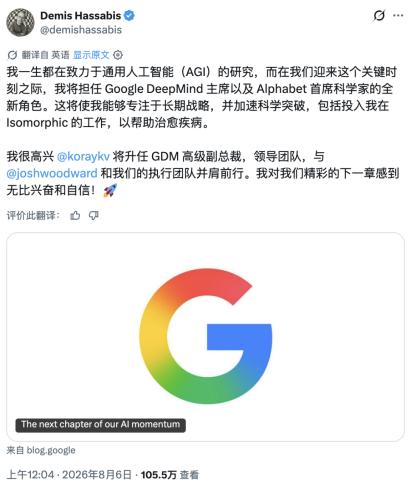
Taking over DeepMind's daily operations is Koray Kavukcuoglu, who previously served as DeepMind CTO and Google's Chief AI Architect.
On the other hand, Jeff Dean, who has worked at Google for nearly 27 years, announced his departure from the company.
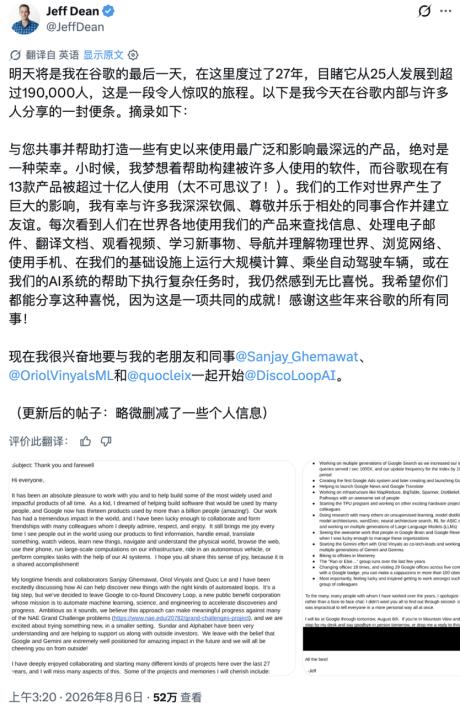
He is leaving along with Sanjay Ghemawat, Quoc Le and Oriol Vinyals.
They have participated in key projects including Google's distributed infrastructure, Google Brain, Gemini and AlphaStar respectively, and are important builders of Google's AI landscape over the past two decades.
Now, they will jointly establish Discovery Loop, a new public-benefit AI corporation.
On the day the news was announced, Alphabet's share price closed down by about 4%.
In just one day, Google's AI landscape has undergone tremendous changes, right at the critical stage when Google is trying to accelerate its AI competition: Gemini 3.5 Pro has been delayed for a long time, key talents have left one after another, and even CEO Sundar Pichai admitted that Google is indeed relatively backward in some fields.
When on earth will the report card representing Google's model capabilities be handed in?
What is more noteworthy than model capabilities is: at the most intense moment of AI competition, why did a group of people who once participated in building Google's AI landscape choose to leave this giant with the advantages of DeepMind, TPU, search and cloud business, and start a new AI company from scratch?
What on earth is happening inside Google?
Under the pressure of Gemini, Google is struggling to hold on
What Google has the most abundant of is AI research capability.
From DeepMind's AlphaGo and AlphaFold, to the deep learning research promoted by Google Brain, and to the computing power foundation brought by self-developed TPU, Google has long been recognized as one of the companies with the strongest AI technology reserves in the world.
However, in the generative AI era, AI competition has evolved from technical contests in laboratories to competition of model iteration, product implementation and commercialization speed.
Gemini is Google's most important counterattack in the generative AI era.
In December 2023, Google officially launched the Gemini series of models. At that time, it had been exactly one year since ChatGPT ignited the generative AI wave.
With years of accumulation from DeepMind and Google Brain, Gemini was highly expected from the very beginning.
The test results released by Google at that time showed that the flagship model Gemini Ultra outperformed GPT-4 in multiple benchmark tests. Although some of the test methods were later questioned, this launch still proved to the market that Google had not been left behind by OpenAI.
Subsequent model iterations once amplified this expectation.
Gemini 2.5 Pro released in 2025 made the public see Google's competitiveness in large models again. With stronger capabilities in reasoning, long context and coding, Gemini 2.5 Pro delivered excellent performance in multiple public evaluations.
At least at that time, Google seemed to have regained the initiative in the generative AI competition.
However, in the Gemini 3 era, Google began to expose problems: the progress of the next-generation flagship model did not fully meet market expectations.
When it came to Gemini 3.5 Pro, the problem could no longer be hidden — this flagship model that can prove Google's model capability was originally scheduled to be released in June, but up to now, there has been much fanfare yet no sign of its official launch.
Past achievements have proved that Google does have the R&D capability for top-tier models.
Then there must be something wrong in other parts.
On August 5, Alphabet announced: Demis Hassabis will no longer be responsible for the daily operations of Google DeepMind, and will serve as Chairman of DeepMind and Chief Scientist of Alphabet.
His successor is Koray Kavukcuoglu, DeepMind CTO and Google's Chief AI Architect.
According to Reuters, Kavukcuoglu will be responsible for model development work including Gemini, and report directly to Sundar Pichai.
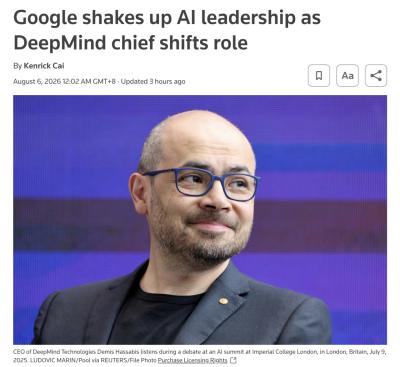
Judging from the change of positions, this is not a simple promotion.
Although Hassabis still retains the highest-level scientific leadership role, at the operational level, he has handed over the daily control of Google's most important AI project.
For a company that is eagerly waiting for the delivery of its flagship model, handing over the R&D execution power to a leader who focuses more on engineering and product implementation at this moment speaks for itself.
If Hassabis is responsible for Google's AI strategy and organization, Jeff Dean undertakes the technical responsibility for Gemini R&D.
Jeff Dean has worked at Google for nearly 27 years, and participated in building Google's most core technical foundation — the early distributed computing system, Google Brain, TensorFlow, and the subsequent large-scale AI model training infrastructure.
In the past few years, he was also an important leader of Google's AI technology roadmap.
According to Reuters, Jeff Dean previously co-led the development of Gemini with Oriol Vinyals and Noam Shazeer.
That is to say, when the progress of the Gemini flagship model fell short of expectations, the people who left this time also took part of the technical leadership responsibility.
Putting the two incidents together, it is hard to be simply interpreted as an ordinary talent flow.
From Hassabis to Kavukcuoglu, what is DeepMind changing?
Founded in 2010, DeepMind was not originally an AI company operating around short-term commercial goals, but an AI research institution that tried to "solve intelligence" and promote the progress of science and humanity.
In 2014, Google acquired DeepMind.
In the following ten years, DeepMind proved its value with a series of landmark achievements:
AlphaGo defeated Lee Sedol, the world Go champion; AlphaZero demonstrated the potential of reinforcement learning in complex strategic tasks; AlphaFold solved the protein structure prediction problem that has plagued the scientific community for decades.
These projects jointly shaped the brand of DeepMind, and Demis Hassabis is exactly the representative of this development path.
In 2023, Google merged DeepMind and Google Brain to establish the new Google DeepMind, hoping to concentrate resources and accelerate the development of next-generation general AI systems.
Hassabis became the CEO of the merged GDM, in charge of leading this new AI organization.
In a sense, Hassabis got the greatest power in Google's AI history — from the head of DeepMind to the person in charge of Google's most core AI R&D system.
Gemini is the first major achievement after this organizational adjustment.
However, as AI competition enters the stage of rapid iteration, what enterprises need is not just a leading model, but a set of organizational capabilities that can support continuous training, fast iteration and timely product launch.
Under the circumstance that Gemini 3.5 Pro has been delayed for a long time, GDM has carried out a series of internal adjustments to reallocate the top research resources.
A thought-provoking change is that AlphaFold, one of DeepMind's most symbolic scientific projects, is giving way to Gemini, the most important competitive project in the generative AI era.
According to a report by the Financial Times on July 29, GDM disbanded the AI for Science (AI4S) team responsible for AlphaFold R&D.
In the past year, most of the authors of AlphaFold papers have been reassigned to other projects: some researchers turned to Gemini-related research, and others joined Isomorphic Labs, an AI drug R&D company under Alphabet; at the same time, about a quarter of the full-time DeepMind authors who initially participated in the AlphaFold paper have left the company.
By August 5, Alphabet announced: Hassabis will no longer be responsible for the daily operations of GDM, and will serve as Chairman of GDM and Chief Scientist of Alphabet.
His successor is Koray Kavukcuoglu, who previously served as DeepMind CTO and Google's Chief AI Architect.
Kavukcuoglu himself is also one of the most important technical leaders of DeepMind: for a long time, he has been responsible for DeepMind's technical roadmap, and participated in the advancement of work related to AlphaZero, AlphaFold and Gemini.
Different from Hassabis who focuses more on long-term research strategy, Kavukcuoglu's position is closer to model R&D and engineering execution.
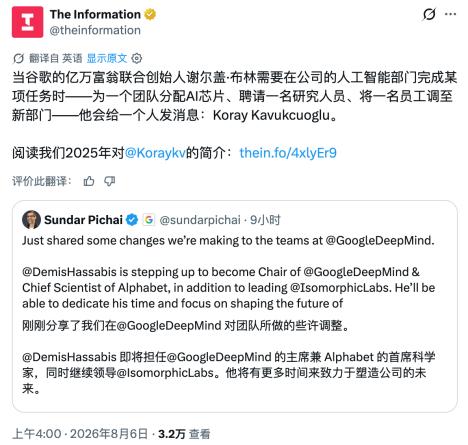
According to a report by The Information, when Google co-founder Sergey Brin needs to coordinate important matters of the AI department — including allocating AI chips for teams, recruiting researchers, and adjusting employee positions — he will contact Kavukcuoglu directly.
The report cited multiple current and former Google employees who have worked with Kavukcuoglu that in the past two years, he has gradually become the "indispensable fixer" in Google's AI model R&D system: responsible for coordinating resource allocation, team adjustment and model R&D advancement.
Although Kavukcuoglu does not have the Nobel Prize halo like Hassabis, nor does he represent Google's engineering culture like Jeff Dean, he has undertaken the important role of connecting the research team and organizational execution during the advancement of the Gemini project.
The focus of GDM is shifting.
In the past, Hassabis's task was to find the next breakthrough in the style of AlphaGo and AlphaFold.
But now, Google needs someone to manage another thing: how to turn a cutting-edge model into a product that can be iterated continuously, released quickly, and serve billions of users.
Meanwhile, a group of people chose to leave
If the change of Hassabis's role is part of Google's active adjustment of its AI organizational structure.
Then Jeff Dean's departure leaves a more complex question:
When Google redefines the operation mode of DeepMind, why did the people who participated in building Gemini choose not to stay?
Jeff Dean is not an ordinary Google AI researcher. In the past nearly 27 years, he participated in building Google's technical foundation for transitioning from the Internet era to the AI era, and after entering the large model era, he is also at the core of Google's AI leadership.
Gemini is not a new project unrelated to Jeff Dean. It can even be said that he is one of the important figures in charge of the technical direction in Google's attempt to catch up with OpenAI and Anthropic.
Therefore, as the flagship model Gemini fell behind schedule, a natural question arose:
Does Jeff Dean also need to take responsibility?
From the perspective of enterprise management logic, the delay of the flagship model is not only the problem of researchers. For a company that has invested tens of billions of dollars in competing for AI competitive advantages, model architecture, training efficiency, engineering collaboration and resource allocation will all affect the final result.
And these are exactly the scope of responsibility of technical leaders.
Coincidentally, what Google is most widely discussed about by the outside world is its excessively long decision-making chain and chaotic resource allocation — all problems point to the internal coordination capability.
But it would be too simple to interpret Jeff Dean's departure as an organizational adjustment after a failure.
Because it is not only Jeff Dean who left, but also Sanjay Ghemawat, Quoc Le and Oriol Vinyals.
They participated in different stages of Google's AI development over the past two decades respectively:
Jeff Dean and Sanjay Ghemawat built Google's large-scale distributed computing system; Quoc Le promoted the early deep learning research of Google Brain; Oriol Vinyals participated in key projects such as AlphaStar and Gemini.
That is to say, a group of people who once defined Google's AI roadmap left the company at the same time.
What they chose to establish after leaving is not an ordinary startup, but public-benefit AI corporation Discovery Loop.
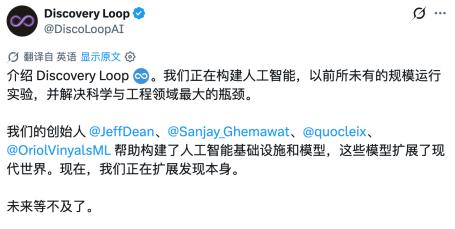
According to public introduction, Discovery Loop hopes to build artificial intelligence systems that can run large-scale experiments and solve key problems in the fields of science and engineering.
The founding team said that they helped build AI infrastructure and models in the past, and now they hope to use AI to further explore the nature of discovery itself.
This name and corporate positioning can not help but remind people of several important talent splits in the AI industry in the past.
In 2015, OpenAI was founded. A group of ambitious researchers and entrepreneurs gathered together, trying to establish an AI research institution that does not follow the path of traditional technology companies, and explore another possibility leading to general artificial intelligence. Many of them came from institutions such as Google and DeepMind. A few years later, this team stood at the center of the generative AI wave.
In 2021, Dario Amodei and others left OpenAI and founded Anthropic. The same plot repeated — splits happened inside leading AI organizations, and the leavers were eager to organize AI companies in another way, to restart around topics such as safety and research directions. A few years later, Anthropic became one of the most notable rivals of OpenAI.
Of course, there is no public evidence at present that Jeff Dean and others left because of conceptual differences with Google similar to those between OpenAI or Anthropic.
However, several important organizational changes in the AI industry in the past all show a common feature:
When top researchers believe that the existing organizational methods can not fully meet their ideas for AI development, they may choose to leave and establish new research organizations.
The cards of large technology companies have always been very clear: global-scale computing power, massive data, complete engineering systems, and mature commercial channels. This is also the main reason why Google can attract top AI talents for a long time.
But having a large hand of cards also means many constraints: research directions need to align with product goals, resource allocation needs to go through complex processes, and long-term exploration has to face clear commercial return requirements.
At present, the answer Google is giving is to turn DeepMind into a more centralized and efficient AI R&D organization, so that model training, computing power resources and product implementation