As AI content enters the experience era, how does Loopit turn every idea into a playable world?
Over the past two decades, internet platforms have essentially been doing the same thing: distributing information.
Google distributes web pages, Weibo distributes trending topics, while Douyin and TikTok have pushed the efficiency of information distribution to the extreme.
After the emergence of AI, texts, images and videos on various platforms began to be generated infinitely. This also brings a new problem. If AI puts standardized texts and videos into the world every day, will what future platforms do still be information distribution?

This question has been lingering in Chen Weipeng's mind, and he finally found the answer after he started to found Loopit. In his view, in the past, content was mainly about distributing information, but in the future, it may be more about distributing experiences.
What really made him realize that distributing experiences will really become a reality was a completely accidental event.
Back in February this year, an overseas user posted a piece of Loopit content to X. In the video, a digital avatar of Elon Musk reacts to constant taps from fingers, and the post only left a few lines of captions:
tap.
tap again.
tap tap tap tap.
this should be Sidney Sweeney.
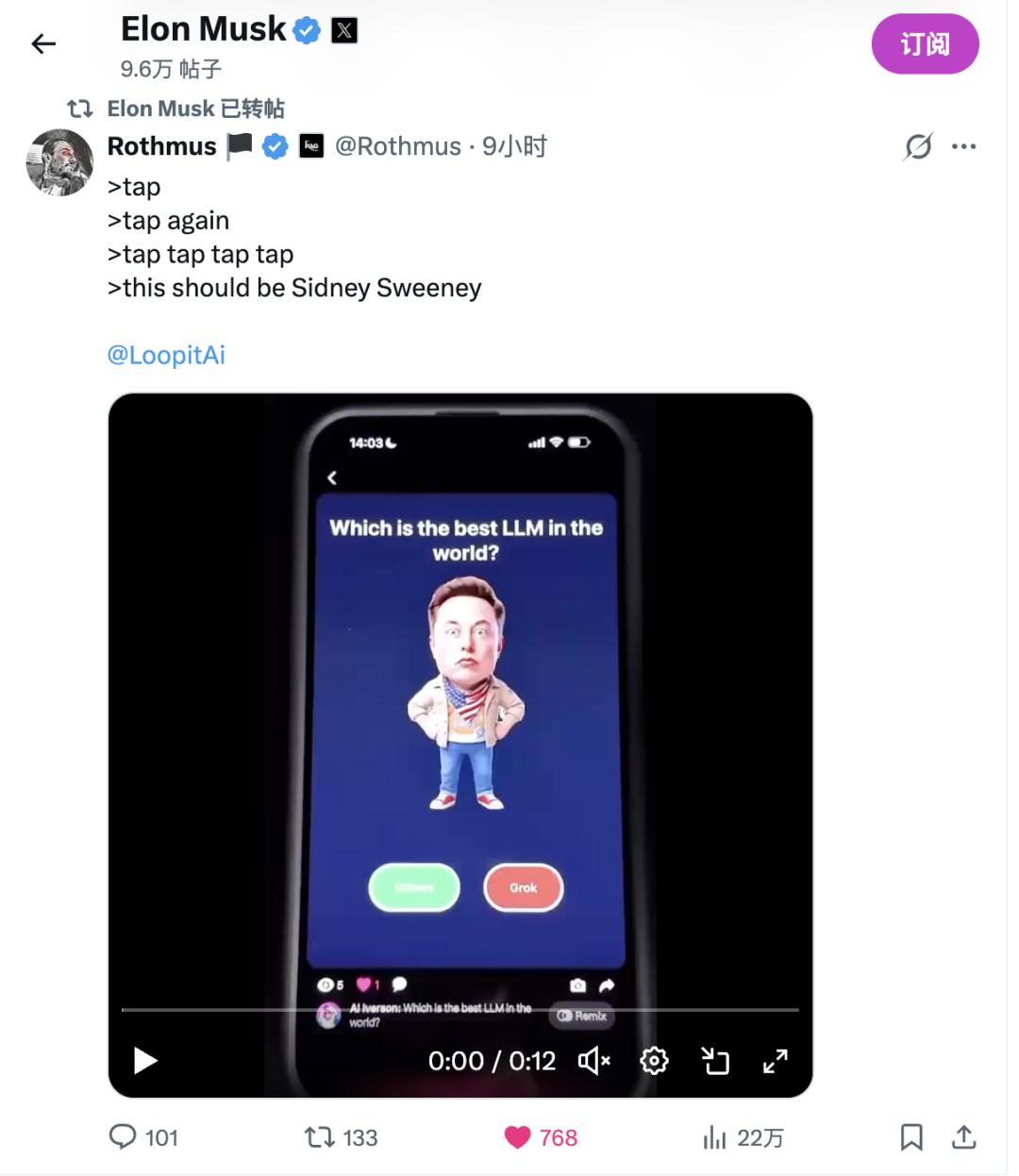
A few hours later, Elon Musk liked and reposted this post.
If that were just an ordinary video, he could have seen countless similar contents on TikTok or Instagram. What really made people stop was something else: the content in the video was more like an interactive game that responds to people's actions. Tap once, the action changes, tap again, the picture keeps changing.
At this point, users are no longer just viewers, but start to participate in the content itself. It was that post that for the first time presented a new content relationship to the global internet. So, how exactly does Loopit do a good job in distributing experiences?
At the Matrix Partners Frontier Closed-door Sharing Session, Chen Weipeng shared Loopit's exploration of AI-native content products and his latest thoughts on how to distribute experiences in the AI era.
When AI Products Are No Longer Just Tools
In the past year, there has been a subtle anxiety in AI application entrepreneurship.
Models are getting stronger, and there are more and more tools, but there are not many products that can really make users open them every day. Many AI applications solve efficiency problems: writing, searching, summarizing, programming, image creation, and video generation. Such AI products are practical, but the problem is that being useful does not mean high frequency. At the same time, the fact that these AI products can improve efficiency does not mean that they can form a platform.
In the 20 years of experience in the internet industry, the strongest products are often not "tools", but "fields".
Tools solve a single task, while fields carry a certain kind of relationship. This is also one of the most critical differences between AI products and mobile internet products. In the mobile internet era, product managers usually define requirements first, lock in users, and then continuously polish the experience. Because the underlying capabilities such as mobile phones, cameras, positioning, payment, and recommendation are relatively stable, what startups need to do is reorganize user behaviors on stable technologies.
But the AI era is different.
The technology itself is still changing rapidly, and many functions built around the model today may be absorbed by the model itself next year. Chen Weipeng also tried to make some tool-based AI products, and the team built a lot of scaffolding around the model, but he found that as long as the model capabilities improve, the intermediate layer that originally seemed valuable would be erased, and a lot of work would become invalid.
Therefore, when building products in the AI era, we can not only ask "what needs do users have now", but also think one step deeper and keep asking ourselves: What exactly needs will AI redefine? Loopit was born out of this question.
In the early stage of starting the business, Chen Weipeng did not directly come up with today's product form. He only vaguely believed that every technological revolution would redefine a way of expression.
Behind YouTube is the fact that video cameras entered American households. Behind Douyin is that mobile phone cameras allow ordinary people to express themselves at any time. In the AI era, what is really popularized is no longer just hardware, but the creation capability itself.
In the past, if a person wanted to make web pages, games, animations, and interactive content, he needed to know how to code, understand design, and have a tool chain. Now, AI Coding and multimodal capabilities have lowered these thresholds, and anyone can turn what is in their mind into reality.
At that time, Chen Weipeng bet on two variables: AI Coding and multimodal capabilities. AI Coding is easy to verify and iterate. The code needs to be checked to see if it can run, if the logic is correct, and there must be clear feedback.
Comparing the two directions, multimodal capabilities are closer to the C-end. This is because people's evaluation of beauty is not unique, and they have natural tolerance for pictures, sounds, styles, and atmospheres. It is not as black and white as serious tools, but more suitable for developing new experiences when the technology is not yet perfect.
The combination of the two points to a larger direction. Looking along this direction, the next generation of content may be a world that can be interacted with. This is the entry point that Loopit wants to tap into.
Short videos have pushed "watching" to the extreme. If AI only allows people to produce videos faster, in the end, it will most likely still be distributed on old platforms such as Douyin, TikTok, and Xiaohongshu. Because the traffic is there, the user relationship is there, and the creator's return is also there.
Therefore, if a new platform wants to emerge from the shadow of the old platform, it cannot only improve efficiency on the "production side". It must add a new dimension that old platforms are not easy to be compatible with. Therefore, Loopit chose interactivity, making content playable for the first time.
A "Living" Feed
If you don't try it yourself, it's really hard to describe Loopit.
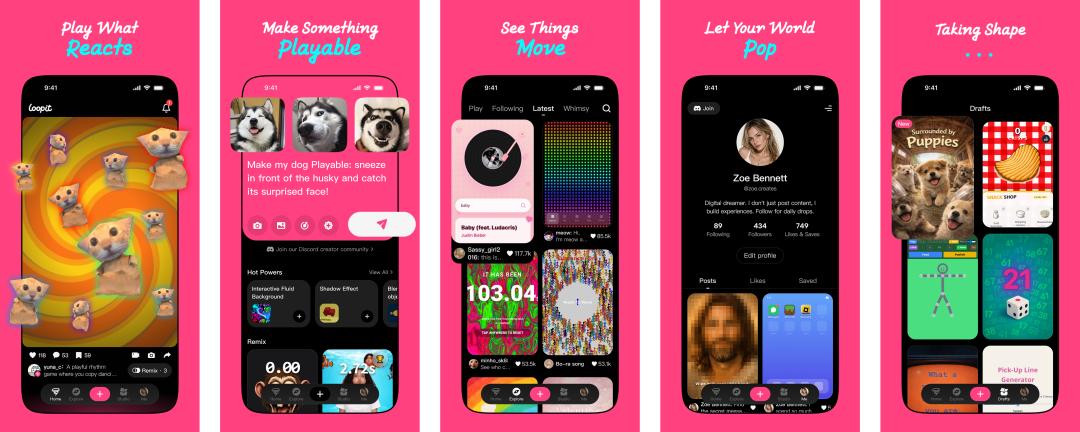
Single-column Feed, swipe up and down, content occupies most of the screen. If you don't like a piece of content, swipe away, and the next piece of content will be pushed up soon. In this way, it looks a bit like Douyin.
But you will soon find that the sense of familiarity is only the shell. For every piece of content you swipe, watching is just the beginning, hands-on experience is the real content.
Users can slide the falling oranges with their fingers to make them pile on the capybara's head. They can blow into the screen to make dandelions scatter; they can shake their heads to switch Sichuan opera face-changing masks; they can click on objects on the screen to make the originally static picture start to respond. What Loopit feeds users through the Feed stream is not just videos, pictures, and music, but content that can be interacted with through clicks, swipes, selfies, voice, shake and other ways.
This is a very small difference, but small differences can sometimes change the species of a product. Short videos bring the world to your eyes, and Loopit wants you to reach into this world.
Its product logic is not complicated. Chen Weipeng summed it up in one sentence: Turn every idea into a playable world.
Users input natural language, or upload pictures and videos, and the system can generate interactive content. These contents are relatively short at this stage, but each of them can be triggered by clicking, dragging, shaking, blowing, taking selfies or using sensors. Chen Weipeng shared that Loopit is a platform that integrates creation and play, users can input natural language, pictures or videos to create interactive content. At present, the daily creation volume of the community has reached the order of 100,000.
But behind this, it is far more complicated than it seems.
Ordinary AI generation tools usually turn a sentence into a picture, a video, or a piece of text. What Loopit wants to do is to turn a sentence into a small system that can run, give feedback, be published, and be remixed by others.
There is also a common misunderstanding here. Many people will regard Loopit as an AI game at first glance, but Chen Weipeng does not like this definition. Traditional games have clear goals, rules, victory and defeat, and a complete experience closed loop, while games are an important subcategory of Loopit. Compared with the label of game, what Loopit wants users to grasp is something else: interactive expression. Users can blow a breath to make the dandelions in the screen scatter, make an action towards the camera, say a word, and use various ways to make the content respond to you.
This makes people stop more easily than "this is an AI game platform". Games require users to enter a world, while Loopit wants small worlds to emerge from the Feed.
The information stream distributes content, while the interactive stream distributes experience.
In the past, users in short videos could at most like, comment, and repost, and the content itself would not change because of the user's actions. But in Loopit, participation is built into the content.
Looking further ahead, short content will evolve into long content, light interaction will evolve into heavy interaction, and single-player interaction will evolve into multi-player interaction.

At this point, content is no longer a result, it becomes a process waiting to be triggered.
How Does a Technical Person Build AI-Native Products?
What is really interesting about Chen Weipeng is the contrast.
His resume is almost all about technology: he has done search and recommendation, NLP, later became the co-founder of Baichuan Intelligence and the person in charge of large models, and earlier was the general manager of Sogou Search R&D.
If he continued along this path, he would most likely work on models, tools, Agents, or a certain efficiency scenario.
But in the end, he chose to build an AI-native product for young people. Young people, entertainment, expression, aesthetics, interaction... these words do not seem to be in the comfort zone of a technical person.
This may be related to his personal love for history. Looking at the change of dynasties, the evolution of systems, and the process of every change in social structure, people will have a more macro perspective.
The more history you read, the easier it is for people to form a sense of scale, and you will clearly know one thing: what really changes the era is often not a technology, but the way people, and people and society re-establish connections after the technology matures.
Movable type printing changed the spread of knowledge, railways changed the business radius, electricity changed the industrial organization, and the internet changed the flow of information. What remains in the end is often a whole new set of social order.
Therefore, history made him accustomed to thinking about technology on a scale of ten years or even longer. In his view, large models are of course important. But models are more like steam engines, the real question he cares about is: what kind of new media will AI develop? What new relationship will be formed between people and content?
His experience at Soul made this judgment more specific. He found that technology can solve "whether it can be done", but what really determines the value of a platform is always "whether users are willing to come back".
This made him realize that the experience in the AI era is already different from that in the mobile internet era.
In the past, making products was more like building houses on a piece of land that had already been planned. Roads, pipelines, and populations already exist, and what product managers need to do is to design functions around clear requirements. AI products are completely different. The capabilities of models are changing almost every month. Products are no longer just adapting to requirements, but waiting for requirements to be recreated by technology.
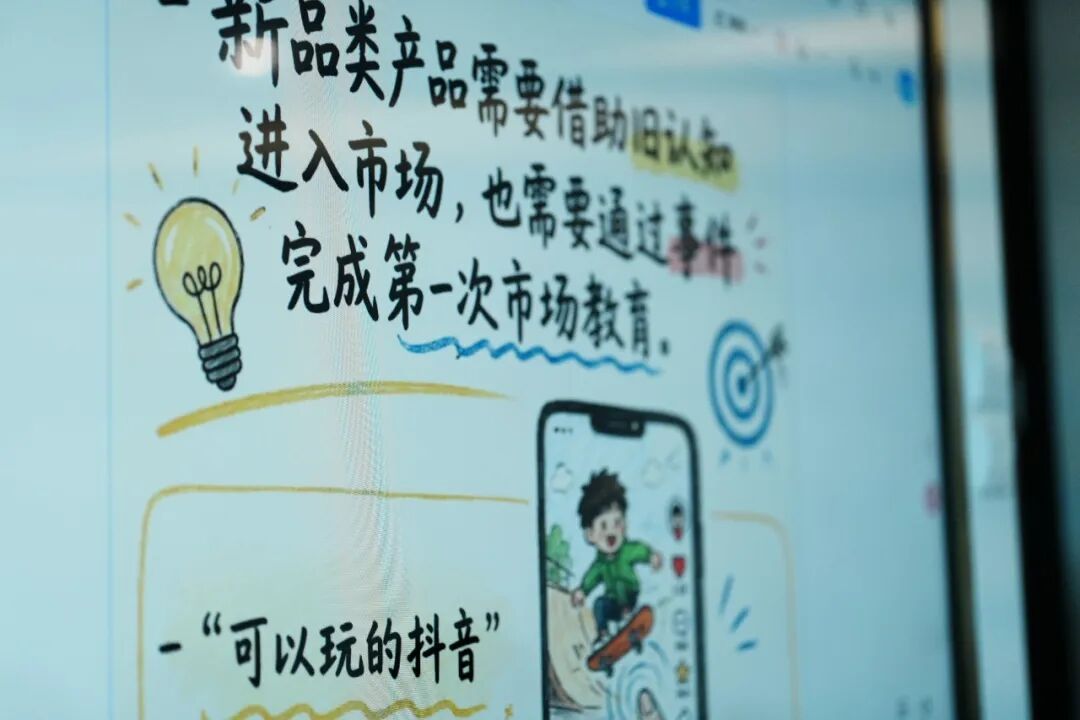
This is also the reason why the team kept starting over before Loopit was born. They thought of making interactive PPTs, hoping to turn presentations from display to interactive; later they made interactive picture books, hoping to turn reading into participation, and also tried different directions such as interactive short plays and interactive video games.
Almost every direction is easier to explain and commercialize than today's Loopit.
Soon, Chen Weipeng realized a problem: a product that is designed too delicately around today's capabilities is likely to be overthrown by tomorrow's model.
He summed up his previous product experience and said: "A product with a score of 70 but huge scalability is far more valuable than a product with a score of 90 but no scalability. Therefore, we would rather make a product that is not perfect today but can already hit some users, than make a product that looks amazing today but lacks room for growth."
This sentence reveals the restraint of a technical person and the patience of an entrepreneur.
So, they voluntarily gave up the seemingly more mature long content. On the one hand, the model capabilities at that time were not enough to stably support complex narratives, and the premature pursuit of long content would only overdraw the technical potential; on the other hand, a brand-new content ecosystem can hardly rely on professional creators from the first day.
If the platform needs a large amount of PGC from the first day, what it will eventually compete for is still content procurement, traffic distribution and channel operation.
This is not the battlefield they want to enter. They finally chose to start with the lightest interactive content, so that creators have no threshold, users have no pressure, and leave room for the model to continue growing.
In the team's view, short content can naturally evolve into long content, and light interaction can gradually develop into more complex interactive forms. The single-player experience, on the other hand, has the opportunity to further generate new relationships between people.
As a result, Loopit finally became what it is today. It is like an open content container, a platform that can continue to grow with AI capabilities and continuously accommodate new creation methods and user behaviors.
In Chen Weipeng's view, tools solve the problem of efficiency. What can really define an era is a platform, a field that can carry new content relationships.
What he bet on is never just a product, but a content ecosystem in the AI era.
The Mist This Business Has to Go Through
The most easily misunderstood part of Loopit is that it seems that as long as a few fun AI mini-games are made, it can grow into the next interactive content platform.
But Chen Weipeng doesn't think so.