The former "No. 1 Province in Nuclear Power" is ramping up efforts to hit the upper limit.
The nuclear power industry is embracing a high-boom cycle.
The "15th Five-Year Plan" for New Power System Construction recently issued by the National Development and Reform Commission and the National Energy Administration clearly states that China will develop nuclear power in an active, safe and orderly manner, and scientifically determine the layout and construction schedule of coastal nuclear power bases. By 2030, the installed nuclear power capacity will reach about 110 million kilowatts.
Almost at the same time, China's first batch of nuclear power projects during the 15th Five-Year Plan period were officially approved — 4 major nuclear power projects with a total of 8 units, with a total investment of more than 170 billion yuan, located in 4 coastal provinces. Among them, the private capital participation ratio in the second phase of Zhejiang Jinqimen Nuclear Power Project has reached 20% for the first time, setting a new record for private capital participation in China's nuclear power sector.
As a typical "small energy province but large energy-consuming province", Zhejiang was once labeled as the most "power-short" major economic province. In 1991, Qinshan Nuclear Power Plant, China's first nuclear power plant independently designed and constructed, was connected to the grid for power generation in Haiyan, Jiaxing, Zhejiang. After that, Qinshan Phase II, Phase III, and Sanmen Nuclear Power Phase I were put into operation successively, making Zhejiang a major nuclear power province.
Zhejiang took the earliest step, but failed to maintain its leading position. Data from the first half of this year shows that Zhejiang ranks third in the country in terms of nuclear power generation, following Guangdong and Fujian which take the top two spots respectively.
At present, with the launch of a new round of nuclear power projects and the continuous entry of private capital, the former "No.1 Nuclear Power Province" is standing at a new starting point on the competitive track.
Favorable Policies
As a strategically critical track to seize the commanding heights of future energy, the importance of nuclear energy has risen to an unprecedented level.
This year's government work report has included "future energy" for the first time, listing it together with cutting-edge fields such as quantum technology, bio-manufacturing, embodied intelligence, brain-computer interface and 6G in the future industry sector, and it ranks first among all these fields.
From a longer-term perspective, China's nuclear power construction has continued to accelerate in recent years.
According to statistics, from 2022 to 2025, China has approved 10 or more nuclear power units every year for four consecutive years. During the 14th Five-Year Plan period, China approved a total of 46 nuclear power units, with an annual average of 9.2 units, adding 54.5 million kilowatts of installed capacity. Both the operating installed capacity and annual power generation increased by about 30%.
The recent approval of 8 units in four nuclear power projects also marks the official kick-off of the 15th Five-Year Plan nuclear power construction cycle. So far, the number of nuclear power units in operation, under construction and approved for pending construction in Chinese mainland has increased to 120.
Specifically, the four newly approved projects are the first phase of Zhuanghe Project in Liaoning, the first phase of Laiyang Project in Shandong, the second phase of Jinqimen Project in Zhejiang, and the third phase of Taipingling Project in Guangdong.
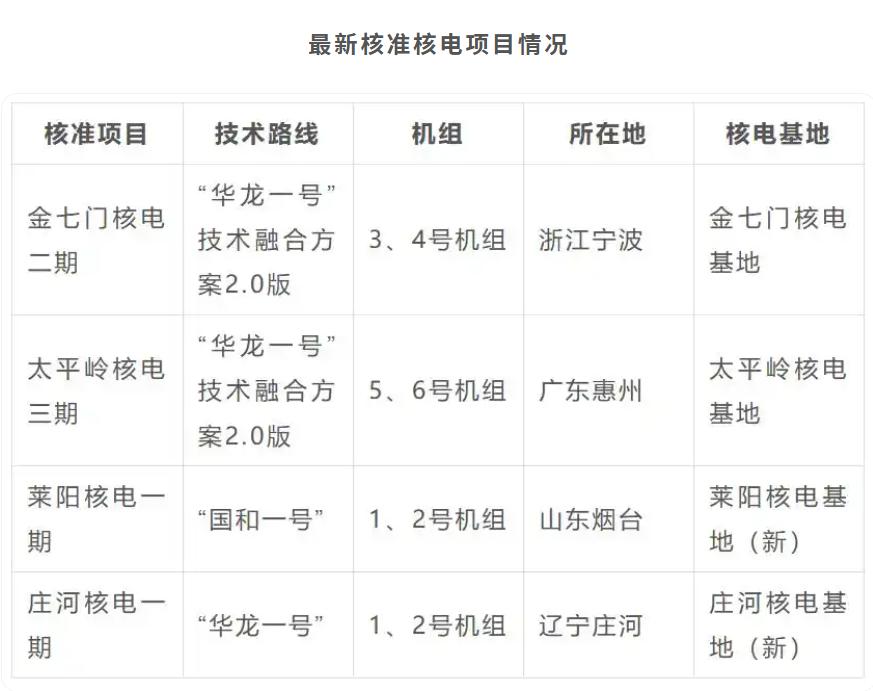
Image source: China Energy News
The layout of these projects in four provinces has profound implications respectively. For example, the Zhuanghe Nuclear Power Project in Liaoning is the first nuclear power project in Northeast China that adopts HPR1000, China's self-developed third-generation nuclear power technology. Since the project planning was launched in October 2006, the local area has been looking forward to it for 20 years, and now it has finally achieved a breakthrough at the national level.
The second phase of Jinqimen Project in Zhejiang and the third phase of Taipingling Project in Guangdong are the highly concerned demonstration projects of "HPR1000 2.0". This technical version features higher safety, better economy and leading comprehensive performance indicators in the world. As a key "test field" for the technology to move from drawings to engineering verification, the projects will strongly support the large-scale construction of nuclear power in China during the 15th Five-Year Plan period.
Focusing on the provincial level, the second phase of Jinqimen Nuclear Power Project is particularly critical for Zhejiang.
Public information shows that Jinqimen, located in Xiangshan, Ningbo, is the fourth nuclear power base in Zhejiang following Qinshan in Jiaxing, Sanmen in Taizhou and San'ao in Wenzhou.
The project plans to build 6 million-kilowatt pressurized water reactor nuclear power units, with a total investment of up to 120 billion yuan. After full completion, the installed capacity will be about 7.2 million kilowatts, with an estimated annual power generation of 55 billion kWh — equivalent to nearly half of Ningbo's total social electricity consumption in 2025.
For Zhejiang, one of the major economic provinces with the fastest growing electricity consumption and the lowest energy self-sufficiency rate in China, this is nothing less than a timely assistance.
Not long ago, Yu Fengqing, Director of Zhejiang Provincial Energy Bureau, wrote an article stating clearly that the 15th Five-Year Plan period is the critical period for Zhejiang's green and low-carbon energy transformation, as well as a key window period for the construction of a new energy system. "We will take the development of nuclear power as a key measure to break the bottleneck of Zhejiang's energy constraints, and develop nuclear power in an active, safe and orderly manner."
Catching Up
Looking at China's nuclear power map, 8 provinces stretch along the entire coastline from Liaoning, Shandong, Jiangsu, Zhejiang to Fujian, Guangdong, Guangxi and Hainan.
Among them, what is the strength of each province?
Statistics from China Power Knowledge Database show that by the end of 2025, the top five provinces in terms of national nuclear power installed capacity are Guangdong (16.18 million kilowatts), Fujian (12.22 million kilowatts), Zhejiang (9.2 million kilowatts), Liaoning (6.71 million kilowatts) and Jiangsu (6.61 million kilowatts). Zhejiang ranks third.
So how was the former "No.1 Nuclear Power Province" overtaken?
Let's first look at Guangdong. Back in February 1994, Unit 1 of Guangdong Daya Bay Nuclear Power Plant was put into commercial operation. Three months later, Unit 2 was also successfully put into operation, making Daya Bay Nuclear Power Plant the first million-kilowatt commercial nuclear power plant in Chinese mainland.
After starting at a high level, Guangdong's nuclear power development has been advancing rapidly, with nuclear power projects blooming in Shenzhen, Yangjiang, Taishan, Huizhou, Lianjiang and Lufeng.
By the end of 2025, the nuclear power installed capacity of Guangdong accounts for more than a quarter of the national total, and it is also the province with the most concentrated distribution of nuclear power projects and the largest scale of units in operation and under construction in China.
Another "overtaker" is Fujian.
In 2008, Fujian started construction of two major nuclear power plants, Ningde and Fuqing, within one year, making it the province with the largest number of nuclear power projects under construction in the country at that time. Among them, Ningde Nuclear Power Plant only took two years to complete all the preliminary work from project initiation to construction start, which was an unprecedented fast progress.
In December 2012, Unit 1 of Ningde Nuclear Power Plant was successfully connected to the grid for the first time, marking a "zero breakthrough" in nuclear power development in Fujian, 21 years later than Zhejiang. After that, the first phase of Ningde Nuclear Power Plant and the first phase of Fuqing Nuclear Power Plant were completed and put into operation successively.
The key turning point came in 2021. According to statistics from China Power Knowledge Database, by the end of 2021, the installed capacity of Fujian increased to 9.86 million kilowatts, surpassing Zhejiang (9.11 million kilowatts) to jump to the second place in the country.
It was also in this year that Fujian's nuclear power generation surpassed Zhejiang, second only to Guangdong, pushing Zhejiang to the third place.
Stepping Up Efforts
Zhejiang is obviously unwilling to "fall behind".
Xu Shuaixi, Deputy Director of the Power Research Office under the Institute of Energy and Environment of Zhejiang Provincial Development & Planning Research Institute, analyzed that during the 14th Five-Year Plan period, the average annual growth rate of Zhejiang's total social electricity consumption reached 8.5%. With the development of new quality productive forces such as artificial intelligence and integrated circuits, the electricity demand of the tertiary industry and residential sector will continue to grow, and the periodic "hard gap" of power supply will always exist.
In Xu Shuaixi's view, the nuclear power technology is on the eve of a revolution. The coming period will be a key window for Zhejiang, a major nuclear power province, to seize the commanding heights in the nuclear power sector and enhance its energy dominance.
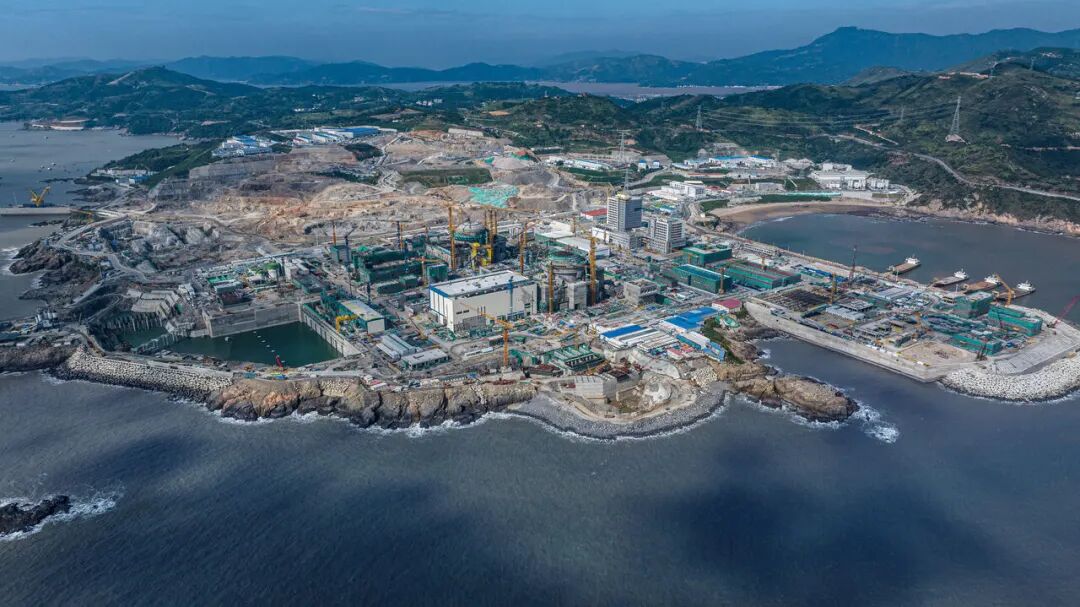
Image source: State Grid Zhejiang Electric Power
In fact, Zhejiang has shown a momentum of accelerated catch-up in recent years.
According to public reports, from 2022 to 2026, Zhejiang's nuclear power projects have been included in the national approval list for five consecutive years. Compared with other regions, Zhejiang's nuclear power projects also have an obvious private capital label —
Statistics from local media show that in 2020, Geely Group took a 2% stake in the first phase of San'ao Nuclear Power Project, making it the first nuclear power project with private capital participation in China. In 2023, Wanxiang Group took a 2% stake in the first phase of Jinqimen Project. In 2024, the private capital share ratio in the second phase of San'ao Nuclear Power Project rose to 10%. In 2025, Tianhuang Pharmaceutical took a 10% stake in the third phase of Sanmen Nuclear Power Project. Now, the second phase of Jinqimen Project has raised the upper limit of private capital participation to 20%.
Back in May this year, Zhejiang also issued the "13 Measures to Further Stimulate the Vitality of Private Investment and Promote the High-quality Development of the Private Economy", which clearly stipulates that the shareholding ratio of private capital in qualified nuclear power and deep-sea wind power projects shall not be less than 20%.
The latest data shows that by the end of June this year, Zhejiang's nuclear power installed capacity has reached 10.41 million kilowatts, breaking the 10 million kilowatt mark for the first time.
According to the local plan, during the 15th Five-Year Plan period, Zhejiang will ensure that the second phase of Sanmen Nuclear Power Project, the second phase of San'ao Nuclear Power Project and the first phase of Jinqimen Nuclear Power Project are put into operation as scheduled. This means that Zhejiang's nuclear power sector will enter a period of intensive harvest in the next few years.
Looking across the country, Zhejiang is not the only one that is accelerating its development.
Up to now, there are 62 nuclear power units in operation in China, with a total installed capacity of 66.14 million kilowatts. There is still an incremental space of about 44 million kilowatts to reach the 110 million kilowatts target by 2030, which will drive a very considerable scale of investment.
Against this background, many regions have stepped up their nuclear power layout. By sorting out this year's government work reports of various regions, 9 provinces including Zhejiang, Shandong, Guangdong, Liaoning, Guangxi, Hainan and Fujian have clearly mentioned their nuclear power development plans. Many major nuclear power provinces have set clear construction targets for 2026 and the 15th Five-Year Plan period.
Among them, Shandong is expected to become a major variable that changes the head pattern. Its 15th Five-Year Plan Outline clearly proposes to "reconstruct the energy pattern" and build a 10-million-kilowatt nuclear power base on the Jiaodong Peninsula. During the 15th Five-Year Plan period, Shandong plans to add 13 million kilowatts of new installed capacity, and by the end of the 15th Five-Year Plan period, the total installed capacity of units in operation, approved and under construction in the province will reach 30 million kilowatts.
Zhejiang is also continuously stepping up its efforts. The 15th Five-Year Plan Outline of Zhejiang Province clearly proposes to "accelerate the construction of nuclear power bases, strive to include new sites in the national plan, and increase the reserve and protection of high-quality sites". By 2030, the nuclear power installed capacity will reach more than 16 million kilowatts. In line with this target, Zhejiang needs to add about 5.6 million kilowatts of installed capacity in the next four years, which is almost equivalent to building half of Zhejiang's current nuclear power capacity from scratch.
This article is from the WeChat Official Account "City Evolution", written by Cheng Xiaoling, and published with authorization from 36Kr.