The current crop of AI office tools have names that are even more difficult to use than the products themselves.
ChatGPT Work、Claude Cowork、Microsoft 365 Copilot Cowork、WorkBuddy、Nano Work、Kimi Work、TRAE Work、QClaw……
What's your impression after looking at this bunch of names?
For me, who has already maintained a 200+ day check-in streak on Duolingo, the feeling is roughly like this:

You recognize every single word individually. But when they are strung together, you still have to pause to figure out what they mean. And when you try to type several of these names accurately and quickly, the situation is like this:

I haven't seen such an abnormal phenomenon for many years.
In the past, when multinational companies entered the Chinese market, they usually localized their brand names through translation. BMW was translated to "Baoma", Mercedes-Benz was translated to "Benchi", Procter & Gamble was translated to "Baojie", and Microsoft got its Chinese name "Weiruan".
Chinese internet companies rarely forced ordinary users to do English reading comprehension. Taobao did not name itself "taomazon" to copy Amazon at the very beginning; Baidu also did not call itself "Boogle".
The "translation" of product names should not simply switch between two languages, the core is to change the way of understanding. Taobao, launched in May 2003, its name itself carries the meaning of "finding treasures through hunting"; WeChat, launched in January 2011, did not put the term "instant messaging" into its product name. Only when users can say the name smoothly, can they gradually learn what the product can do.
However, in the recently booming "AI office" sector, this common sense seems to have temporarily failed.
On January 12, Anthropic launched the research preview of Claude Cowork. On February 12, QoderWork under Alibaba Cloud's Qoder series opened public beta testing. On March 9, Tencent's WorkBuddy was officially launched to the public; on the same day, Microsoft announced Microsoft 365 Copilot Cowork. On June 3, Kimi Work was launched and entered Beta testing. On June 9, ByteDance renamed TRAE SOLO to TRAE Work. On June 16, Microsoft 365 Copilot Cowork was officially commercially available globally. On July 9, OpenAI launched ChatGPT Work.
In half a year, a group of large companies seemed to have reached a consensus, directly turning "Work" and "Cowork" into a "reading comprehension question" posted at the entrance of their products.
And this reading comprehension question exactly exposes the current problem of AI office products: Technology has evolved from the Coding scenario to the Work scenario, but the naming is still stuck on the screens of engineers. Everyone knows that the AI office market is not only for programmers, but no one has learned how to communicate with the general public through products.
A set of Coding language from programmers is taking over the office sector
On January 12, Anthropic launched the research preview of Cowork, trying to bring the core capabilities of developer tools to ordinary users.
After the launch, Anthropic itself also talked about the origin of this product. At that time, non-programmer teams such as the marketing and data teams inside the company began to bypass chatbot products like Claude, and used Claude Code to handle complex non-programming tasks.
Claude Code is Anthropic's terminal AI programming assistant. After its capabilities spilled over to other scenarios, Cowork came into being.
Cowork inherits Claude Code's capabilities of processing long tasks, operating files and calling tools, and at the same time remade the interaction, authorization and security boundaries for non-technical users: Users do not need to enter the terminal, they can directly select the working folder, view the progress and take over the task at key nodes.
From the perspective of product relationship, Cowork can be understood as a "low-threshold popular version" of Claude Code for non-technical users. From the very beginning of its birth, Cowork's mission is to break the "code wall" between ordinary office workers and software engineers.
In July, Anthropic released a set of usage data. The research team sampled about 1.2 million anonymously aggregated Claude Cowork sessions from May 11 to 31 according to the set upper limit. The largest category was "business process and operation", accounting for 33.4%; followed by content creation and copywriting, accounting for 16.4%. The two categories add up to 49.8%, which Anthropic summarized as a large number of "work around work": summarizing progress, making materials, sorting out information and maintaining processes.
This story of unintended success also happened at ByteDance.
On June 9, TRAE announced on its official blog that TRAE SOLO was renamed TRAE Work. TRAE was originally positioned to serve developers. But during the process, the team found that users were already using it to write product requirements, process data sets, make marketing plans and conduct research. So the product added two modes of Work and Code, pushing the Agent that originally worked around the code base to a wider professional crowd.
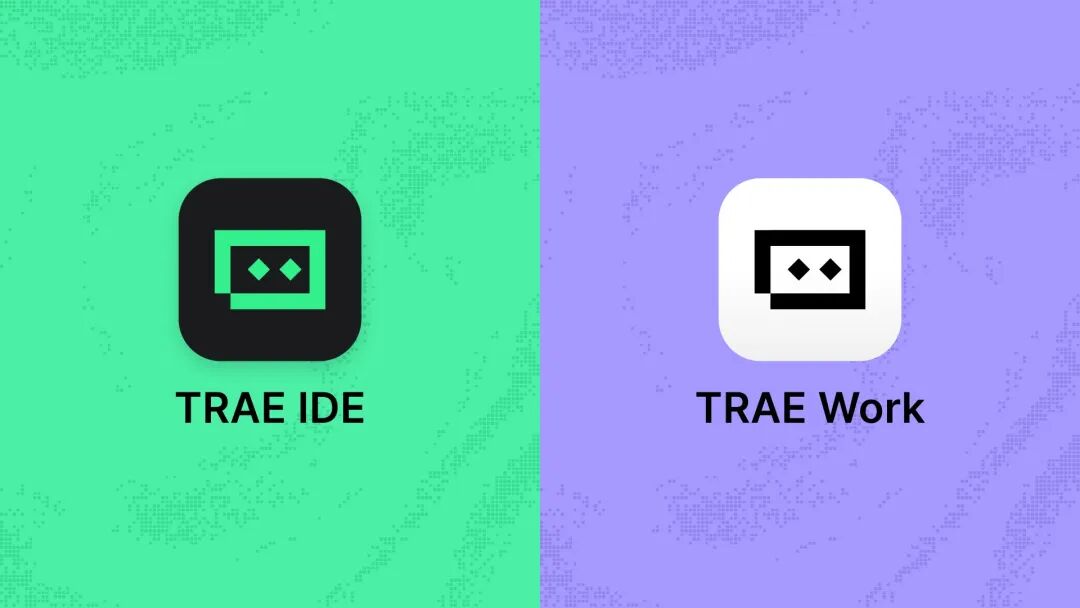
TRAE directly summarized the division of labor between the two products in the announcement: TRAE IDE continues to dig deep into software engineering, while TRAE Work expands horizontally into a wider range of professional work scenarios.
Alibaba's Qoder also used almost the exact same sentence in its announcement. When QoderWork was released on February 12, its definition in the official documents on its official website is: bring Qoder's Agent capabilities from coding to daily work.
Tencent, which is good at internal competition and trial, did not create a new path either.
WorkBuddy, launched publicly on March 9, was developed by the CodeBuddy team, and shares the same account system and Credits with CodeBuddy. A set of Agent capabilities that have been verified in the Coding scenario has been pushed to two groups: one for programmers, and the other for knowledge workers.
On June 5, when releasing the enterprise version, Tencent put the two products side by side into the "Buddy Family". In the official announcement, Tencent classified the two products into the "Buddy Family". CodeBuddy is responsible for development scenarios, and WorkBuddy targets a wider range of knowledge workers. Code did not disappear, but Work began to step into the public view.
This is not a coincidence.
Coding Agent solved a set of difficult problems at a relatively early stage: reading project files, independently decomposing tasks, calling terminals and tools, running continuously for a long time, displaying changes, and running tests, providing rollback or recovery mechanisms when conditions permit. After the capability spillover, replace the "code repository" with "working folder", replace "submitting code" with "delivering PPT, Word and Excel", and a new skeleton of office products emerges.
From the perspective of technology and engineering, this path is very reasonable — mature capabilities should of course be reused. The first round of traffic data also provided initial signals for this path.
On July 22, Analysys released the data of AI-native office agents on the desktop in June 2026. The 17 products included in the statistics had a total of more than 60 million monthly visits. Among them, WorkBuddy, which shares the same origin with CodeBuddy, reached 20.97 million visits; QoderWork, extended from the Qoder coding product, reached 7.88 million visits. In the semi-annual report of the AI application market released by QuestMobile on July 14, it also mentioned that the scale of active users of WorkBuddy has increased by 115.3% in the past three months.
There is no problem with reusing technology. However, the inertia of copying the naming structure and grammar may become a problem.
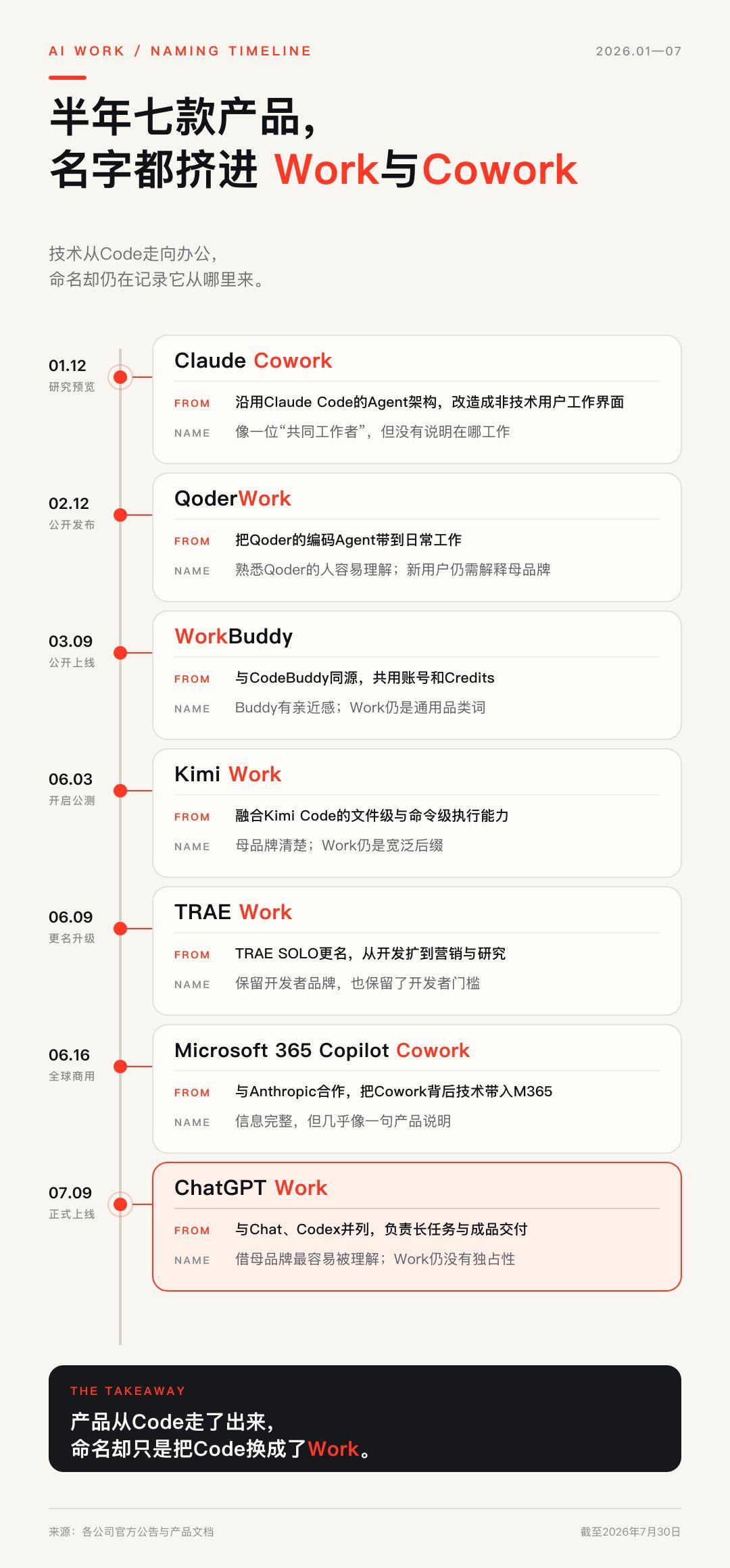
Produced by: Heshan Finance
In the above incomplete statistics, it is not difficult to find that the difficulty of pronouncing the names is only the superficial phenomenon. The more core problem is that these names seem to follow a template: "parent brand + capability label".
Work is used to tell users: this time it is not chatting, it is getting actual work done.
Cowork is used to tell users: this time it is not just a button, it is a role that can work with you.
Agent goes a step further. It describes the technical structure: the model can plan, call tools and take actions.
In addition, there is a set of language from the OpenClaw ecosystem. On April 21, Tencent emphasized in the article "Tencent Launches Overseas Version of QClaw to Lower the Threshold for AI Agent Deployment" that this product is built based on open source OpenClaw, hoping to allow non-technical users to complete deployment in three minutes.
The product has compressed the deployment time to three minutes, but the name "Claw" still requires ordinary users to first understand a layer of technical metaphor from the open source community.
Different from the Coding scenario, office is not a purely professional market.
People who write weekly reports, sort out reimbursement forms, and do sales reviews do not need to judge which kind of Agent architecture the product belongs to first. Coding products face people who actively look for new tools, while mass office products face a large number of people who have no willingness to migrate and no patience for technical terms.
The same set of names is an identity label in the former market, but becomes a usage cost in the latter market. What's more troublesome is that Work has changed from a word that explains the product category to a crowded street full of similar names.
The current names of AI office products are more like semi-finished products that have not been fully translated.
The so-called translation is not to replace the English of the product name with Chinese. It includes at least four things: translate technical language into user language, translate abstract capabilities into specific scenarios, translate globally accepted concepts into expressions in local culture, and translate a new interaction into user familiar experience.
Good products deserve good "translation"
There is nothing new under the sun.
In 1981, Al Ries and Jack Trout regarded the name as a "hook" to hang into the user's mind in the book Positioning. The 20th anniversary edition of the book used four consecutive chapters to discuss the power of names, the nameless trap, riding the coattails of others' reputation, and brand extension.
The name should not only explain what the product belongs to, but also help users hang it in a separate position. This "hook" effect is particularly obvious for mass consumer products.
There are many more such cases in business.
On October 21, 1979, the 6th edition of People's Daily specially explained a name change when introducing Daimler-Benz.
"Daimler-Benz" is the oldest automobile company in the world. In 1886, Daimler and Benz each manufactured a car, which is said to be the prototype of the world's automobiles. This year is usually regarded as the birth year of automobiles. After that, the two each set up their own automobile manufacturing companies. In 1926, the two companies merged into Daimler-Benz, and the brand name of the product was "Mercedes-Benz".
The article also wrote: "In China, people used to call it 'Benci' for short, and since last year (1978), it has been translated as 'Benchi'."
This report at least shows that around 1978, People's Daily had begun to use the translated name "Benchi". From the perspective of Chinese reading effect, this name not only has a sound association with Benz, but also directly presents the picture of a car speeding forward.
When a brand crosses market boundaries, it requires a specific language engineering work.
On August 18, 1988, P&G participated in the establishment of its first enterprise in China in Guangzhou, with the registered name "Guangzhou Procter & Gamble Co., Ltd.". Guangzhou P&G is the first enterprise established by P&G in China. The English abbreviation P&G has never disappeared, but the public first remembered the Chinese name "Baojie".
The same is true for the Chinese internet industry.
In January 2000, Baidu started its business in Zhongguancun, Beijing. In February 2002, Baidu's official website published an article titled "Li Yanhong, Looking for Her in the Crowd 'Bai Du'". The article explained the origin of Baidu's name.
Search made Li Yanhong think of the famous line from Xin Qiji's ci poem: "Looking for her thousands of times in the crowd", and the saying that "things will reach their limit when you have done 99% of the work". Baidu means to strive to do things to 100 degrees, to reach the realm of full bloom at the top.
At that time, Baidu was not well-known on the C-end. It introduced itself as "Baidu is a technology-based company that independently masters and provides core internet technologies". In order to make the public understand better, it even added an explanation that it provides search engine services for portal websites such as sina, sohu and 263.
If we followed the current "parent brand + capability label" structure, or borrowed the influence of overseas benchmark products, Baidu at that time could have been named "xxx Search" or a variant of Google. But it chose to turn the action of "repeated searching" into an ownable brand word.
In May 2003, Taobao was launched. On Alibaba's official website, Taobao is directly translated as "search for treasures". It not only makes people guess that it is related to shopping, but also does not lock itself in the four words of "online mall".

In October 2003, Taobao launched Alipay's escrow transaction service; in December 2004, Alipay was officially established. It originally solved the problem of lack of trust between buyers and sellers in online transactions. The name "Alipay" is almost a functional promise. But when it later expanded to transfer, payment, wealth management and offline services, this name did not fail immediately.
In January 2011, WeChat was launched. Tencent recorded this time point in the company profile on its official website. At that time, it was not named Mobile IM, nor did it put communication, Moments, payment and mini-program