AI browsers: Are they about to be abandoned before they even become popular?
Early in July, James Sun, Head of OpenAI's Browser Business, posted a message on X:
Its AI-native browser Atlas will be deactivated on August 9.
Launched in October 2025, this product was once described by Sam Altman as "a once-in-a-decade opportunity", but it survived for less than ten months. It only had a macOS version from start to finish, with no Windows, iOS or Android versions ever released.
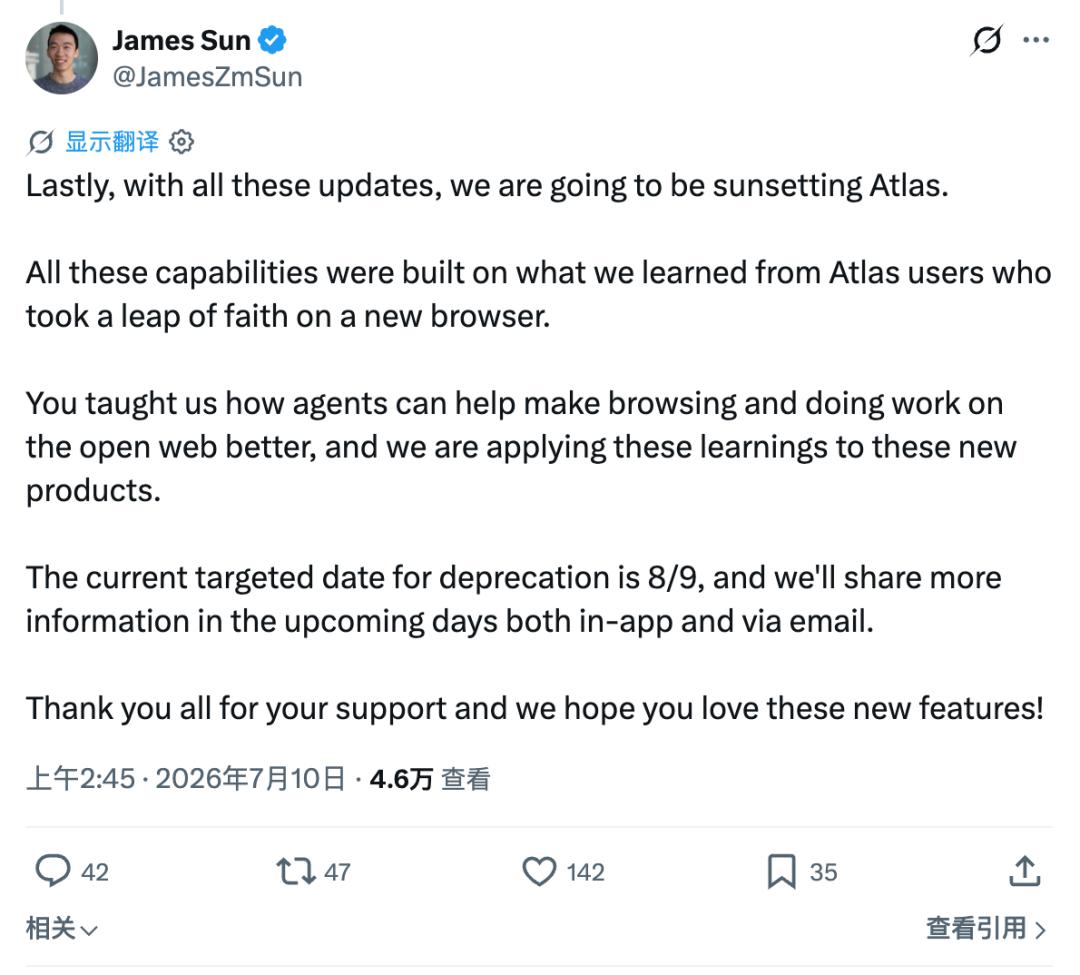
Image source: X
Over the past year, AI browsers have been portrayed as a compelling story: Since AI can search, read and write for people, why not build a browser designed from the ground up for AI?
Appealing as the story is, reality has poured cold water on it.
In the overseas market, Arc from The Browser Company has long ceased active development, and the team has moved to the new project Dia; Perplexity's Comet reached 18 million monthly active users in the first quarter, but due to its overly professional positioning, its public popularity has always been low.
In China, ByteDance's Doubao, Alibaba's Qwen, and Tencent's Yuanbao are all injecting AI capabilities into browsers and search boxes, but the "AI browser" itself has never become a popular category.
At present, among the three major manufacturers, only Doubao has launched an independent "Doubao Browser", and the AI browsers launched by other domestic manufacturers are more like adding an AI shell to traditional browsers.
Why is this sought-after concept about to be abandoned before it even becomes popular? From the perspective of "TopKlout", the root cause lies in the change of the search entry.
The moat of search is beginning to change
In the past two years, the basic market of traditional search engines has been rapidly disintegrating.
On the one hand, it is a slow erosion process. The in-app search traffic of Xiaohongshu, Douyin and WeChat has been rising for years, a large number of users have developed the habit of directly searching for information within the apps, and the market share of traditional search engines has been continuously diverted and eroded.
The impact on the other side is even more fatal. AI search has reconstructed the search logic. In the past, users took the initiative to search and browse web links one by one; now the large model integrates massive search results in batches and outputs complete conclusions directly to users.
Behind this is a fundamental change in user demand, and people increasingly hope that AI can get things done directly for them.
Whoever can meet this demand will evolve from a tool to an entry. And the competition for entries is essentially the competition for the next super app.
Therefore, all AI products are developing desktop and web versions, and are striving to embed AI capabilities into the search within their own systems.
Alibaba's approach is to integrate Qwen's AI search into Quark; Tencent connects Yuanbao to QQ Browser and WeChat Search. Both of them already have mature traditional browsers, so they no longer separately develop AI browsers.
ByteDance is slightly different. It does not have its own traditional browser, so it has independently developed Doubao Browser to fill the gaps in its ecosystem.
The moat of search has also begun to evolve from providing links to handling affairs for users. Whoever can take the lead in forming a closed loop of handling affairs will be able to take over the next wave of traffic.
The threshold for getting users to switch browsers is extremely high
So why have few major domestic AI manufacturers followed the trend of this AI browser boom? Why have the overseas pioneers retreated one after another? The reasons can be summed up in two points.
First, the cost of switching browsers is too high.
Products such as Chrome, Edge, Safari, 360 Browser, and QQ Browser have been used by a large number of users for many years. Bookmarks, passwords, history records, plugins... Users have formed fixed usage habits. Unless the new browser has sufficient overwhelming advantages, users have no incentive to switch.
After all, browsers are tools. What users care about is ease of use, not novelty. Instead of forcing users to switch to new browsers, it is better to embed AI capabilities directly into the browsers they are already using.
Therefore, Google embedded Gemini into the Chrome address bar, Edge launched Copilot, and domestic browsers have also connected to large models one after another. This path is obviously smoother.
Second, the functions that independent AI browsers can achieve can even be better realized by traditional browsers plus plugins, AI desktop clients, and other means.
In addition to the high migration cost, a bigger problem is that the functions of independent AI browsers are more like the icing on the cake, far from a timely help.
Take Doubao Browser as an example. Its functions such as bookmark and password management are almost the same as those of Google Chrome. If you change the search engine to Baidu or Sogou, it is almost an ordinary browser.

Image source: Doubao Browser
The only difference is the extra "Summarize for me" and "Ask Doubao" in the upper right corner, as well as functions such as word translation, summarization, and text-to-speech when right-clicking, which can also be realized by veteran browsers through plugins.
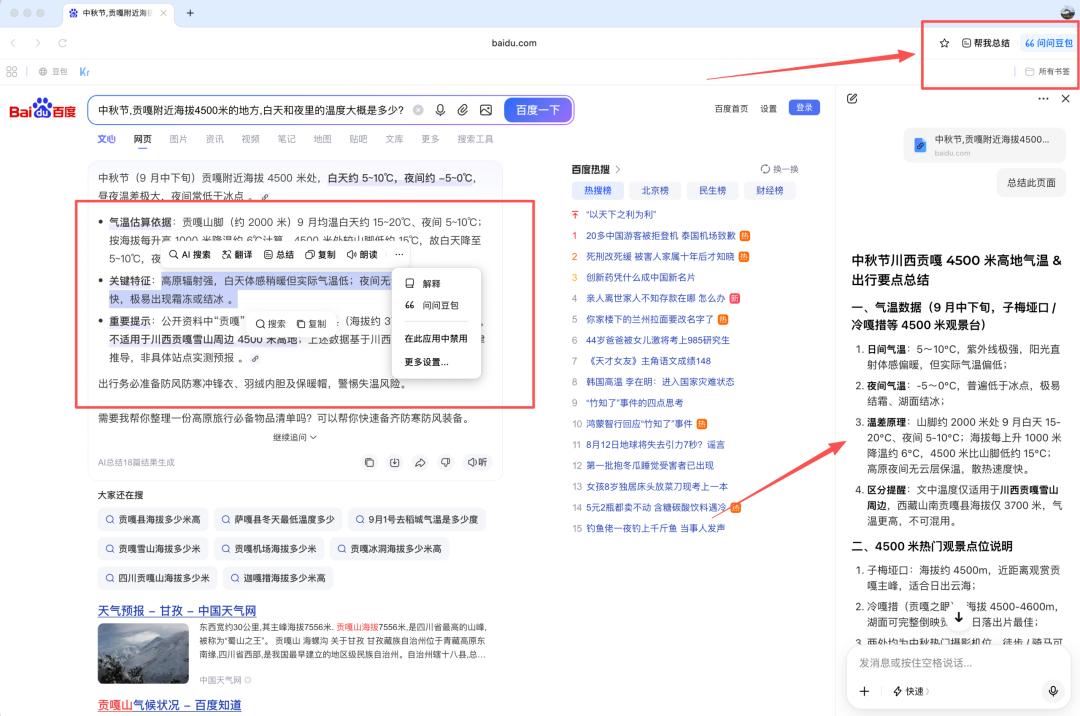
Image source: Doubao Browser
In addition, in the search engine options of Doubao Browser, besides Google, Baidu, 360 and Sogou, there is an extra option for "Doubao".
But after switching to Doubao, we found that the new page is exactly the same as the Doubao desktop client and web version. So why do users have to download an extra browser?
Surviving in the crack, squeezed from both sides
In addition to the lack of enough highlights in the experience, the more critical point is that AI desktop clients are becoming increasingly powerful.
Desktop versions of AI products such as Doubao, Qwen and Yuanbao all have built-in web reading functions. Open the client, and you can complete all operations. Users only need to give instructions, and it will automatically search, summarize and generate files. The browser is only one of the tools called.
This means that traditional browsers are rapidly becoming AI-enabled, and AI clients are rapidly evolving browser-like capabilities, leaving independent AI browsers caught in the middle with no support from either side.
With no advantages in existing users and no differentiated functional highlights, the living space is getting narrower and narrower, the shutdown of Atlas seems inevitable.
But OpenAI's exploration is not meaningless, because Atlas's browsing functions have not disappeared, but are split and integrated into three places: the ChatGPT desktop application, Chrome extension, and cloud browser service. The past 10 months of exploration have allowed it to embed AI browsing capabilities into every existing scenario of users.
This also means that the era of browsers as independent destinations is coming to an end, but browsing as a capability can be ubiquitous.
In the AI era, the browser is a function, not a destination, which may be the best destination AI endows browsers with. It is no longer a software that needs to be opened specially, but a pair of hands that quietly assists behind every operation.
Conclusion
Back to the initial question: Is the AI browser about to be abandoned before it even becomes popular?
The accurate answer is that what is abandoned is the product form of "independent browser", but the transformation of browsing experience by AI is not abandoned at all.
In the future, AI capabilities will become the standard configuration of all browsers, just like water, electricity and gas, and the act of browsing will also be separated from the browser.
What do you think of the ebb of AI browsers? Let's discuss it!
This article is from the WeChat Official Account "TopKlout (ID: TopKlout)", written by Xiao Song, and published with authorization from 36Kr.