Lancôme's largest store in China has been closed.
On August 4, according to a report by China Business Herald, the former Lancome global flagship store on the first floor of Beijing Wangfujing APM has been locked up, the 320-square-meter space has been completely emptied, and only the dismantled display racks and cables are left inside. This high-end beauty flagship store, which was once the first and largest of its kind in Chinese mainland, opened with fanfare on the 2020 National Day, but quietly closed down less than six years after its opening.
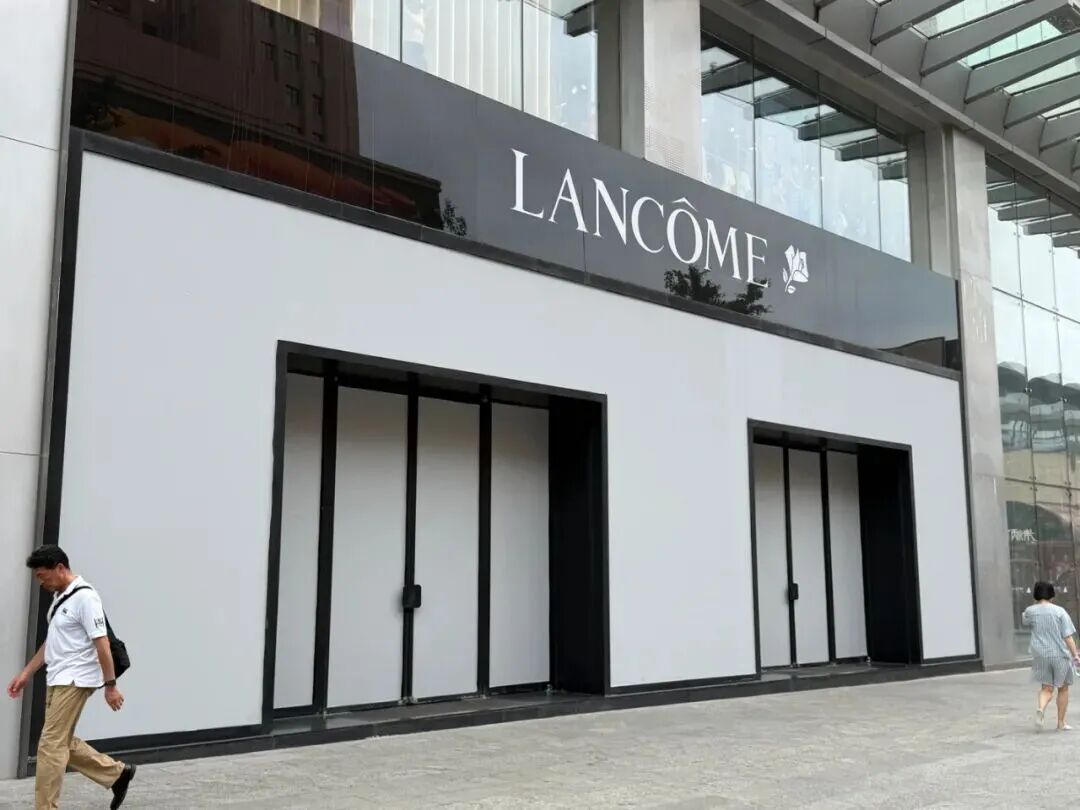
Source: China Business Herald official WeChat account
Jumeili then verified through Lancome's official WeChat public account and found that the "Beijing APM" entry can still be searched in the store list, but the reserved store phone number cannot be connected after multiple calls when clicking in, and the "add beauty consultant" function does not pop up any business card or QR code. When switching to other stores, all these functions work normally.
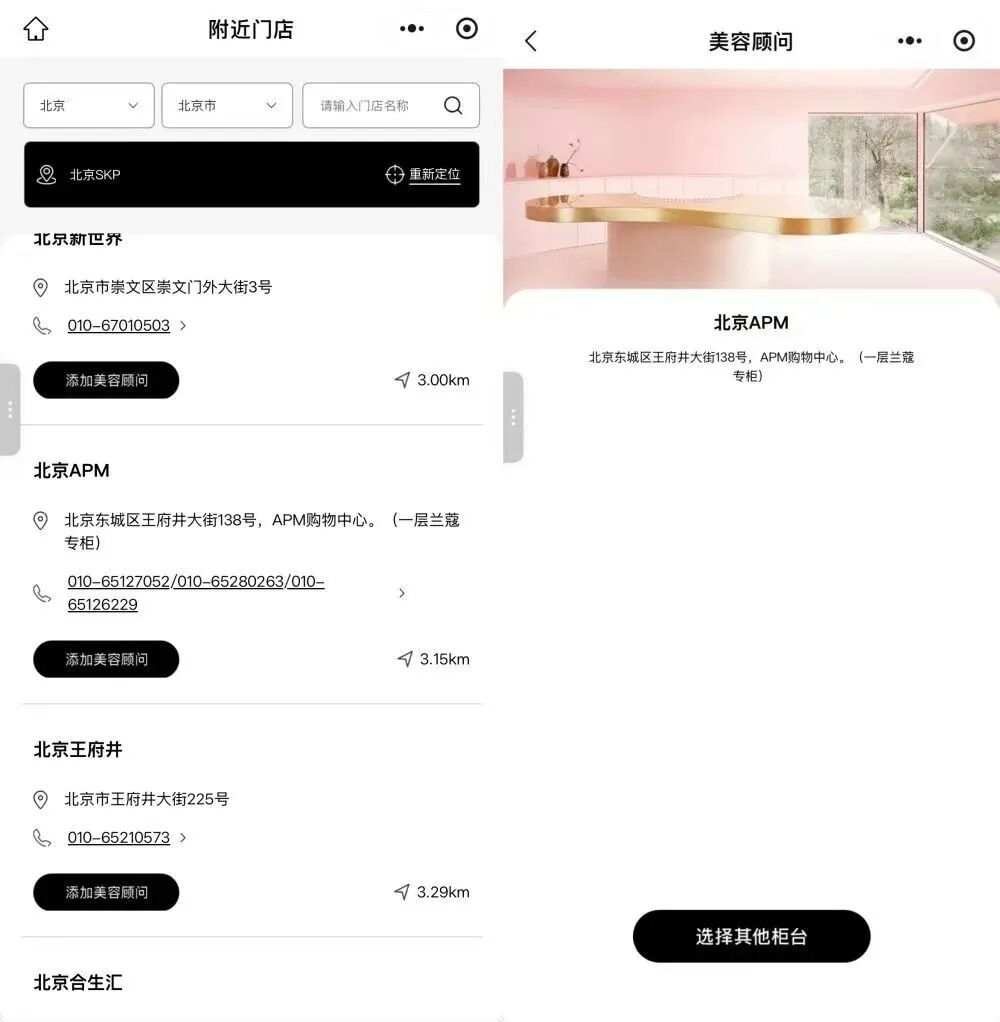
Source: Lancome official WeChat public account
From highlight moment to hasty exit
Turn the clock back to October 1, 2020. On this day, Lancome China and the first Asia-Pacific flagship store were inaugurated at Beijing APM, and the brand named it "Beijing Inner Court", which implies the integration of French elegance and the charm of the capital. This store is the second largest high-end beauty flagship store of Lancome in the world and the largest one in Chinese mainland after the Champs Elysees in Paris. At the beginning of its opening, it was positioned as an incubator for offline retail models, carrying multiple functions such as new product debut, member service and brand image display [1].
In terms of space design, the Sino-French team jointly integrated French court aesthetics with elements of Beijing's siheyuan (quadrangle courtyard). The iconic "Little Black Bottle" Eiffel Tower installation and large-area rose decorations made the store a popular check-in spot in Wangfujing business district in the early stage of opening.
At that time, the store provided services such as customized makeup, skin detection and full-set skin care experience. Consumers often queued up at the door. The surrounding counter clerks recalled that "young girls would stay for one or two hours". This store was once a landmark store for high-end beauty consumption in Beijing [2].
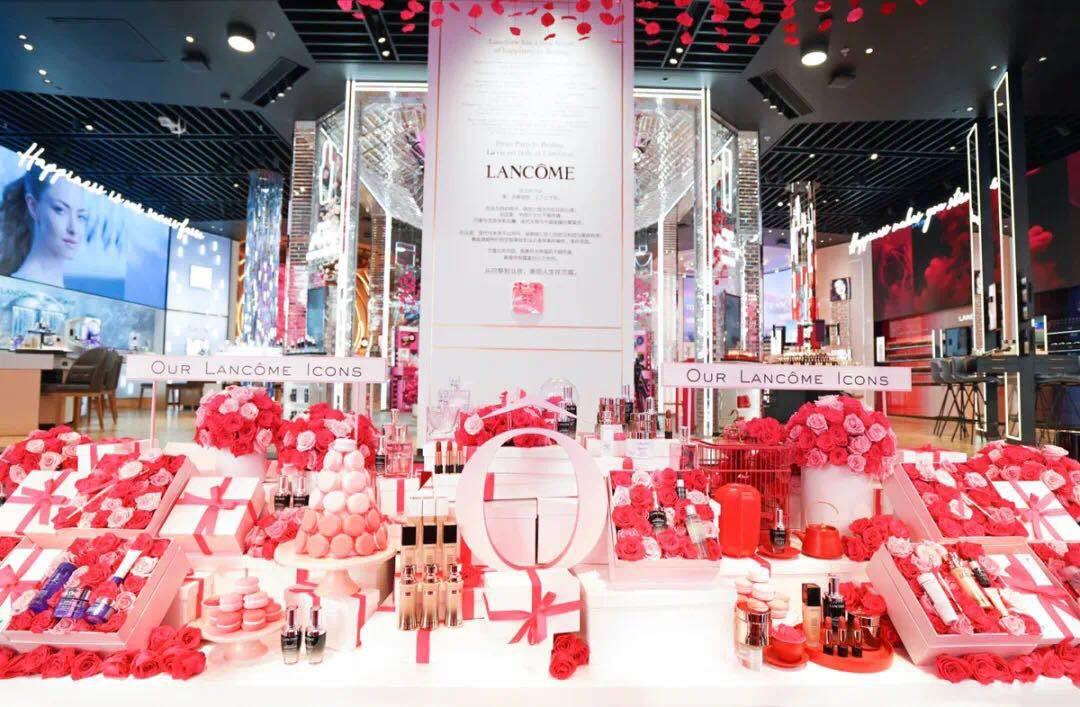
Source: Lancome Flagship Store at Beijing APM
However, six years later, at the end of July 2026, the store closed quietly.
It needs to be clarified that the closure of this single store is not caused by poor brand operation or declining performance. On the contrary, the high-end beauty sector of L'Oreal Group, to which Lancome belongs, maintains a growth trend.
Financial reports show that L'Oreal Group's total annual sales in 2025 were about 44.05 billion euros (equivalent to about 343 billion RMB), a year-on-year increase of 4%; sales in the first half of 2026 reached 23.776 billion euros (equivalent to about 185.1 billion RMB), a year-on-year increase of 5.8%. The luxury cosmetics department, to which Lancome belongs, contributed prominently, achieving sales of 7.997 billion euros (equivalent to about 62.2 billion RMB), a year-on-year increase of 5.1%.
The Chief Financial Officer of L'Oreal Group mentioned at the 2026 first-half performance meeting that the continuous growth of the high-end beauty market in the North Asia region is mainly driven by core leading brands such as Helena Rubinstein and Lancome.
Judging from the performance of the 618 online promotion, during the 2025 618 shopping festival, Lancome won the first place in beauty category on JD.com and ranked second on Tmall; the popularity remained high during the 2026 618 promotion, ranking steadily in TOP4 of Tmall beauty brands and top 10 of JD.com skin care brands.
Regarding the reason for the store closure, according to insiders in the business district, the sales per square meter of this store is not poor in Lancome's national system. The main reason for the closure may be that the brand's online sales proportion has exceeded the critical line of 50%. When more than half of the transactions are transferred online, the "goods selling" function of the super-large flagship store is greatly weakened. Its role as a brand image carrier is faced with high cost pressure of rent, manpower and operation maintenance, so the input-output ratio needs to be re-evaluated [3].
Is the channel contraction of international beauty brands becoming the norm?
The closure of Lancome's flagship store is not an isolated case. In recent years, international beauty brands have been optimizing their domestic channel structures one after another, and offline stores and online flagship stores are starting a round of intensive layout adjustment.
According to previous incomplete statistics from Jumeili, at least 40 beauty brands announced the closure of online stores or withdrew from the Chinese market in the whole year of 2025; by the end of July 2026, at least 12 overseas brands including Filorga and Mamonde have taken clear actions to reduce stores or exit channels in the Chinese market.
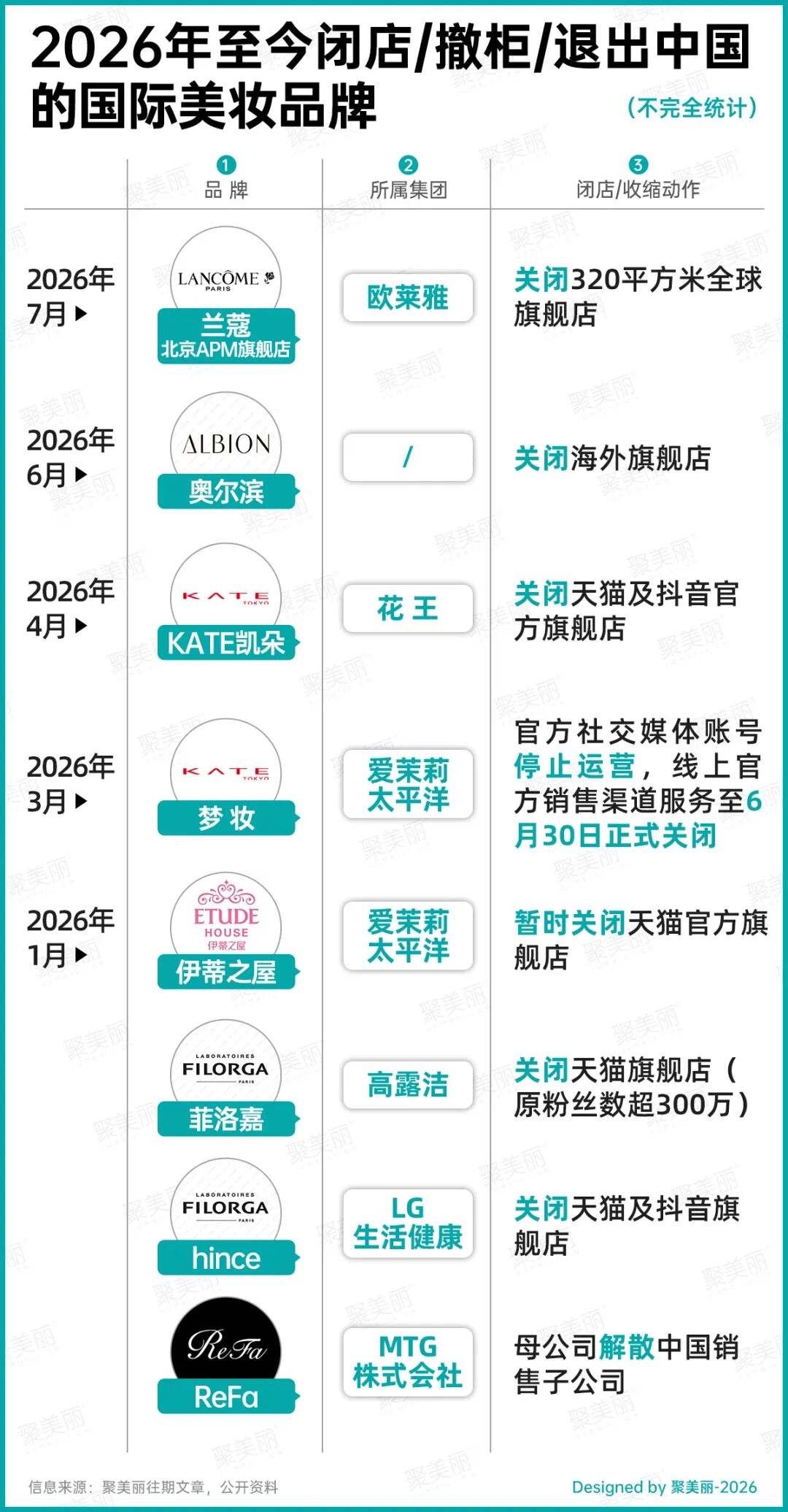
As can be seen from the figure above, in January 2026 alone, many brands such as Filorga, Etude House, hince and ReFa made intensive adjustments. At the same time, from the perspective of brand hierarchy, the store closure tide is no longer limited to niche or mid-to-low-end brands, but affects core brands under groups such as L'Oreal, Amore Pacific, Kao and Colgate. What is closed is not only online stores, but also landmark large offline stores in core business districts.
This round of large-scale channel contraction may be the result of the superposition of multiple factors such as market competition, channel cost and consumption habits.
First of all, the competitive environment in the Chinese market is no longer what it used to be. The new generation of consumers has grown into the main consumer force, and the aura effect of international brands has gradually weakened. A number of domestic brands that have risen in recent years have formed strong competition in the mass price range, and more cost-effective choices with the same efficacy are emerging, so the market share of small and medium-sized international brands has been continuously squeezed.
Secondly, the operation mode of large offline stores itself is facing pressure. Passenger flow and transaction volume are decreasing, while fixed costs such as rent and manpower remain high, and the input-output ratio continues to deteriorate.
In addition, the change of consumer behavior can not be ignored. The traditional counter mode of "promotion as soon as customers enter the store" is gradually losing its attraction. Young people are more used to the closed-loop path of doing homework online, having light experience offline, and finally making transactions online. The role of super-large flagship stores in this process is becoming vague and awkward [4].
Under multiple pressures, the previous expansion mode of international beauty brands in China of seizing markets and spreading offline stores on a large scale is unsustainable, and the whole industry may be turning to fine operation with strict cost control and precise efficiency improvement. In the future, even the international beauty giants need to find a new balance between cost control and maintaining high-end image. Perhaps only by more accurately matching channel efficiency and consumer experience can they stabilize their position in this reshuffle.
Note: The exchange rate conversion in this article is calculated at 1 euro ≈ 7.79 RMB
Source:
[1] From the article of Beijing Youth Network
[2][3] From the report of China Business Herald
[4] From NetEase News
This article is from the WeChat public account "Jumeili" (ID: jumeili-cn), Author: Shui Jin, Editor in charge: Age, released with authorization from 36Kr.