Why are these brands still highly sought after by investors?
In trending tracks, opening offline stores brings definite room for growth, with a global vision and distinct brand recognition.
Although from the overall market perspective, consumer investment in 2026 has recovered from the low level of 2025 when the market dropped to freezing point, the increment mainly flows to AI smart consumption, and financing for traditional brands is still very rare.
According to incomplete statistics from iBrandi, 366 new consumer projects disclosed financing in the first half of 2022, with the total amount exceeding 25 billion yuan, while only 44 projects were left in the first half of 2025, with a total amount of nearly 2.8 billion yuan; the figure rebounded to 63 deals in the first half of 2026, with the disclosed and estimated amount reaching about 5.356 billion yuan, but 28 of these deals were invested in AI smart consumption, and the sum of deals in food, beverage, beauty & personal care and apparel sectors only amounted to 20.
The divergence on the M&A side is more direct. According to PwC's statistics, the global consumer market M&A value increased by 41% in 2025, while the number of transactions decreased by 1%, and the increment mainly came from 12 large transactions of more than 5 billion US dollars.
In other words, what is rebounding is not the transaction breadth of the entire consumer brand sector, but the circulation of a small number of high-quality assets.
Against this backdrop, the transactions around traditional consumer brands that are still ongoing are more worthy of attention. Generally, they can be divided into two categories:
The first category is equity transactions and M&As of mature brand assets, including the completed acquisition of high-end footwear brand Golden Goose by HSG, Proya's capital increase to acquire controlling stake in teen makeup brand Flower Knows, Black Ant Capital's small stake investment in bicycle brand Brompton, the ongoing acquisition plan of mass sports brand Puma by Anta, and the signed acquisition of outdoor sports brand Mammut by CPE Yuanfeng.
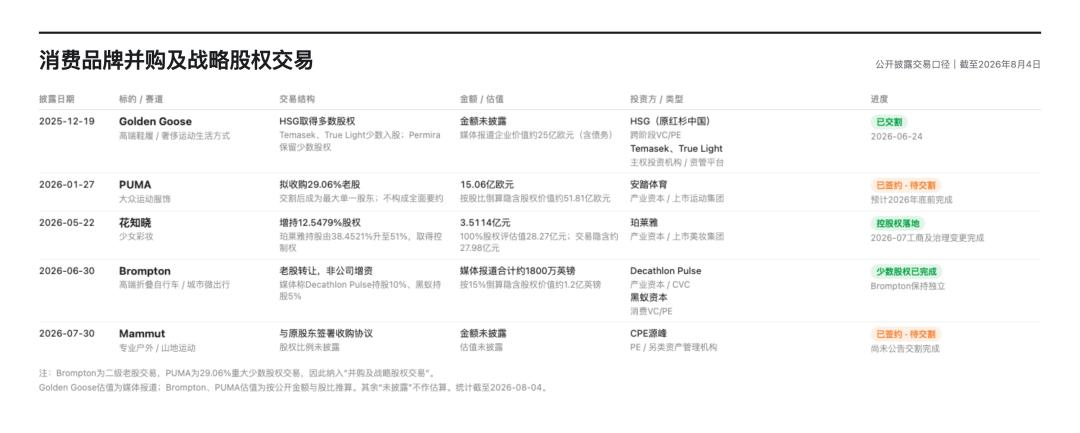
Narrowcast Infographic
The second category is financing for brands that have achieved certain scale and are still in the growth stage: Huaying Capital led the Series B financing of outdoor brand Outopia, Qicheng Capital, Peakview Capital and Black Ant Capital successively invested more than 100 million yuan in tactical apparel brand Longya, Intu purchased 15% equity of the parent company of Full of Aroma with 97.5 million yuan, gold jewelry brand Junpei obtained investment from Deji Plaza, and new brands including outdoor sports brand KAILAS, footwear brand PANE, and accessory brand BLACKHEAD are also the focus of the investment market.
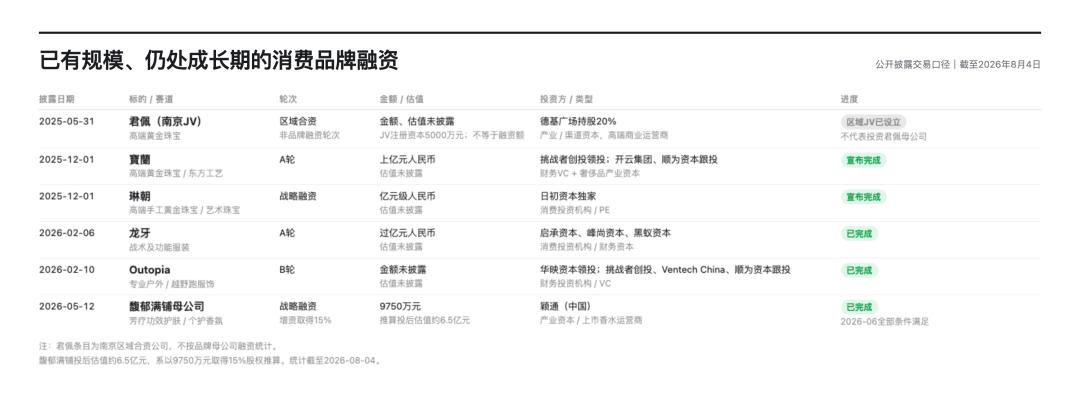
Narrowcast Infographic
The flow of capital has always been a weather vane in the business world. These brands that are still being valued may represent the future of consumption, or they may just be exceptions in the gaps of the consumption cycle, but they are undoubtedly of observation significance: they truly reflect where the measurable value of the current consumer market lies, and where the market-consensus growth opportunities are.
Approaches to tap into high-potential trends
Capital usually values future development space. From this perspective, whether a brand is in a trending track is almost a basic consideration for a growing brand to get transactions. At present, pan-outdoor consumption, mood-based consumption, and fresh snacks are all trending tracks, with many brands participating in and leveraging these trends, but only a few of them can grow effectively and obtain financing.
Data from Worldpanel and Bain can explain this gap: China's urban FMCG expenditure increased by 0.9% in 2025, sales volume increased by 3.6%, but the average selling price decreased by 2.6%; new SKUs from 2022 to 2025 accounted for nearly 40% of all SKUs, but taking 2024 as an example, only 3.9% of new products launched in the year achieved a penetration rate of more than 1% in the first year after listing.
This shows that new consumer products are constantly emerging, but what is missing is a path for effective distribution that does not rely on price cuts.
To distribute new products effectively, at least three questions need to be answered: whether the target group is clear and users can be found at low cost; whether the demand can generate full-price purchases and repurchases; whether the brand can extend to adjacent scenarios and categories. An overly broad positioning will rely on paid traffic, while an overly narrow positioning may have user loyalty but no scale.
Most of these brands that have entered the vision of capital can find a specific segmented entry point from an upward trend, then land on products, prices and target groups, and gradually popularize the track.
Outopia targets the trail running track, which has the most significant growth momentum in the pan-outdoor sector. According to industry data, the number of trail running participants in China exceeded 190,000 in 2025, with a year-on-year growth of more than 50%. Outopia's differentiated entry point is that while most outdoor brands are focusing on new technologies such as GORE-TEX, it chooses to use merino wool to make sports base layers. Of course, this also benefits from one of its co-founders, Aaron Jackson, a fabric expert who once served Lululemon.
In recent years, more and more brands have taken merino wool as their selling point. Data released by Tmall and the International Woolmark (WOOLMARK) last July shows that the growth rate of merino wool products reached 119% within one year. Outopia also saw its transaction volume double year-on-year on the first day of Tmall 618 shopping festival this year.

Longya also seizes the opportunity of pan-outdoor consumption, and focuses on functional attributes, with a stronger professional temperament than mass brands such as Pelliot, which is similar to a cost-effective alternative to Descente.
It started from a niche user group. Its founder Jiang Lei graduated from Tsinghua University with a major in materials science, is a military enthusiast himself, and once founded Tiexue.com, gathering a group of military fans who are familiar with fabrics and parameters. In 2011, he decided to develop tactical apparel by himself because imported tactical apparel was expensive and the quality of domestic products was unstable, and thus the brand "Longya" was born. Since its establishment, Longya has both tactical apparel attributes and cost-effectiveness.
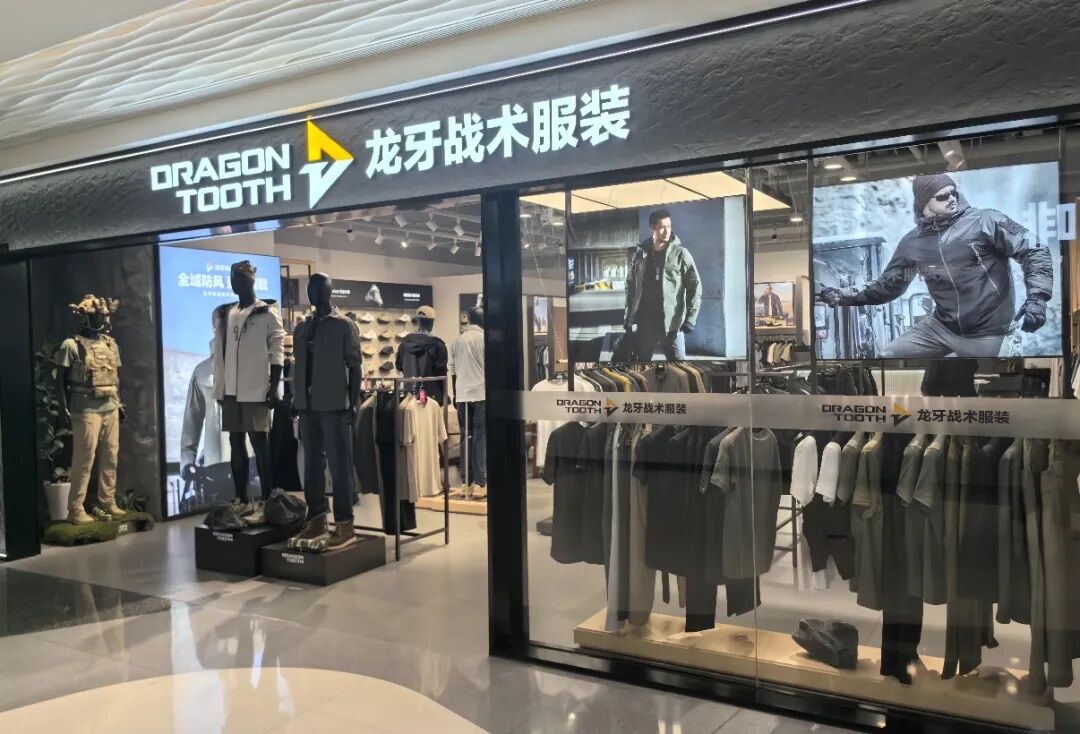
Therefore, Longya's product differentiation mainly relies on the functionality stacked by structures such as multiple pockets and cut pieces: one jacket can contain 218 cut pieces and 12 main pockets; the waist circumference and trouser length are designed separately, so one pair of trousers can have 20 to 30 sizes. With the rise of outdoor activities, the flexibility for squatting, wear resistance and loading capacity required by military fans have been translated into comfort, durability and convenience for field work, fishing, cycling and commuting; the price is also very affordable, and the original price of a core tactical trousers ranges from 260 yuan to 380 yuan.
According to industry data, Longya's revenue in 2025 was about 2 billion yuan, doubling in two years, and a large part of the growth came from Douyin E-commerce. According to data from Chenbanma, it ranked 12th on Douyin's men's wear list in 2025, and rose to 6th during the 618 shopping festival. Data from Huitun shows that as of June this year, Longya has opened 9 live streaming rooms on Douyin. At the end of 2024, Bogdan, a legendary Russian test pilot, went to the Longya store in Taiyuan to purchase products, which also triggered a wave of purchases by a large number of military fans.
However, multiple sizes, multiple categories and accelerated store opening will often increase the depth of brand stocking and the complexity of inventory management, which is also an inevitable test for Longya to move from niche professionalism to the mass market.
Pan-mood consumption is another definite trending track, and aromatherapy brand Full of Aroma, accessory brand BLACKHEAD, Baodeyi and a number of gold jewelry brands all fall into this track.
Full of Aroma does not simply sell perfume or aromatherapy products, but combines aromatherapy, skincare, personal care and emotional experience. It started as a small aromatherapy shop in Hangzhou, and turned to the development of aromatherapy skincare products in 2021. The GMV of Full of Aroma reached 237 million yuan in 2024, and its omni-channel GMV exceeded 600 million yuan in 2025.
Jewelry and accessories are inherently part of pan-mood consumption, which carries the functions of self-pleasure, identity expression, relationship commemoration, auspicious wishes and inheritance, and has become a rising consumption track in the current consumption cycle - the jewelry and accessory sectors of high-end luxury groups such as Cartier and LVMH even achieved double-digit growth in the first half of this year due to the added hedge attribute, and Kering's jewelry sector was even defined as "leading far ahead" with a 20% comparable growth rate.
For domestic accessory brands, different brands focus on different segments: Junpei sells auspicious blessing and social decency; Baolan meets the demand for ritual sense and cultural inheritance through filigree inlay technology; Linchao provides a scarce collection sense with original, all-handmade and long-cycle customization. In terms of transactions, Deji has participated in the equity of Junpei's Nanjing operation company; at the end of 2025, Baolan completed a Series A financing of over 100 million yuan led by Challenger Capital and followed by Kering and Shunwei Capital, and Linchao completed a 100 million yuan level strategic financing exclusively invested by Richland Capital.
BLACKHEAD, an accessory brand with considerable growth rate in recent years, takes another path. It does not have the value preservation function, and its emotional value comes from punk, rock style and niche group identity. 95% of its jewelry is made of stainless steel, which does not fade or corrode. The material cost is much lower than that of gold and silver, and the material is easy to obtain, so the price can be stably maintained at several hundred yuan, making it a friendly consumption choice for young people that can be replaced frequently.
Fresh snacks are also a popular trend. Brands such as Jinlimen, Yili and Jiduohave formed stores with high customer flow and high joint rate through the re-combination of short-baked bakery products, roasted seeds and nuts, braised food and packaged snacks. Some sample stores have shown very high monthly sales, and capital contacts are also very active. But at present, except for Jinlimen which is rumored to have obtained financing and Mingmangmang which has entered the fresh snack sector by incubating the brand "Youdian Tuijian", public financing information in this track has not been released yet.
The reason may be that the essence of fresh snacks is more like short-shelf-life, multi-category catering + retail, and some of the freshly made products add labor, equipment and food safety costs similar to the catering sector. Industry surveys also show that the average loss rate of freshly made snacks is about 8% to 15%, which is significantly higher than that of traditional packaged snacks and bulk snack stores.
In the final analysis, compared with consumer brands, retail investment pays more attention to scale space. Practitioners have a consensus on the health and freshness of snacks, but there is no definite answer whether fresh snacks can become the most suitable carrier. In the end, it will test the stability, replicability and large-scale space of this model.
Offline store opening capability
Many of the above-mentioned brands started online or have a high proportion of online revenue, but at the financing node, they have more or less proved their offline store opening capabilities - of course, some brands only have a small number of sample offline stores for the time being.
The reason why the offline factor is highlighted is not only that online traffic has become more expensive and there is still incremental space offline, but also that platform recommendations, live streaming paid traffic, low-price promotions and low-threshold returns make it increasingly difficult for online GMV to explain brand quality alone. Alibaba Mom even launched a new measurement framework for this purpose - Brand Power = New Customer Scale × Active Search Scale × Brand Repurchase Scale.
Against this background, opening offline stores on the one hand tests whether consumers will actively go to the store, are willing to buy at full price, and even travel specially to the store - which essentially means whether the brand has consumer-side brand recognition; on the other hand, it tests whether the brand can manage rent, labor efficiency, inventory and payback period, whether it has a sufficiently rich product matrix rather than only relying on single hit products, whether it can develop a mature and replicable store model, and finally grow new channels and find new increments.
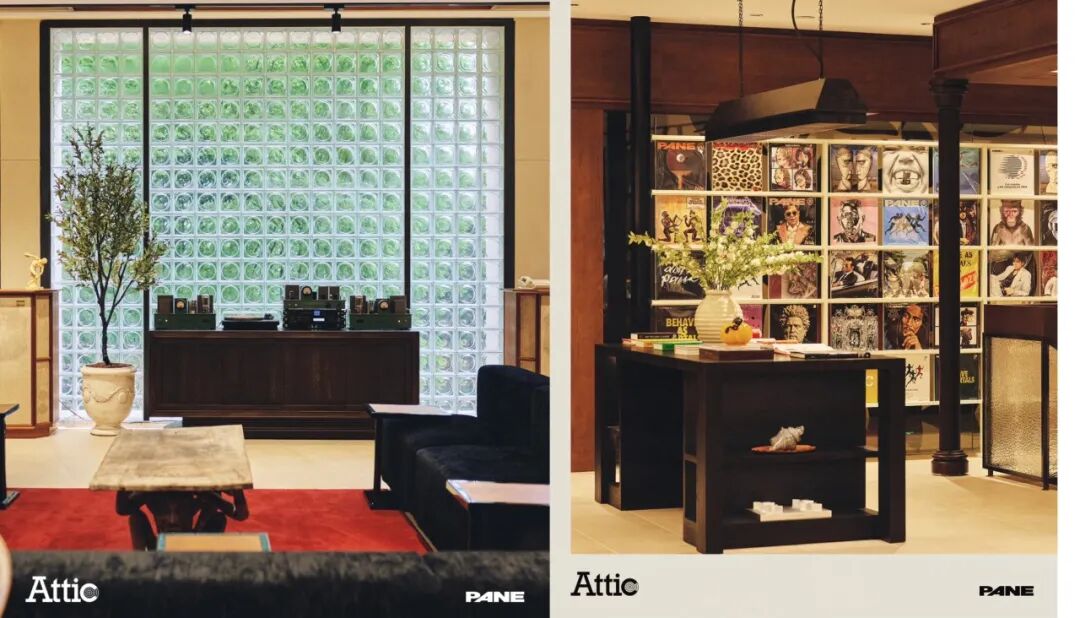
PANE is a typical example of the first set of indicators. It started from mini-program and Tmall. According to third-party estimates, its Tmall GMV exceeded 100 million yuan in 2025, and most of its revenue still comes from online channels so far, but it has attracted the attention of the industry and capital market largely due to the outstanding performance of its offline stores.
PANE started to test offline business through pop-up stores in 2024, and now has 5 official stores and 2 pop-up stores. All official stores are located in non-standard commercial complexes, explaining the brand through display and complete visual system, and each store has an independent theme. For example, the store on Yongyuan Road in Shanghai is inspired by the Greek Revival style, and an experience space on the first floor was specially expanded this year; the store in Shenyang MixC opened in July this year is inspired by the local historical building Liaoning Hotel. During holidays in the first half of this year, foreign customers once accounted for 60% to 80% of the passenger flow in the Shanghai store, and many products needed to be reserved for two to three weeks, making it a sample of high-potential sites.
As of the first half of this year, Longya has opened 37 physical stores, more than 30% of which were opened in the last six months. It did not all enter high-rent shopping malls, but retained a large number of office building and ground-floor stores, relying on online diversion and precise enthusiast visits, with relatively low cost, which is in line with its cost-effective and niche positioning. In the later stage, if the proportion