Feishu is integrated into Doubao and Qianwen Office is consolidated. Is the AI race among major tech firms shifting from the "horse racing" model to the "unified deployment of combined forces"?
On July 30, ByteDance issued an internal notice to integrate the businesses related to Doubao, Feishu and Volcano Engine. Among them, the Feishu product team and the Doubao product team were merged to form a new Doubao product team, which is under the unified management of Zhao Qi, the head of Doubao.
This is an important architectural adjustment for ByteDance's B-end business since it established six business units in 2021. ByteDance stated in the internal letter that AI will profoundly change enterprise productivity and personal work methods. This integration aims to connect the R&D systems of office and productivity products, and further improve the ability to serve enterprise customers.
This round of adjustment is not a simple team merger, but a recombination from products, technologies to the underlying commercial system. After the integration, Doubao is responsible for model capabilities and unified entry, Feishu provides enterprise office scenarios and customer touchpoints, and Volcano Engine undertakes the computing power base, technical infrastructure and commercial support. As a result, ByteDance's B-end AI business has shifted from relatively scattered operations to collaborative operations.
Similar changes are also taking place within Alibaba and Tencent at the same time. Alibaba integrated QoderWork, Wukong and MuleRun into "Qianwen Office", and connected the product and sales systems of DingTalk and Alibaba Cloud; Tencent merged QClaw into the 6th Cloud Product Division where WorkBuddy is located, and gradually concentrated model, application and channel resources on office Agent. The "horse racing mechanism" that used to rely on multi-team parallel trial and error is giving way to the "joint force mode" that emphasizes organizational efficiency and commercial implementation.
When the traffic brought by the C-end red envelope war begins to ebb, why has office Agent become a new battlefield for large tech companies to collectively turn to? From organizational structure reconstruction to work entry migration, how will this competition around enterprise productivity rewrite the roles of Feishu, DingTalk and WeCom?
Large Tech Companies' AI Organizational Reconstruction: From "Horse Racing" to "Joint Force"
At present, the Feishu product team and the Doubao product team have completed the integration and formed a "new Doubao product team", which is under the unified management of Zhao Qi, the head of Doubao. This adjustment aims to open up the R&D system of productivity products, inject the experience of enterprise office and collaborative scenarios accumulated by Feishu in the past ten years into Doubao, and promote Doubao to become the unified product export of ByteDance's Agent capabilities.

At the same time, Feishu's GTM system, including the marketing, sales and customer service teams, has also completed integration with the relevant teams of Volcano Engine, and established a new To B GTM organization for enterprise customers - "Creativity Service Platform" to unify the capabilities of enterprise market expansion, sales conversion and customer service.
After the adjustment is completed, ByteDance has formed a clearer three-layer architecture in the field of enterprise services and AI products: Volcano Engine is responsible for the underlying computing power, technical infrastructure and commercial support, Doubao undertakes model capabilities and user entry, and Feishu provides specific office scenarios and enterprise penetration channels. The three have shifted from relatively independent business units in the past to a system where the base, core and scenarios collaborate with each other.
Feishu was born in 2016, initially to meet ByteDance's internal collaboration needs, and was officially open to the outside world in 2019. In 2021, after ByteDance promoted the business segmentation adjustment, Feishu, together with Douyin and Volcano Engine, was listed as a first-level business division. Before the rise of large models, Feishu mainly focused on enterprise collaboration, while Volcano Engine was responsible for cloud computing and technical services. The two had a clear division of labor and reported to Liang Rubo, CEO respectively.
At the end of July 2026, major domestic Internet companies unanimously accelerated the pace of AI business integration, and reconstructed products and organizational systems around models, Agents and enterprise office scenarios.
Alibaba has deeply integrated the three products QoderWork, Wukong and MuleRun, which originally belonged to different business directions. Among them, QoderWork focuses on AI programming and desktop applications, Wukong focuses on DingTalk's enterprise workflow and permission system, and MuleRun is mainly responsible for cloud workspace and Agent orchestration capabilities.
The new integrated product is named "Qianwen Office", which is fully managed by Chen Yusen, the new CEO of DingTalk born in 1992. Chen Yusen did not come from the original management system of DingTalk, and had promoted the MuleRun business on the cloud. This personnel arrangement shows that Alibaba is strengthening its emphasis on Agent cross-platform collaboration and cloud-native capabilities. According to the new product architecture, "Qianwen Office" takes the Tongyi Qianwen large model as the unified base, and is deeply integrated with the DingTalk enterprise ecosystem, focusing on "one-stop AI office".
On July 20, Tencent issued an internal notice to merge the relevant businesses and teams of the QClaw Product Center into the 6th Cloud Product Division. This department is also responsible for WorkBuddy, another AI office agent of Tencent, which has become an important product of the company in the field of AI-native desktop office. According to the data in June 2026, the monthly visits of WorkBuddy have exceeded 20 million, ranking first in the domestic market.
In the past six months, major domestic Internet companies have generally adopted the multi-line parallel "horse racing mechanism" in the AI field to quickly try and make mistakes through different teams and products. As technology and products gradually enter the mature stage, the focus of competition is shifting from single-point innovation to systematic capability building. Giants have taken the initiative to break down departmental barriers, further integrate model R&D, application engineering, product operation and marketing, to cope with the systematic competition that emphasizes collaborative efficiency and commercial implementation capabilities.
C-end Capital Burn Ebb, Major Tech Companies Bet on Office Agent
Nowadays, the focus of AI competition among major domestic Internet companies is gradually shifting from C-end traffic competition to B-end productivity scenarios, and office Agent has become the core of the new round of layout.
In early 2026, Internet companies launched a high-investment "red envelope war" around C-end users, trying to rapidly expand the user scale and usage frequency of AI products with the help of the Spring Festival traffic window.

On January 25, Tencent announced that the Yuanbao App will launch the "Split 1 Billion Yuan Cash Red Envelope" activity on February 1; on the same day, Baidu announced that it will invest 500 million yuan from January 26 to March 12, and combine red envelope incentives with Wenxin Assistant, AI special effects and card collection tasks. On February 2, Alibaba further increased its efforts and announced that Qianwen would invest 3 billion yuan to launch the "Spring Festival Treat Plan". On February 10, Doubao under ByteDance officially entered the market, distributing cash red envelopes with the help of the traffic entrance of CCTV Spring Festival Gala, and launching more than 100,000 technology prizes such as smart car usage rights and robots.
However, what the red envelope subsidies bring is more traffic "ripened" by short-term incentives, which is not enough to prove that C-end AI has formed a stable and sustainable commercial closed loop.
As of February 23, Doubao's daily active users still exceeded 100 million, an increase of about 40% compared with the beginning of February; Qianwen's daily active users remained at about 32 million, although 3.6 times higher than before the activity, it has dropped by more than half from the peak; Yuanbao dropped from 40.54 million on New Year's Eve to 7.685 million, a drop of more than 81%, basically returning to the level before the red envelope activity. The obvious decline in user scale shows that before monetization methods such as advertising, membership subscriptions and transaction commissions cannot cover costs, C-end AI is still a business with high investment and low certainty. Platforms not only have to bear the costs of model training, computing power procurement and reasoning calls, but also need to continue to invest in red envelopes, free orders and advertising expenses to maintain user activity.
In contrast, companies focusing on the B-end market are showing higher commercialization efficiency. Anthropic, which focuses on the enterprise-level AI market, has reached an annual recurring revenue (ARR) of 741 billion US dollars; although OpenAI has a larger C-end user base, its ARR is only about 56% of that of Anthropic. From this perspective, the clearer willingness to pay of enterprise customers and more stable usage scenarios are promoting the focus of AI competition to further shift to the B-end.
Facing the accelerated implementation of office Agent, major domestic Internet companies are further increasing their product, model and channel layout.
In mid-January this year, after the release of Claude Cowork, Tencent product manager Wang Shenjie and others developed a similar product WorkBuddy over the weekend, and Tencent thus quickly launched internal verification of AI office agents.
Since March, Tencent has gradually concentrated relevant resources on WorkBuddy, and promoted it to cooperate closely with Yao Shunyu's team, the head of Hunyuan large model. In June this year, Tencent further increased its marketing efforts, with advertisements covering social media, streets and subway carriages; at the product level, it has successively accessed services such as WeChat Pay, ima, QQ Mail, QQ News and Select Stocks, and merged the "lobster" product QClaw into the 6th Cloud Product Division.
ByteDance is also accelerating the commercialization of enterprise-level AI. By July 2026, calculated based on the average consumption caliber, its large model business annualized recurring revenue (ARR) has reached 4 billion US dollars. Different from traditional software which mainly relies on account subscriptions, most of ByteDance's related revenue comes from Token consumption of enterprise customers, which means that AI capabilities are continuously embedded in the daily production process of enterprises. In the second quarter of 2026, new customers of Feishu showed obvious AI procurement tendency, and more than 90% of customers purchased AI products at the same time as purchasing office suites.
Work Entries Are Being Rewritten, AI Agent Moves to the Forefront of Office
In the past ten years, Feishu, DingTalk and WeCom have reshaped the way of enterprise collaboration. They migrated the processes that were originally completed offline to online, and "formatted" organizational collaboration through standardized templates, approval links and permission systems. Taking reimbursement as an example, a process is usually broken down into three nodes: "submission - approval - financial confirmation", and employees need to complete the operations step by step within the framework preset by the system. Its underlying logic is that people adapt to the software: users must first understand the product rules and process nodes, and then perform corresponding operations at the corresponding positions.
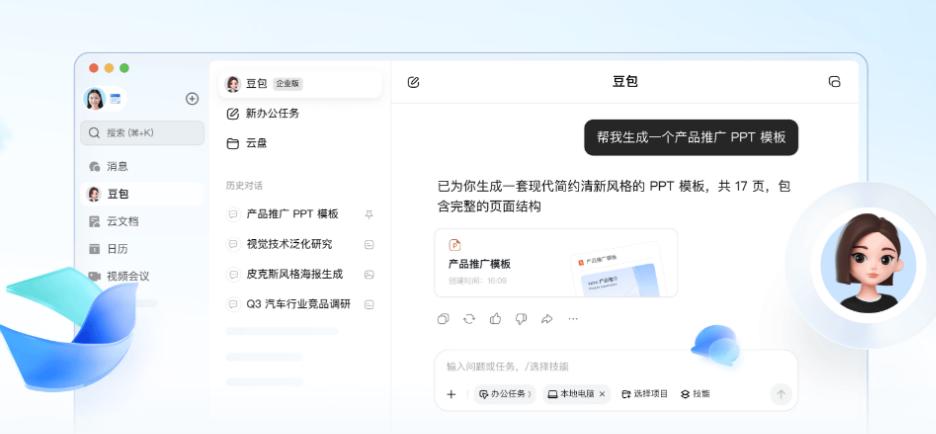
The emergence of AI Agent has begun to shake this model. It is not simply adding an AI-assisted entry to the existing process, but autonomously understanding requirements, decomposing steps and arranging execution paths around the task objectives, thus bypassing some preset processes.
With the change, the entry of enterprise work is no longer limited to traditional instant messaging tools or document interfaces, and AI-native office agents are becoming new task initiation and execution interfaces. According to the "2026 Q2 China Office Agent Platform Market Insight Report" released by Analysys, in June 2026, the total visits of 17 mainstream desktop AI-native office agents in China have exceeded 60 million.
WorkBuddy is one of the products with rapid growth. Since its release in March 2026, its visits have increased from 8.85 million in that month to 20.97 million in June, an increase of about 2.4 times in three months. Tencent also stated in its first quarter 2026 financial report that in terms of daily active accounts, WorkBuddy has become the most popular productivity AI agent service in China.
In this transformation, collaborative office software, which was once at the core of enterprise digitalization, is undergoing a strategic re-evaluation. As AI moves from auxiliary functions to the forefront, the roles of products such as Feishu and DingTalk have also begun to change: they are gradually transforming into application carriers and digital bases that carry model capabilities and connect enterprise data and business processes.
The future office software may no longer be limited to instant messaging, document editing and process approval, but evolve into an intelligent hub that connects multiple applications and can actively understand and complete tasks. Agent needs to continuously call information and perform actions among meetings, knowledge bases, spreadsheets, PPTs, emails and group chats. Therefore, the key to platform competition is not how strong a single function is, but whether it can tear down the "walls" between applications to achieve cross-system collaboration and automated execution. The platform that takes the lead in completing this integration will have more opportunities to gain the right to speak in the future enterprise software ecosystem.
This article is from the WeChat official account "Entertainment Unicorn" (ID: yuledujiaoshou), Author: Wu Jiujiu, Editor: Mia, Published with authorization from 36Kr.