Tencent Music and SM Entertainment have established a joint venture. Is K-Pop really coming back?
From copyright cooperation to capital equity participation, and then to the establishment of a joint venture, the relationship between Tencent Music and SM Entertainment has taken another step forward.
Tianyancha shows that on July 30, SM Entertainment and Tencent Music jointly established Aisiteng (Beijing) Culture Communication Co., Ltd., with a registered capital of 40 million RMB. The company is jointly held by Tencent Music (Beijing) Co., Ltd. and Kasimeng (Shanghai) Culture Communication Co., Ltd. under SM. Zhou Mi, a member of Super Junior-M, serves as the legal representative. Its business scope covers multiple fields including cultural entertainment brokerage, copyright agency, performance services, cultural and artistic creation, and exhibitions, almost covering the core businesses of Korean artists' development in China.
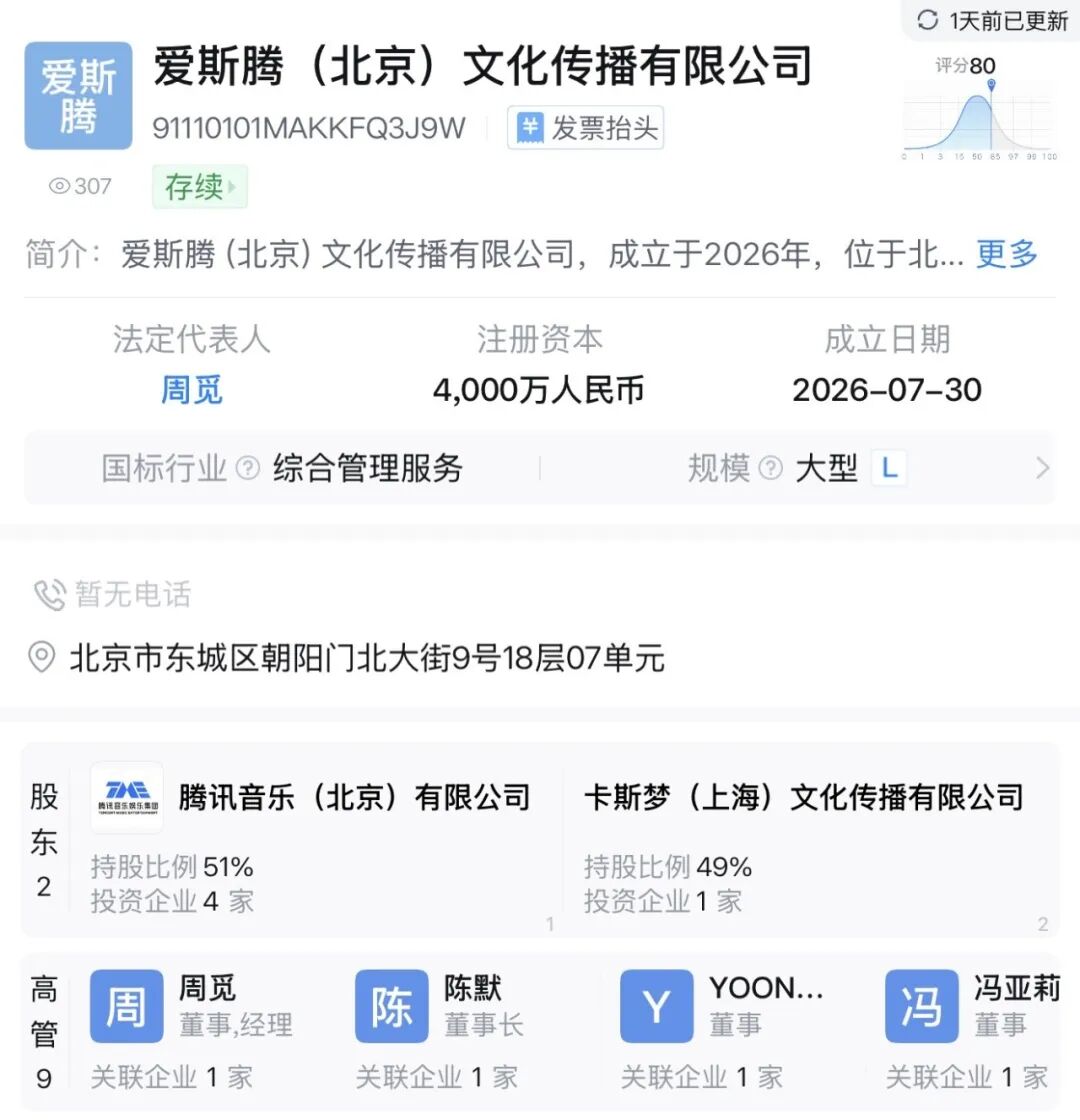
This is the first time that SM has formed deep ties with a leading Chinese music platform in the form of a joint venture, which also means that K-POP's layout in the Chinese market is entering a new stage. Looking at the timeline of the past decade, the signal it sends is even more meaningful.
As early as 2019, Tencent Music reached a strategic cooperation with SM Entertainment, and the two sides cooperated in areas such as digital music copyright and artist promotion; in 2025, Tencent Music acquired approximately 9.38% of SM Entertainment's shares from HYBE, becoming its second-largest shareholder, further upgrading from business cooperation to capital bonding.
Now, the establishment of the joint venture has effectively implemented the cooperation of the past few years at the level of localized operation. The cooperation model is also very clear: SM provides artist and IP resources, Tencent Music provides platforms, promotion, ticketing, performance and local commercial resources, and the two sides are jointly responsible for the operation of the Chinese market.
From an industry perspective, this incident sends at least three signals:
First, the Chinese market remains one of the most important overseas markets for K-Pop. Even in recent years, South Korean entertainment companies have continuously expanded their presence in Europe, America and Japan, Chinese fans still have extremely strong consumption power whether in terms of album sales, digital music consumption or the concert market. Therefore, SM is willing to entrust deeper local operations to local partners.
Second, Tencent Music is evolving from a music platform to a music entertainment infrastructure. In the past, Tencent Music mainly provided streaming media services. Now it has a complete ecosystem covering long-form audio, copyright investment, artist management, record labels, performances, ticketing, and commercialization. Coupled with its investment in SM and the joint venture, its role is increasingly like a "super entry point" connecting international music companies and the Chinese market.
Third, the China strategies of international entertainment companies are changing. In the past, they relied more on general agents or copyright agencies, but now they tend to set up joint ventures with local platforms to achieve more efficient local operations. This model may also be replicated by more international record labels and entertainment companies in the future.
At the same time, another notable point of this cooperation is the timing.
As we all know, after 2016, China-South Korea cultural exchanges entered a low ebb. Although the authorities have never issued an official document titled "Korea Restriction Order", the entire industry can clearly perceive that the market environment has changed significantly. Korean artists' concerts, variety shows, film and television collaborations, and commercial activities have decreased rapidly, many confirmed cooperation projects have been put on hold one after another, and the Chinese market once "disappeared" from the global K-POP landscape.
But market demand has never disappeared.
Chinese fans are still buying albums, charting for their idols, and chasing concerts, except that the locations have changed from Beijing and Shanghai to Bangkok, Singapore, Tokyo, and even Seoul. Many people joke that Chinese consumers spend the most money but have to fly abroad to support their idols.
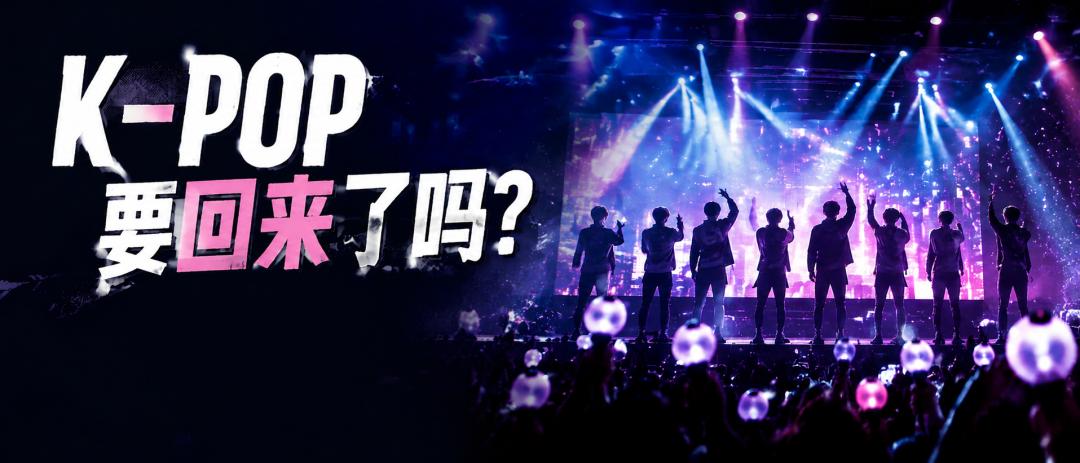
For South Korean entertainment companies, operations in the Chinese market have shifted more to online channels.
In the past ten years, the development of K-Pop in China has relied more on digital music, physical albums, e-commerce sales, online memberships and social media communication. What is truly missing is the offline industry. Concerts, fan meetings, commercial endorsements, variety show recordings... These businesses that originally had the highest profit and could best amplify the value of star IP have never returned to the state before 2016.
However, in the past two years, with the relaxation of the "Korea Restriction Order", the market has begun to send positive signals. Previously, performances by Korean artists in China have already obtained approval for filing. Although they have not been successfully held, they may gradually resume in the near future.
Therefore, when Tencent Music and SM choose to set up a joint venture covering performances, copyright, brokerage and other businesses, what they are targeting is exactly the missing piece of the puzzle in the past ten years.
Of course, the establishment of a joint venture does not mean that the so-called "Korea Restriction Order" has been fully lifted. Cultural exchanges and commercial performances still need to be examined and approved in accordance with relevant regulations.
But capital is often more sensitive than the market.
Tencent Music has continuously invested in SM, becoming an important shareholder, and then established a joint venture. This capital layout has lasted for seven years. If enterprises are willing to increase their investment at this point in time, it at least shows that what they are optimistic about is not a short-term market rebound, but the commercial opportunities that the Chinese market will release again in the next few years.
As for whether this investment can finally deliver the expected returns, it depends on whether the market environment and cultural exchanges can continue to pick up in the next few years.
This article is from the WeChat Official Account "Music Pioneer" (ID: nakedmusic), written by Zhou Mo, edited by FAN Zhihui, and published with authorization from 36Kr.