AI short dramas have pushed the "going global" craze to a new peak, how many remaining tickets for this voyage are still available?
Four years ago, a company with Chinese background verified the one-minute vertical short drama model in North America, and its application topped the US iOS entertainment chart in the second half of 2023, once outshining TikTok, thus kicking off the prelude to the global expansion of Chinese short dramas.
After that, Chinese short drama operators set off a magnificent wave of going global. Spreading from North America to more than 200 countries and regions around the world, with the market dominance of Chinese teams gradually joined by players from South Korea, India and other regional markets, short drama, an entertainment content format originating from China, has begun to sweep the globe.
Earlier this year, overseas industry analysis firm Omdia stated that micro short dramas have ushered in a milestone moment. Data shows that for the first time, US users spent more time watching vertical videos on mobile devices than watching content on Netflix, Disney+ or Prime Video.
Various signs indicate that Hollywood can no longer stand by. Dramabox, a Chinese short drama global operation platform, appeared on Disney Accelerator's list last year; Fox Entertainment invested in Israeli short drama platform Holywater and pledged to produce hundreds of vertical series; Kim Kardashian invested in GammaTime, a short drama platform founded by former Miramax president; Jeffrey Katzenberg, who founded Quibi, returned to this market through investment, and his venture capital firm WndrCo invested in Idilio, a Latin American short drama platform...
In North America, whether it is micro short drama applications, social media giants (TikTok, Snapchat, Instagram) or streaming services (Peacock, Amazon Prime and India's JioHotstar) — all are developing products or adding relevant features to seize this opportunity. Brands such as Crocs, Dr Pepper and JCPenney have launched branded short drama advertisements, which have gained strong attention from consumers.
The overseas short drama market seems to be retracing the path that the domestic market has gone through. But behind the seemingly steady development, a transformation has quietly started inside the global expansion of short dramas.
By 2026, the AI production line of the short drama industry, which started from the Chinese market, has risen rapidly. This logic has been quickly transmitted to overseas markets.
Companies including Dianzhong Technology, Jiuzhou Culture, Kunlun Wanwei, Maiya Media, Chinese Online, Shanhai Xingchen, and even Tinghuadao, have all gone all-in on global expansion in the first half of the year, and AI short drama going global has become the core battlefield for short drama platforms competing in the overseas market.
Companies in different links of the short drama industrial chain such as Yuewen, Chizi City, and Wondershare Technology have also increased their investment to enter the global short drama track.
When AI penetrates from an instrumental auxiliary role to the full chain of script creation, content production, multilingual dubbing and translation, localization adaptation and even delivery monetization, the pain points that once plagued the global expansion of short dramas, including high localization cost, slow capacity ramp-up and high trial-and-error threshold, are being solved one by one by technology.
The global expansion of short dramas is undergoing an unprecedented paradigm reconstruction.
In TikTok's latest monthly revenue-sharing list, local AI-generated short dramas appeared for the first time, and AI remastering was taken as an important incentive direction.
As of the first half of 2026, Chinese short drama operators still account for 80% of the global short drama market share. ReelShort and Dramabox still maintain the pattern of two leading players.
However, no matter the accelerated layout rhythm of large enterprises, the matrix transformation of existing platforms, or the entry of emerging AI short drama platforms, all are launching new impacts on the ranking of global short drama operators.
In this new technology-driven race, who will finally seize the advantageous position of short drama global operation in the AI era?
The Short Drama Global Operation Circle: All-in on AI
The sudden acceleration of short drama global expansion took place in the first half of the year.
Third-party data forecasts show that the overseas AI short drama market size is expected to reach 650 million US dollars in 2026, a year-on-year increase of about 6 times.
With the rapid penetration of AI, the original dichotomy of translated dramas and local dramas in the overseas market is being replaced by AI-generated dramas and live-action dramas.
In the first quarter, along with the update of seedance 2.0, the domestic AI short drama output took off rapidly. Almost at the same time, leading short drama institutions such as Dianzhong, Jiuzhou, Maiya, Shanhai, and Kunlun all went all-in on AI.
At the beginning of March this year, Chen Ruiqing, chairman of Dianzhong Technology, took the lead in making the latest prediction for global short dramas: In the next 5-10 years, the market size of China's micro short drama industry will exceed 4 trillion yuan. Among them, the overseas short drama market will exceed 1.5 trillion US dollars, equivalent to 2.5 to 3 times the size of the Chinese market, and China will become the world's most powerful story factory.

Prior to this, the widely circulated market prediction was that the overseas micro short drama market size is expected to exceed 500 billion US dollars. This figure is calculated based on the scale of global short video audiences and the short drama penetration rate close to the domestic level.
This figure has obviously increased several times on the original basis.
Chen Ruiqing attributed the core reason for the rapid market growth to AI promotion. In 2025, there were about 2 million practitioners in the whole industry, with an annual production capacity of about 50,000 dramas. This year, the total number of micro short dramas in the whole industry will exceed 1 million. Next year, it may exceed 5 million. In this process, China will become the world's story factory, and this singularity is coming.
By April, Maiya shouted at the "Global Short Drama Ecological Cooperation Forum in the AI Era" at the Chengdu Online Audio-Visual Conference that the singularity of the global short drama industry in the AI era has arrived.
NetShort, launched in September 2024, although more than a year later than its peers, has entered the first echelon since March this year. Maiya attributes the acceleration of NetShort to AI production capabilities, a 100-person translation team covering 17 languages, AI dubbing and translation that emphasizes "content re-creation" rather than word-for-word literal translation, and AI automated delivery.

Also in April, Tinghuadao, one of the most well-known domestic short drama studios, announced in a high-profile manner that it would join hands with Zhangwan to shift to AI short drama global operation.
Almost at the same time, Chinese local short drama global operators have collectively turned to AI.
Wang Jiacheng, founder of Jiuzhou Culture, said in an interview with Shanghai Securities News in May that currently AI dramas and comic dramas of Jiuzhou Culture have accounted for 95% of the company's total production capacity (including live-action shooting and AI content), and this proportion is expected to further increase in the future.
As early as the second half of 2025, Jiuzhou cut more than half of its live-action drama production capacity and shifted to AI dramas. By March 2026, Jiuzhou announced that its monthly production and broadcast volume reached 1399 new dramas, which is called "cliff-leading" by many practitioners.
During the semi-annual report disclosure window period, the data of listed companies further confirmed that AI short dramas have completely overwhelmed live-action dramas and become the mainstream layout of leading companies.
For A-share listed company Kunlun Wanwei, the AI short drama platform business has become the fastest growing application scenario of its Tiangong AI ecosystem.
According to the disclosure of the listed company, Tiangong AI achieved an annual recurring revenue (ARR) of more than 800 million US dollars in its AI Native model and product business in the second quarter of 2026. Among them, the ARR of the AI short drama platform exceeded 700 million US dollars, accounting for nearly 90%. Since the beginning of this year, more than 80% of the newly released content on DramaWave has been generated by AI.
As one of the earliest players involved in AI comic dramas, Chinese Online stated in a recent investor exchange meeting that its flagship platform FlareFlow has now launched more than 500 high-quality AI short dramas. It is expected that by the end of 2026, the annualized production capacity of the company's AI short dramas is expected to reach 3000. The application of AI has promoted the leap of global short dramas from the traditional "shooting handicraft system" to the "automated industrial application system".

At the end of last year, Chinese Online launched an A+H share listing impact to further expand the space for short drama global operation.
AI Unleashes Production Capacity, Reconstructing the Paradigm of Short Drama Global Operation
The most important impact of AI on global short dramas is breaking the original production capacity bottleneck of live-action short dramas.
Previously, the cost of shooting a live-action short drama in North America has climbed to 200,000 to 300,000 US dollars, and it often takes 2 to 3 months to complete and launch. Even for leading global short drama platforms, the monthly update of localized content is only dozens of episodes, far lower than the domestic rhythm.
The high cost made local overseas short dramas highly concentrated in female-oriented themes such as domineering presidents and werewolves. With the penetration of AI, the cost of AI short dramas can be compressed to tens of thousands of US dollars, the cycle can be as fast as 2 weeks, and there is more room for trial and error in terms of themes.
For example, traditional overseas live-action male-oriented short dramas once declined, but AI just makes up for the grand scenes that they most need but cannot afford to shoot in live action, so categories such as fantasy western fantasy, the return of war gods, system flow, and supernatural doomsday have achieved excellent performance in traffic. According to data, the proportion of investment in male-oriented related themes has increased month by month.
For example, the hit global short drama One Move God Mode in the first half of the year combines western fantasy mythology and male-oriented counterattack, which skillfully deeply binds the mature "grassroots counterattack" narrative template in Chinese online literature with the Greek mythology worldview familiar to Western audiences.
In the first batch of global AI short dramas delivered by Tinghuadao in May this year, Doomsday Boss also belongs to this kind of narrative, integrating elements such as doomsday, science fiction, mecha, and zombies that overseas audiences pay more attention to. In the past, the use of these elements in live-action short dramas faced high production costs.
Data can prove that the proportion of AI short dramas going global is gradually increasing. As an important carrier channel and operating platform for global short drama content, TikTok released its May short drama revenue-sharing report, showing that the total monthly revenue sharing reached 21 million US dollars, a 40% month-on-month increase and a record high. Among them, AI short dramas accounted for 6.5 million US dollars, and the proportion rose to 30%.
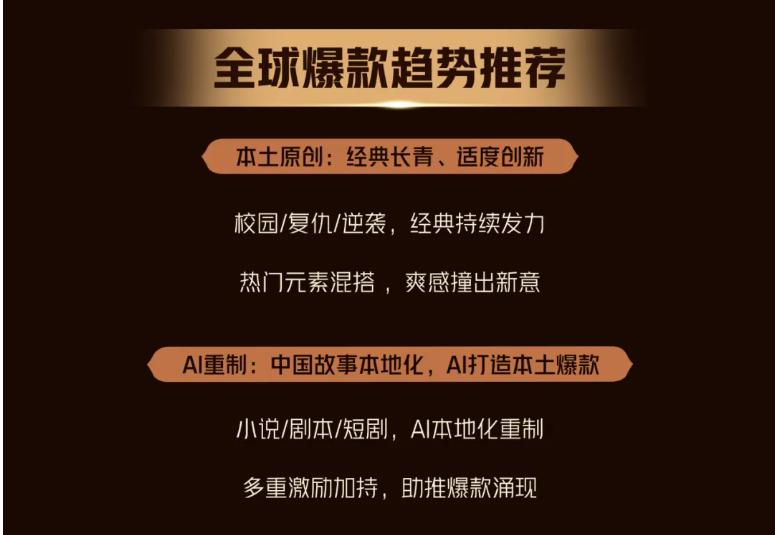
In June, the total revenue sharing of TikTok short dramas further rose to 22 million US dollars, among which local AI dramas increased by 112%. This is the first time that TikTok's report has mentioned local AI dramas, with obvious signal meaning. It also clearly put forward the direction of AI remastering in the creation guidelines: Chinese stories and content such as novels, scripts and short dramas, after high-quality localized script adaptation and with the help of AI large-scale production capacity, can create AI local dramas and open up the global market for high-quality stories.
The reduction of thresholds and efficiency reconstruction of short drama global operation has become a reality. Actively or passively, more practitioners are joining the army of short drama global operation.
On the active side, many global short drama platforms and teams have seen the positive effect of AI on overseas content supply, and believe that this is a blue ocean market.
Leading domestic film and television companies such as Huace Film & TV and Perfect World Pictures have all entered the AI short drama global operation track.
At the same time, after AI removes the thresholds with extremely high live-action costs, many talented or established screenwriters have come to try to make AI short dramas, which further expands the talent pool for AI dramas going global.
Under the domestic production capacity war, the domestic short drama market is highly involuted, coupled with increasingly strict supervision, prompting some teams to shift their production capacity to overseas AI dramas.
However, some overseas live-action shooting teams are not very enthusiastic. The reason is that they feel that the price of AI dramas is still too cheap, and they do not want to join this new rule of the global operation game, even though AI has reduced the trial-and-error cost to a very low level.
Along with the booming industry, there has always been a question about whether overseas AI short dramas can make money, but there is no doubt that AI is already changing the content ecology and business model of short drama global operation.
In the words of Wang Jiacheng, founder of Jiuzhou Culture, AI has changed the old global operation logic of "selecting 1 story out of 100 to translate and sell abroad" to "directly using AI to translate 100 stories into multilingual versions and launch all of them".
Relying on the advantages brought by AI, China's mature online literature IP is being quickly converted into video content. The hit narrative logic that originally belonged only to the Chinese market is being transformed into content products adapted to different cultural contexts, promoting the influence of China's story factory to radiate to the whole world.

TikTok Accelerates Layout, Chinese Platforms Make Strategic Adjustments
Compared with four years ago when short drama global operation just started overseas, the awareness of Chinese vertical short dramas at major film festivals and in the North American market has been fully improved since the beginning of this year.
Disney and Google have launched vertical video channels on their own products; short dramas made their appearance at the Cannes Lions International Festival of Creativity, attracting brands such as Procter & Gamble and Apple to shoot branded short dramas; local talk show talents and other well-known performing artists star in short dramas; even Jeffrey Katzenberg, who founded Quibi, has refocused