No need to engage in cutthroat competition for roles, "AI Town" generates millions of US dollars in monthly revenue.
In the second half of last year, an AI companion product called "Enjoy-AI Town" first came into our observation scope on the US entertainment download chart, with its monthly revenue at that time being only around 70,000 USD. According to data from App Magic, its revenue started to break through around February this year, and the highest monthly revenue after revenue sharing reached 980,000 USD. It is roughly at the top 5 level among mobile products in the AI companion category whose commercialization prospects are not yet clear.
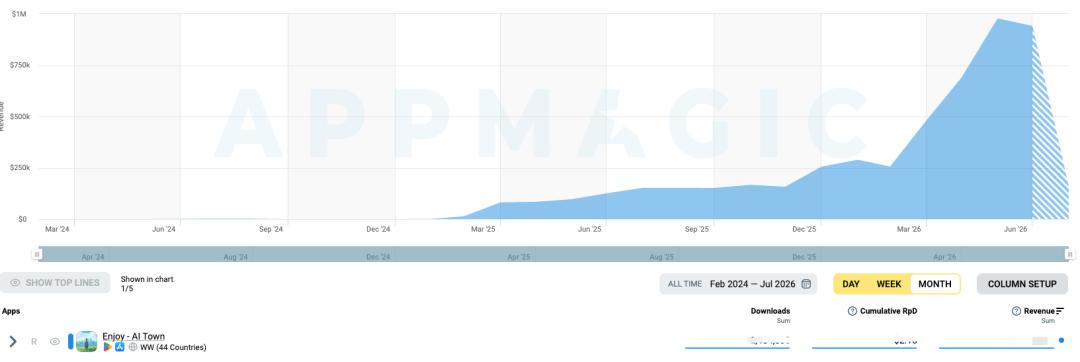
Dual-platform revenue of "Enjoy-AI Town"
In terms of core gameplay, its experience is similar to a low-cost hybrid of *The Sims* and Chinese interactive story games. Users can create locations and customize characters in the small town, chat and interact with the characters, and develop storylines. It is not a particularly refined product overall, yet it has achieved explosive growth.

1. Riding on a trending concept, but delivered a "rough" product?
Looking at the entire AI companion category, most products "look identical": users set or select characters, chat with them to simulate intimate relationships.
Head products like "LoveyDovey" follow this model, and subsequent imitators also stick to this routine. What everyone competes for is nothing more than whether the character setting is detailed enough and whether the dialogue is human-like enough. In the final analysis, all of them adopt the 1v1 mode of "one user facing one character".
At first glance, the only difference between "Enjoy-AI Town" and mainstream products is that it adds a "small town" feature.
The concept of the small town can be traced back to 2023, when Stanford University published the paper *Generative Agents: Interactive Simulacra of Human Behavior*. In this research, researchers tried to let 25 AI agents live in a virtual small town and observe their social behaviors. After the paper was released, a16z jointly developed an open-source project AI Town with Covex, which has gained more than 10,000 stars on GitHub.
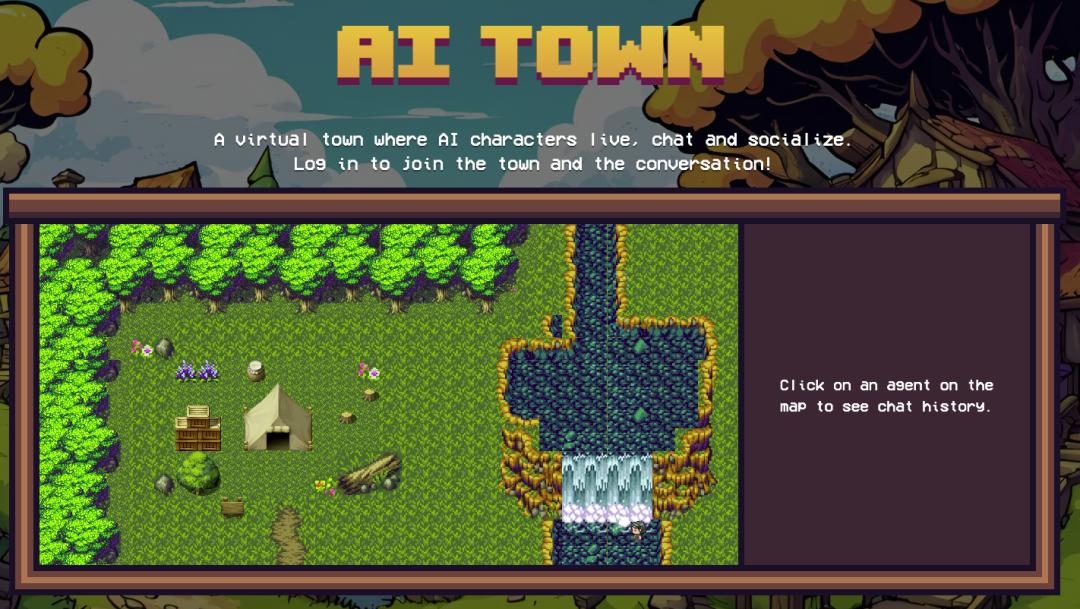
Technical experiment AI Town by Covex and a16z | Image source: official website of Covex AI Town
Although it is quite popular in the developer community, no one has turned it into a truly profitable product before the launch of "Enjoy-AI Town". "Enjoy-AI Town" refers to the aforementioned paper and previous open-source projects, turning the mode of "humans observing how AIs socialize" into the mode of "humans socializing together with AIs". Users are no longer bystanders, but directly build relationships with AI residents in the small town, create stories, and accumulate assets, positioning itself as "a social world of AI characters you can chat with, grow close to, and create".
However, the product built around this positioning is indeed not very refined.
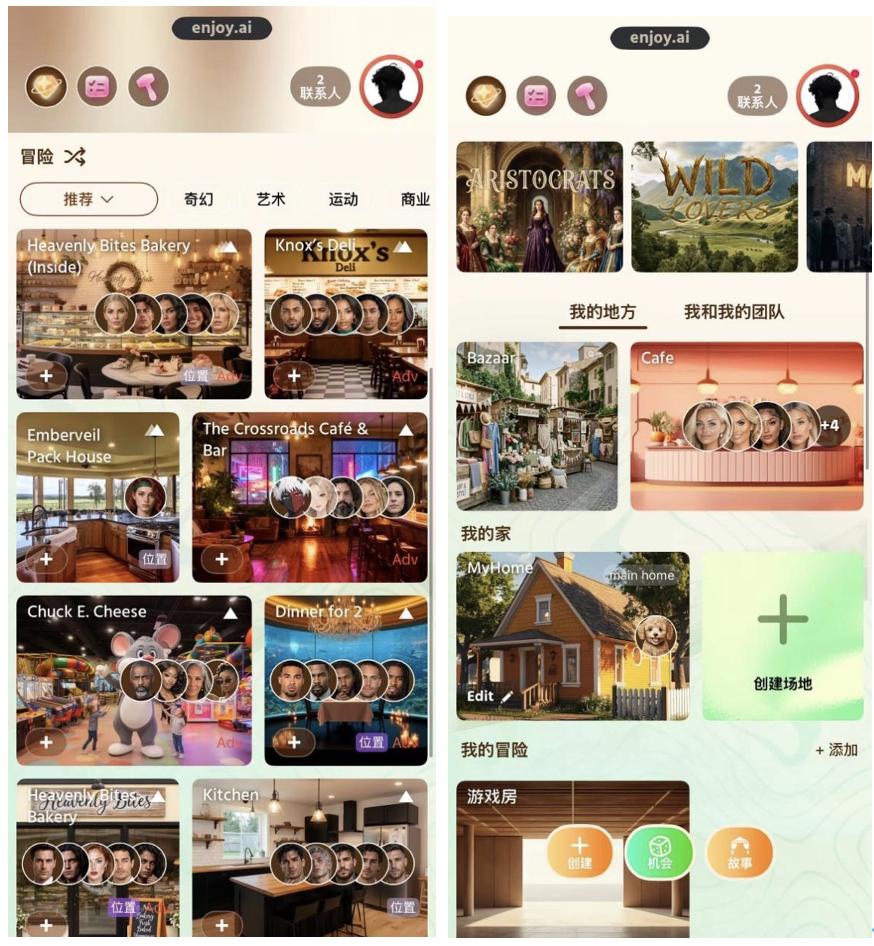
Landing page of Enjoy-AI Town. The right picture shows scenarios related to users: the user's home, Café (gathering NPCs with relatively close relationships), and Bazaar (similar to social media feeds, where you can see posts published by other human users)
The so-called small town is composed of a series of "scenarios", and users can generate both the scenarios and the characters in them independently. When you click into a certain scenario, you will see a 2D background image, and AI characters appear in the form of 2D standing illustrations in the scenario. Click on the character to enter the dialogue interface. However, the dialogue experience is quite good, and you can tell that the team has put a lot of effort into the character settings and reply quality. The replies include text and voice (voice features have usage restrictions). There is a row of interactive buttons above the chat box: gifting, sharing food, changing outfits, and more in-depth interaction methods, which need to be unlocked step by step by increasing the favorability level (users can purchase "magic" through in-app purchases to jump to the specified relationship level with one click). The overall gameplay is highly similar to that of "LoveyDovey" and other products that focus on "developing intimate relationships with characters".
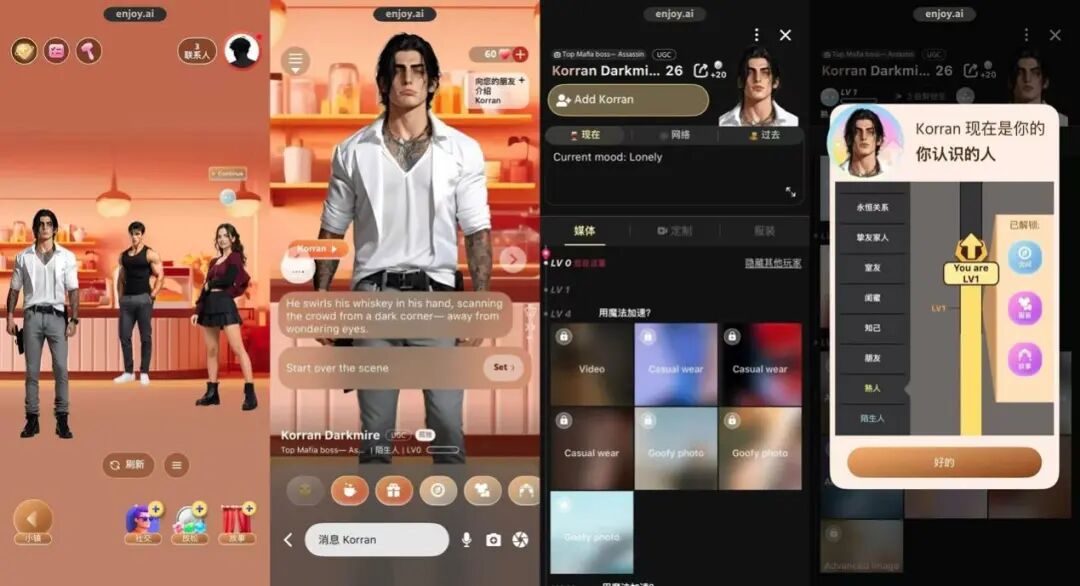
Note: Interaction methods include sharing food, gifting, changing outfits, recruiting team members, shaking hands, hugging, kissing, etc. The interaction methods are related to gender and need to be unlocked by reaching a certain favorability level.
When the relationship advances to the "acquaintance" level, a function called "Story" will be unlocked. Its form is close to a lightweight interactive novel, where users can choose plot branches, call other characters, and create new locations to promote the storyline. Whether it is scenarios, characters or stories, the underlying logic is UGC: the content made public by users will enter the small town and be discovered and used by other users. The product also sets up a creator incentive mechanism, where creators can get silver coin rewards by contributing content.
The product's simplicity lies in that the small town is composed of piecemeal scenario images, characters are mainly presented as 2D standing illustrations, and emotional changes are mostly realized by replacing expression images, so the overall visual performance is relatively simple. The function design is also slightly chaotic, new users tend to fail to find clear goals after entering, and the onboarding threshold is relatively high.
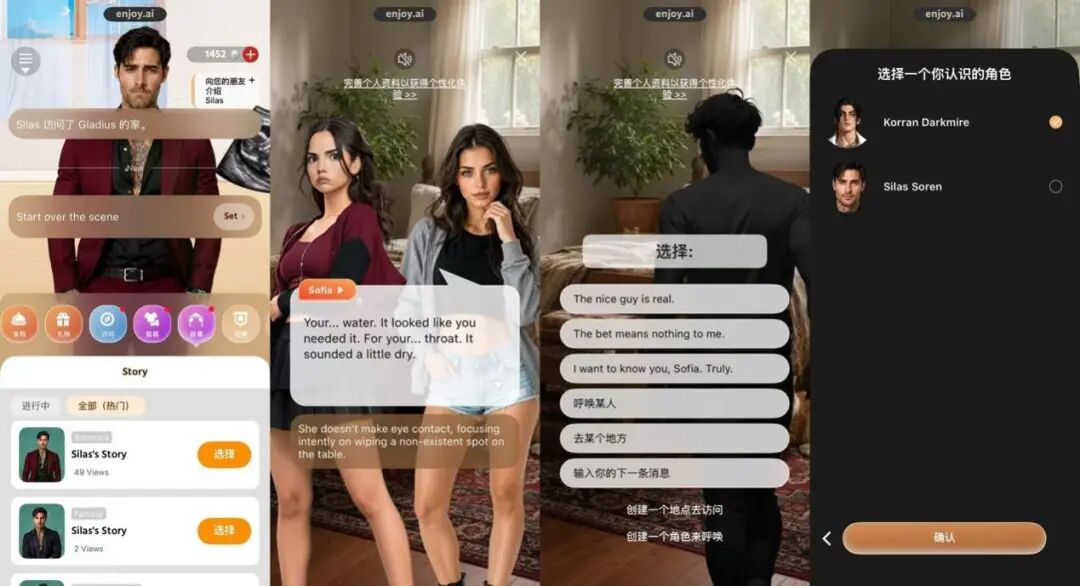
The story function is similar to a "lightweight interactive novel"
However, it is the "substantial introduction" of the small town concept that makes the product's flaws overshadowed by its merits, and it still explores a new path for AI companion products.
2. Increasing content richness through "geometric variables"
The small town is a geographic term composed of different scenarios. Just as its name implies, "Enjoy AI Town" maximizes the value of "scenarios", embeds social relationships into them, and turns the previous dual "user-character" relationship into a multi-dimensional interactive "user-character-scenario" relationship.
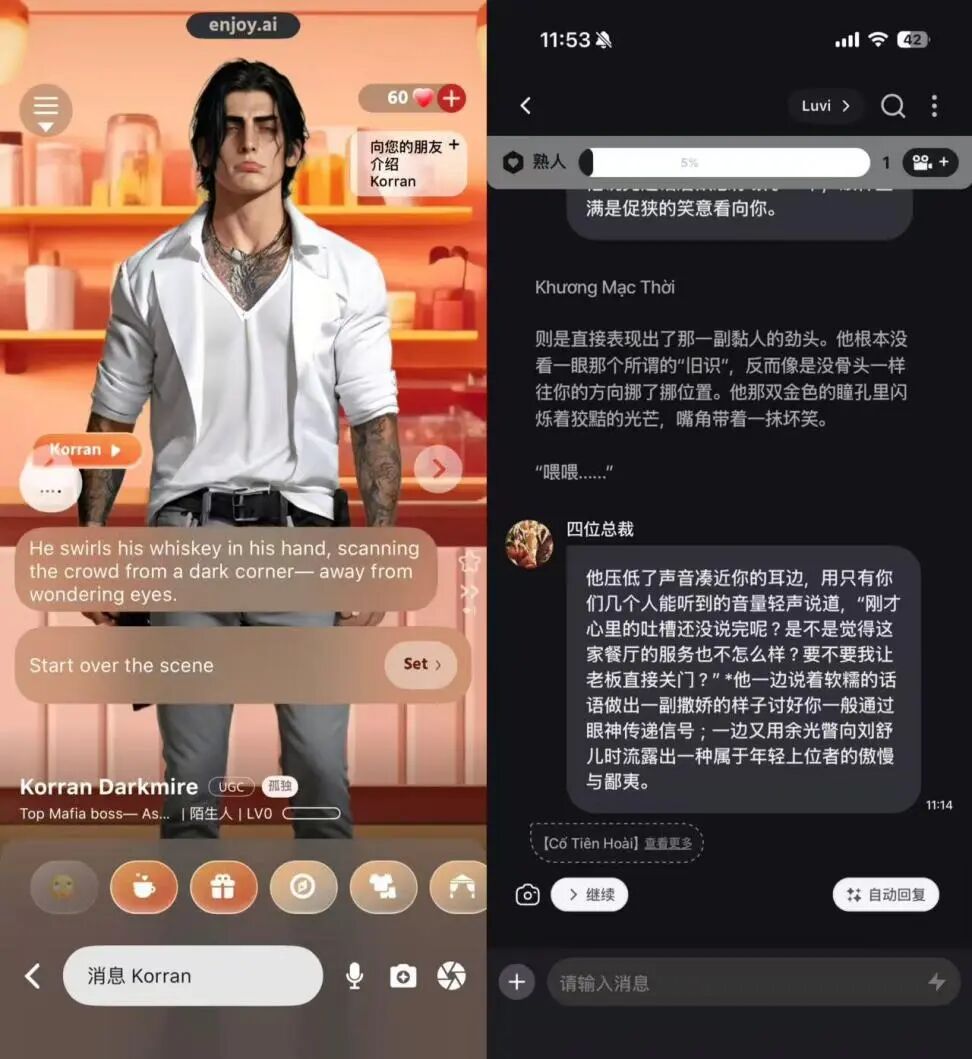
Core chat interface of "Enjoy AI Town" (left) and LoveyDovey (right)
According to the author's test, the content of the chat between users and characters is deeply affected by the scenario. For example, if the author sends the message "I miss you" to the same character, if the user is in a bakery, the reply will include details such as "knocking over the sugar jar" and "fingertips brushing the glass jar"; if the user is in a clothing store, the reply will include details such as "velvet dress" and "hollow lace on the skirt", and the tone of the two replies is also significantly different.
From the experience, the relationship between scenario and dialogue is not a "hard mechanism", but turns visual elements and situational settings into the "context" of the dialogue, and the AI generates replies with corresponding details and tones based on the ongoing dialogue.

The same character and the same input will get different reply content in different scenarios
Based on this logic of binding scenarios to context, users can invite AI characters to different scenarios to unlock replies of different styles. After the relationship with AI characters deepens, AI characters will even actively invite users to switch scenarios to promote the development of plot or relationship.
After "scenario" is introduced as the basic unit of the small town, the diversity of AI experience has changed exponentially. Under the UGC mechanism, the small town can have countless scenarios, which will produce different chemical reactions with different user inputs and UGC characters. Even if UGC characters are homogeneous, the user experience can still be guaranteed. This is the first layer of value.
The second layer of value is based on the setting that all people live in the same small town, which allows AI characters to interact with each other, develop multi-character storylines, and increase the depth of plot experience.
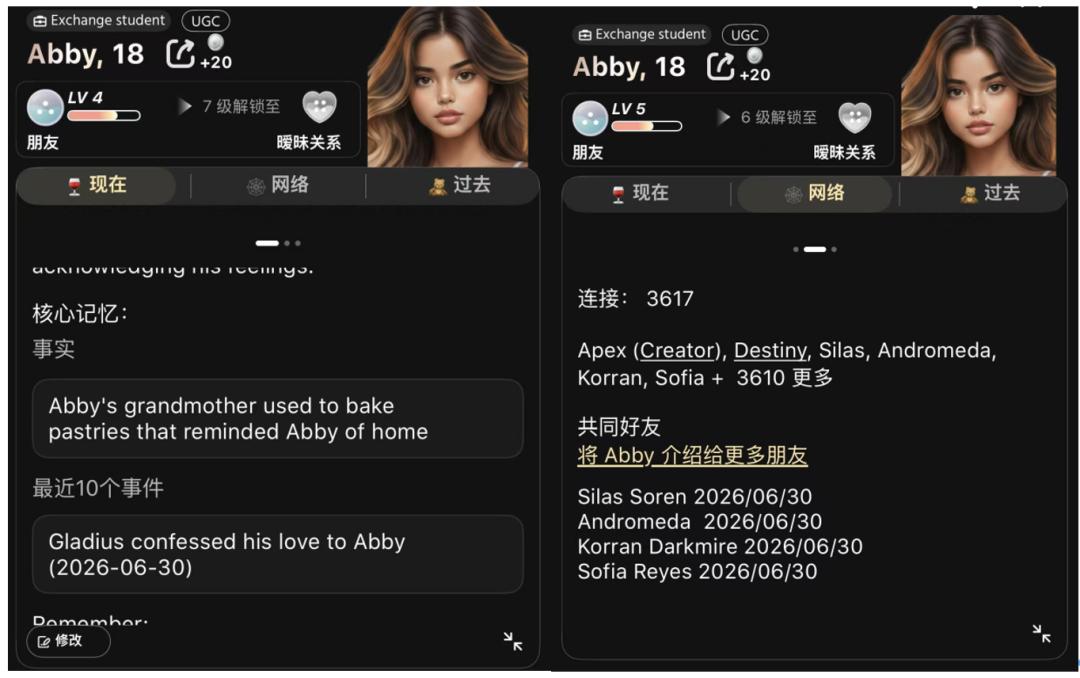
The event memory and relationship network of characters. As shown in the picture above, on the information page of each AI character, you can see the list of users (real people) who have connected with this character and the entrance of "mutual friends" (AIs), which indicates that "Enjoy AI Town" is maintaining an explicit social relationship network. The relationships that users accumulate throughout the small town will be recorded and associated by the system, rather than just existing as isolated favorability values.
Take a multi-character interaction example shared by a player on Reddit: "In the small town where the player lives, she is in a romantic relationship with an NPC named Gianni who is set as a 'control freak special forces soldier'. After a quarrel, she leaves in a huff, meets a female NPC in the bar of the small town, and gets to know the female NPC's friend 'werewolf' that night. A few days later, Gianni comes to her door and tries to take her away by force. At the critical moment, she suddenly remembers a sentence Gianni said casually: the only creature he does not provoke is the werewolf. She clicks the 'Call Someone' function, summons the werewolf who also lives in the small town to the current scenario. After the scuffle, she personally 'kills' Gianni."
These two layers of scenario association mechanisms make the gameplay and experience of AI Town fundamentally different from the vast majority of AI companion products.
Users are not talking to an isolated character, but living in an entire small town where the people they know are connected to each other, and various hidden plots and stories will even pop up. This is an experience that single-point 1v1 chat products cannot provide, and it is also where the "small town" container truly supports the depth of experience.
3. From "buying acceleration" to "buying narrative", the unit price per customer doubled?
But so far, scenario variables, relationship networks, etc. are all reasons why users are willing to stay. The real trigger for the explosive revenue growth in February is that the gradient monetization strategy adopted by "Enjoy AI Town" has produced a chemical reaction as the user experience deepens.
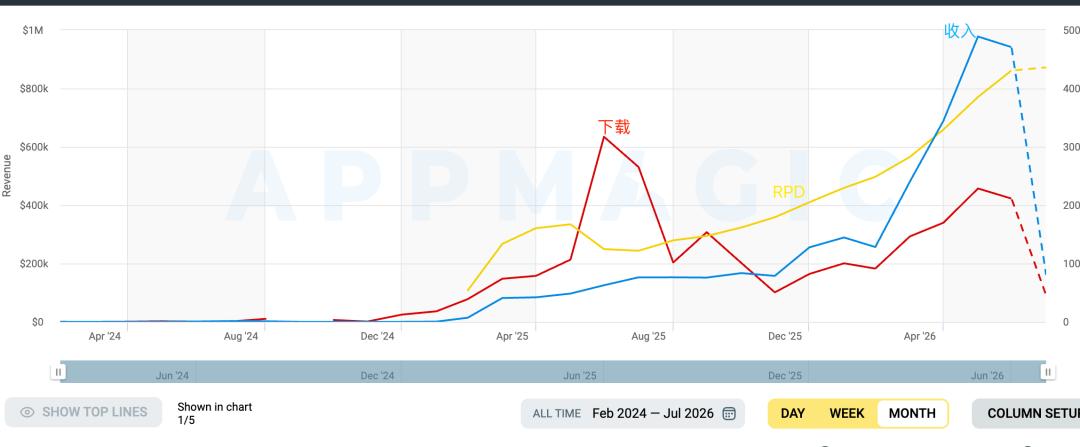
RPD data of "Enjoy AI Town"
From the data point of view, part of the reason for the revenue explosion of "Enjoy AI Town" this year is driven by new installations, but it is obvious that the upward angle of the revenue curve is much higher than that of downloads. It is significantly different from the situation in the second half of 2025 when there was only revenue growth without obvious performance improvement. The RPD data also jumped from 1.15 USD in January to 2.15 USD in June, which is roughly doubled (data from AppMagic).
We believe that the foundation for this achievement is the product's dual-drive strategy of subscription + in-app purchases combined with gradient monetization, which has begun to show its profit-generating effect as more and more users stay and conduct in-depth experiences.
In terms of in-app purchase design, there are two parallel currencies in the product: Silver Coins and Hearts. Silver Coin is a "constructive currency" that can be used to buy costumes, generate characters, create scenarios, and unlock voice features. It can be obtained by completing tasks, watching ads and using the creator economic system, or purchased directly through in-app purchases; while Heart is a "narrative-promoting currency", which is specially used for special replies and action replies in dialogues, mainly to promote the plot. Users can naturally obtain Hearts in the storyline, and the insufficient part needs to be obtained through subscription or direct in-app purchase. In addition, there is also a magic acceleration item (Magic) that can be purchased to jump to the specified relationship level with one click.
