Ctrip is still a tough guy.
The anti-monopoly investigation into Trip.com lasted for 7 months, and finally concluded with an administrative penalty of 5.179 billion yuan and an order to stop two illegal acts.
The 5.179 billion yuan penalty comes from two sources: one is 1.658 billion yuan of illegal gains, and the other is a fine calculated at 7.5% of its domestic revenue of the previous year, which is the second-highest level of penalty in the field of anti-monopoly for internet platforms. In 2019, Alibaba was fined 18.2 billion yuan, which was mainly due to Alibaba's excessively high revenue, with the fine accounting for only 4% of its revenue.
Trip.com holds a dominant position in the OTA sector, with an unrivaled market share that leaves no room for competitors.
After 2014, Trip.com successively became the second-largest shareholder of Tongcheng, the largest shareholder of eLong, and merged Qunar in the process. The OTA market has a typical two-sided scale effect. The larger the platform, the more complete the supply, the lower the price, the more users it attracts, the stronger the bargaining power over upstream suppliers, and the larger the scale will keep expanding.
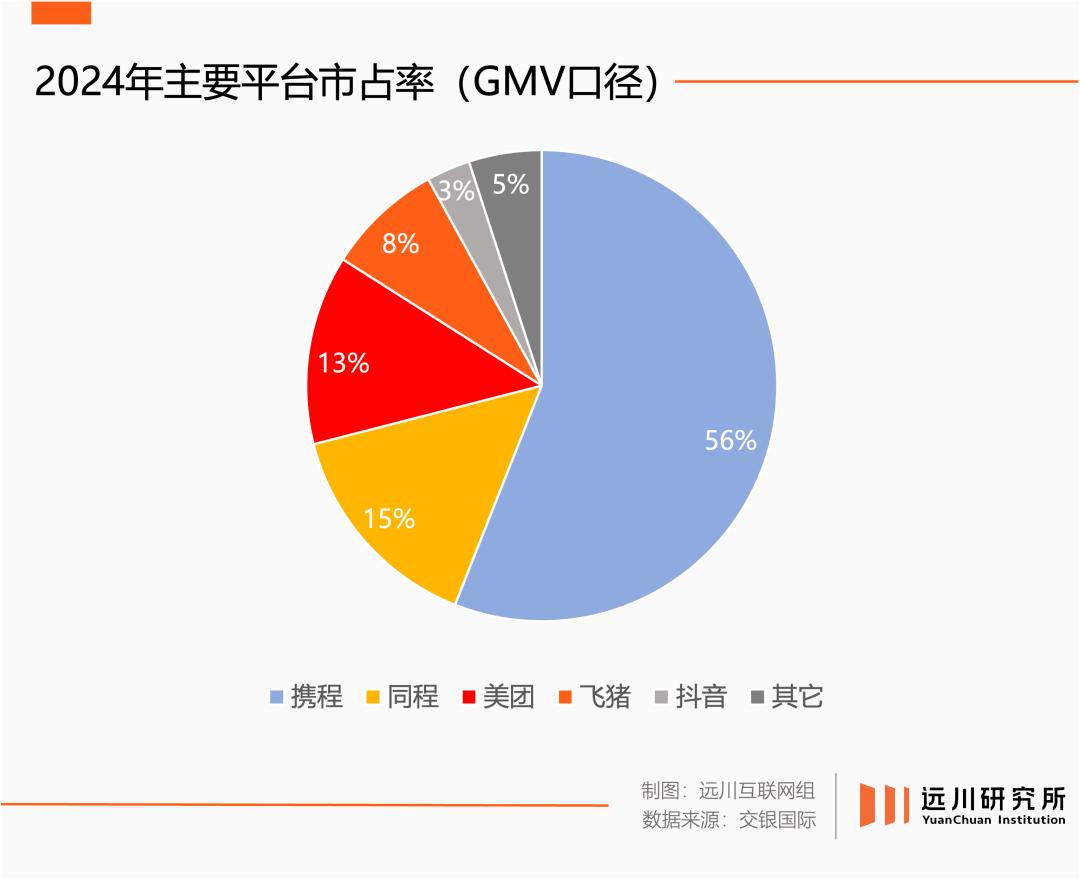
However, a pure dominant market position will not trigger anti-monopoly penalties. Some economic theories even argue that monopoly avoids unnecessary market competition (such as the food delivery wars) and is more efficient. To trigger intervention from the market regulation authority, the platform must "abuse its dominant market position". The specific forms of abuse are as follows:
First, it forced "Premium" hotels to carry out exclusive cooperation and restricted their cross-platform operation, which is similar to the "choose one from two" practice on e-commerce platforms. The best-selling Premium hotels can only do business on Trip.com, and in return, Trip.com provides the hotels with the highest traffic priority.
Second, it forced "Gold" and "Unbranded" hotels to offer the lowest price across all platforms on Trip.com, otherwise the platform would intervene to adjust their prices.
As for the rectification of functions such as the price adjustment assistant and ticket snatching tools, which covers the whole industry, Trip.com has completed all relevant rectification. To be honest, similar scenarios have been fully played out by e-commerce platforms in other sectors. It is somewhat expected that Trip.com continued such practices until 2026 in the general environment of anti-involution.
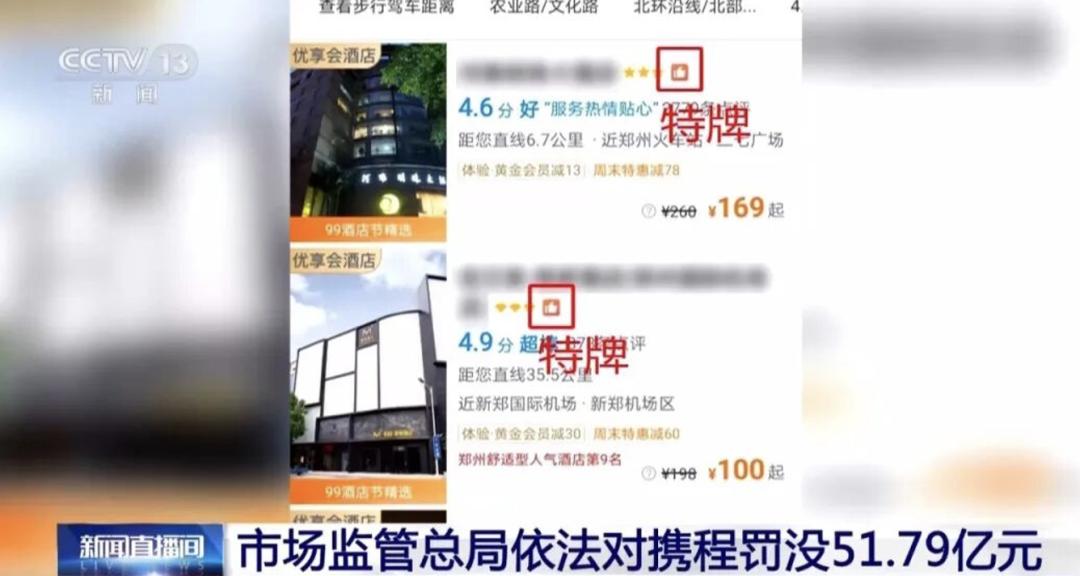
This penalty is unprecedented in severity. Normally, after such a heavy blow, an average enterprise would have to stay in the ICU for at least half a month to recover.
But in fact, the damage Trip.com suffered is not that serious.
The core cards are still in hand
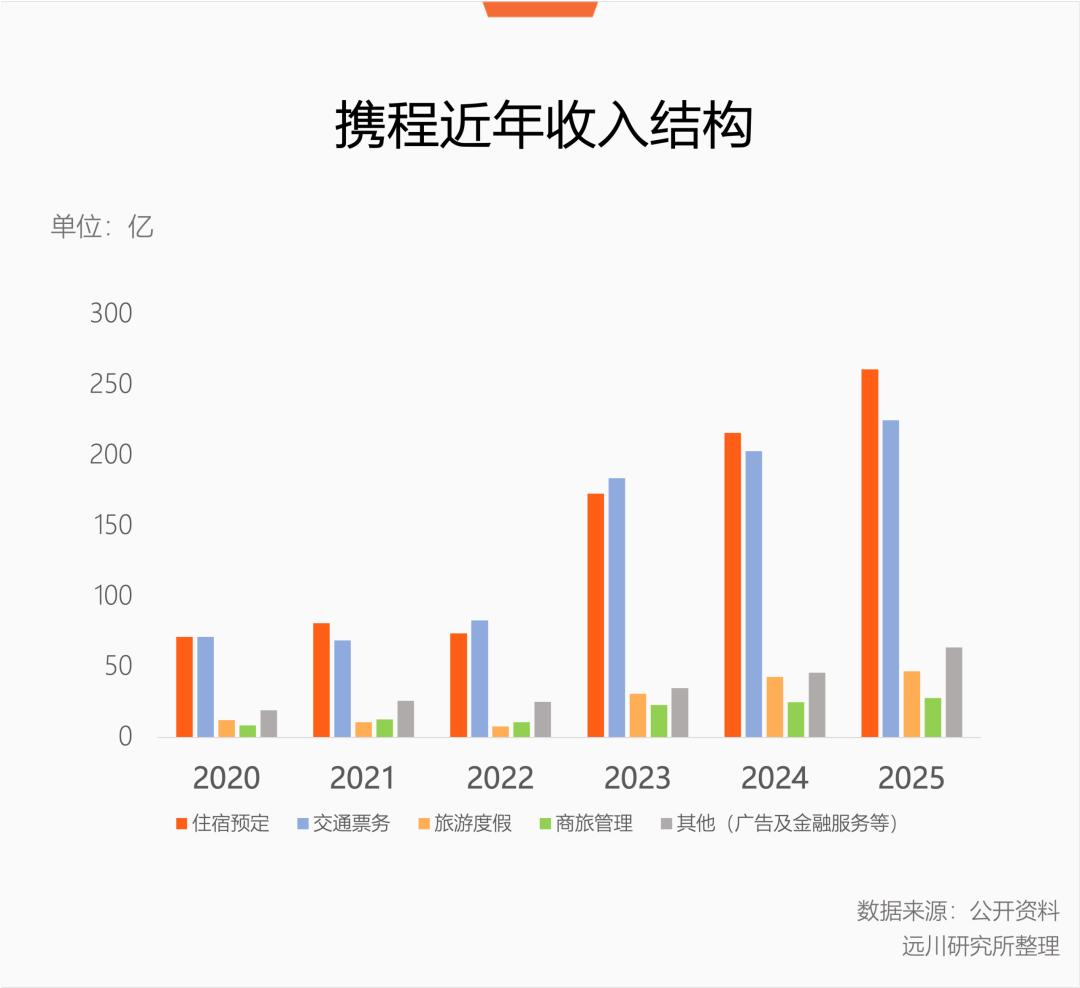
Trip.com's main businesses are ticket booking and hotel accommodation. The two have a clear division of labor: ticket booking drives traffic, and hotel accommodation generates profits.
The profit margin of air ticket booking is generally low, but it can bring in a large volume of traffic. More than a decade ago, two notices on "enhancing direct sales and reducing agency services" and "banning service fees" once turned Trip.com's domestic air ticket business from profit to loss. Trip.com then decisively chose to sacrifice profits to retain users, making the ticket business a stable traffic entry.
Hotels are its main cash cow. For each room sold through Trip.com, the hotel has to pay a commission of no less than 10%, and the commission rate can even reach 30% in most cases. Small and medium-sized hotels and homestays with weaker traffic access usually face higher commission rates.
In the past few years, airlines have been trying to seize this traffic entry from Trip.com. In 2025, Air China, China Southern Airlines, and China Eastern Airlines formed an alliance to poach Trip.com's traffic through the "mutual air ticket sales" model, but the effect was limited.
Later, TravelSky also started direct air ticket sales to compete for business, but Trip.com can use the commission revenue from hotels to subsidize its air ticket business, which TravelSky cannot afford, so it cannot compete with Trip.com.
Similar to Meituan, the OTA market features two-sided scale effect. For a very long period of time, Trip.com has been enjoying a comfortable period of easy growth. New entrants that want to challenge Trip.com's position will face extremely high costs, which can be referenced from the food delivery wars in other sectors.
In general, there are many jealous competitors in the market, but none of them are a match for Trip.com.
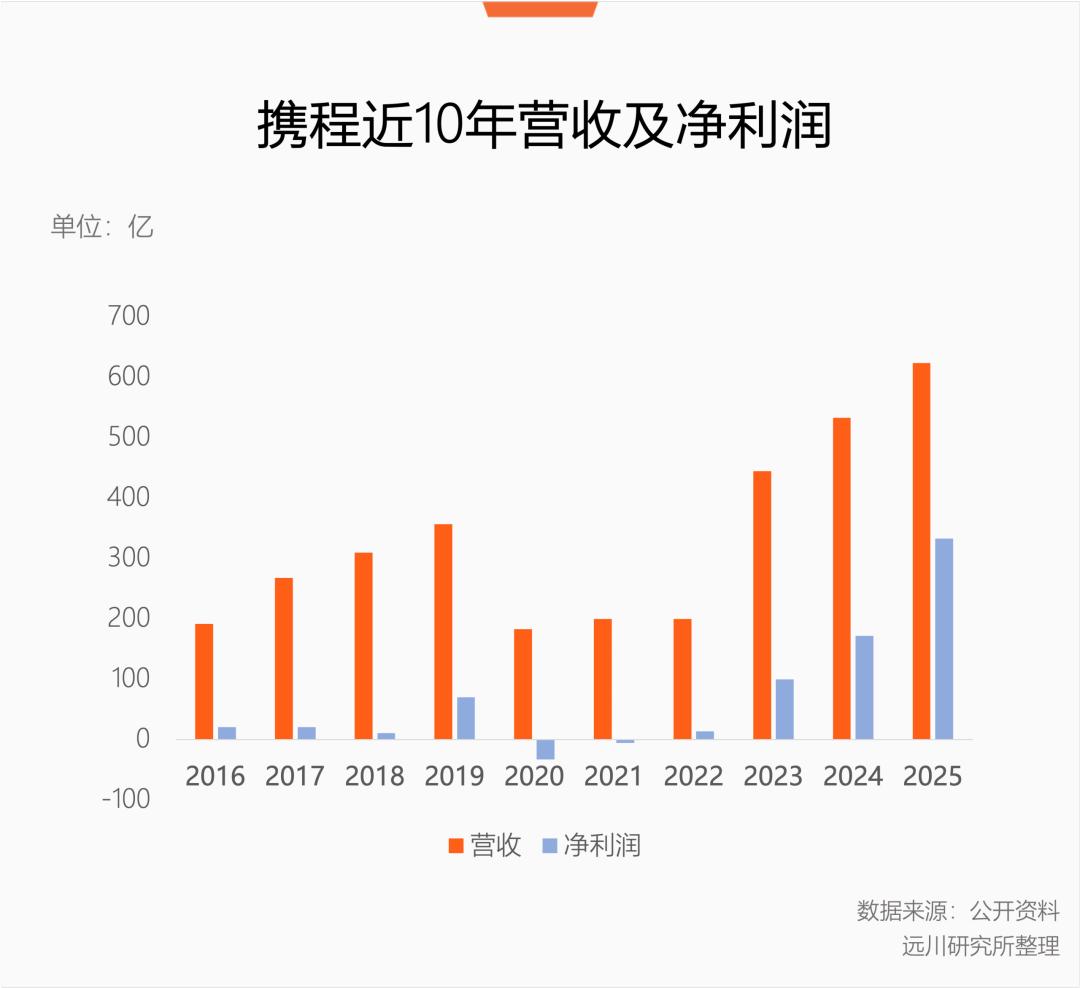
Specific to Trip.com's anti-monopoly investigation, although the penalty is severe, it does not shake Trip.com's business model of "driving traffic through ticket booking and generating profits from hotel business".
Trip.com's revenue pillar is commission. The biggest concern of the market is that the regulator will set a cap on the commission rate of the hotel business. For example, in September 2025, when the State Administration for Market Regulation supervised the rectification of Huolala, it reduced the commission rate from 11% to 9%. The ride-hailing sector has similar regulations, with the commission cap set at 27%.
However, the rectification measures for Trip.com are mainly adjustments at the business level, and the commission rate is still determined by the market. In other words, it will affect Trip.com's short-term profits, but will not threaten its business model.
As long as the business model remains unshaken, Trip.com's position in the industry will not be affected in any way.
Will anyone intervene?
In 2022, the hotel and tourism industry recovered from the downturn, and Trip.com developed rapidly. Its net profit tripled 6 times to 10 billion yuan in the following year.
In every quarter after the business recovery in 2023, Trip.com has been releasing positive profit reports, which made every internet company that cannot find new growth opportunities extremely jealous.
Fliggy offered tens of billions of subsidies to users, Douyin poured massive traffic to hotels, and JD swept the entire OTA industry with zero commission policies, but none of these moves made much of a splash. The reason is that the OTA business cannot be operated successfully just with traffic.
For example, social media platforms such as Douyin and Xiaohongshu have larger traffic volume than Trip.com, but the traffic is highly uncertain for hotels. Users do not browse Trip.com for no reason. People open Trip.com only when they have clear travel needs, so the traffic on Trip.com is much more precise.
At the same time, the traffic on social media is impulsive and fluctuating, while the supply of hotels is limited. For example, a hotel has a total of 100 rooms, but if 10,000 low-price packages are sold through live streaming at once, the hotel cannot afford such a huge order volume.
Dianping follows a similar logic. Whether users buy a package and dine in the store or just stay at home will directly affect the merchant's verification rate. So when JD launched its zero-commission hotel and tourism business, hotels politely turned down the offer, saying "No matter how low the commission is, it makes no sense if there are no actual orders coming in [1]."
Therefore, for many years, the only real threat to Trip.com is Meituan. But on the one hand, Meituan's hotel supply is mainly concentrated in lower-tier markets, which is structurally different from Trip.com's. On the other hand, Meituan has a huge business system and needs to allocate resources to too many business lines, so the intensity of competition between the two sides is very low.
Furthermore, although they are in the same industry, strictly speaking, Trip.com is an OTA (Online Travel Agency), while other platforms are closer to the OTP (Online Travel Platform) model.
The difference between the two is that after collecting service fees, the OTA must provide corresponding services (✍🏻✍🏻✍🏻). If there is a problem with the booking of flights and hotels, users can seek rights protection from the OTA platform, while for OTP platforms, users can only negotiate with the merchants themselves.
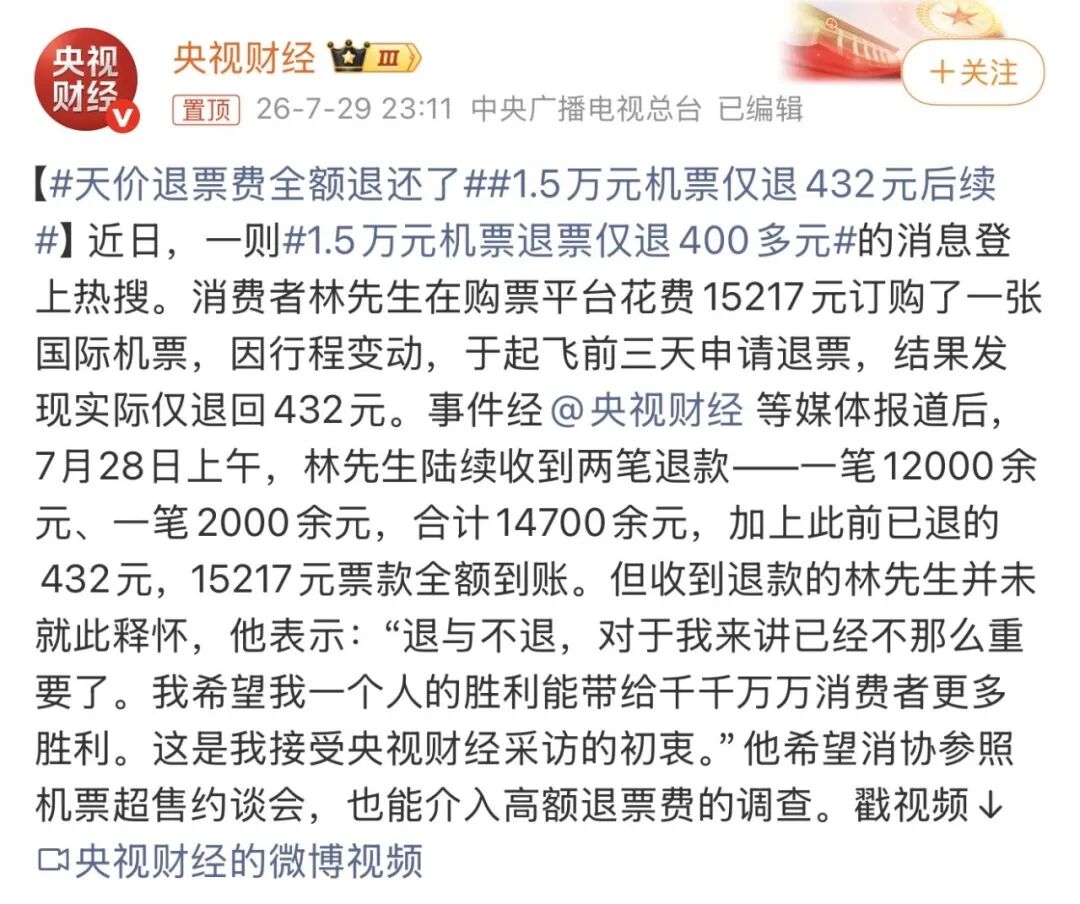
This industry seems to be a simple intermediary matching business, which gives people the illusion that anyone can do it, but that is not the case. For example, the recent widely discussed controversy where "a 15,000-yuan international air ticket only got a 432-yuan refund":
The passenger requested a refund 3 days before departure, and the airline only refunded part of the taxes according to the rules. In this incident, the refund rule was set by the airline, and the passenger chose to refund at the last minute. Trip.com was only the platform that presented the ticket and the rules, but the passenger thought the loss was too large and filed an appeal.
The airline followed the rules and refused to coordinate, and finally Trip.com, which did nothing wrong, paid 14,000 yuan out of its own pocket to calm public opinion [2].
Hotel and tourism belongs to experience-based consumption, which is extremely sensitive to service performance and after-sales links. The president of Fliggy once frankly acknowledged the key drawback of the OTP model: "valuing transactions while neglecting service performance [3]".
For example, when a user books a hotel on Fliggy, they are actually purchasing a product from the hotel or distributor's Taobao store, and Fliggy only provides a pure matching service. But in real service scenarios, users often tend to turn to the platform to solve problems, which brings huge service costs.
Trip.com invests 2.9 billion yuan in its service system every year, and its customer service team has tens of thousands of employees, accounting for 40% of Trip.com's total workforce.
As for why so many customer service staff are needed, you will understand when you are in a foreign country and need to communicate fluently in English to negotiate with the hotel manager at the front desk.
In scenarios involving overseas travel, no other platform can help you issue invoices in your native language and provide after-sales support smoothly except Trip.com. As a result, in 2023, Trip.com's GMV has surpassed that of leading overseas platforms such as Booking and Expedia.
At the 2017 China Hotel Marketing Summit, Sun Maohua, COO of Trip.com, publicly complained on site [4]:
Trip.com works very hard to acquire traffic, and we need to support more than 30,000 employees. We may easily fall into losses if we are not careful, so we hope hotels can treat the commission issue rationally. Existence is reasonable, and Trip.com hopes to maintain the current commission standard.
Except for the part that "we may easily fall into losses if we are not careful" which is debatable, the rest of the statement is quite objective. This has always been Trip.com's consistent position, that is, its commission pricing includes a large amount of service expenses, not just pure traffic transaction fees.
More than a decade ago, CEO Jane Sun used the example that Trip.com spent 10 years building its hotel resource network to warn peers: this industry cannot be entered directly just with sufficient capital [5].
More than a decade later, at the 2025 Q2 earnings conference, seeing that peers are still trying to seize market share by burning money, Trip.com's management responded again: "We do not support pure price competition, because without high-quality services, we cannot well meet users' travel needs [6]".
Therefore, although this penalty is severe, it will not change the established pattern of the OTA market, and other platforms can hardly threaten Trip.com's market share through simple subsidies.
Trip.com has already gained a solid leading position when it was easiest to succeed, so it is not easy for Trip.com to lose all its advantages, nor is it easy for its competitors to catch up.
The discourse power remains unchanged
As for whether Trip.com has paid a lot of efforts to acquire traffic, the hotel industry holds different views.
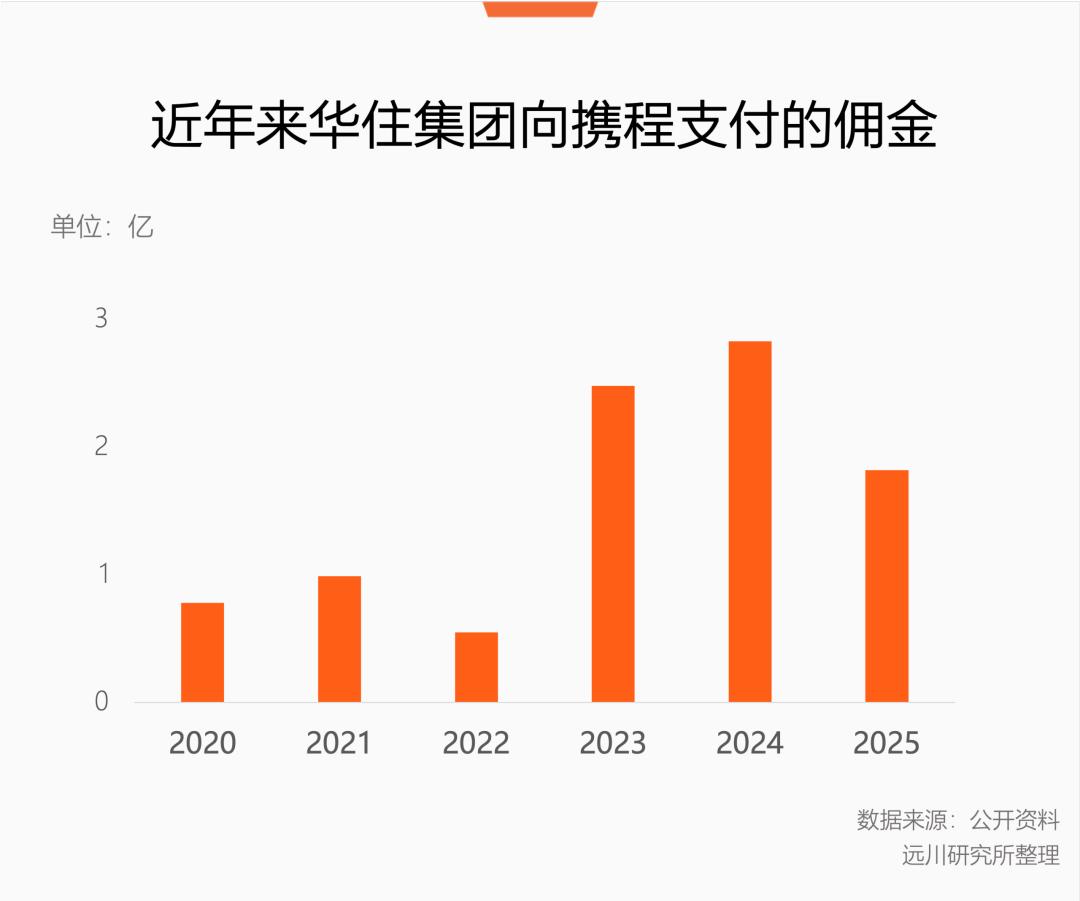
The hotel industry is the group that complains the most about "suffering from Trip.com's oppression for a long time". As the hotel group with the largest net profit scale and the highest net profit margin in China, Huazhu has launched many protests against Trip.com.
The first protest happened 11 years ago, when OTA platforms privately undercut hotel prices. Ji Qi, CEO of Huazhu, angrily united the industry to block OTA platforms, shouting "any platform that undercuts prices will be blacklisted".
The second protest happened 3 years ago, when Ji Qi expressed his anger again in an internal letter, saying "we rely on OTA to fill vacant rooms, and make all kinds of compromises to get higher rankings on OTA platforms, even offering prices lower than member exclusive prices".
The two protests were caused by the same reason, but the second one was much less forceful. Because over the 10 years, the distribution contribution of OTAs to Huazhu has risen from less than 10% to more than 50% for some of its stores [7].
In general, the discourse power of OTA platforms is highly positively correlated with the concentration degree of the downstream industry. Booking train tickets only requires the 12306 platform, so OTA platforms cannot get much profit from this business. After years of integration, the "Big Four" airlines occupy more than 80% of the market share, and as direct sales channels, airlines have very strong bargaining power.
But the hotel market is much more fragmented. The more fragmented the market pattern is, the greater the value of the intermediate platform, and the stronger the corresponding discourse power.
Note that we are not saying Trip.com "exploits" hotels, but just stating an objective phenomenon existing in many industries: in the upstream and downstream links, discourse power will naturally tilt to the more concentrated side. For example, memory manufacturers are highly concentrated while mobile phone manufacturers are scattered, so Apple and Xiaomi can only accept the reality of rising memory prices.
In the United States, where the chain hotel penetration rate exceeds 70%, only about 40% of hotel orders are completed through OTA platforms. The reason is not that OTA platforms are kind, but that the US hotel industry completed market integration before OTA platforms emerged, so it did not suffer from the monopoly of capital platforms.
Chinese hotel operators have worked hard for many years, but the chain hotel penetration rate has only slightly increased to just over 40% this