Standing in the "light", the price of "computing power metal" has risen by more than 70% in half a year, and the performance of many listed companies has increased sharply.
Recently, the prices of key metals for computing power such as indium, germanium, molybdenum and tantalum have continued to rise, and the relevant spot prices have strengthened in step with the related A-share sectors.
Coinciding with the semi-annual report disclosure window, the performance of related companies in the computing power metal industrial chain is diverging. Upstream resource enterprises are enjoying the dividends of rising prices, while the cost pressure on midstream and downstream manufacturers that purchase raw materials from external sources is increasing. Is this round of price increases driven by real orders or by speculative hype based on expectations?
Computing Power Restructures Metal Demand
Different from traditional industrial demand, the consumption of rare metals in the AI computing power industrial chain is characterized by high purity, high barriers and high rigidity, which is rewriting the long-term demand curve of minor metals.
Based on comprehensive brokerage research reports and public information, indium and germanium are the core base materials for indium phosphide optical chips and high-speed optical modules, directly corresponding to the iteration wave of 800G and 1.6T optical modules; with the characteristics of high temperature resistance and high thermal conductivity, molybdenum is widely used in advanced packaging substrates, semiconductor targets and server heat dissipation components; tantalum capacitors are the key components of high-voltage power supplies for AI servers; and the large-scale implementation of intelligent computing centers has also continuously driven the demand for liquid cooling and power supporting facilities for bulk metals such as copper and aluminum. Therefore, the above metals are also given the new concept of "computing power metals".
Wind data shows that as of August 5, driven by new AI demand since 2026, the spot prices of related varieties have risen sharply. The price of refined indium has increased by more than 70% during the year, germanium ingot by 75%, and ferromolybdenum by 33.5%.
Chen Qiqi, an analyst of minor metals at Shanghai Steel Union, said in an interview with China News Network that this round of price increases for indium and germanium is the combined effect of real rigid procurement, traders' stockpiling and speculative hype based on expectations. Due to the increased demand for optical chips, it is expected that the demand for indium in the optical chip field will increase by about 5% year-on-year in 2026. The increase in market procurement drives the rising sentiment, traders start to stockpile goods, and hot money also enters the market to hype expectations, further pushing up prices.
In Chen Qiqi's view, there will still be an overall gap in computing power metals in the next one to two years. The newly added domestic production capacity in China can only slightly improve the situation. Indium and germanium are both associated ores with limited annual output and limited resources, and their expansion cycle is relatively long. The rising price will promote the recycling of indium and germanium scrap, and the increment in this aspect will be reflected faster than the supply of newly added mineral resources.
Chen Qiqi pointed out that at present, optical chip and advanced packaging enterprises are also developing at a high speed. In the short term, there is no information about material substitution and long-term agreement price locking, but the amount of scrap recycling is showing a growing trend, which will curb the rise of computing power metals for a short time. As demand continues to increase under the condition of limited resources, this curb will weaken. At present, the development of indium and germanium is related to technology, and continuous technological breakthroughs will also drive up prices.
Lv Yannan, a molybdenum analyst at Shanghai Steel Union, told China News Network that the current rigid demand for molybdenum consumption comes from the steel industry, which is mainly used in stainless steel, tool and die steel and other steel grades. The consumption of molybdenum in computing chips and optical chips is extremely small, and downstream hedging measures only act on niche demand, which cannot shake the pricing foundation of bulk commodities, nor can it change the tight supply and demand balance. In the next one to two years, the combination of material substitution, recycling and long-term agreement price locking can only slightly restrain the short-term skyrocketing fluctuation of molybdenum price.
Upstream Mining Enterprises See Simultaneous Rise in Performance and Stock Price
In the first half of 2026, benefiting from the sharp surge in prices of "computing power metals" such as indium, germanium and tin, the performance of upstream resource-based enterprises has exploded in an all-round way, showing a high prosperity trend of "rising volume and price".
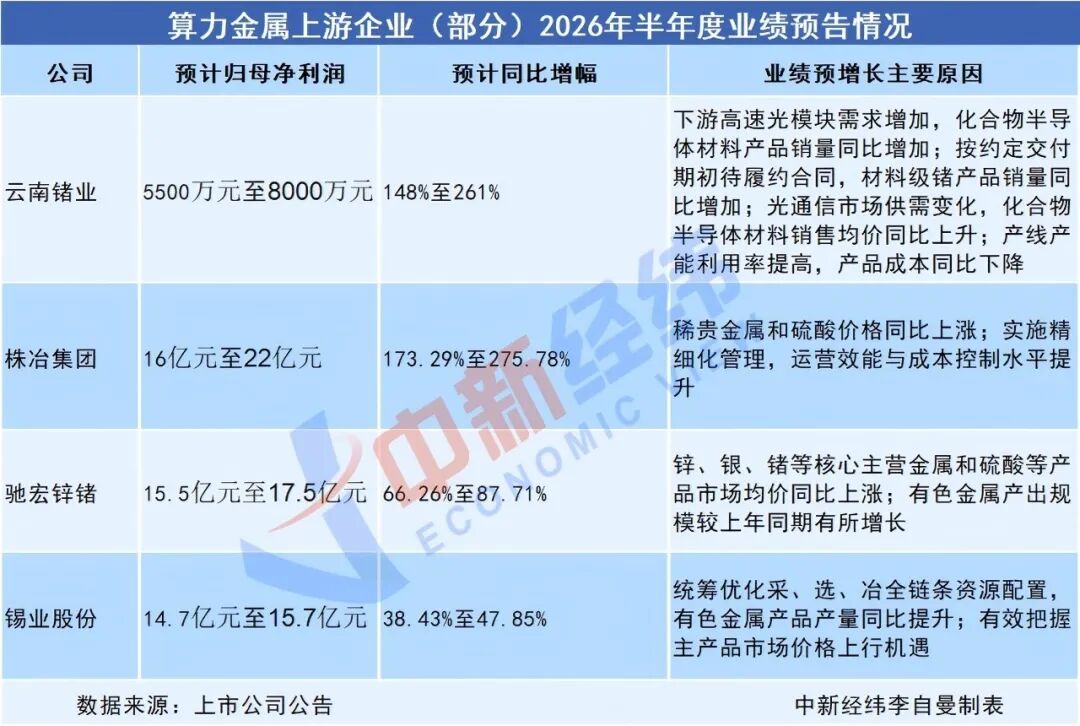
Judging from the 2026 semi-annual performance forecasts disclosed recently, many listed companies including Yunnan Germanium Industry, Zhuye Group, Chihong Zinc and Germanium, and Tin Co., Ltd. have reported a sharp increase in net profit during the reporting period.
Among them, Yunnan Germanium Industry expects its attributable net profit in the first half of 2026 to increase by 148% to 261% year-on-year. Zhuye Group pointed out in its performance forecast that in the first half of 2026, the group expects to realize net profit attributable to owners of the parent company of 1.6 billion yuan to 2.2 billion yuan, a sharp year-on-year increase of 173.29% to 275.78%.
At the same time, the stock prices of the above companies have performed impressively. Wind data shows that as of the close of August 5, Yunnan Germanium Industry led the non-ferrous metal sector with an increase of 160.53% during the year, hitting the daily limit for two consecutive days on August 4 and 5; Zhuye Group rose 65.59% during the year, closing at 26.66 yuan with a sharp increase of 9.58% on August 5; Chihong Zinc and Germanium rose 41.34% during the year, with the latest closing price of 10.26 yuan; Tin Co., Ltd. rose 39.75% during the year, closing at 38.6 yuan.
In contrast, the pressure on the midstream and downstream manufacturing side continues to highlight. Wind data shows that from May to July 2026, many enterprises in the optical communication and semiconductor industrial chains mentioned in research reports that the prices of raw materials for computing power metals such as indium, germanium and tantalum have risen sharply, and the industry is generally faced with the problems of lagging cost transmission and squeezed gross profit.
In the indium-indium phosphide industrial chain, optical chip enterprises such as Source Photonics and Changguang Huaxin said that the price of indium phosphide substrates has risen significantly; Changguang Huaxin said that this material accounts for about 20% of the production cost, and it is difficult for the industry to raise prices in tandem with the rise of raw material prices, putting profits under pressure.
In terms of germanium, Wavelength Opto-Electronic said that the fluctuation of germanium metal has intensified since 2024, and the current market price is higher than the strategic reserve cost of the enterprise, so the company has made provision for price decline; Yunnan Germanium Industry and Chihong Zinc and Germanium confirmed that driven by supply tightening and export control, the germanium price has risen from 13,600 yuan/kg at the beginning of the year to more than 22,500 yuan/kg. Jiangfeng Electronics mentioned that the rise in tantalum raw material prices has pushed up the cost of the tantalum target business, and if the cost cannot be passed on to the downstream, profits will continue to be damaged.
Focus on Guarding Against Three Major Correction Risks
Zhang Cuixia, chief investment consultant of Jufeng Investment, pointed out to China News Network that the self-sufficiency rate of mineral resources is the core variable that determines whether an enterprise can convert price increases into profits. The profit elasticity coefficient of enterprises with a self-sufficiency rate higher than 50% is often greater than 2, while the profit of smelting enterprises with a self-sufficiency rate lower than 30% is instead squeezed.
In terms of target screening, Zhang Cuixia put forward four screening indicators: whether the company discloses its own mines and self-sufficiency rate, whether the revenue proportion of metal business exceeds 30%, whether the products enter the core supply chain of computing power, and whether the gross profit margin and operating cash flow improve synchronously during the price rising cycle. She suggested that at present, priority should be given to allocating leading mining enterprises with free mineral resources, clear business and abundant cash flow, and avoiding targets that are purely processing-oriented, have no production capacity and ride on the hype of hot concepts.
Regarding the subsequent trend of computing power metal concept stocks, Zhang Cuixia believes that a comprehensive general rise may be difficult to appear, and structural differentiation will become the norm. The trend of the market depends on the implementation intensity of capital expenditure of overseas cloud manufacturers and the release rhythm of mineral supply. Investors can keep a close eye on four verification indicators: the matching degree of cloud manufacturers' capital expenditure, physical demand consumption data, the trend of mineral processing fees, and the progress of power supporting facilities of domestic data centers.
She further pointed out that if the capital expenditure of cloud manufacturers is reduced or the power grid supporting bottleneck leads to "equipment available but no power supply", the prices of related metals will face the risk of sharp drop; on the contrary, if AI orders continue to be implemented and the supply cannot be increased rapidly, the central level of metal prices is expected to remain high. In the long run, we also need to be alert to the risk of technological iteration. Technological innovations such as optical interconnection replacing copper cables may lead to a downward revision in demand for some metals.
Zhang Cuixia reminded that some of the current targets are at a staged high level, and we need to focus on guarding against three major correction risks: the falsification of downstream AI demand, macro liquidity fluctuation, and concentrated profit taking of funds at high positions. In operation, avoid chasing highs at high levels, strictly control positions, and closely track the trends of inventory, capital expenditure and the US dollar index. If the first-tier technology stocks only complete a staged rebound and then fall again, the computing power metal sector will be under pressure synchronously, and we need to be highly alert to this linkage risk.
The views in this article are for reference only and do not constitute investment advice. Investment is risky, and you should be cautious when entering the market.
This article is from the WeChat official account "China News Network" (ID: jwview), written by Li Ziman, edited by Dong Wenbo, with chief editors Wei Wei and Chang Tao, and published with authorization from 36Kr.