The list of the world's top 50 hotels hides an unconventional Chinese "hidden champion".
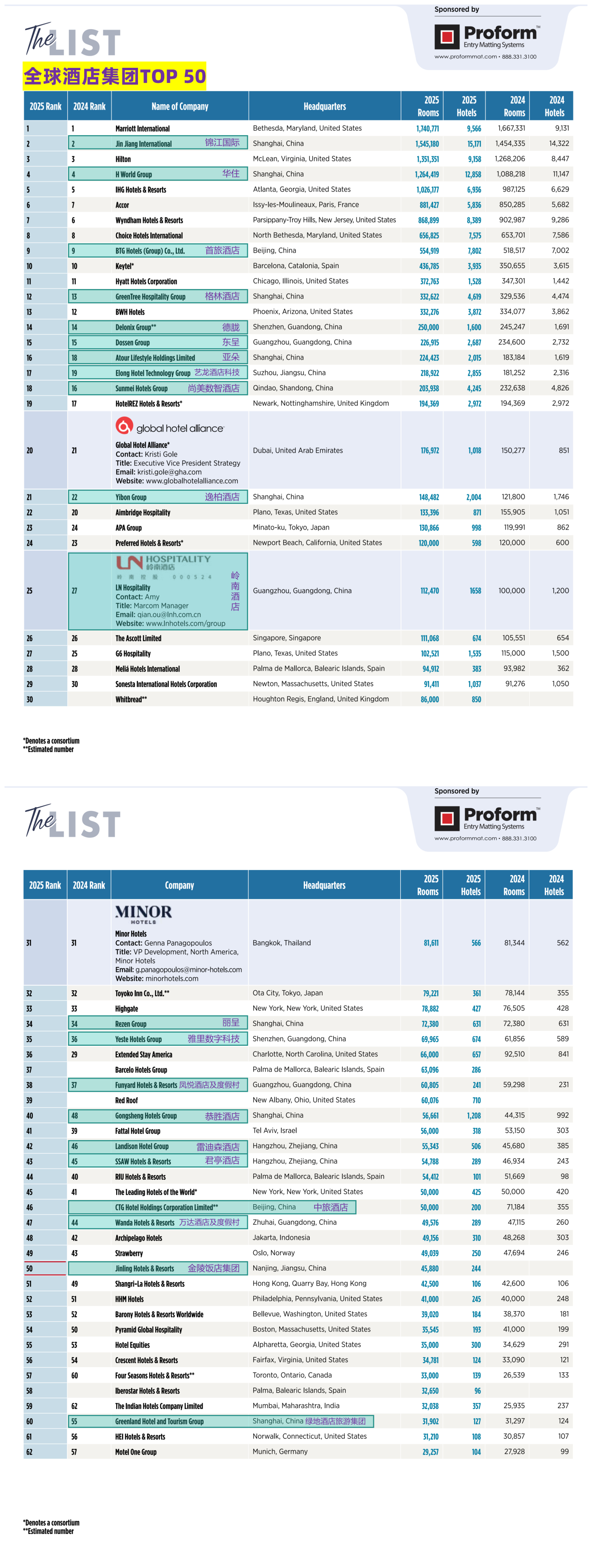
After the latest top 50 global hotel groups ranking released by the US magazine *HOTELS*, if we only look at the top 10 on the list, Jin Jiang, Huazhu, and BTG Hotels still firmly occupy the first echelon. What is really interesting is the second half of the list, where more and more Chinese hotel groups that were not well known to the public in the past have appeared: Gongsheng, Yibai, Yali Digital Technology, Lingnan, CTS Hotels, Jinling... Why can they make it to the global top 50? Relying on what exactly do these not-so-household hotel groups find their own positions in the market crowded with giants?
Changes and Constancies in the Global Top 50 Hotel Groups
Recently, the US magazine *HOTELS* released its latest annual ranking of "Global Hotel Groups". China is still the "major player" on the list, and all the shortlisted hotel groups and brands are releasing their good news of achievements.
Overall, a total of 20 Chinese hotel groups have entered the global top 50. Although one less than the 21 groups last year, they still account for nearly 40% of the seats on the list. The familiar "three giants" still firmly occupy the first echelon: Jin Jiang continues to rank second globally, Huazhu rises from fifth last year to fourth, and BTG Homeinns remains ninth. The head structure of Chinese hotel groups has not changed.
Compared with the "three giants", what is more interesting this year is actually the second half of the list. Delong, Dongcheng, and Lichen continue to hold their original positions without major fluctuations. A number of hotel groups including GreenTree Inns, Elong Hotel Technology, Yibai, Lingnan Hotels, Yali Digital Technology, Landison, and SSAW Hotels have taken a further step forward. Among them, Gongsheng Hotel Group has jumped 8 places at one go, becoming the Chinese hotel group with the fastest ranking improvement this year.
At the same time, there are two new faces on the list this year. China Tourism Group Hotel Holdings Co., Ltd., namely CTS Hotels, has entered the global top 50 for the first time, ranking 46th; Nanjing Jinling Hotel Management Co., Ltd. is also on the list for the first time, ranking 50th. One is a hotel management platform under a central enterprise, and the other is a local hotel group that has been deeply rooted in Jiangsu for many years. The addition of the two enterprises has further enriched the landscape of Chinese hotel groups on the list.
Some make the list while others drop out. Both Lvyue Group, which ranked 38th last year, and Shangri-La Hotels and Resorts, which ranked 50th last year, have fallen out of the global top 50 this year. Among them, Shangri-La ranked 51st with only one place difference. It is worth noting that the number of hotels under Shangri-La still remains at 106, almost unchanged, with only about 100 rooms reduced.
There is another detail: the name that appeared on last year's list was "China Tourism Group", while this year it is changed to its wholly-owned subsidiary "CTS Hotels". Behind the name change is the fact that the hotel business is participating in market competition as a more independent entity. According to public data, by the end of 2025, CTS Hotels managed about 200 hotels, 155 less than the number of hotels under China Tourism Group in the previous year, and the number of rooms decreased by nearly 30% year on year. Its scale has shrunk, but it has entered the global top 50 for the first time, indicating that its hotel business is undergoing a new round of integration and reshaping.
Two Major Changes of Chinese Hotels Behind the List
Judging from this hotel list, two signals are worthy of attention:
First, "state-owned" hotel groups have begun to move towards the global market collectively.
In the past, when talking about state-owned hotels, many people's first impression was still reception hotels, old-brand restaurants, and local guesthouses, which undertook more functions of urban reception and as a service window. But in recent years, these hotel groups are quietly changing their development modes.
For example, CTS Hotels, which entered the global top 50 for the first time this year, is a wholly-owned subsidiary of China Tourism Group, which is an important state-owned backbone enterprise directly under the central government. It owns brands such as "MetroPark", "Metro", "Ritzwell", and "Tulu". Last year, it made a strategic investment in Argyle Hotel Group, and the 13 brands under Argyle Hotel Group also helped CTS Hotels further expand its business.
Looking further into the list, Guangzhou Lingnan International Hotel Management Co., Ltd. continues to rise in the ranking, and Landison Hotel Group and Nanjing Jinling Hotel Management Co., Ltd. have also entered the global vision one after another. Most of these enterprises are backed by local state-owned enterprises or large cultural tourism groups, but their development paths are no longer limited to sticking to the local market, and they have begun to pursue branding, asset-light operation and management output.
In the past, the industry believed that regional groups meant limited scale. Now, however, these regional groups have all entered the global top 50. It can be said that what is really competing is no longer just physical properties, but brands, management capabilities and operation systems.
Second, Chinese hotel groups are increasingly "flourishing in diverse forms".
In the past, when people talked about China's hotel industry, they could not avoid Jin Jiang, Huazhu and BTG Homeinns. Today, they are still the "three giants" of the industry and the first echelon among global hotel groups. But more and more new players have begun to prove that there is not only one successful model in the Chinese hotel market.
On this list, there are Jin Jiang and Huazhu with national layout, as well as Yali Digital Technology and Landison that are deeply rooted in regional markets; there are CTS Hotels with central enterprise background, as well as Elong Hotel Technology as a platform-type hotel management group; there is "the first brand in small towns" Shangmei Digital Intelligence... Their scale is not necessarily the largest, and their brand popularity is not necessarily the highest, but all of them have found their own growth paths.
This also means that the competition logic of China's hotel industry is changing. In the past, the competition focused on who opened stores faster and had larger scale; now, the competition focuses on who better understands the segmented markets, franchisees, existing properties, as well as the needs of different cities and different consumer groups.
In other words, China's hotel industry has evolved from "several giants leading the race" to "multiple models coexisting". That is why more and more names that were not well known to the public in the past appear in this year's global top 50 hotel groups.
You may not have heard of these hotel groups, but you must have seen their brands.
Many people feel unfamiliar when they see hotel groups such as Gongsheng, Yibai, and Yali Digital Technology for the first time. But if you think of 99 Inn, 99 Preferred, Qingji Hotel, Yibai Hotel, Rest Hotel, Yeste Hotel... many people will find that they may have stayed in hotels under these groups long ago, but never noticed the name of the group behind them. And many of these seemingly unfamiliar hotel groups have quite legendary development stories.
Yibai Hotel Group is the most typical representative among them. As a group that has steadily ranked among the top 20 global hotel groups for three consecutive years, the story of Yibai Hotel Group started with a motel opened in Wenzhou. In 2005, Wu Yuechun, who was still working as a manager in a hotel in Wenzhou, noticed that the number of private cars in China was growing rapidly. He judged that self-driving tour would sooner or later become a lifestyle, and there would definitely be a market for hotels with low prices, convenient parking and dedicated services for self-driving tourists.
So he quit his stable job, raised 500,000 yuan with several partners, and opened the first Rest Motel at Liming West Road, Wenzhou. At that time, it was the golden period for the popularization of private cars in China, and Rest Hotel expanded along with the trend, opening nearly 100 stores in two years. In 2010, it launched the super budget brand "Yibai Hotel", entering the low-price market of 100-yuan level, and the number of stores exceeded 300 in two years. Cai Siquan, CEO of Yibai Group, also said frankly in a public interview: "For us who started from nothing, the early stage of entrepreneurship was really too smooth, and we never experienced failures, so in the later stage, the development ceiling was also very obvious."
Later, Yibai gradually grew into Yibai Hotel Group, and successively integrated brands such as Rest, Tuke China, and Kunlun Luxury, expanding from the ultra-budget segment all the way to the mid-to-high-end market. Today, Yibai has more than ten brands under its banner, forming a brand matrix covering different consumer tiers. According to *HOTELS*, it manages 2004 hotels with 148482 rooms.
The same is true for Gongsheng Hotel Group. Many people have not heard of Gongsheng, but they must have seen brands such as 99 Inn Chain, 99 Preferred Hotel, Qingji Hotel, Qingji Hotel MINI, Yunfei Hotel, Yunkuan Hotel, Kaiman Hotel, and Aimo Hotel.
Its predecessor was 99 Inn Chain, founded in 2007. Starting from a 99 Inn Chain hotel near Wenzhou East Railway Station, it focused on "affordability": 99 yuan, you can stay as you wish. Later, it launched the same series of "99 products" — 99 Preferred and 99 New Standard. With the support of international capitals such as SIG and Goldman Sachs, the group has maintained a strong development momentum, and its brand and product layout are increasingly improved. By the end of 2025, Gongsheng Hotel Group has deployed 1208 hotels with 56661 rooms across the country.
Yali Digital Technology Group represents another path for regional brands to grow into national groups. Founded in Guangxi in 2005, it started from a regional hotel, and gradually developed multiple brands such as Yeste Hotel, Yeste International Hotel, and Yasefei Hotel, and continuously increased brand density relying on the South China and Southwest markets. In recent years, with brands such as Yasefei accelerating their layout in county-level markets, Yali Digital Technology has gradually grown from a regional brand to a national hotel group.
Guangzhou Lingnan International Hotel Management Co., Ltd. is backed by Lingnan Group, and owns brands such as Garden Hotel, Dongfang Hotel, and Lingju Creative Apartment. Compared with simply operating hotels, Lingnan's advantages come more from the comprehensive operation capability of "hotel + catering + exhibition + tourism", which forms strong resource synergy.
Nanjing Jinling Hotel Management Co., Ltd., which is on the list for the first time, represents another typical model. Starting from Jinling Hotel, after decades of development, it has formed a brand system covering high-end hotels, mid-to-high-end hotels and cultural tourism projects, and its management output scope has gradually extended from Jiangsu to many provinces and cities across the country.
Putting these enterprises together, we can find that although they have different starting points and different paths, for consumers, what they know is the hotel brand, but for the industry, what really determines the competitiveness is the hotel group behind it. That is why these hotel groups with seemingly unfamiliar names can, unconsciously, open their brands in more and more cities, and finally make it to the global top 50 hotel groups.
Why Can These Hotel Groups Break into the Global Top 50 Amid the Surrounding of Giants?
The three giants Jin Jiang, Huazhu, and BTG Hotels almost occupy half of China's economy and mid-range hotel market. Under such a competitive pattern, why can hotel groups such as Gongsheng, Yibai, Lingnan, and CTS Hotels also make their way to the global top 50?
The reason is not complicated: they did not choose to compete head-on with the giants, but found their own unique positions.
First of all, they cut into the price bands that the giants have not fully covered. For example, when economy hotels such as Homeinns, Hanting, and 7 Days focused their competition on the price range of 100 yuan to 200 yuan, Gongsheng and Yibai turned their attention to the lower price range, and turned "100-yuan hotels" into a large-scale business.
When many people hear of 100-yuan hotels, their first reaction is "cheap goods are not good", can you still make money at a price below 100 yuan? How to ensure hygiene and service? In fact, what they reduce is not the accommodation quality, but make improvements on the product itself.
Take 99 Inn Chain under Gongsheng as an example. Most of the guest rooms are controlled at 8 to 15 square meters, leaving as much space as possible for the accommodation itself. Judging from user reviews on OTA platforms, what people mention most is not "luxury", but "clean and hygienic", "complete facilities", and "high cost performance". Qingji Hotel and Qingji Hotel MINI with higher positioning add design sense and youthful elements in limited space, making "small but exquisite" a product feature.
Yibai's Yibai Hotel follows a similar idea: the investment area starts from only 800 square meters, and the room area starts from 12 square meters. With smaller properties and higher space efficiency, it achieves lower operating costs, and at the same time can enter many urban areas with high rents that traditional hotels cannot afford to operate profitably.
In the final analysis, this is a completely different set of operation logic. Traditional hotels mostly rely on raising room rates to increase revenue, while 100-yuan hotels compete for space efficiency, occupancy rate and operation efficiency. In the same building, they can make more rooms; the public space is reduced, and the decoration and maintenance costs are also lowered.
Secondly, they take a different approach in selecting existing properties for renovation. Now almost all hotel groups are talking about existing property renovation, but what they renovate is actually not the same type of property. National chain brands such as Jin Jiang and Huazhu are more suitable for projects with sufficient rooms, good property conditions, and that can quickly replicate standard products.
What Gongsheng and Yibai do are mostly small hotels, old inns, and community hotels with 20 to 30 rooms, and even guest rooms of only about 10 square meters. This type of property has a limited budget, and it is difficult to completely renovate according to the standards of mature chain brands. Therefore, they did not require the property to adapt to the brand, but made the product adapt to the property as much as possible. For example, brands such as 99 Inn Chain, Qingji Hotel MINI, and Yibai Hotel are built around small properties with a small number of rooms and small area. By optimizing the space layout, adjusting product configurations, and controlling renovation investment, small properties that were originally difficult to realize branding can also be incorporated into the chain system.
In contrast, "state-owned" hotel groups such as Lingnan, CTS Hotels, and Jinling adopt another set of strategies. They already have a large number of existing assets such as hotels, guesthouses, training centers, and conference centers, many of which are in good locations, but did not give full play to their value in the past. With the continuous advancement of state-owned enterprise reform and the revitalization of existing assets, these resources have begun to accelerate integration, and release value through brand operation, management output, strategic investment and other methods.
In recent years, whether it is CTS Hotels' investment in Argyle Hotel, Hubei Cultural Tourism's acquisition of SSAW Hotels, or Lingnan and Jinling's continuous expansion of hotel management business, the essence is to gradually convert the original asset advantages into brand advantages and management advantages, which is also a growth path for local state-owned hotel groups that is different from market-oriented hotel groups.
Finally, in the franchise management mode, the threshold is lower and more flexible. For many family-run hotels, county-level guesthouses, and community hotels, the number of rooms is small, the budget is limited, and it is difficult to meet the standard requirements of large chain brands. Coupled with the franchise fee, management fee, system fee, and the continuous investment brought by subsequent product upgrades, many owners calculate that the input and output may not be proportional.
What Gongsheng and Yibai serve is exactly this part of the market. Many of their brands do not require a unified lobby or unified guest room model. Instead, on the premise of retaining the original foundation of the property, they connect capabilities such as the brand, membership system, central reservation, and digital operation, so that individual hotels can complete chain upgrading with relatively controllable investment.
For many owners, this is actually a very practical calculation: they