Liang Wenfeng's High-Flyer Quant has seen the returns of many of its products turn negative within this year, with 9 products plunging by more than 20% in July. Institutional research indicates that the core mainline of AI computing power still remains intact.
In the past July, China's domestic quantitative private equity industry suffered a considerable drawdown. It was not uncommon for the net value of products to fall by more than 20% in a single month and turn their positive annual returns negative, which has aroused widespread public concern. Whether the AI market rally will come to an end has also become a topic of widespread attention in the market.
However, reporters from National Business Daily noticed that the latest research judgments from multiple institutions all point out that this round of adjustment is more driven by sentiment and trading structure, rather than the end of the AI industry trend — the market may be stepping from the "first half" of computing power infrastructure construction into the "second half" of "intelligence democratization".
Multiple products of High-Flyer Quant have seen their annual returns turn from positive to negative
In July, the domestic quantitative private equity industry went through a tough period. The latest data from PaiPaiWang shows that products under multiple quantitative institutions have experienced large-scale and deep drawdowns in July, with some products' annual returns turning from positive to negative, and the monthly decline exceeding 20%.
Specifically, as of July 31, 2026, among the 9 publicly displayed products under High-Flyer Quant managed by Liang Wenfeng, except for Jiuzhang High-Flyer CSI 500 Quantitative Multi-Strategy No.2 which still has a tiny positive annual return of 0.04%, the remaining 8 products have all posted negative annual returns. Among them, the net value of High-Flyer Quant Xinhuai 500 Index Special No.19 Phase 7 has dropped by 3.84% since the beginning of the year. What attracts more attention is the monthly performance: all 9 products under High-Flyer have fallen by more than 20% in the single month of July, and the maximum drawdown came from High-Flyer CSI 500 Quantitative Aggressive No.1, whose net value plunged 22.15% in that month.
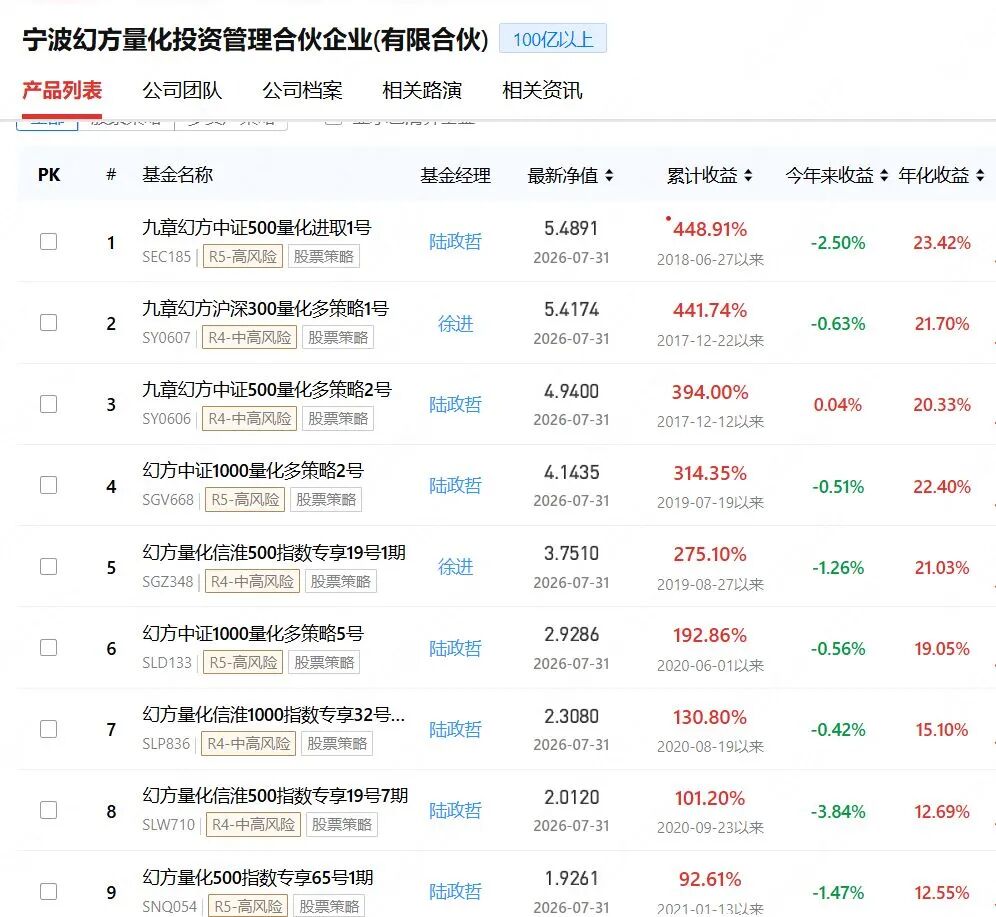
Data further shows that among the 14 publicly displayed products of Minghong Investment, 9 have recorded negative returns for the year, and the worst-performing Minghong Select CTA has lost 10.78% in the first seven months. Among the 15 products under Jiukun Investment, 14 still have positive annual returns, but the drawdown in July was also significant. The annual return of Jiukun Yuanjia CSI A500 Index Enhanced No.1 is close to 8%, but its decline in July exceeded 11%, erasing a large part of the previous gains.
In comparison, Yanfu Investment has shown relatively robust performance: only 1 of its 14 publicly displayed products posted negative annual returns, with a decline of merely 0.86% in the first seven months. Among the 15 publicly displayed products under Century Frontier, 6 recorded negative returns in the first seven months, and the net value of Century Frontier 1000 Index Enhanced Plus No.9 fell by 5.22% in the first seven months.
Regarding this systemic drawdown, a number of professionals from quantitative private equity firms stated that the fundamental reason lies in the convergence of the market's extreme style, overcrowded trades, and the resonance of internal and external market sentiment.
However, some quantitative private equity practitioners also admitted: "We notice that many investors often attribute the drawdown to the excessive exposure of managers and high industry deviation, that is, too much investment in technology stocks, but risks are never determined by a single variable of exposure, but also by the combined effect of factor volatility. The volatility of the momentum factor has multiplied several times in July, which is the key to amplifying the risks."
Institutions judge that AI has entered the "second half"
Despite the sharp adjustment in the market, the mainstream view of leading institutions tends to believe that this is not a trend reversal, but a necessary correction after overpricing.
The Xingzheng Strategy team found in a survey of local institutions in July that during the recent significant market pullback, the position of "relative return funds" has declined, while "absolute return funds" represented by insurance capital increased their positions against the trend. The survey shows that the level near 3700 points (Shanghai Composite Index) is regarded as the consensus bottom, and all types of funds tend to choose opportunities to increase their positions in the next month.
In terms of style, the proportion of investors who are optimistic about the dominance of growth stocks in the next month has decreased, and maintaining a balanced allocation has become the mainstream judgment. AI computing power is still the consensus of transactions, but the willingness to go long on dividend assets has risen significantly. As for the attribution of this round of adjustment, the mainstream market view still attributes it to disturbances on the denominator side rather than the weakening of the numerator side: excessive optimistic pricing during the data vacuum period, while the fundamentals have not been fully verified, superimposed with the contagion effect of liquidity risks caused by deleveraging in South Korea.
Freshwater Spring Investment put forward a more clear judgment in its latest view: "The AI-led technology growth market rally is not over." They believe that the recent AI industry itself has indeed seen changes that prompt the market to re-examine: the improvement speed of leading model capabilities has gradually slowed down, and the market has begun to question the return rhythm of computing power investment; some cloud vendors have turned to debt expansion after exhausting their positive cash flow, and the sustainability of capital expenditure has attracted widespread attention; the rise in storage prices caused by the mismatch between supply and demand has also squeezed the AI budget of cloud vendors. The superposition of multiple factors has indeed formed a short-term impact on the narrative of "sustained expansion of AI computing power" in the past few years.
But returning to the industry itself, Freshwater Spring emphasized that current AI is still in a stage of rapid development in dimensions such as model capability improvement, usage cost reduction, and application scenario expansion. Referring to the historical experience of the Internet and mobile Internet eras, it is normal for a wave of technological development to encounter twists and turns in the process of advancement, and the general trend will not change as a result.
If we extend the perspective to two or three years, Freshwater Spring believes that AI investment will gradually move from the "first half" which previously focused on computing power infrastructure to the "second half" of "intelligence democratization" — that is, whether the usage cost of intelligence can continue to decline, so as to unlock application scenarios in all walks of life. In this process, those supply chain enterprises that can provide higher-efficiency and more cost-effective solutions for leading model companies and large cloud vendors will gain opportunities to stand out.
(Disclaimer: The content and data of this article are for reference only, and do not constitute investment advice. Investors shall bear their own risks if they operate based on the content herein.)
This article is from the WeChat official account "National Business Daily", author: Li Na, published by 36Kr with authorization.