Why has Meiji Milk fallen from its pedestal in the Chinese market?
The sale of its China business by Meiji Dairies has sent shockwaves through the industry.
As an iconic representative of the transition to functional yogurt in Japan and even across the globe, why did Meiji Dairies ultimately fail in the Chinese market? Is it that Meiji's development path does not align with the market conditions in China, or are there inherent problems in its own development strategy?
In particular, as Chinese dairy enterprises are now embarking on the functional transformation, is Meiji's experience still of reference value?
1. Retreat from the Chinese Market
To understand why Meiji sold its China business, we first need to clarify what products Meiji has been selling in China, and what exactly the divested business covers.
First, the business divested by Meiji China covers the fresh milk, yogurt and dairy B2B sectors in the Chinese market, which does not mean a complete withdrawal from China.
According to the announcement released by Meiji Holdings on July 21, the transaction targets include the drinking milk, yogurt and dairy B2B business operated in China, together with two low-temperature dairy plants in Tianjin and Suzhou, all of which are sold to AustAsia Group, including a two-year right to use the Meiji trademark. The base consideration of this transaction is 320 million RMB, with a cap of 350 million RMB.
The businesses retained by Meiji China include the chocolate and ice cream plants in Shanghai, as well as the nutrition products sector.
Secondly, and most critically, Meiji Dairies' business in China is not completely equivalent to its business in the Japanese market.
In terms of scale, Meiji China only accounts for a very small part of Meiji Holdings' total revenue. In 2025, Meiji Holdings' total sales reached 271.3 billion yen for dairy products, 171.0 billion yen for chocolate, 119.0 billion yen for nutrition products, and 195.2 billion yen for food solutions (nursing care food), totaling 924.4 billion yen for the food segment, plus an independent pharmaceutical division that recorded 229.6 billion yen in revenue.
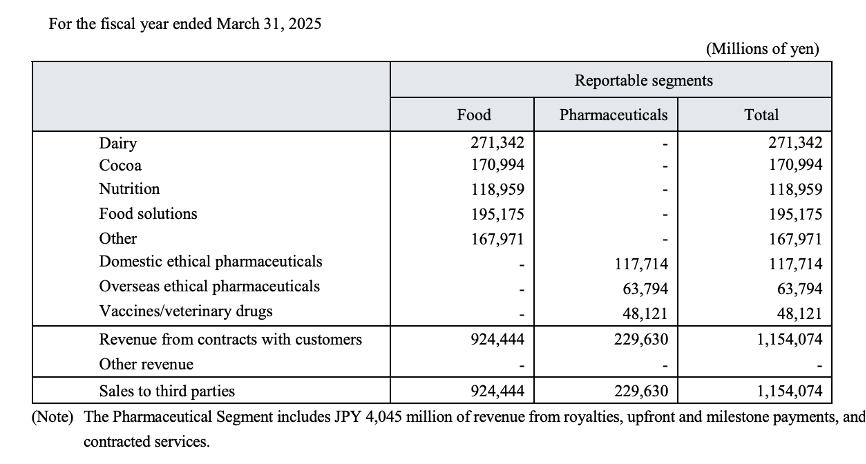
(Meiji Holdings 2025 Fiscal Annual Report)
However, the revenue from the Chinese market in the same period was 28.2 billion yen, divided into four major segments: milk and yogurt, ice cream, chocolate and confectionery, and nutritional food, while the nutritional food business was just in its infancy with a very small scale.
In terms of products, the products Meiji sells in the Chinese market only belong to the food business. Its real core profit sectors, including the functional yogurt system, nursing care / infant nutrition, and pharmaceuticals, are almost not involved at all. In addition, without the home delivery channel that is its advantage in the Japanese market, Meiji cannot replicate its experience in the Japanese market in China at all.
This involves policy issues in different markets, as well as differences in market stages and business strategies.
For example, the same yogurt is classified as functional food in Japan, but can only be labeled as flavored food in China; the mature nursing care food sector in the Japanese market is still in the early stage and has not formed a complete system in China.
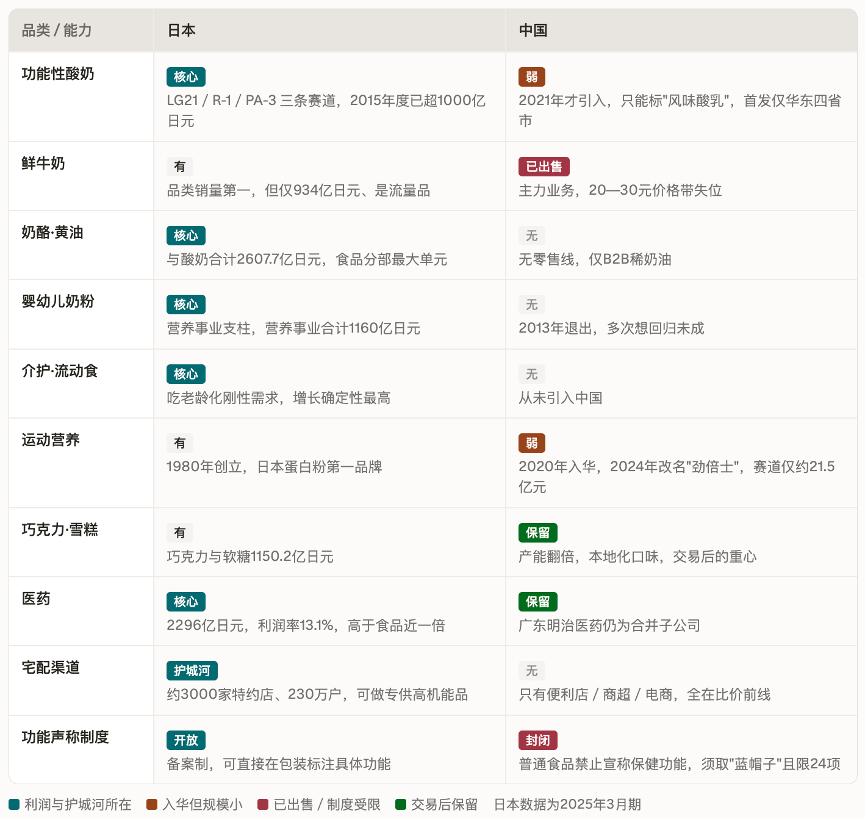
(Comparison of different products between Meiji China and the Japanese market)
2. Failed to Succeed in the High-end Segment?
Meiji Dairies has always focused on high-end milk in the Chinese market. For some consumer groups, Meiji's high-end positioning is acceptable, but we found that Meiji's high-end strategy ended up in a failure in terms of actual market share and sales performance.
Apart from the premium price tag, Meiji's high-end positioning is also affected by its functional yogurt business in Japan.
In Japan, Meiji can directly link yogurt to health functions. The Japanese government established the Foods with Function Claims system in 2015, which allows enterprises to directly label functions such as "inhibiting the rise of uric acid level" and "improving intestinal health" on product packaging after completing the filing process. Meiji's PA-3 product relies on this system to print the "purine-fighting lactic acid bacteria" claim directly on the package.
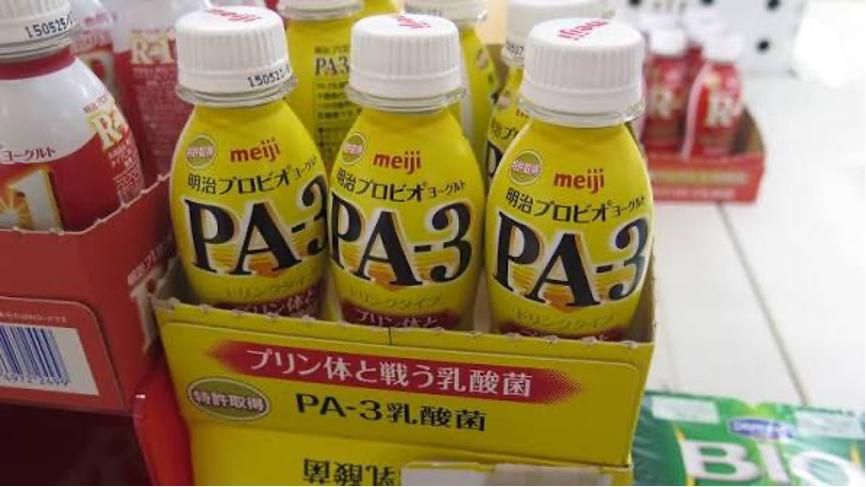
(Functional yogurt products of Meiji in the Japanese market)
The rules in China are completely different. Products with health care functions need to obtain the "Blue Cap" certification, so Meiji R-1 can only be labeled as flavored yogurt or flavored fermented milk when it was launched in China.
This also leads to zero functional premium for the product.
It is also worth mentioning that Meiji is a key benchmark of the transition from fresh milk to functional dairy products in Japan. The Chinese market is currently going through a similar process. The underlying change in the consumption environment is the gradual aggravation of the aging society, which brings changes in consumers' demand for different dairy products.
The sales revenue of Meiji Japan's nutrition business reached 119.0 billion yen in 2025, with core products being infant formula and nursing care liquid food. This category that meets the significant demand of an aging society has hardly entered the Chinese market.
Therefore, we can see that neither the functional yogurt nor the important category of nursing care liquid food of Meiji has played an effective role in the Chinese market.
3. Meiji's Failure
Even if the above two important sectors did not give full play to their advantages, Meiji was also an early player in the domestic dairy market that placed heavy bets on the fresh milk track.
At present, when low-temperature fresh milk has become a new growth point in the dairy industry, why did Meiji fail to seize the outbreak of the fresh milk market?
This is caused by three combined factors: the misalignment of Meiji's fresh milk business in the Chinese market in terms of pricing, channels, and the rhythm of the industry cycle.
First of all, Meiji's pricing strategy in the Chinese market is problematic.
The so-called high-end positioning of Meiji in the Chinese market is essentially just high prices.
The price of Meiji's milk in the Chinese market is almost twice that in the Japanese market, and its pricing range in China is more than twice that of local Chinese brands.
The strategic new product "Zhenhaohao Milk" launched in July 2025 has a regular price of 33.9 yuan for 900mL, and its promotional price is mostly over 25 yuan, while the equivalent price of the same product in Japan is only 13-15 yuan. On the same shelf, the 950mL fresh milk of Hema's private brand Ririxian is priced at 7.8 yuan, 900mL of Sanyuan 72° fresh milk costs 9.9 yuan, and Meiji Chunyi 950mL is priced at more than 20 yuan.
Moreover, although Meiji's milk is placed in the freezer cabinets of convenience stores, it is actually high-temperature sterilized milk, which is commonly known as ultra-pasteurized milk. If this were a Chinese brand, it would probably be criticized by consumers for pretending to be fresh milk.
In fact, the fresh milk category in the Chinese market is also showing a trend of increasing sales volume but decreasing price, and the high-end segment does not have a competitive advantage.
According to data from Kantar, the sales revenue of the fresh milk category in the Chinese market increased by 2.6% in the first half of 2025, among which the sales volume increased by 11.7% and the average unit price dropped by 8.2%.
The second factor is the channel problem.
Meiji's advantage in the Japanese market lies in its home delivery channels, while in the Chinese market, its sales rely on convenience stores, supermarkets and e-commerce platforms.
The fresh milk market in China also shows the characteristics of weak offline performance and strong online performance. According to data from NielsenIQ, in 2024, the total offline sales of the national low-temperature fresh milk market decreased by 5.4% year on year, while online sales increased by 29.7% year on year.
This means that the offline channels that Meiji has placed heavy bets on have been shrinking in recent years.
The third factor is that Meiji's expansion pace is mismatched with the outbreak cycle of China's fresh milk market.
Judging from the market rhythm this year, fresh milk is one of the growth points of the dairy industry, but we cannot ignore the fact that the whole industry was in a stage where fresh milk was a cash-burning business in the past few years.
In other words, in the years before the outbreak of the fresh milk market, enterprises usually had to bear high transportation and preservation costs to expand their market share, which means that the fresh milk business was unprofitable for dairy enterprises.
Meiji China was no exception.
Meiji launched its low-temperature fresh milk business in the Chinese market as early as 2013, and its Suzhou plant was also put into operation in the same year, mainly targeting consumers in the Yangtze River Delta economic zone.
Meiji accelerated its expansion in 2019. It built a new plant in Tianjin in September that year, and expanded the production lines in Suzhou the following year. The Tianjin plant was finally put into operation in January 2023. In addition, the yogurt plant in Guangzhou opened in March 2024.
It can be seen that the concentrated launch of Meiji's production capacity from 2023 to 2024 coincided with the stage when the raw milk price of China's liquid milk continued to decline and market demand began to weaken. Euromonitor data shows that the compound annual growth rate of the liquid milk industry from 2022 to 2024 was -4.2%.
Therefore, for Meiji China, its expansion happened to fall in the period when the overall Chinese dairy market presented three characteristics: rising sales volume with falling prices, online channels replacing offline channels, and low-priced segments expanding. These three characteristics are exactly the disadvantages of Meiji, which positions itself as a high-end brand.
This article is from the WeChat official account "Big V Business", written by Liu Ying, and published with authorization from 36Kr.