The 70-billion-yuan bullfrog industry is mired in antibiotic-related predicaments.
Recently, an in-depth investigation report on excessive antibiotic residues in bullfrogs has sparked a huge stir in the 70-billion-yuan bullfrog industry. Consumers are deeply worried when facing popular dishes such as spicy dry-pot bullfrog and pickled pepper flavored bullfrog.
In fact, excessive drug residues in bullfrogs occur from time to time every year, and this long-standing industry problem has always been difficult to solve fundamentally rather than just treating the symptoms. The core crux lies in that farmers adopt excessively high breeding density to pursue higher yield, which forces them to abuse antibiotics; the drug residue inspection in the circulation link is a mere formality, making food safety a sharp sword hanging over the industry all the time.
With high protein and low fat, bullfrog has become a featured dish. If the breeding side does not adjust the breeding mode and strictly control the use of drugs, the whole industry will be negatively affected in the end.
Frequent Occurrence of Drug Residues
After the recent investigation report on excessive antibiotic residues in bullfrogs was widely spread, the pickled pepper flavored bullfrog and spicy dry-pot bullfrog on the dining table instantly became unappetizing, as people would associate every bite with excessive antibiotics.
In the catering industry, bullfrog is a common featured dish, which has won countless consumers with its advantages of high-quality protein and low fat. After years of R&D and practice, various flavors of bullfrog dishes have been developed, providing consumers with diversified choices and gourmet experiences.
However, behind the booming market, there are hidden food safety chaos in the bullfrog breeding and circulation links.
According to the investigation by The Paper, to pursue higher yield, farmers generally adopt high-density breeding of bullfrogs. In this case, bullfrogs are very prone to get sick, making antibiotic abuse a normal practice. At the same time, in the processing and sales links of bullfrogs, drug residue detection is even more ineffective, making it impossible to stop problematic bullfrogs from reaching the dining tables.
The report pointed out that the enrofloxacin (a type of antibiotic) content in some samples exceeded the standard by more than 5 times, and furazolidone, a drug explicitly banned due to its carcinogenicity and genotoxicity, was also detected.
To evade supervision, upstream and downstream enterprises divide bullfrog products into export-oriented, antibiotic-free and conventional products. At present, the conventional products, which account for the largest proportion of the bullfrogs flowing to food delivery platforms and wholesale markets, have the highest risk of excessive drug residues.
In fact, the problem of excessive drug residues in bullfrogs did not only emerge this year. According to the statistics of China Consumer Daily in July 2025, from 2014 to the publication of the report, the State Administration for Market Regulation has sampled and tested 21,518 batches of bullfrogs in total, with 4,077 unqualified batches.
From May to July 2025 alone, relevant authorities in Nanjing, Changsha, Wuhan and Guiyang have successively publicized multiple unqualified cases of bullfrogs with excessive enrofloxacin in the catering and aquatic product wholesale links.
Antibiotics are not completely prohibited in the bullfrog breeding industry. In March this year, the Ministry of Agriculture and Rural Affairs issued the Technical Guidelines for Spring Quality Safety Risk Prevention and Scientific Drug Use for Bullfrogs, clarifying that if antibiotics need to be used, they should be administered strictly in accordance with the specified dosage and course of treatment, and the drug withdrawal period should be strictly implemented to eliminate excessive drug residues from the source. So far, the implementation of this standard is not optimistic.
Fluctuations in Industry Scale
In the 1980s, the domestic bullfrog breeding and seedling raising technologies were popularized, marking the official start of commercial bullfrog farming. After the 1990s, the launch of professional bullfrog feed and the improvement of disease prevention and control system promoted the expansion of bullfrog breeding across the country, gradually forming a featured breeding industry.
Compared with other frog species, bullfrogs eat more and grow faster, with prominent economic benefits, so the industrial scale expanded rapidly.
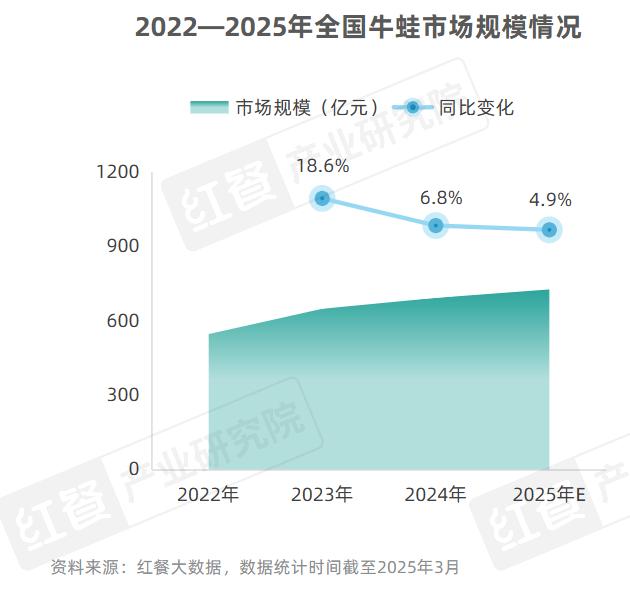
According to the statistics of Southern Rural Daily, the national annual output of bullfrogs increased from 200,000 tons in 2015 to more than 1 million tons in 2023, making it the 9th aquatic product in China with an annual output exceeding 1 million tons, following grass carp, silver carp, bighead carp, crucian carp, prawn, tilapia and crayfish.
Affected by the market environment in 2024, the national bullfrog output dropped to 700,000 tons, and fell back to 550,000-600,000 tons last year.
The layout of bullfrog breeding areas has undergone two changes. Before 2017, 80% of the national breeding volume was concentrated in Shantou of Guangdong, Zhangzhou and Xiamen of Fujian. Among them, the breeding scale of Chenghai District, Shantou once accounted for 40% of the total national output.
After 2017, many cities and counties in Fujian carried out rectification of bullfrog breeding prohibition, followed by Guangdong and Jiangxi later, so the traditional breeding areas shifted to other regions across the country.
The expansion of breeding production capacity is driven by the growing demand from the downstream consumer side. In 2023, the maturity of the bullfrog catering track increased significantly, giving rise to a large number of leading national chain brands such as Walaida, Wuxia, Wowo, Gelao Guan, Laofoye, Taowa and Weizhijue.
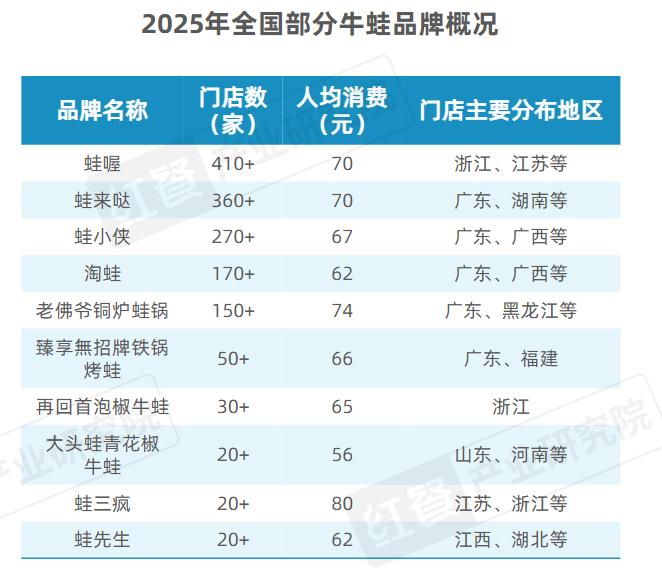
Among them, Walaida, founded in Changsha, is the benchmark in this track. It entered the market with the single product of spicy dry-pot bullfrog in 2010, and completed Series A financing in 2021, jointly invested by Juele Fund and Tomato Capital. According to public reports, it has more than 500 stores across the country so far, distributed in more than 120 cities in China.
In terms of product forms, major brands focus on innovation in cooking methods, expanding from main dish features such as charcoal-grilled, dry-pot, fried and bullfrog hot pot to the tracks of snacks, barbecue and hot pot.
However, the entire catering industry has not been prosperous in the past two years, the market of single-product featured catering has shrunk significantly, and the number of stores of related brands is decreasing.
According to the big data of Zhaimen Canyan, in November 2025, there were 20,772 operating stores of national bullfrog catering brands, with a net growth of -2,585 in the past year.
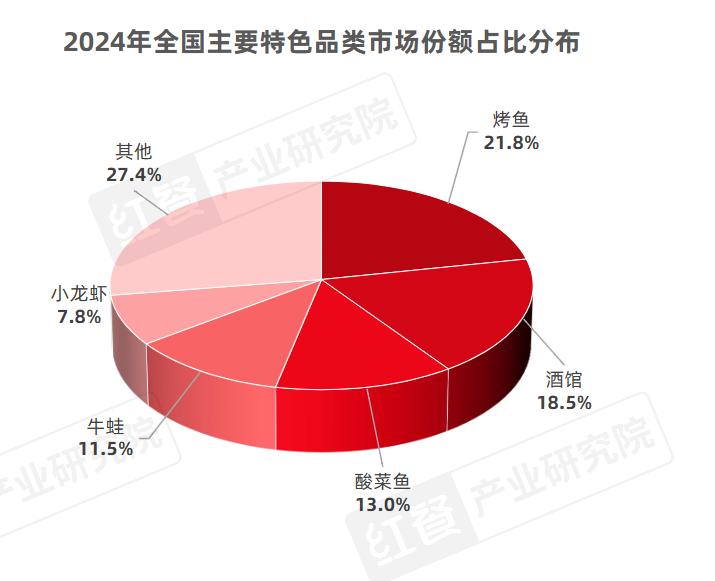
Affected by hidden food safety risks and the adjustment of consumer demand structure, the bullfrog catering track failed to reach the previously predicted 100-billion-yuan market scale, and the current market size is only 48 billion yuan.
Transformation of the Track
Bullfrogs are generally bred at high density, which makes it difficult to control feed, drug use and environmental protection, and becomes the biggest pain point restricting the development of the industry.
At present, the total output value of the whole industrial chain has reached 70 billion yuan. The track has a huge volume, but it has never cultivated upstream leading enterprises with industry influence, and only several national chain brands have emerged at the catering end. From the perspective of financing frequency, the bullfrog track is far lower than that of common aquatic products such as freshwater fish and poultry such as chickens and ducks.
This is mainly because bullfrog is not a necessary food for all people. Compared with general market ingredients such as chickens, ducks, fish and shrimp, bullfrog has limited consumption scenarios and narrow adaptation range, with obvious industry shortcomings. In addition, the sword of food safety has always been hanging over the industry, making the primary and secondary markets remain highly cautious about it for a long time.
To expand the growth space of the industry, bullfrog products have begun to extend from offline catering to pre-made dishes. During the special period in 2020, the circulation of live bullfrogs was restricted, bringing development opportunities for quick-frozen pre-processed bullfrog products. Semi-finished products suitable for B-end customers, such as marinated bullfrogs and non-sized batter bullfrogs, officially started to develop along with the boom of the pre-made dish industry.
From 2021 to 2022, non-sized batter bullfrog products achieved large-scale commercial use in the B-end market; in 2023, heat-and-eat pre-made bullfrog dishes were launched on the market.
Guolian Fisheries is probably one of the earliest listed companies to enter the bullfrog sector. It has 3 breeding bases in Hunan, conducted in-depth research on pre-made bullfrog dishes in 2018, began to supply products to large domestic catering enterprises in 2022, and regards bullfrog as a key product for cultivation and support.
According to public data, in 2023, its holding subsidiary Guolian (Yiyang) Food had an annual bullfrog processing capacity of 3,000 tons. Its products are not only supplied to channels such as Yum China and Walmart, but also developed finished pre-made bullfrog dishes to meet the demand of C-end consumers.
After 2023, pre-made bullfrog dishes have become the new favorite of food enterprises. In addition to Guolian Fisheries, Anjoy Foods (603345.SH), Zhenwei Xiaomeiyuan, New Hope Meihao and other enterprises have also successively launched pre-made bullfrog products, which are sold through all online and offline channels.
However, compared with the mature development of crayfish and fish with pickled cabbage, the development of pre-made bullfrog dishes is still relatively lagging behind. Few enterprises dare to make large-scale heavy investment. On the one hand, public opinions about drug residues in the breeding field keep emerging repeatedly; on the other hand, consumers' cognition of bullfrog products still stays at the concept of freshly slaughtered live bullfrogs, and the market education of pre-made bullfrog products has not been completed.
This article is from the WeChat official account "Zebra Consumption" (ID: banmaxiaofei), written by Shen Tuo, and authorized for release by 36Kr.