Reselling NVIDIA GPU computing power generates revenue faster than the rocket and satellite business, and Elon Musk has released SpaceX's first financial report.
SpaceX, the Elon Musk-founded company renowned for its rockets, saw that the rockets were no longer the highlight when it released its first post-IPO earnings report.
According to the financial report, SpaceX's revenue reached 7.814 billion US dollars, up 92% year on year, exceeding the market expectation of around 6.9 billion US dollars; among which, the AI business revenue hit 2.561 billion US dollars, surging 247% year on year and more than tripling quarter on quarter.
Don't get excited too soon.
Of the total capital expenditure of about 18.369 billion US dollars in the second quarter, the AI business alone accounted for about 15.828 billion US dollars, making it the primary cash-burning item.
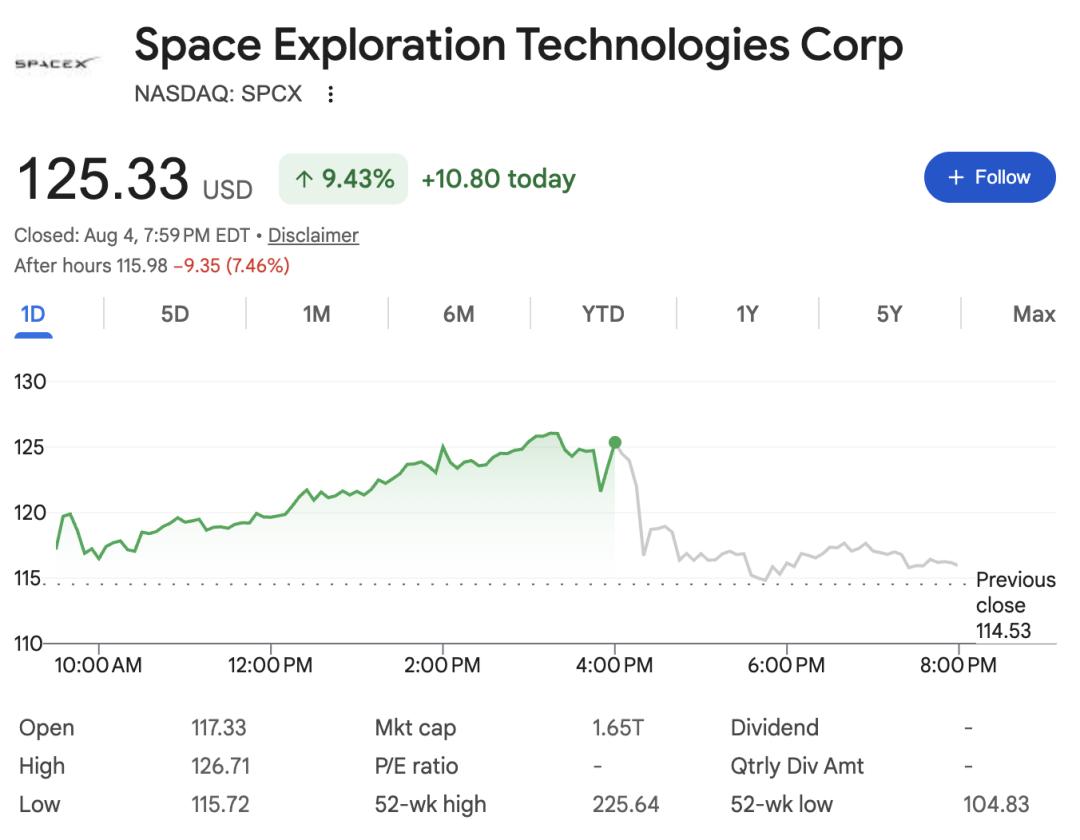
Dramatically, following the earnings release, SpaceX's stock price staged a "cheer first, calculate later" trend.
During regular trading hours, driven by the better-than-expected revenue, the stock price once rose 9.4%; after the market close, investors shifted their focus from the 247% growth rate of AI revenue to the 15.8 billion US dollars AI capital expenditure and continuous losses.
Meanwhile, the market is also concerned about the upcoming pressure of post-IPO restricted share lifting...
The stock price immediately turned down by more than 6%, remaining below the 135 US dollars issue price.
At the same time, the short positions on SpaceX in the market have risen rapidly. S3 Partners, the world's most well-known US stock short and securities lending data service provider, estimates that short sellers hold about 206 million shares, accounting for roughly 32% of the publicly tradable shares.
Musk was so furious that he almost jumped through the roof.
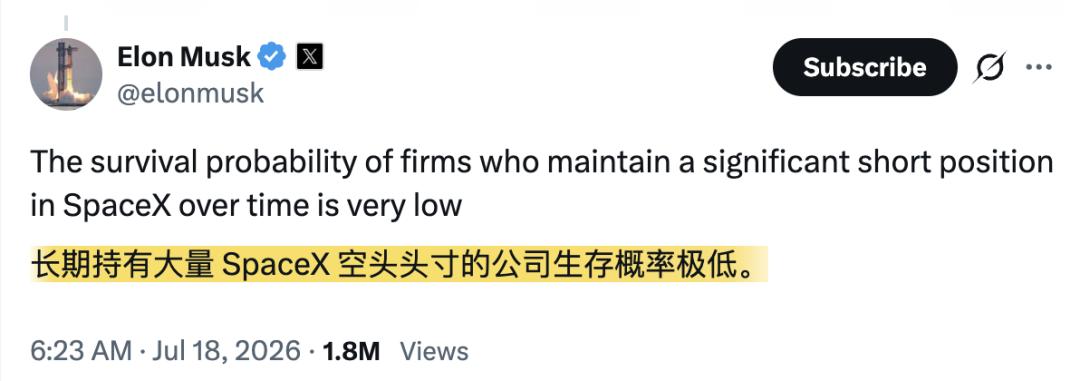
He warned short sellers on X that institutions maintaining large short positions for a long time have an "extremely low survival probability".
SpaceX is reaping huge profits as an "AI cloud service provider"
SpaceX's AI business is indeed enjoying robust growth.
In the second quarter of this year, SpaceX's revenue reached 7.814 billion US dollars, up 92% year on year, exceeding the market expectation of around 6.9 billion US dollars.
Adjusted EBITDA (Earnings Before Interest, Taxes, Depreciation and Amortization) reached 3.538 billion US dollars, up 191% year on year.
It is worth noting that the AI business has stepped onto the forefront with particularly outstanding performance.
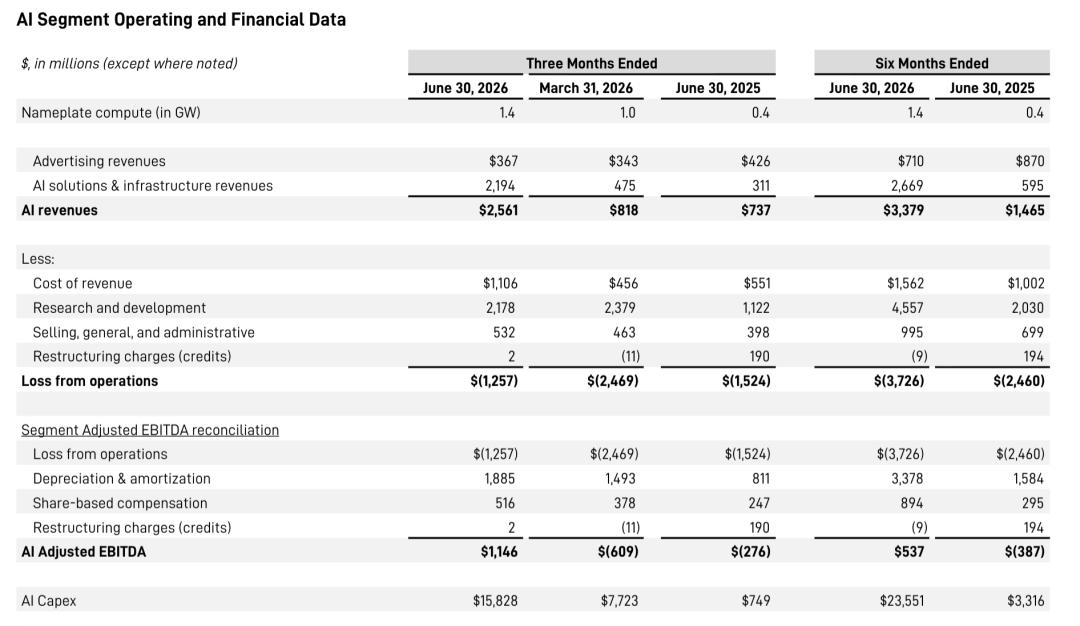
The AI business revenue in this quarter hit 2.561 billion US dollars, accounting for nearly 1/3 of the total revenue; it increased by 247% year on year and 213% quarter on quarter.
The business of this segment not only outperformed the market expectation of around 6.9 billion US dollars, but also ranked first in the company in terms of growth rate, rapidly growing into the second largest revenue source of the company.
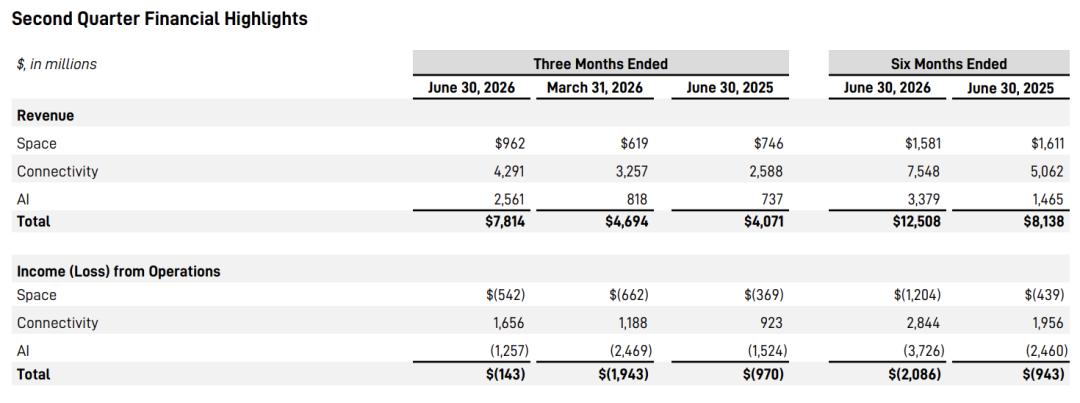
According to the financial report, AI advertising revenue was 367 million US dollars, a year-on-year decline. That means the growth of AI business revenue in this round does not mainly come from the ads on X.
It is the revenue from "AI solutions and infrastructure" that truly drives the AI business to surge, which reached 2.194 billion US dollars in this single quarter.
The company stated in the financial report that the newly signed cloud service agreements brought 1.6 billion US dollars of new AI infrastructure revenue in the quarter, and the total amount of signed non-cancellable contracts reached 14.1 billion US dollars.
The financial report does not disclose the specific customers that contributed the 1.6 billion US dollars revenue one by one.
However, previously public cooperation cases have outlined the picture, and the two most important customers are Anthropic and Google.
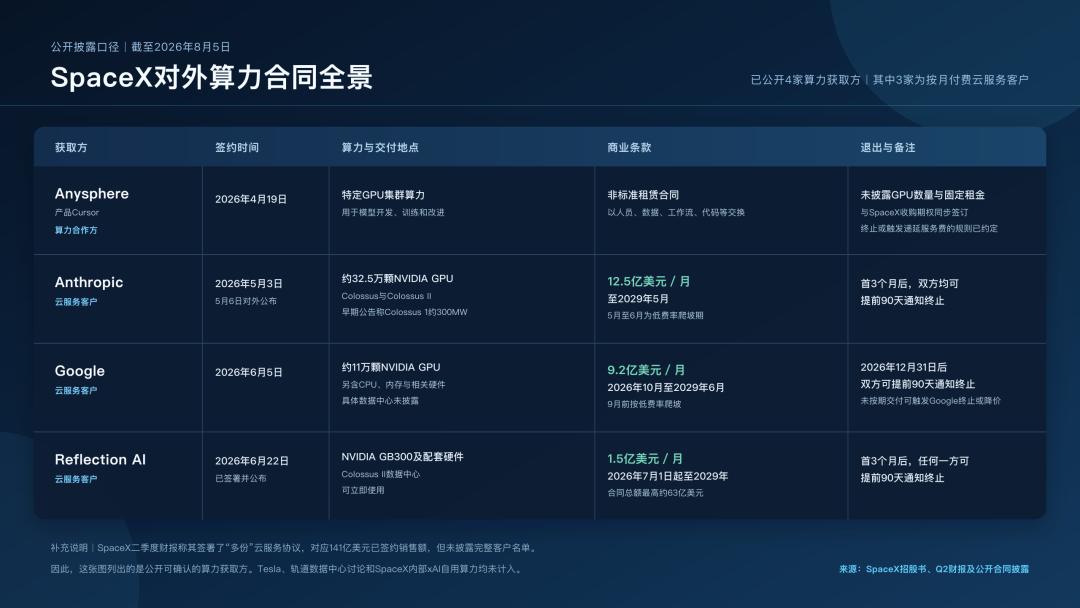
It is not hard to see that SpaceX is rapidly transforming from a self-used infrastructure for training Grok to an AI cloud service provider selling computing power to external parties.
During the analyst call after the company released its performance, Musk also said, "We expect the development pace of AI to increase significantly".
The strongest growth corresponds to the heaviest capital expenditure
The company has opened an online question platform, where investors' questions are sorted by popularity. The question of "when the AI business will turn profitable" does not rank high, which proves that retail investors are more interested in technical vision than short-term financial results.
However, some realistic situations cannot be ignored.
The pattern that SpaceX's satellite business cash flow supports AI expansion in the short term has not changed —
In the second quarter, although SpaceX's AI business revenue has rapidly grown to the range of more than 2 billion US dollars, it is still far from enough to cover the investment.
According to the financial report, SpaceX's single-quarter capital expenditure was 18.369 billion US dollars, of which 15.828 billion US dollars was invested in AI, accounting for about 86%.
This AI expenditure is not only more than 6 times the AI revenue of the quarter, but also exceeds twice the total quarterly revenue of the company.
For AI-related capital expenditure, daily operating expenses only account for a small part, and the vast majority is invested in AI infrastructure — it even accounts for about 86% of the total capital expenditure.
This part of the expenditure is mainly used to purchase future supply capacity in advance.
The financial report shows that SpaceX's one-time large-scale infrastructure investment (Capex) in the second quarter is mainly concentrated in three aspects.
First, expand the Colossus II giant AI supercomputing data center and purchase GPU servers in large quantities.
Second, build supporting infrastructure such as power plants, natural gas supply, power supply and heat dissipation facilities.
Third, purchase land, plant and hardware equipment for computing power clusters, with the goal of continuously expanding the computing power scale to the maximum.
As of the end of June, the total computing power power load of SpaceX was 1.4GW, which was only 1GW in the first quarter and 0.4GW in the same period of last year, meaning the computing power scale has tripled in a year.
In terms of daily operating costs, the largest expenditure still falls on R&D, costing 2.178 billion US dollars.
Specifically, it refers to training the Grok series of models, joint R&D with the code tool Cursor, and self-developed AI computing power scheduling and cloud service software.

This is also the most interesting tension in SpaceX's earnings report.
On the one hand, AI revenue has skyrocketed 247% year on year, the amount of newly signed contracts has reached 14.1 billion US dollars, and computing power leasing has taken initial shape in commercialization.
On the other hand, the outbreak of AI revenue has not yet caught up with the capital speed of the company's AI infrastructure expansion, and SpaceX is still exchanging pre-investment for future supply.
Musk mentioned on the call that SpaceX's "tentative goal" is to achieve 20GW of power and heat dissipation supporting capacity online by the end of next year, and even if there is a delay, the capacity will most likely reach close to 15GW.
However, building data centers and purchasing GPUs need to pay in advance, while the revenue from customers using computing power will be recognized gradually later.
This time mismatch between revenue and capital expenditure is directly reflected in the AI division's income statement of this quarter.
Overall, the loss of SpaceX's AI business is narrowing, but the absolute scale is still large — the AI division recorded an operating loss of about 1.26 billion US dollars in this quarter, which is better than the pessimistic estimates of some analysts. This proves for the first time that SpaceX's AI business has the ability to generate commercial revenue,
but there is still a clear distance from profitability. For SpaceX, which set sail with the tag of "the largest IPO in history", this is a sweet but heavy burden.
Moreover, it is worth noting that SpaceX's depreciation and amortization in the quarter has reached 2.848 billion US dollars, of which the AI business accounted for 1.885 billion US dollars.
The more you build today, the higher the depreciation, maintenance, energy and financing costs in the profit statement in the future, so the computing power utilization rate, customer renewal rate and unit computing power price all need to continue to rise.
Now, three important issues are in front of Musk:
Can customers such as Anthropic and Google absorb the newly added computing power for a long time?
Can AI infrastructure revenue continue to grow faster than capital expenditure?
As the computing power continues to expand from 1.4GW, can the construction cost and operating cost per unit of computing power decline?
One More Thing
On the earnings call, Musk kept making famous remarks, acting in his usual Musk style.
He stated directly, "We think the architecture designed by VeraBubin is the best architecture".
He also emphasized on X:
SpaceX has committed to using only NVIDIA's GPUs, because they are the best.
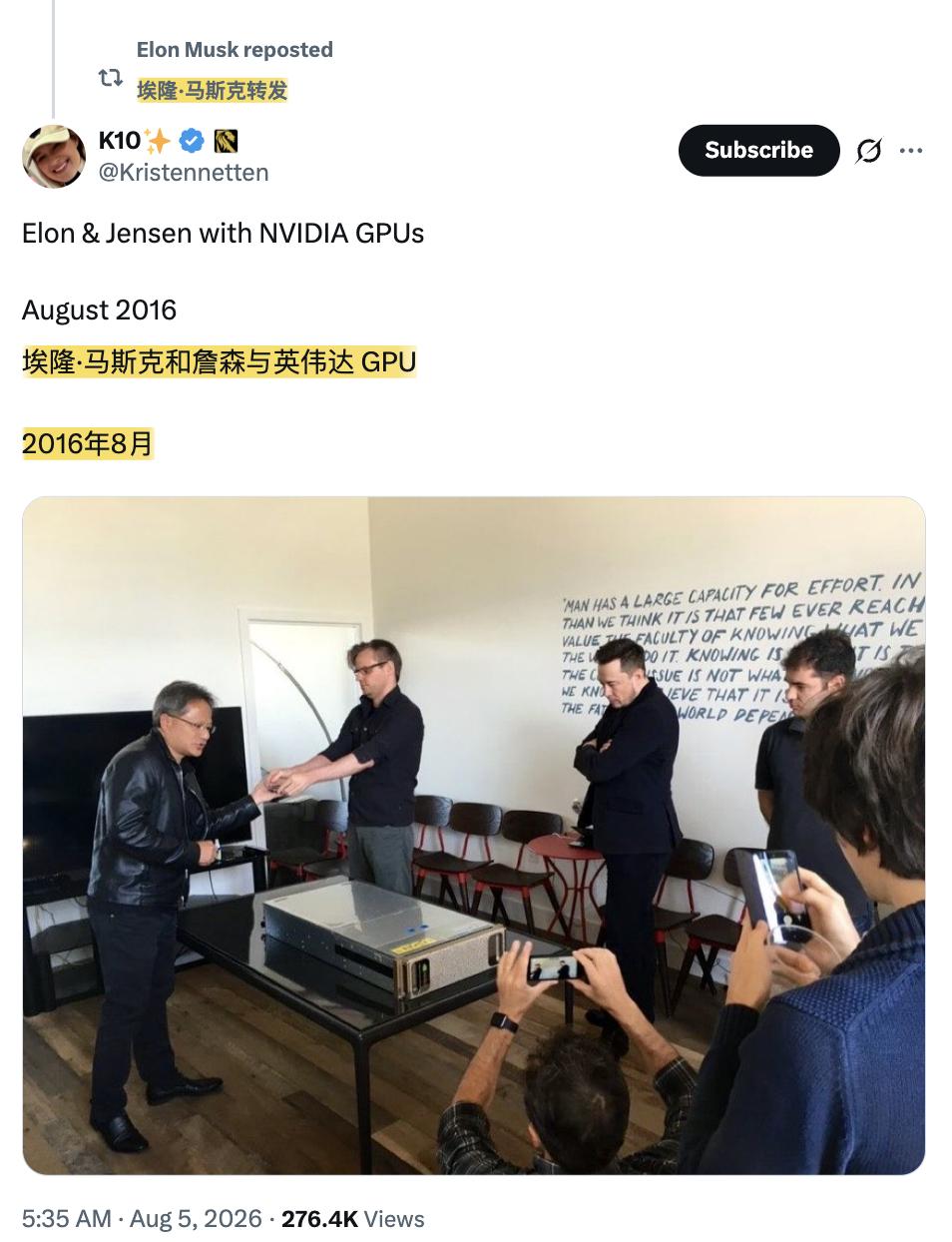
Almost at the same time he sent this tweet, he quietly liked an old photo:
Reference Links:
[1]https://s21.q4cdn.com/184289198/files/doc_financials/2026/q2/SpaceX-Reports-Second-Quarter-2026-Results.pdf
[2]https://x.com/elonmusk/status/2084744157470351541
[3]https://x.com/elonmusk/status/2078244138626031912
[4]https://www.businessinsider.com/spacex-first-earnings-report-spcx-stock-lockup-period-expiration-2026-8
[5]https://x.com/i/trending/2084756364723908767
This article is from the WeChat official account "QbitAI", written by Heng Yu, and published with authorization from 36Kr.