16.2 billion, Visa bought an anti-fraud company that comes from Israel
Every year, scammers siphon over 1 trillion US dollars from online fraud.
Stolen accounts, online scams, AI impersonation — scammers are using increasingly sophisticated methods that are getting harder to guard against. As one of the world's largest payment networks, Visa suffers financial losses, reputational damage, and erosion of customer trust every time a fraudulent transaction occurs.
On August 3, 2026, Visa acquired BioCatch, a company specializing in anti-fraud solutions, for 2.4 billion US dollars (approximately 16.2 billion RMB).
Currently, Visa is the world's largest financial payment company with a market capitalization of around 670 billion US dollars (approximately 4.5 trillion RMB).
- 01 - What kind of business is anti-fraud?
Founded in 2011, BioCatch is headquartered in Tel Aviv, Israel, and currently has around 400 employees.
Its offering is very unique: instead of verifying whether your password is correct, it monitors how you operate: the rhythm of your keystrokes, the trajectory of your mouse movement, the pressure you apply when touching the screen with your finger. Everyone's habits of using mobile phones and computers are different, as unique as their walking posture, and extremely difficult to imitate. Robots can steal your password, but they cannot steal your typing speed and gesture habits.
Its technology analyzes thousands of behavioral, device, application and network signals, and can generate a risk score within 300 milliseconds when a user performs online banking operations, directly telling the bank to "approve" or "block" the transaction.
So how exactly does it make money? BioCatch runs a SaaS subscription business. Customers pay annual fees, and the pricing is based on the number of protected sessions per month — that is, how many users are monitored by its system when using banking apps or websites. The more the bank uses the service and the wider the user coverage, the more it pays.
Who are paying for the service? It serves more than 350 banks and financial institutions across 21 countries worldwide, including over 100 of the world's top banks such as American Express, Barclays, HSBC, and National Australia Bank. Currently, BioCatch protects 1.8 billion devices and 760 million users globally.
Banks lose tens of millions or even hundreds of millions of US dollars to fraud every year, and spending millions of US dollars on BioCatch's services can reduce these losses. Since 2018, BioCatch has helped its customers block an estimated 4.7 billion US dollars in fraudulent transactions in total.
The company's revenue is growing rapidly. Gadi Mazor was appointed as CEO in 2018, when the company's annual revenue was only 7 million US dollars. By the end of 2023, its annual recurring revenue (ARR) had exceeded 100 million US dollars, representing a 49% year-on-year growth that year. In 2025, its full-year ARR grew by 43%.
Moreover, the loyalty of its existing customers is very high, with them paying an average of 24% more in fees each year than the previous year. In 2025, the company also signed 90 new customers, including Wells Fargo.
- 02 - Visa Can No Longer Wait on the Sidelines
Why did Visa spend such a huge sum of money? Because scamming activities are extremely rampant.
Account theft, online fraud and related activities cause losses of over 1 trillion US dollars to the global economy every year. What's more, scammers are now also using AI, which lowers attack costs, speeds up attacks, and makes them harder to detect. As one of the world's largest payment networks, Visa has to bear compensation risks and brand damage for every fraudulent transaction that occurs.
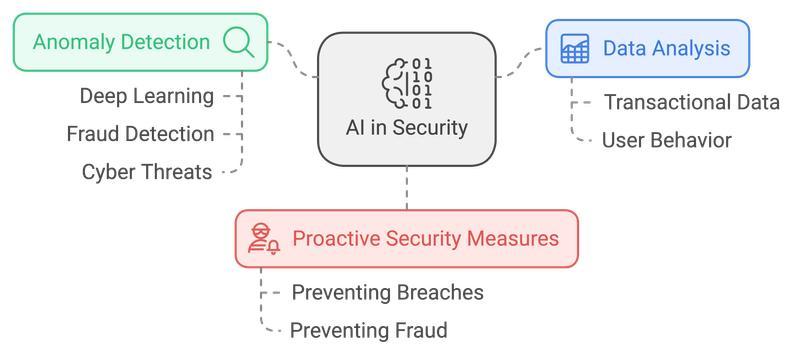
Three Major Application Directions of AI in the Security Field Source: Virtus
Over the past five years, Visa has invested more than 13 billion US dollars in technology and infrastructure to protect the security of the payment system. But relying solely on its own strength is not enough, and it needs more advanced tools. After the full acquisition, Visa can directly embed BioCatch's AI model into its own transaction processing system to achieve millisecond-level fraud detection.
There is another background: selling anti-fraud software to banks has become one of the fastest-growing businesses for Visa. Acquiring BioCatch is equivalent to installing a more powerful engine for this profit-generating machine.
For BioCatch, being acquired by Visa is also a good choice. Previously it was an independent company with banks as its main customers. Now with the backing of Visa, it has more stable capital and more data — Visa's network connects nearly 14,500 financial institutions, processing more than 329 billion transactions a year with a total value of over 17 trillion US dollars. The more data it has, the more accurate the AI model will be, forming a positive feedback loop.
After the acquisition, BioCatch will continue to operate as it did before, and it has now become part of Visa. Its management team will remain unchanged.
- 03 - A Win-Win-Win Acquisition
Visa is a winner. Spending 2.4 billion US dollars on BioCatch brings it a core capability that can directly reduce fraud losses and make banks and merchants trust it more. Moreover, BioCatch's ARR has exceeded 185 million US dollars and is still growing rapidly. Calculated based on the acquisition price of 2.4 billion US dollars, its valuation is about 13 times ARR — for a SaaS company with 43% annual growth and a 124% net retention rate, this price is not expensive.
BioCatch's investors are also winners. The 2.4 billion US dollars sale price means early investors have reaped huge profits.
How much total financing has BioCatch raised before being acquired? There are slight differences in calibers across different data sources. Overall, the total financing amount ranges between 240 million and 320 million US dollars.
This is already the second time that BioCatch has been sold. In May 2024, private equity firm Permira announced the acquisition of the majority stake in BioCatch, and the transaction was completed in September 2024 at an estimated valuation of 1.3 billion US dollars. Permira invested about 750 million US dollars to acquire a 60% stake. Just over two years later, it sold the company for 2.4 billion US dollars, with a value appreciation of over 1 billion US dollars.
BioCatch's bank customers may worry about Visa's data monopoly in the short term, but Visa has promised that BioCatch will remain open, existing contracts will continue to be executed, and all parties who want to use the service can access it.
- 04 - AI-Powered Anti-Fraud Has Become the Main Battlefield
Visa's acquisition of BioCatch is not an isolated case.
In September 2024, Visa announced the acquisition of Featurespace, a UK-based AI anti-fraud company. Headquartered in Cambridge, Featurespace was founded by Dave Excell in 2008. The transaction was completed in December the same year, and the amount was not officially disclosed, with media reports estimating it at around 946 million US dollars (approximately 6.4 billion RMB). Featurespace's technology is also used for real-time payment fraud detection, and it was integrated into Visa's Risk and Identity Solutions department after the acquisition.
Earlier in June 2018, PayPal acquired anti-fraud platform Simility for 120 million US dollars in cash. Headquartered in Palo Alto, California, Simility provides machine learning-based fraud detection technology. PayPal already held approximately 3% of Simility's shares before the acquisition.
All these transactions point to one fact: payment giants are turning anti-fraud from an "external plugin" into a "core capability" — instead of just buying third-party software for use, they are integrating it directly into their own operational system.
For startups, the time window for independently operating anti-fraud SaaS business is closing — they either get acquired by giants, or transform to target vertical industries such as healthcare and government services, or serve small and medium-sized enterprises.
For investors, those AI security companies that hold unique data and have already established connections with large payment institutions may be the next batch of targets worth paying attention to.
The content of this article is for reference only and does not constitute investment advice.
This article is from the WeChat Official Account "Pencil News" (ID: pencilnews), the author is Pencil News, and 36Kr publishes it with authorization.