China's robotic vacuum cleaners rely on technology to occupy 70% of the global market.
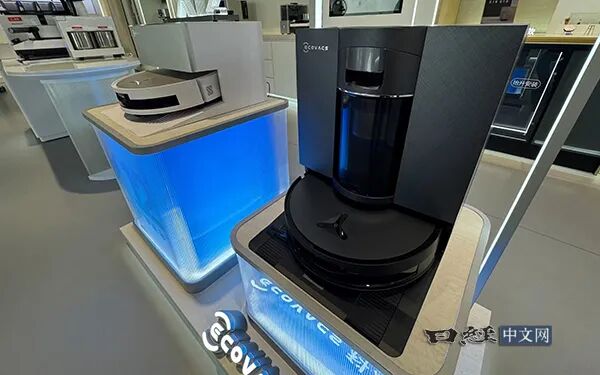
Ecovacs' selling points include a base station with functions such as automatic dust emptying after cleaning, automatic mop washing and drying, etc. (Suzhou, Jiangsu Province)
The five major players in the global robot vacuum cleaner market are all from China. The strategy of competing to develop independent features instead of engaging in price wars has paid off. Some models have the function of climbing stairs; some can perform sweeping and mopping in one go; some are equipped with robotic arms to tidy up rooms...
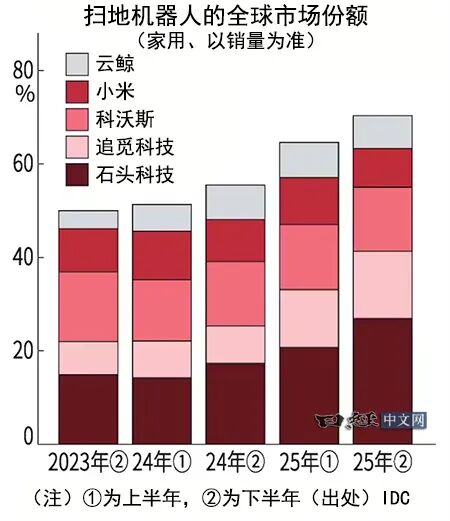
Chinese domestic robot vacuum manufacturers are forming an oligopolistic pattern in the global market. The strategy of Chinese manufacturers focusing on developing independent features rather than waging price wars has proven successful, with the top five enterprises together accounting for more than 70% of the global market share. This is a rare growth achievement in China's industrial sector, which has long been mired in attrition battles due to low-price competition.
Roborock Plans to Support Multi-Floor Cleaning
Flexibly manipulating its two extendable legs and the front wheels, it sucks up debris while crossing steps taller than itself. The "Saros Rover" robot vacuum is a model with stair-climbing capability.
The product is developed by Beijing-based Roborock (full name: Roborock Technology Co., Ltd.). The company is striving to start mass production of the world's first stair-climbing robot vacuum within several years and is currently advancing related development work.
Traditional robot vacuums can only clean one floor. The Saros Rover can finish cleaning on the first floor, then climb up to the second floor on its own to continue working. Even for detached houses with stairs, a single unit can clean the entire house thoroughly.
Roborock was founded in 2014 by software technicians who previously worked at Microsoft and Tencent Holdings. According to statistics from US-based IDC, its global market share reached 27% in the second half of 2025, ranking first. It also takes the leading position in major developed markets including the United States, Germany and South Korea.

Lu Cheng (middle), who is in charge of product promotion at Roborock (taken in late April, Beijing)
The company is actively expanding its global business. Of its 18.6 billion yuan revenue in fiscal 2025 (ending December 2025), overseas sales accounted for 56%. Lu Cheng in charge of product promotion said that by maintaining technological advancement, the company has established the image that Roborock is the top choice for high-end robot vacuum products.
All 5 Major Players Are Chinese Enterprises
It is not only Roborock that has been increasing its presence in the global robot vacuum market. According to IDC data, the five major enterprises in the robot vacuum market are all Chinese companies, and their combined global market share exceeded 70% for the first time in the second half of 2025.
In addition to the top-ranking enterprises, Anker, which mainly produces mobile power banks, and drone giant DJI have also crossed into this market, making the actual total market share of Chinese enterprises even higher. At the end of 2025, US company iRobot, which opened up the global market with its "Roomba" series, went bankrupt and was acquired by a Chinese enterprise.
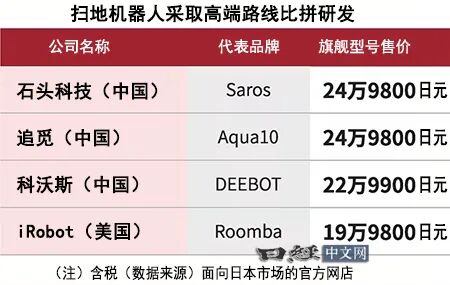
The characteristic of large Chinese enterprises involved in the robot vacuum industry is that they attach more importance to developing independent technologies than cutting prices. A survey of the Japanese selling prices of the flagship models of the three major Chinese companies shows that all of them are priced higher than iRobot's products.
When Chinese enterprises carry out global expansion, they usually first build up their strength in the huge domestic market with a population of 1.4 billion, and then enter overseas markets with price competitiveness as their weapon. In addition to smartphones, the recent boom in battery electric vehicles (EVs) is a typical example.
Ecovacs Launches All-In-One Sweeping and Mopping Robots
In the robot vacuum industry, Ecovacs, which ranked third in global market share in the second half of 2025, initially followed this very path.
When the group was established in 1998, it undertook OEM (original equipment manufacturing) orders for overseas manufacturers in the vacuum cleaner sector, first honing its mass production technology.
Ecovacs launched its self-branded robot vacuum cleaners in the late 2000s and shifted its focus to technological innovation. Ma Xiaodong, who is in charge of the Asia-Pacific region, said that they believe winning by price would bring huge cost-cutting pressure and make it impossible to develop innovative products.
In fact, the growth of the company's global market share is not driven by winning price competitions. In addition to launching all-in-one sweeping and mopping models at an early stage, it has actively added new functions such as automatic dust emptying after cleaning, automatic mop washing and drying, which have achieved remarkable results.
Dreame Robot Vacuums Can Tidy Up Rooms While Cleaning
Dreame Technology, which ranks second in market share, is also entering the global market relying on its technological strength.
The model planned to be launched as soon as possible is equipped with a function that, when detecting obstacles during cleaning, the robotic arm can extend up to 33 centimeters away from the main unit to move the obstacles to a designated position.
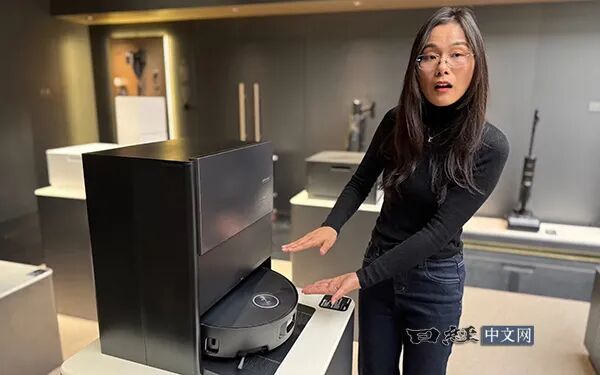
Dai Qian, Head of Japan, South Korea and Australia Markets at Dreame Technology (taken in February, Suzhou, Jiangsu Province)
Regarding robot vacuums, the voice that "you cannot use them unless you tidy up the room to a certain extent" (a woman in her 30s living in Tokyo) is deeply rooted. The robotic arm of the new model can handle objects weighing less than 500 grams, moving toys, shoes and other items aside before continuing cleaning. This will greatly improve convenience especially for families with children whose rooms tend to get messy easily.
Dai Qian, Head of Japan, South Korea and Australia Markets at Dreame Technology, said that users are paying for the exclusive technologies that no other company has, and the company will not participate in price wars. She also set a target to raise the current roughly 2% market share in Japan to 10% by the end of 2026.
In China, the phenomenon of "involution", where investment is concentrated in growing industries, products become homogeneous, and fierce price competition drags the whole sector into an attrition war, has become a social problem. Can the robot vacuum industry be an exception? It can also serve as a reference for other industries seeking to get rid of involution.
This article is from the WeChat Official Account "Nikkei Chinese" (ID: rijingzhongwenwang), written by Fujimura Kohei, and published by 36Kr with authorization.