AI spending has surged by 2013%, it turns out that Elon Musk is actually "working for" Jensen Huang?
Musk burned 106.8 billion yuan on AI in three months, and the stock market value evaporated 877.2 billion yuan overnight.
Reported by Zhidx on August 5, today, SpaceX released its first financial report after going public.
In the second quarter of 2026, the company's revenue exceeded expectations and reached 7.8 billion US dollars (about 52.6 billion yuan), almost doubling compared with 4.1 billion US dollars (about 27.7 billion yuan) in the same period last year; its net loss narrowed by 46.3% year-on-year to 541 million US dollars (about 3.65 billion yuan).
Among them, Starlink's revenue accounts for more than half of the total revenue, growing by 66%; while the revenue of the AI business surged by approximately 250%.
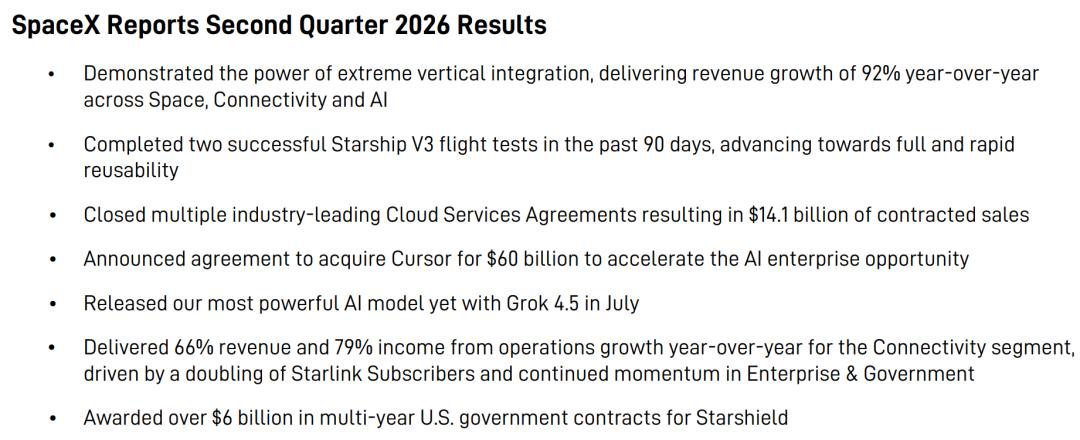
Screenshot of SpaceX's financial report
Before the release of the financial report, SpaceX's stock price rose by 9.4% during the trading day. However, after the financial report was released, the stock price fell by about 8% in the after-hours trading session, closing at $115.98, and the market value approximately evaporated by 130 billion US dollars (about 877.2 billion yuan) overnight. Why is this?
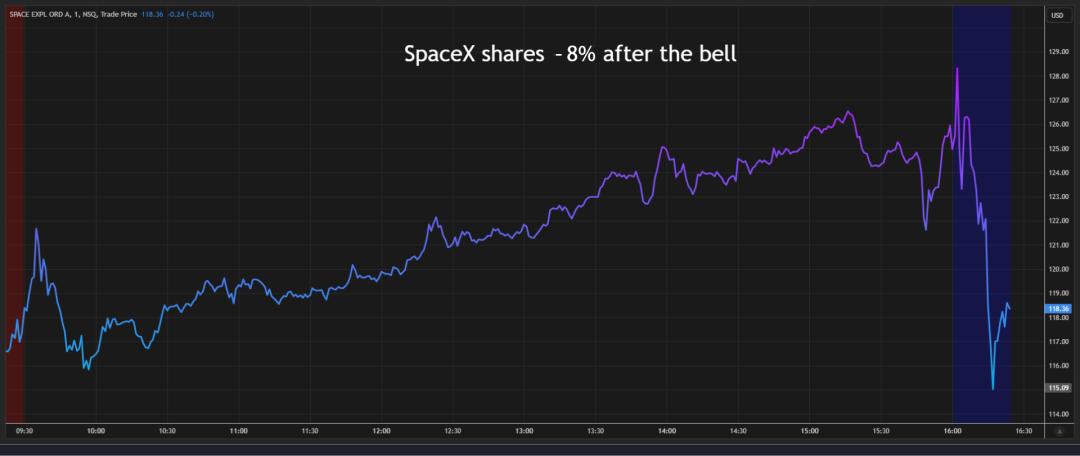
SpaceX stock price trend (Source: TradingView)
The main reason is that Musk's input-output ratio in the AI field failed to meet the capital market's expectations. The capital expenditure for this quarter reached as high as 18.37 billion US dollars, of which AI expenditure even increased by 2013% year-on-year to 15.83 billion US dollars (about 106.8 billion yuan). Coupled with the upcoming selling pressure after the stock lift ban, all these have become major concerns for investors.
Musk recently revealed that SpaceX expects to build more than 2 gigawatts of computing power this year, reaching nearly 10 gigawatts by the end of next year, and the company plans to fully adopt NVIDIA hardware. It should be noted that every 1 gigawatt of computing power can generate approximately 400-500 billion US dollars in revenue for NVIDIA. This makes people can't help but ask: After working for so long, is Musk "working for Jensen Huang"?
01. Overall quarterly revenue surged 92%, AI revenue increased by 247%
First, let's look at the fundamentals of SpaceX's financial report. SpaceX's revenue for the quarter ending June 30 surged 92% to 7.81 billion US dollars, far exceeding the previous forecast of 6.9 billion US dollars by Visible Alpha. It mainly includes three major parts:
- The revenue of the Connectivity division (including Starlink satellite internet services) was 4.29 billion US dollars, a year-on-year increase of 66%.
- AI revenue reached 2.56 billion US dollars, a year-on-year increase of 247%.
- Space revenue reached 962 million US dollars, a year-on-year increase of 29%.
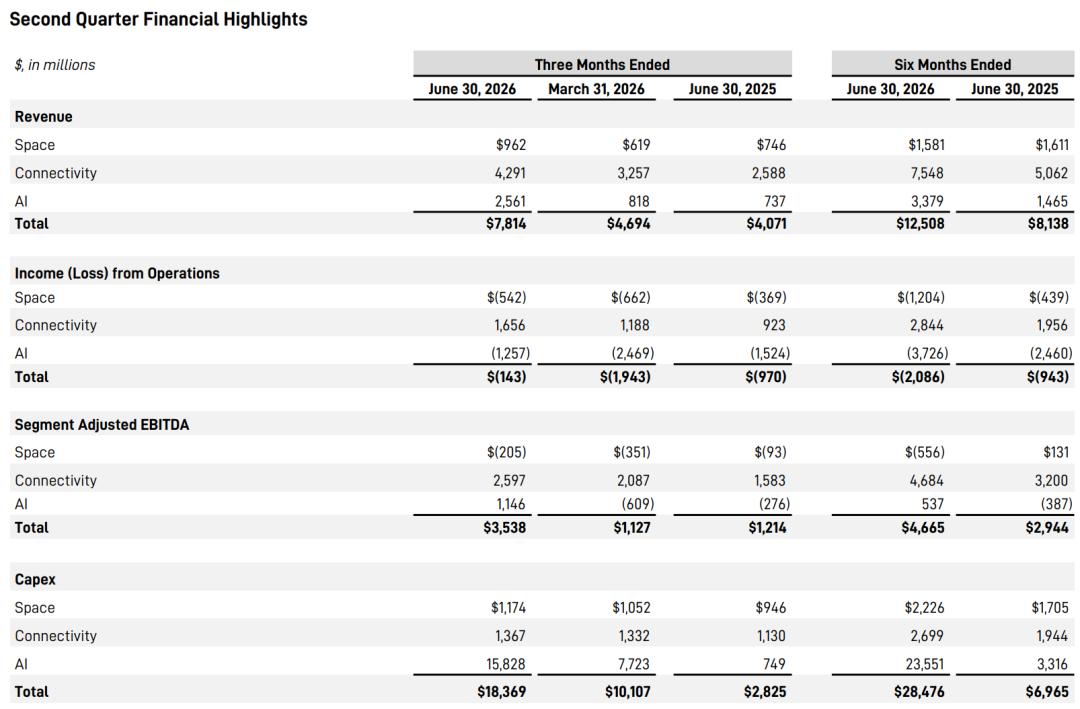
SpaceX's main financial statements
It can be seen that Starlink and other connectivity businesses are still the company's main source of revenue, supporting Musk's AI strategy. But AI has begun to achieve commercialization and does not fully rely on funding from Starlink.
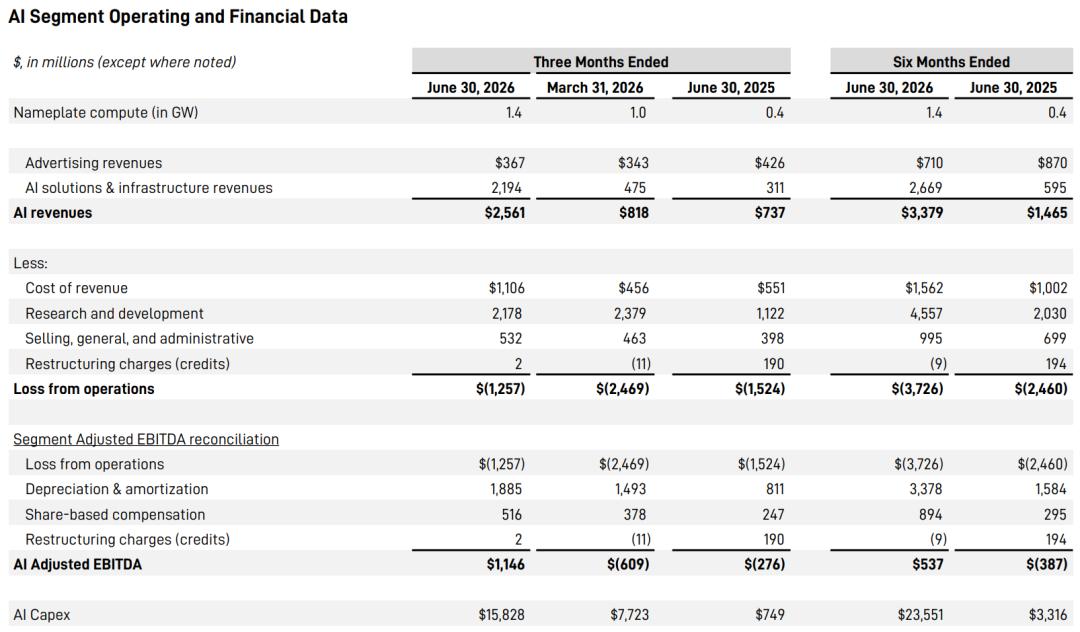
SpaceX's AI business, including xAI, Grok, the social media platform X, and the rapidly expanding data center operations, has always been its largest investment area. The main revenue for this quarter comes from solution and infrastructure income brought by the increased cloud service agreements for AI, as well as the growth of Grok and X subscription revenue.
In this quarter, as it signed several cloud service agreements with a total contracted sales of 14.1 billion US dollars, it generated 1.6 billion US dollars of incremental AI infrastructure revenue. The revenue of this business mainly comes from computing contracts signed with Google, Anthropic, Reflection AI and other companies, but part of its recurring revenue has not yet been recognized.
This quarter, SpaceX also announced the acquisition of Cursor for 60 billion US dollars to accelerate the launch of its AI enterprise product line, and the transaction is expected to be completed in the third quarter of 2026.
On July 9, SpaceX just launched the company's most powerful model to date, Grok 4.5, which is also its first model specially developed for programming and agent tasks, co-trained with Cursor. This model is positioned against the Claude Opus series of models. Market reviews generally say that the model is "good and fast" but "slightly high in cost".
02. Loss narrowed by about 46.3%, but AI expenditure surged 2013%
Looking at the profitability, SpaceX's net loss for this quarter dropped from 1 billion US dollars in the same period a year ago to 541 million US dollars this year, narrowing by about 46.3%.
From the perspective of the whole first half of the year, SpaceX's net loss was about 4.817 billion US dollars, an increase of about 213.6% compared with 1.536 billion US dollars in the same period of the previous year.
The narrowing of losses in the second quarter is mainly due to the strong growth of the connectivity business which contributed profits, and the operating loss of the AI business has improved, but it is still affected by the R&D of Starship, high investment in AI infrastructure and other factors.
The company expects that with heavy investment in the Starship rocket program, the cost of orbital access will drop by 99%.
SpaceX CFO Brett Johnson said in a statement: "This financial strength gives us the ability to make substantial investments in Starship, Starlink broadband and mobile satellites, and our AI platform."
In the second quarter, the company's capital expenditure surged from 2.83 billion US dollars in the same period of the previous year to more than 18 billion US dollars. Treasurer Brett Johnson said he expects capital expenditure in the coming quarters to be similar.
Among them, SpaceX has significantly increased its capital expenditure in the AI field, investing 15.83 billion US dollars in the second quarter, a year-on-year increase of 2013% compared with 749 million US dollars in the same period of the previous year.
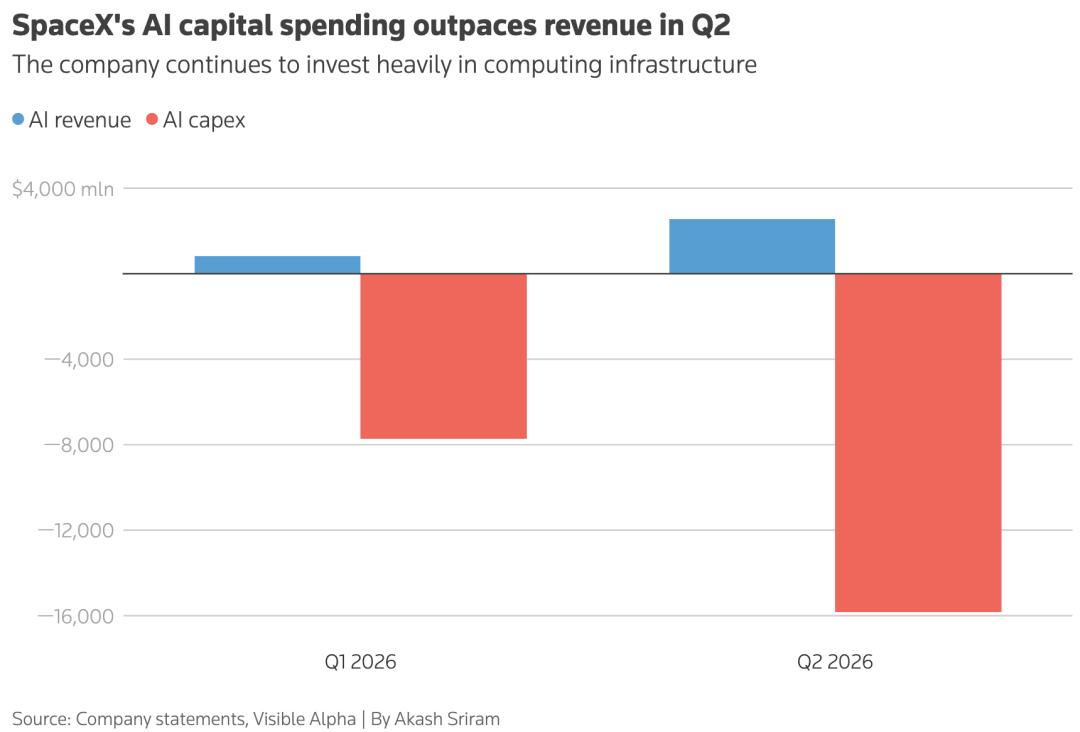
SpaceX's AI capital expenditure in the second quarter exceeded its revenue
"SpaceX expects to build more than 2 gigawatts of computing power this year, and will have nearly 10 gigawatts of computing power by the end of next year," Musk said.
The company plans to fully adopt NVIDIA hardware to build its own data centers. NVIDIA CEO Jensen Huang once said that every 1 gigawatt of computing power can generate approximately 400-500 billion US dollars in revenue for NVIDIA.
03. Annualized revenue will reach 100 billion US dollars, over-expansion of AI and data centers raises concerns
Melissa Otto, Head of Research at Visible Alpha, a professional financial report data analysis platform, said: "Part of the reason for the market weakness is people's concerns about the over-expansion of AI and data centers. The market is increasingly worried that AI infrastructure investment cannot generate returns that match the required level of capital."
However, Musk, as always, made an optimistic prediction: SpaceX will achieve 1 trillion US dollars in revenue in 2030, earlier than the previous forecast of 2031.
It is expected that by December this year, the company's annualized revenue will reach 100 billion US dollars, promising that the return on investment of new capital investment in the AI computing sector will be less than one year, and it predicts that at least 1000 next-generation V3 Starlink satellites will be launched within one year, and plans to compete with mobile communication operators will be announced.
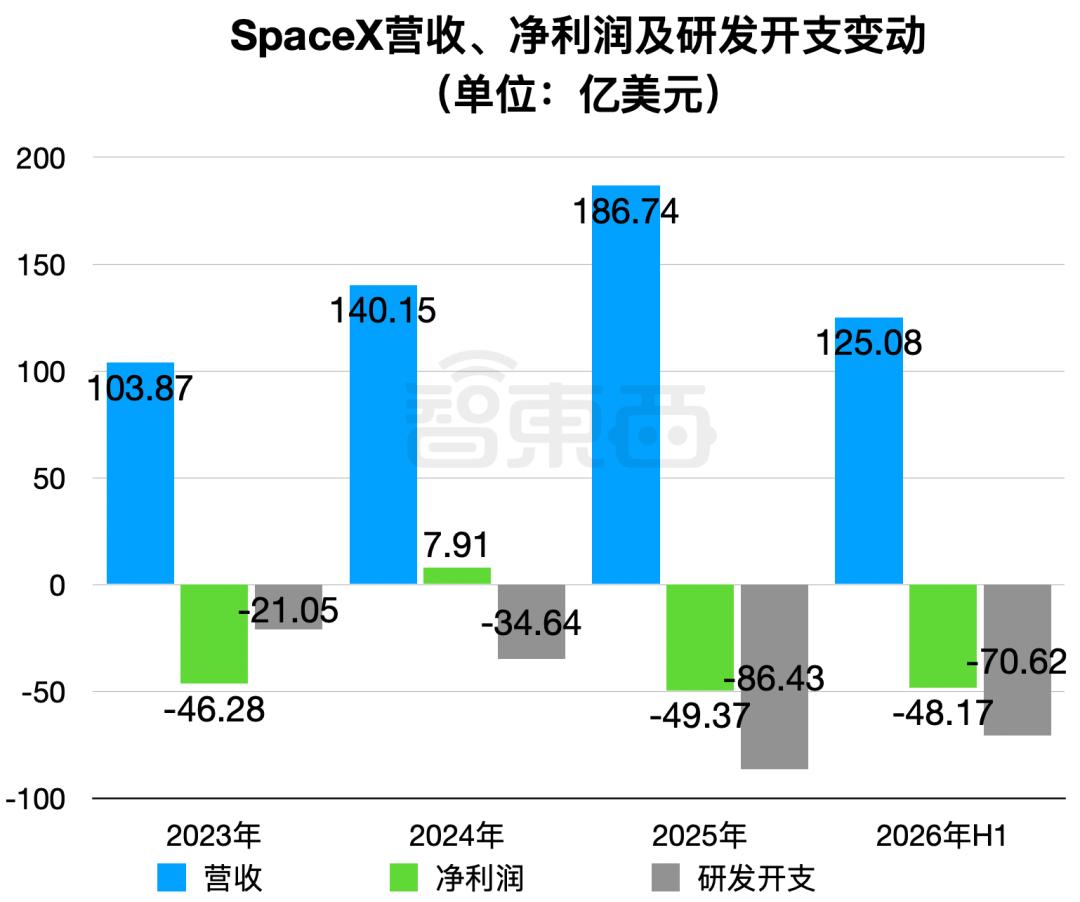
SpaceX's annualized revenue is expected to reach 100 billion US dollars (Chart by Zhidx)
"We believe that SpaceX is building AI computing capabilities at scale faster than anyone else, and significantly improving our AI models," Musk said on the earnings call.
04. Conclusion: Large-scale AI investment raises concerns, the approaching end of the lock-up period may usher in a large sell-off
"The core issue of SpaceX's first quarter as a public listed company is whether the machine behind it is really effective, and Musk and his team have given some positive feedback on this issue," said Thomas Monteiro, analyst at Investing.com.
The message conveyed by the financial report put pressure on SpaceX's stock price. SpaceX's post-IPO lock-up period will expire this Thursday, which may bring greater pressure to the company, as it may lead to a large number of shares from insiders and early investors flooding into the market.
This article is from the WeChat official account "Zhidongxi" (ID: zhidxc), author: Li Shuiqing, editor: Yun Peng, authorized for release by 36Kr.