The 102-yuan pure titanium food storage containers have become a runaway hit, and a high-margin blue ocean market has emerged in the kitchenware industry.
A 400ml food storage container was unexpectedly sold for 102 yuan and became a total hit.
While most people still consider Lock&Lock the top-tier brand for food storage containers, with a price ceiling of 30 to 40 yuan per unit, a Finland-registered brand named Mishanbao suddenly stands out from the fierce competition.
Its pure titanium food storage containers are directly priced at over 100 yuan each, even the vegetable washing basins can sell for hundreds of yuan, with the customer unit price 10 to 30 times that of traditional stainless steel basins.
Pure titanium used to be a niche material for the outdoor and medical sectors, but it has rapidly gained popularity across the entire kitchenware industry in recent years. Starting from pure titanium vacuum flasks, titanium food storage containers to titanium cooking basins, traditional major brands including Lock&Lock and SUPOR have all followed suit to launch related products.
In an extremely low-price market where the average price of the whole segment is less than 20 yuan, and the 0-10 yuan price range contributes 46.7% of total sales, how can brands like Mishanbao break through consumers' psychological price thresholds? In the current era of consumption downgrade, why are people willing to pay sky-high prices for food storage containers? What opportunities lie behind this phenomenon? Let's find out together with Lijin.
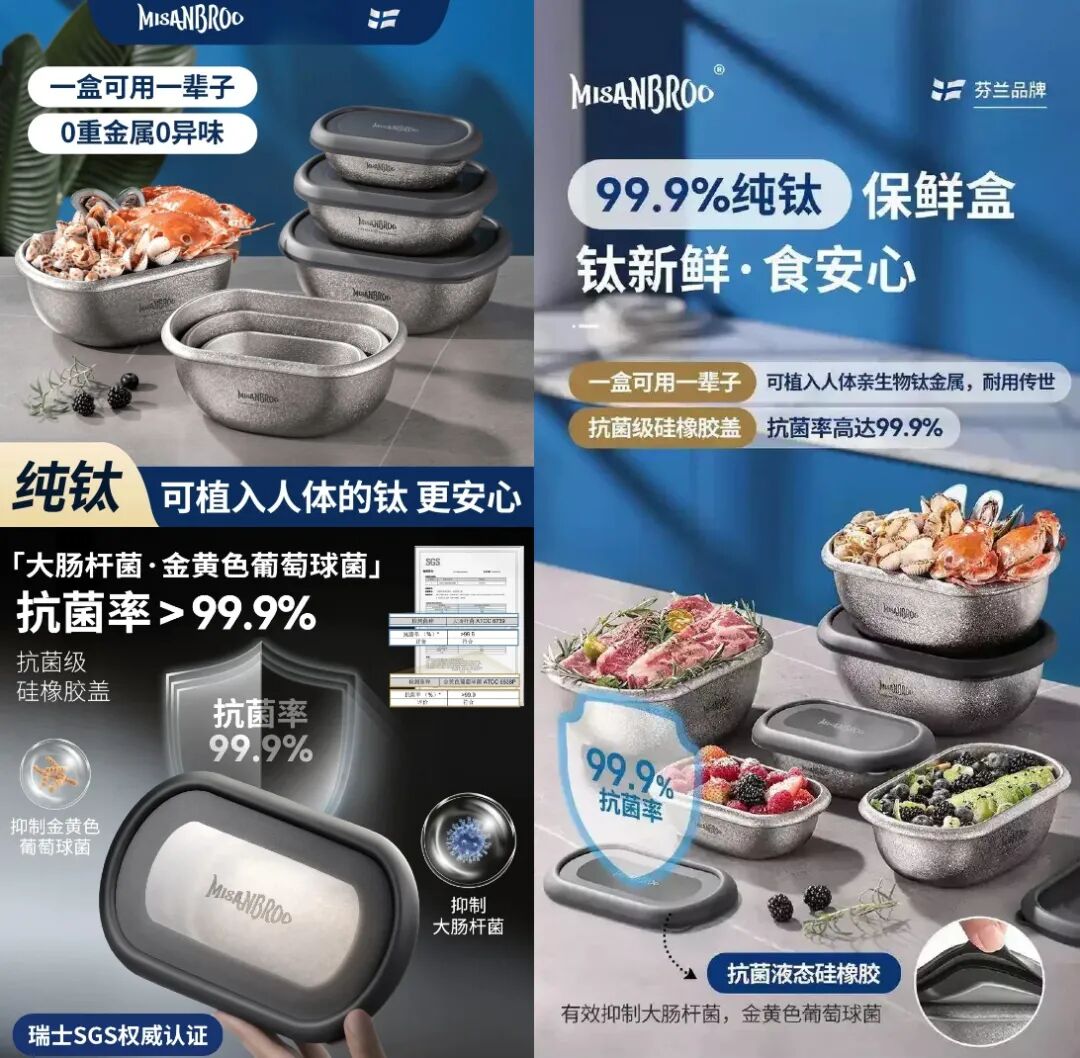
Various brands have launched pure titanium products. Source: Internet
Why do more people buy products at higher prices?
The skyrocketing popularity of pure titanium products is a sign of consumption upgrading from the category perspective, but it is essentially technology transfer from the industrial perspective.
In recent years, the price per kilogram of pure titanium sheet has dropped from the level of thousands of yuan to around 100 yuan, successfully bringing the unit product price down from the thousand-yuan level to the hundred-yuan level.
In the long run, pure titanium products will definitely gradually penetrate from high customer unit price categories to low customer unit price categories.
But for a specific food storage container, if you want to sell it for more than 100 yuan, focusing only on the storage function will definitely lead to a dead end.
The core reason why brands like Mishanbao can break through the price ceiling lies in the realization of the consumer mindset leap from storage anxiety to health panic.
When buying food storage containers, consumers' basic demands are low cost, space saving, and no odor mixing.
Beyond these basic physical demands, Mishanbao keenly captures the pain point of the middle class, that is, the lack of trust in food safety.
Traditional food storage containers have accumulated a large number of unmet hidden anxieties. Plastic containers may leach plasticizers when heated, stainless steel products may have substandard material labels and even the risk of residual heavy metals, while glass containers are too heavy and fragile. These pain points are magnified in the family kitchen into deep panic about the chronic threat to the health of family members.
Pure titanium has become the perfect antidote to this panic. In people's common perception, titanium metal, which is often used in medical artificial bones and aerospace fields, is inherently endowed with the absolute safety aura of antibacterial and fresh-keeping properties, acid and alkali corrosion resistance, and zero heavy metal content.
To highlight this feature, most pure titanium merchants have put forward the label of "biocompatible metal that can be implanted into the human body" to highlight the value of the material. Due to the outstanding marketing feature, the selling points related to "pure titanium" directly account for 45.35% of Mishanbao's Douyin sales this year, far exceeding the traditional concepts of "sealing" or "food grade".
At this point, the value of food storage containers has been redefined. It is no longer a storage tool worth dozens of yuan, but a reassuring choice to solve the problems of food spoilage and heavy metal concerns. When consumers think they are buying a health insurance for the whole family, the gap between 102 yuan and 26 yuan is no longer 4 times more expensive, but health is priceless.
Among these consumers with stimulated demands, 88.39% are female, and the 31-40 age group accounts for as high as 44.71%. They are the absolute decision-makers of household kitchen supplies, in the peak period of income, and highly sensitive to family health. First-tier cities have the highest transaction proportion, with Beijing (22.26%) and Shanghai (9.89%) alone accounting for more than 30% of total sales. This group of middle-aged women in first-tier cities not only have strong consumption power, but also are willing to pay a premium for health. The high-end label inherent in pure titanium material also exactly meets their needs for social sharing and emotional value.
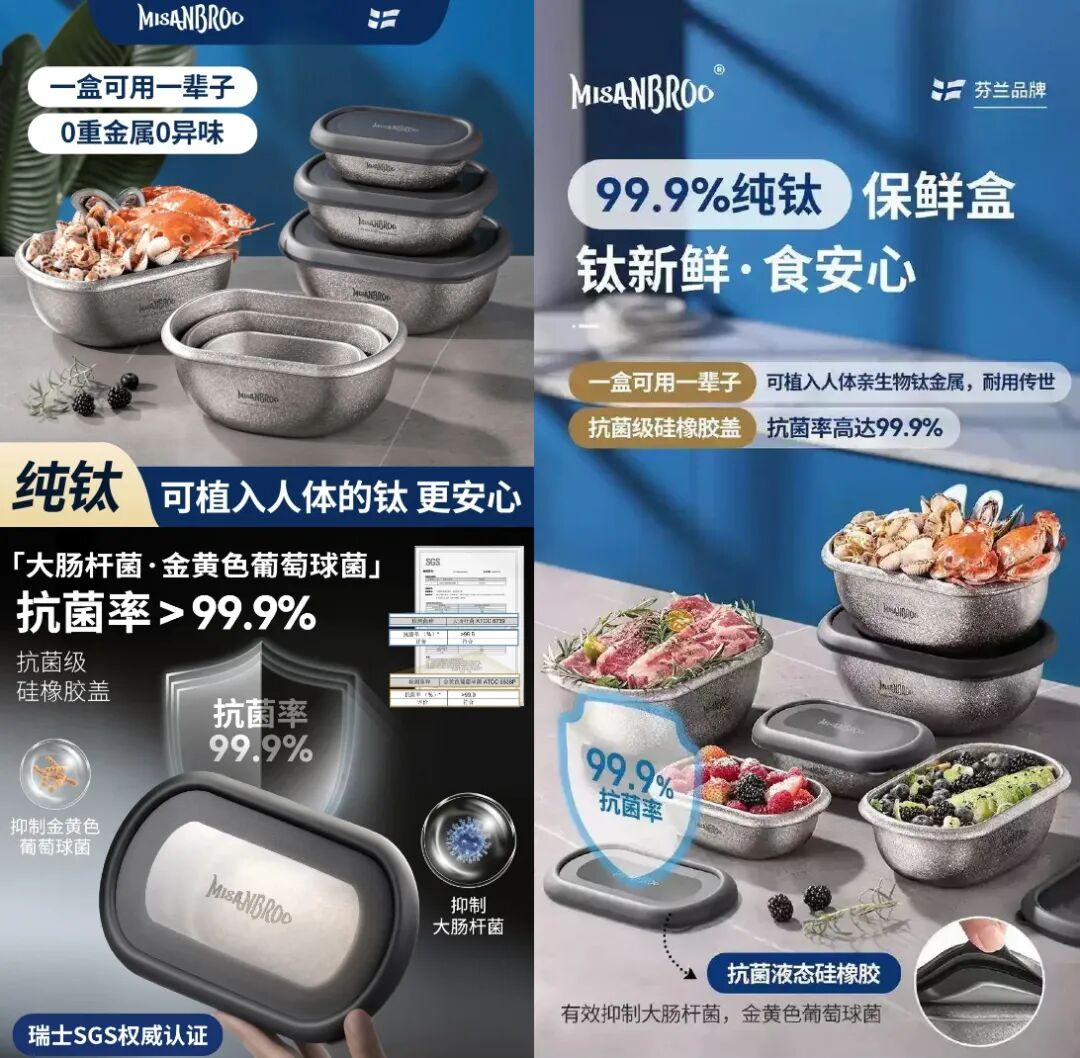
Mishanbao's pure titanium food storage containers. Source: Brand Flagship Store
How do brands push consumers to click the payment button?
Digging out the pain points is one thing, to make consumers willingly pay hundreds of yuan, brands also need to design a smooth conversion path.
A set of food storage containers priced at nearly 400 yuan sounds expensive, but in all its product recommendation content, Mishanbao repeatedly anchors a core value: "One set can last a lifetime", "You can use it forever as long as you don't lose it".
Priced 3 to 4 times higher than the average price of the category, pure titanium food storage containers are almost at the top of the price range, which will lead to a very high conversion threshold for consumers; but after reconstructing the value anchor point and extending the whole product life cycle, the 102 yuan cost is spread over a 30-year service life, which only costs 3.4 yuan per year, even cheaper than low-quality plastic containers that need to be replaced every year.
This clever value anchor quietly transforms a daily consumption expenditure into a one-time long-term investment, greatly improves the rationality of people's high-price purchase, and completely breaks through the psychological defense line against high prices.
Another reason for raising the customer unit price is to create enough gross profit margin to support distribution. Under the meager profit of traditional food storage containers, it is difficult for brands to afford high commissions for influencers, while the premium of pure titanium gives brands sufficient resources for traffic promotion.
Mishanbao did not blindly pursue top influencers, but concentrated resources on mid-tier and micro influencers. Take the typical home lifestyle blogger "Xiunou's Dream Grocery Store" as an example, it has only 18,000 followers, but its short videos alone contributed 1 million to 2.5 million yuan in sales for the brand.
By disassembling its script, we can get an invincible conversion formula: traditional pain points (plasticizer/residual fishy smell) — pure titanium solution (antibacterial and odor-free) — long-term use value anchoring (one set lasts a lifetime).
In May, the brand launched a large-scale volume expansion campaign with influencers using this formula, and the number of related live broadcasts surged to 245, directly pushing the monthly sales to a peak of 346,000 yuan, achieving an extremely successful explosive start.
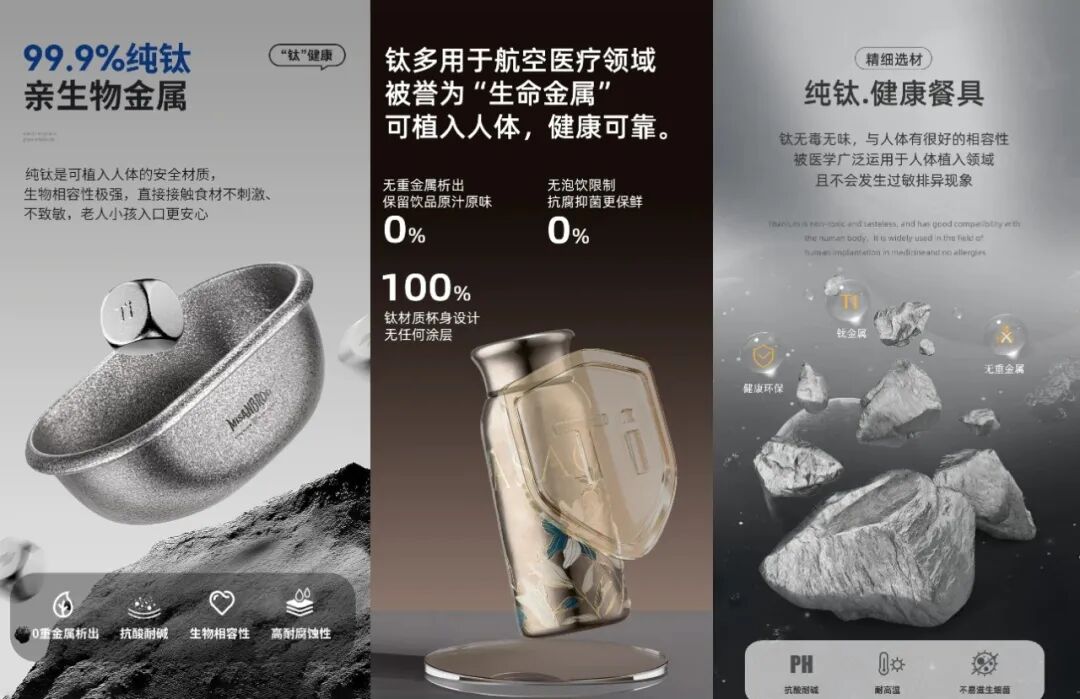
Expressions of human biocompatibility for various titanium products. Source: Internet
Most kitchenware products are worth remaking with pure titanium
The explosive popularity of pure titanium food storage containers marks that the kitchenware industry is undergoing a material-driven structural reshaping.
From pure titanium dinner plates to pure titanium cooking basins, high premium is extending outward. In the future, those low-cost consumable products that frequently contact acidic and alkaline food, as long as they involve long-term storage and high-temperature heating, all have the opportunity to achieve dimensionality reduction attack with pure titanium, and enter the mid-to-high-end blank price range.
For example, pure titanium dinner plates have become the second most popular hit product after food storage containers, featuring direct use in steam ovens, ovens and air fryers, with both aesthetic appearance and safety; pure titanium cutting boards accurately hit the pain points of traditional wooden cutting boards that are prone to mildew, dirt accumulation and residual aflatoxin, featuring mildew resistance, no paint and no glue, which has strong penetration among maternal and child groups; there are also pure titanium steamers/woks, which extend the material upgrading to large cookware, featuring non-stick without coating, acid and alkali resistant cooking, completely solving the anxiety of toxin shedding from traditional coated pans.
Extending from Mishanbao's successful path, there are three other highly potential application scenarios worth remaking with pure titanium in the future.
The first major scenario is maternal and child and catering containers that frequently contact acidic and alkaline food. Such as baby food supplement boxes, milk powder distribution boxes, juicer liners, jam/coffee storage tanks, etc. As long as long-term storage, high-temperature disinfection and acid-base corrosion are involved, pure titanium can carry out dimensionality reduction attack with the advantage of zero heavy metal precipitation.
The second major scenario is products in hygienic dead corners under high humidity environment, such as kitchen draining racks, chopstick holders, knife racks, refrigerator storage trays, etc. These products are very easy to breed bacteria and mildew in daily use, and the natural antibacterial property of pure titanium can endow them with extremely high health added value.
The third major scenario is outdoor and portable catering utensils. Combined with the physical properties of titanium metal "lightweight" and "sturdy", pure titanium portable lunch boxes, pure titanium bowls, and titanium braising pots are both lightweight and high-end textured in the scenarios of outdoor camping and office workers bringing meals.
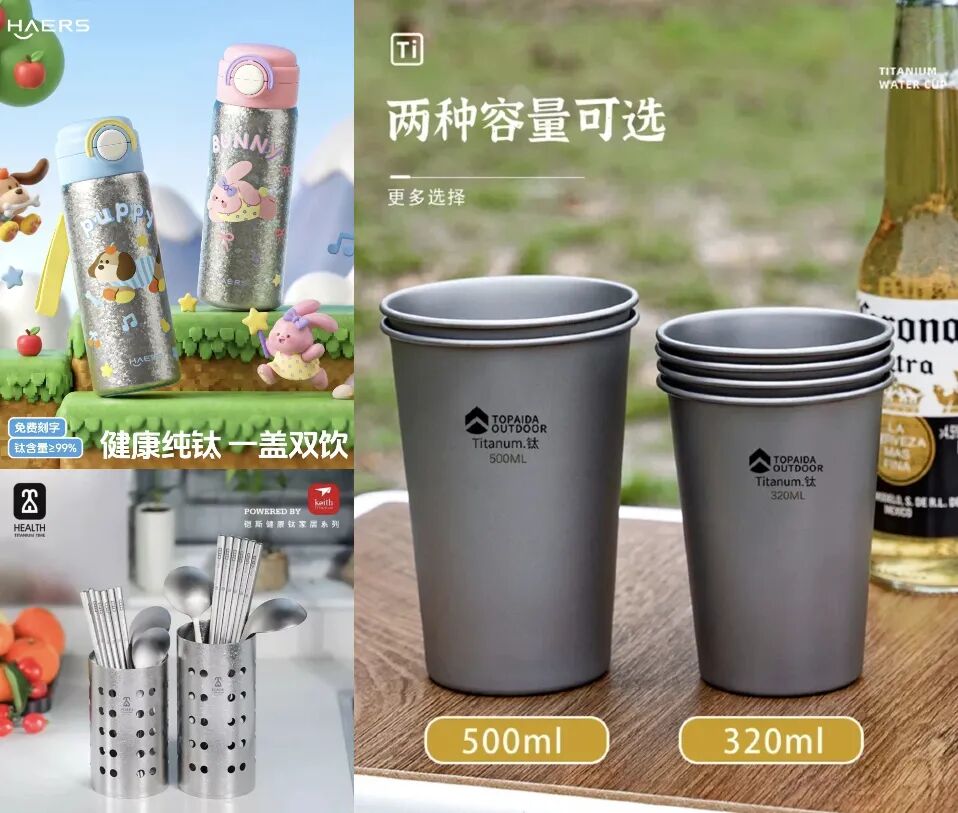
Pure titanium products in various forms. Source: Internet
Lijin's Comments
Mishanbao's startup logic points out a way out for all new consumer brands trapped in price wars: in a red ocean market with extremely fierce competition, competing on price is the only way to fail. The core of breaking through the predicament is to find the structural blank in the price range, upgrade products with high-awareness materials, and redefine the cheap "storage tool" as the expensive "health asset".
But from the perspective of long-term operation, this strategy also has potential hidden dangers. The brand's premium is built on the single feature of absolute safety of pure titanium. With the influx of competitors, disputes over titanium purity, surface treatment technology and other issues will inevitably follow. Establishing endorsement from authoritative testing institutions, transparent supply chain traceability and strict public opinion risk control mechanisms in advance are required courses for brands to strengthen their trust barriers.
Reshaping cheap storage tools into priceless health assets, whoever takes the lead in completing the material upgrading and emotional map reconstruction will be able to harvest the most lucrative blue ocean dividends in the era of consumption differentiation.
This article is from WeChat official account "Lijin", author: Lijin, authorized for release by 36Kr.