US After-Hours Market Double Selloff: AMD -9%, SPCX -8%, Elon Musk calls out the $24.6 billion short sellers
After market hours today, two companies simultaneously gave the market a vivid lesson.
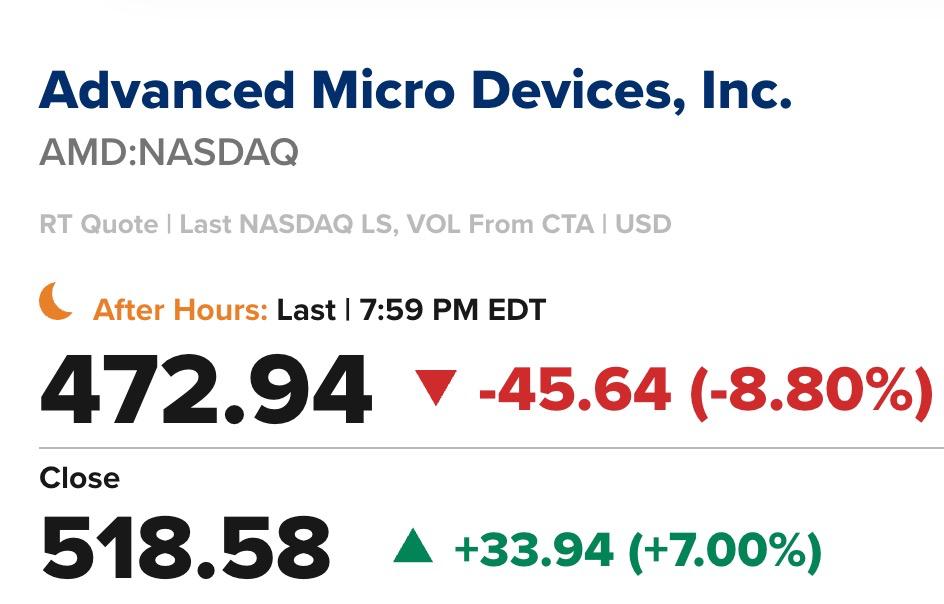
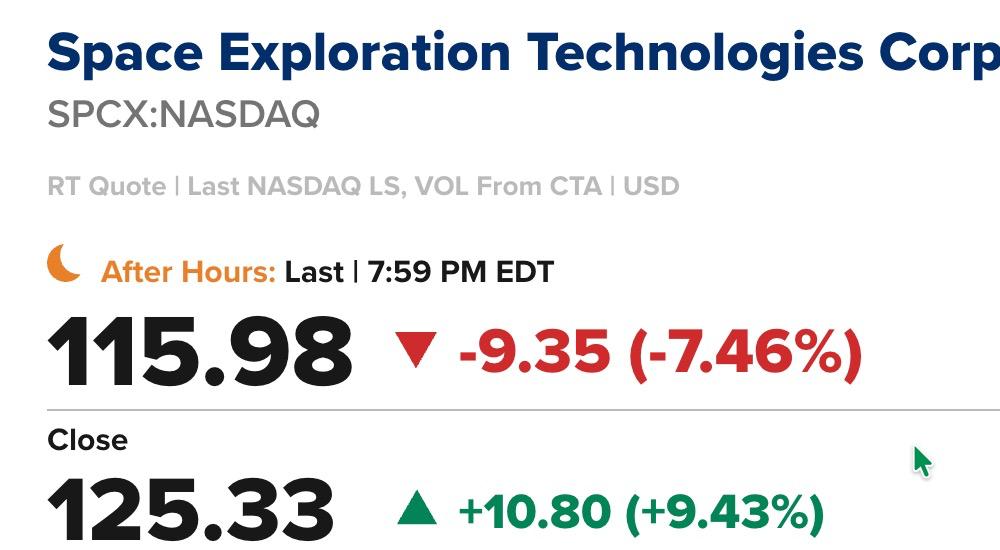
AMD released a financial report that exceeded analysts' expectations, but its stock price fell by about 9%; SPCX also corrected by more than 7% after the earnings release, and the market began to re-examine the profit realization speed behind SpaceX's high valuation.
On the surface, this is a post-earnings decline for the two companies.
But the logic behind it is completely different.
AMD's problem is: its performance is good, but the market is expecting even higher results.
SPCX's problem is: the future story is grand enough, but the market is beginning to question how long it will take for this future to materialize.
AMD: Earnings are public information, while expectations are the hidden variable
AMD handed in a solid report card, but the market told everyone with a 7% drop:
For high-expectation AI companies, beating expectations is just the starting point. What really drives stock price growth is whether the company can further raise the market's imagination for future growth.
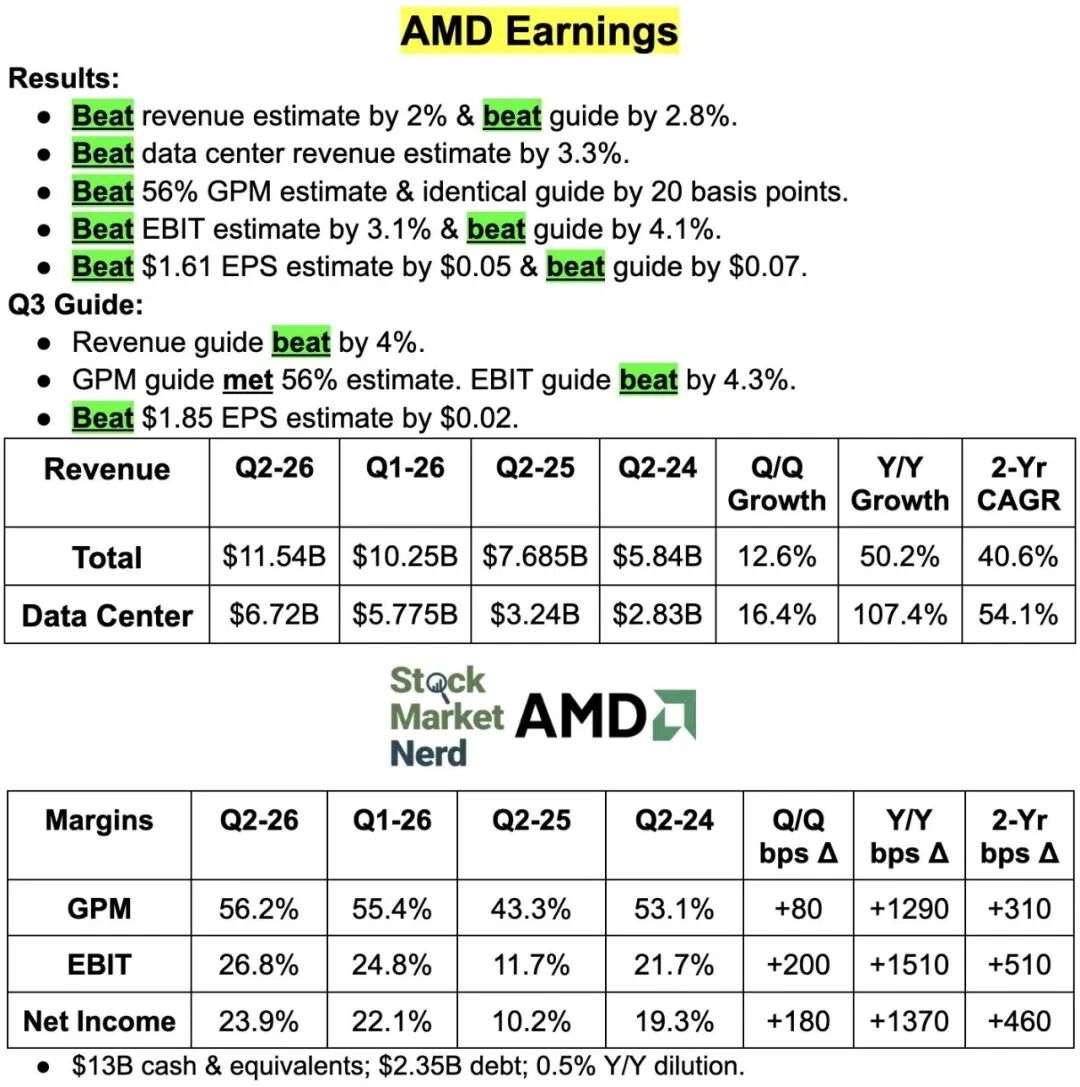
According to public data, AMD's performance in the second quarter is not bad at all.
The company's revenue reached 11.54 billion US dollars, higher than Wall Street's expectation of 11.31 billion US dollars;
The gross profit margin reached 56.2%, exceeding the market expectation of 55.8%;
The adjusted earnings per share was 1.66 US dollars, also higher than the market expectation of 1.62 US dollars.
As the most important growing business at present, the data center division contributed 6.72 billion US dollars in revenue this quarter, accounting for about 58% of total revenue, which also exceeded the market expectation of 6.55 billion US dollars.
Meanwhile, the midpoint of the company's third-quarter revenue guidance reached 13 billion US dollars, which is also higher than the 12.5 billion US dollars previously predicted by sell-side institutions.
The data is good, why did the stock price fall instead?
The reason is that before the earnings report was released, market funds had already priced in more optimistic results in advance.
With the continuous advancement of the AI market rally, AMD has become an important target for the market to bet on "the second AI supplier besides NVIDIA". Therefore, the internal targets set by some buy-side institutions are actually much higher than the public market forecasts.
The market previously expected AMD's second-quarter revenue to reach around 12 billion US dollars, and hoped that the third-quarter guidance would be near 13.2 billion US dollars.
The final result is:
AMD beat the expectations of sell-side analysts, but failed to meet the targets in the minds of some aggressive buy-side funds.
For ordinary companies, this is still a pretty good earnings report.
But for high-valuation AI stocks, the market does not trade on "whether there is growth", but on "whether the growth is surprising enough". Therefore, some funds that laid out positions in advance chose to take profits, which is also an important reason for the after-hours decline.
The real problem for AMD
If you only interpret AMD's decline as an expectation gap, you actually underestimate the real problems the company is facing.
What the market really cares about now is:
Can AMD turn an AI chip with excellent performance into an AI computing platform that can operate on a large scale commercially?
From a hardware perspective, AMD has made obvious progress.
Products such as MI355X and MI455X already have the capability to support large model training and inference. Large customers including Microsoft, OpenAI, Meta and Anthropic have also begun to seriously evaluate the possibility of AMD becoming the second computing power source besides NVIDIA.
Over the past year, AMD's software ecosystem has also improved significantly.
ROCm has been continuously optimized, and has been deeply adapted to mainstream AI frameworks such as vLLM and SGLang. The performance improvement speed in some inference scenarios has been significantly accelerated.
But AI competition is entering the next stage.
What customers buy is not a single GPU, but a complete set of large-scale computing systems that can run for a long time.
The real test lies in:
Whether the system is stable after thousands of GPUs are connected;
Whether multi-node communication is efficient;
Whether the software can be continuously optimized;
Whether problems can be solved quickly after they occur.
AMD already has competitiveness in a single-node environment, but in large-scale distributed scenarios, there is still a gap compared with NVIDIA's mature ecosystem.
Helios mass production capacity is the biggest verification in the next stage
Compared with chip performance, the market will pay more attention to Helios next.
Because Helios represents AMD's first real entry into the competition for rack-level AI systems.
A complete Helios system needs to integrate 72 GPUs, 18 CPUs, and a large number of network, switching, power supply and heat dissipation components.
This means that AMD is no longer competing with a single chip, but a complete set of AI infrastructure.
The biggest challenge among them is system complexity.
Since it does not fully adopt a cable-free design, Helios still requires a large number of high-speed connection components and relies on a large number of retimer chips to maintain signal quality.
The more complex the system, the higher the assembly difficulty, the higher the power consumption, and the more potential failure points will increase at the same time.
Therefore, whether AMD can succeed in the future does not depend on whether the first device can be delivered, but on whether the 1000th and 10000th units can be stably produced and operated for a long time.
This is also an important reason why the market is currently re-evaluating AMD's valuation.
Behind large orders, more attention should be paid to profit quality
AMD's acquisition of orders from customers such as OpenAI and Meta is undoubtedly an important breakthrough.
This proves that large AI companies are looking for a second supplier besides NVIDIA.
But investors should not only look at the order size.
For challengers, entering a market already occupied by giants usually requires paying costs, including more attractive commercial terms and a certain degree of profit concession.
Therefore, what the market really cares about in the future is:
Whether these orders can form long-term procurement;
Whether customers will actively promote the development of the ROCm ecosystem;
Whether AMD can maintain profit margins while growing revenue.
If AMD only obtains market share through preferential terms, what it sells may only be low-cost computing power, but if these customers eventually promote the growth of the software ecosystem, what AMD gains will not only be revenue, but also a set of long-term competitiveness.
US Stock Investment Network believes that AMD's after-hours decline is essentially a re-adjustment of the market's short-term expectations and valuations, which does not mean the end of the AI logic. AMD has crossed the stage of "qualifying to participate in AI competition".
The next three issues the market will focus on are:
Whether Helios can be mass-produced stably;
Whether the software ecosystem can support large-scale cluster operation;
Whether AI revenue growth can be truly converted into profits.
Chips determine whether AMD can enter the competition.
Systems and profits determine how much market share it can finally obtain.
SPCX: The market begins to re-examine Musk's future story
Following AMD, SPCX also fell by more than 7% after market hours.
But compared with AMD's "expectation gap", SpaceX is facing a different kind of problem.
What the market is focusing on now is not whether SpaceX has a future, but how much capital this future requires, and how long it will take to be realized.
At present, SPCX's pressure comes from three aspects:
Short-term profitability;
High valuation pressure;
Supply expectation brought by the stock lifting ban on August 6.
At the same time, a huge short position has accumulated in the market, making SPCX one of the targets with the most intense capital game recently.
SpaceX's biggest problem
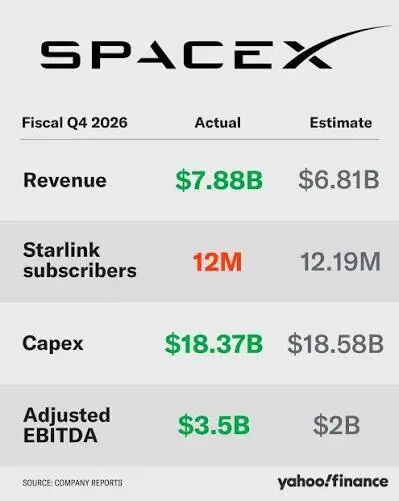
Judging from the just-released second-quarter earnings report, the biggest contradiction SpaceX currently faces is still: revenue is growing rapidly, but profit realization speed has not kept up.
SpaceX's revenue in the second quarter reached about 6.8 billion US dollars, with a significant year-on-year growth, but net profit is still under pressure, and a stable profit model has not been formed in the short term.
This is also the issue that the market is most concerned about at present.
Starlink is becoming SpaceX's most important commercial asset. User growth and subscription revenue continue to rise, providing the company with an increasingly important source of cash flow. But at the same time, Starship R&D, AI infrastructure construction and future space-related businesses are all in the stage of high investment, requiring continuous large amounts of capital investment.
So what the market really cares about is not:
Does SpaceX have growth?
Instead:
When can the cash flow generated by Starlink cover the capital investment of the entire company?
If the future cash flow growth rate of Starlink can exceed the growth rate of capital expenditure, the current high valuation will have the opportunity to be gradually digested by new revenue and profits. But if the business expansion speed is faster than the profit realization speed, the valuation pressure from the market will continue to exist.
$24.6 billion in short positions
In addition to fundamentals, the biggest particularity of SPCX lies in the scale of short positions.
By the end of July, SpaceX's short position reached 219.3 million shares, accounting for about 34% of the publicly tradable shares, corresponding to a short position size of about 24.6 billion US dollars.
The logic of short sellers' bets is very clear:
The current valuation has already priced in a large amount of future growth;
Short-term profits cannot match the market price;
The lifting ban on August 6 may increase market supply.
Facing the growing short positions, Musk also publicly responded recently, saying that he had warned the short sellers, but they still chose to continue increasing their bets.
This is actually changing market expectations.
Musk is not denying losses, but emphasizing that:
The market may have underestimated the speed of SpaceX's future growth.
If there are better-than-expected progress in subsequent Starlink growth, AI infrastructure or Starship, a large number of short positions may in turn become the driving force for stock price rise.
Because short sellers also need to buy back shares to close their positions during the price rise.
The key short-term observation level around $100
From a trading perspective, the $100 level is a position worthy of focused attention at present.
The importance of this level is not only reflected in the technical aspect, but also because the market has already priced in a lot of pressure in advance:
High valuation;
Profit pressure;
Capital investment;
Lifting ban expectation;
A large number of short sellers.
If the stock price gets support near this level, and the market re-recognizes Starlink and the future business space, the sentiment may recover. But if selling pressure continues after the lifting ban, the market may continue to look for a new balance.
It should be noted that a capital-driven rebound and a fundamental reversal are two different things. Short covering can drive a short-term rise, but long-term value still depends on when SpaceX truly establishes stable cash flow.
US Stock Investment Network believes that the biggest contradiction for SPCX now is not whether it has a future. The market has actually recognized Musk's long-term capabilities.
The real question is:
How much capital investment does SpaceX's future require, and how long will it take to realize?
Short sellers are trading on today's income statement.
The market is looking forward to the business landscape for the next ten years.
After the lifting ban on August 6, the market will further tell us whether the current stock price is digesting pressure or starting to reprice the future.