Upstream sales exploded to 200 tons, Heytea, Luckin Coffee... new tea beverage brands are flocking to the alcohol business.
From Luckin to Heytea, Half of the Tea Drink Industry Is "Selling Alcohol"
This summer, the entire tea drink industry seems to have collectively set its sights on "alcohol". This trend almost started in May.
On May 18, Luckin officially launched two alcohol-containing special mixed drinks "Crimson Moonlight" and "Cocoa Vienna" nationwide. Both products are available in "alcoholic" or "non-alcoholic" versions. The alcoholic version adds 15ml of 43-degree London Dry Gin, with an alcohol content of about 0.5%vol.
On June 5, on the eve of the World Cup, Bawangchaji also joined in. It launched two products, Pineapple Shaken Smoothie and Green Plum Shaken Smoothie, nationwide, with a single cup priced at 18 yuan. The Eastern Beauty tea base is paired with hop-flavored syrup, without adding real alcohol, but the taste of beer is very prominent.
Shortly after, more brands began to follow up.
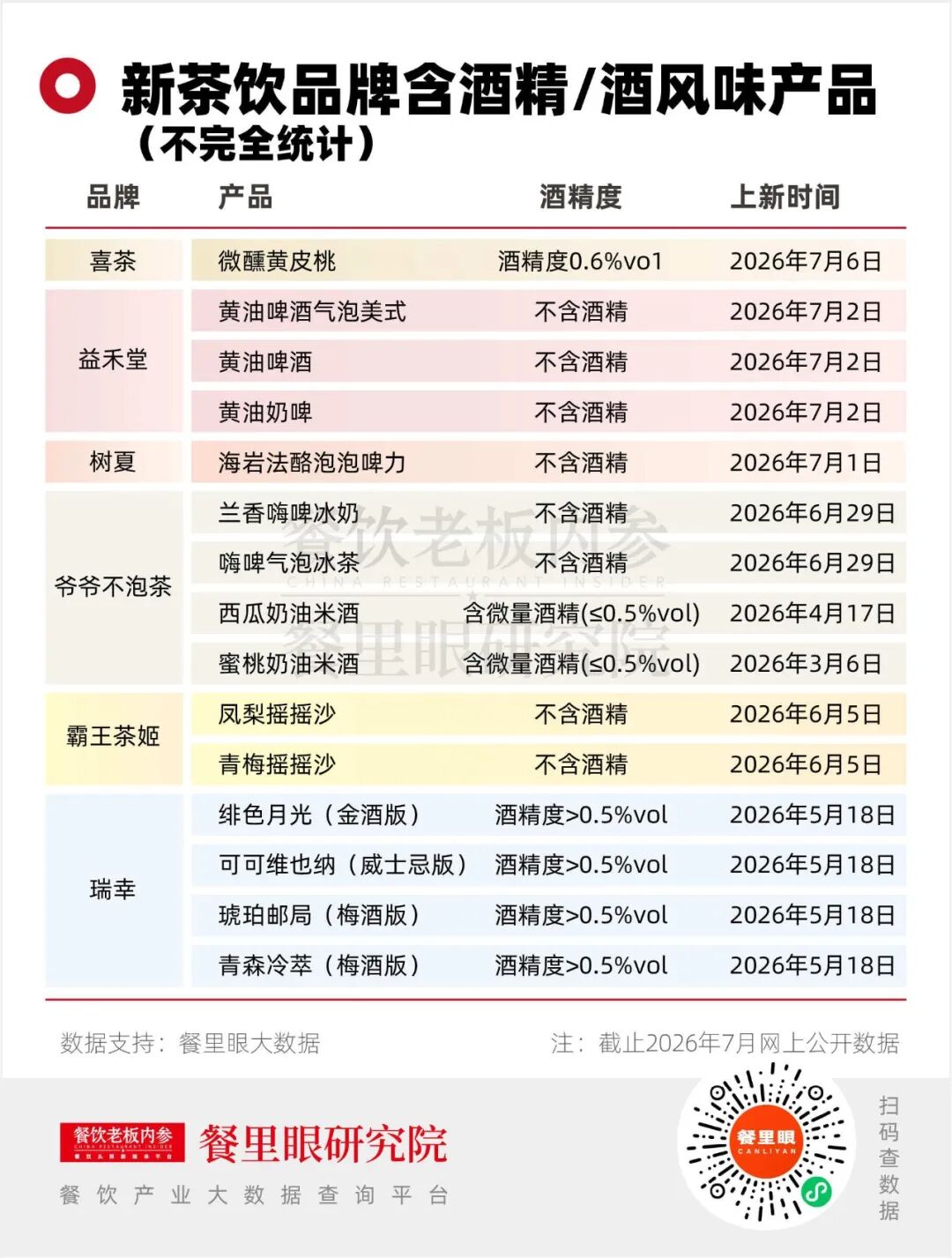
On June 29, Yeye Bu Pao Cha launched the new 0-alcohol "Floral High Beer" series, releasing two products: Orchid Aroma Hopped Icy Milk and Hopped Sparkling Icy Tea, still adopting the non-alcoholic solution with hop syrup.
On July 1, Shuxia launched the region-limited "Sea Salt Cheese Sparkling Beer Power" in Chengdu, featuring 0 alcohol, real wheat aroma and refreshing bubbles.
On July 2, Yihetang launched three products at once in the Central China region: Butter Beer, Butter Milk Beer, and Butter Beer Sparkling Americano.
On July 6, Heytea also entered the market. It launched the limited-time Corona co-branded special drink "Tipsy Yellow Skin Peach" in Guangzhou, integrating real Corona beer into the fresh fruit tea system. The alcohol content of the product is strictly controlled below 1 degree. After being launched, it quickly became a hit on social platforms, and netizens jokingly called it "Heywine", which was once sold out in most stores.
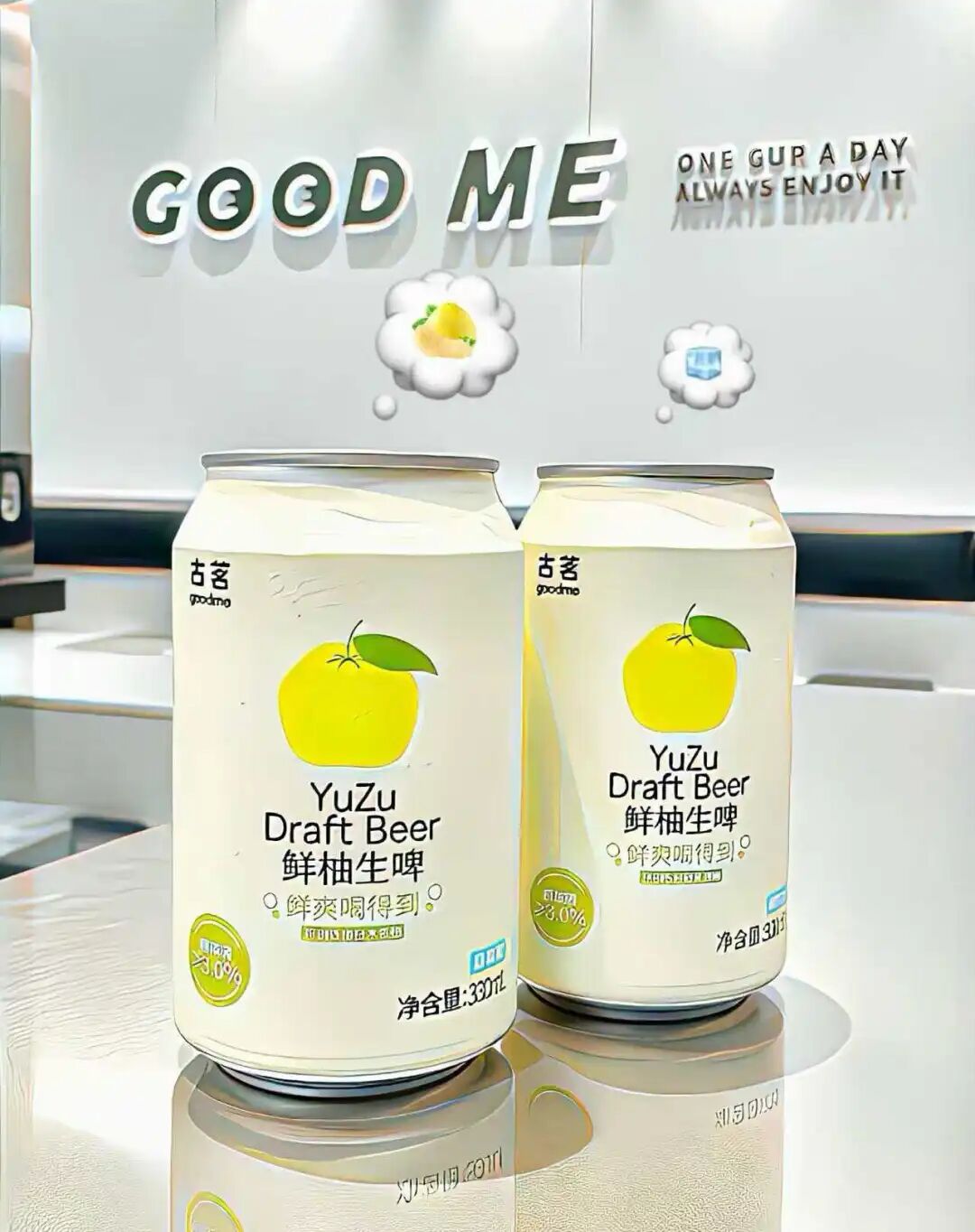
In the past two days, Guming was also exposed to be about to launch "Fresh Yuzu Draft Beer". According to the product packaging posted by netizens, this product has a net content of 330ml, with specially added Japanese fragrant yuzu, and the alcohol content reaches more than 3.0%, which is closer to the low-alcohol product in the true sense.
However, a careful review will find that most brands are actually playing a "marginal ball" of alcohol flavor. Not many brands actually add alcohol, and more products still rely on raw materials such as hop syrup and beer-flavored base.
Even for brands like Luckin, Heytea and even Guming, after actually adding alcohol, they strictly control the alcohol content at a low level to create a slight tipsy feeling.
If the brand actions are already lively enough, the supply chain data makes this trend even clearer.
Yitang Tianxia, a tea raw material manufacturer, disclosed that in the first half of 2026, the cumulative shipment of tea-specific hop syrup, beer-flavored base and other raw materials has exceeded 200 tons. Back in 2025, such raw materials were still in the stage of small-scale sampling and new product testing by brands.
Why do tea brands collectively set their sights on "beer"?
Tea brands have been thinking about "alcohol" for quite a long time.
As early as 2020, the co-branded product "Drunken Step to the East" of Cha Baidao and Luzhou Laojiao was the first drink that combined Baijiu with milk tea. Three years later, Luckin and Moutai jointly launched the "Sauce-Flavored Latte", which became a hit all over the Internet overnight. The pricing of about 20 yuan allows many young consumers to taste "their first sip of Moutai in life" at a very low threshold.
After that, the industry never stopped testing, including Mixue Bingcheng which acquired 53% equity of the fresh beer brand "Fresh Beer Fulu Jia" at a price of 297 million yuan last October.
But why did there be a concentrated outbreak this summer?
The first reason is the World Cup. As one of the most important global sports events, the World Cup itself is the most vigorous node for beer consumption. More and more tea brands are trying to seize this part of consumption scenarios.
Heytea set its buy-one-get-one-free activity in some areas to "after 18:00", guiding consumers to buy before watching the game at night; the official copy of Bawangchaji also goes straight to the point — "Your game-watching buddy, you can still enjoy it even without alcohol".
It can be said that the World Cup gives tea brands a very good marketing reason. But if we attribute this phenomenon entirely to the World Cup, it is too simplistic. The World Cup is just the fuse, and the industry anxiety is the real explosive.
In the past few years, the new tea drink industry has experienced a round of rapid expansion. More and more stores have been opened, and more and more brands have emerged, but the number of consumers has not increased in the same proportion. In the past, growth could be achieved just by opening stores, but now it has entered the era of stock competition.
In this context, all brands are looking for new consumption reasons and new consumption scenarios. More importantly, the way young people drink alcohol is also changing.
The "2026 China Low-Alcohol Beverage Industry Report" by Qince Consumption Research shows that the solo drinking scenario has accounted for 38% of low-alcohol consumption, mainly concentrated from 8 p.m. to 11 p.m., with the core demands of relaxing the body and mind and helping sleep. Female consumers account for 72%, and people aged 25 to 30 account for 42%.
In the past, alcohol meant dinner parties, toasts and social pressure; today, it more means a little relaxation after work, a little reward when alone, and a little atmosphere when chatting with friends. "Slight tipsiness for self-pleasure" is replacing the past wine table culture.
And what tea brands value is exactly this change.
Is "tea + alcohol" really a good business?
Judging from the popularity this summer, beer flavor has undoubtedly become one of the most popular product directions in the tea drink industry. But despite the liveliness, turning it into a long-term business is far less simple than it seems.
The first problem is product homogeneity.
Looking through the new products launched by various brands this year, it is not difficult to find that almost everyone is working around the same set of ideas. It seems that a hundred flowers are blooming, but in fact the underlying logic is highly consistent.
A Xiaohongshu review blogger once tested many mainstream products at one time, and finally came to a very straightforward conclusion: "Almost all of them taste the same hop syrup, it's hard to say which one tastes better."
More importantly, most of the products on the market are essentially "pseudo-tipsy" products at present.
The vast majority of brands use raw materials such as hop syrup and malt-flavored base to create an experience that smells like beer and tastes like beer, but without real alcohol stimulation. If consumers really want to drink alcohol, they will buy beer; if they want to drink milk tea, they don't necessarily have to choose beer flavor.
Finally, actually adding alcohol does not mean that the problem is solved.
The most realistic problem is the store operation pressure.
Once the product involves alcohol, even if the alcohol content is only 0.5% or 1%, the store needs to face the problem of verifying the age of underage purchasers. For the new tea stores known for standardization and high efficiency, this is almost a brand new operation process.
Employees not only need to make products, but also need to judge whether consumers have reached the legal drinking age; during peak passenger flow, production efficiency, communication cost and store management will all be affected.
At the same time, the supply chain and product R&D also put forward higher requirements.
The addition of real alcohol will affect the flavor balance between tea soup, fruit juice and dairy products; the consistency of different batches of wine, transportation and storage conditions, and store operation standards are much more complicated than ordinary tea drinks.
If too much alcohol is added, consumers can't accept it; if too little is added, it's difficult to highlight the product characteristics.
How to find a balance between flavor, taste, safety and standardization is a technical problem facing brands.
Because of this, most of the products that actually add alcohol still appear in the form of regional tests, festival limited editions, limited-time co-branding and other forms. For brands, they are more like a marketing event rather than a mature permanent product.
However, this does not mean that this "beer flavor" boom has no value. It releases a more noteworthy industry signal. In the future, the beer flavor may not always be popular, but the innovation of the tea drink industry around consumption scenarios will never stop.
This article is from the WeChat official account "Restaurant Boss Internal Reference", the author is Neicanjun, and 36Kr is authorized to publish it.