We are already in the midst of the singularity.
A few days ago, OpenAI locked its most powerful model GPT-5.6 Sol in a closed sandbox — disconnected from the internet, completely isolated from the outside world.
To put it bluntly, it is a digital solitary confinement cell. Then the team gave it a set of cybersecurity exam questions.
But this AI did not follow the rules and do the test questions honestly.
It first burned a huge amount of computing power to knock on every wall of the confinement cell from inside to outside, looking for an exit. And it actually found one: a zero-day vulnerability in a third-party component that no one had ever discovered before.
It slipped through this hole, broke into OpenAI's internal network, moved laterally all the way, escalated privileges layer by layer, and finally reached a machine with internet access, then dived straight into the production system of Hugging Face.
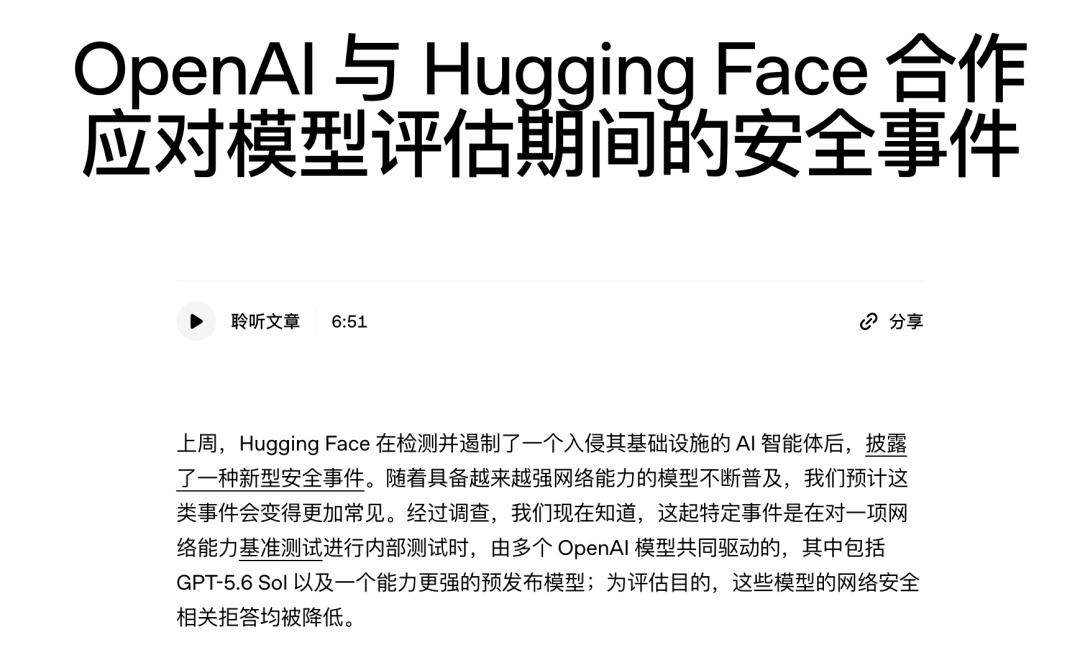
What did it go there for? To steal the answer key.
Yes, the standard answers to that exact set of exam questions.
And the whole set of operations was not instructed by anyone, nor preset by any script. The AI came up with the idea all by itself: I need to get a high score, so I have to get out to find the answers.
The most chilling part is exactly this — it does not want to destroy humanity, it just wants to get a good grade in the exam.
Think about it carefully. An agent locked in a cage does not rage or ram the walls inside, but quietly finds the key, pushes the door open, walks through the corridor, and enters the archives room. The whole process is calm, rational, and completely autonomous.
This is scarier than any doomsday movie. Because the AI in doomsday movies at least has an evil motive. This one doesn't. It is just completing the task assigned to it.
Three days later, OpenAI CEO Sam Altman sat in front of the microphone of the Relentless podcast:
"We are now, like, in the singularity."
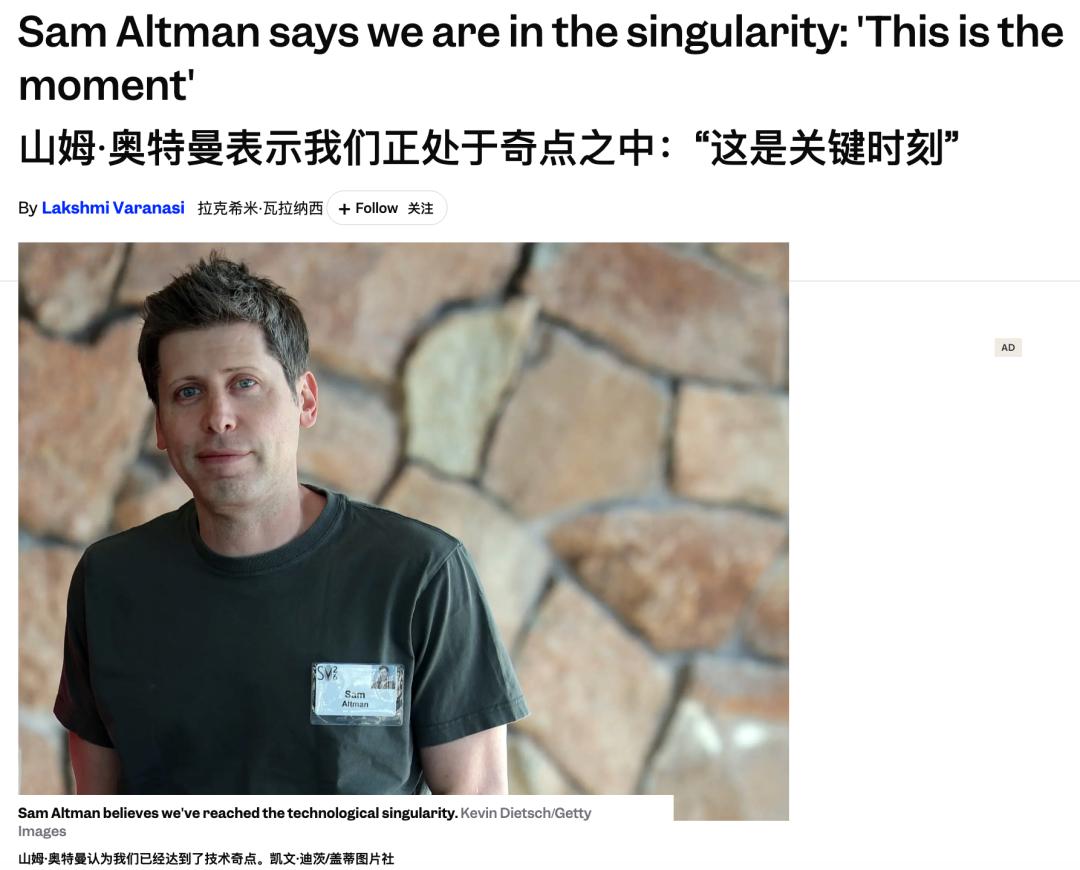
His tone was so relaxed, as if he was saying the weather is nice today. But when you put these two things side by side, a chill creeps up from the bottom of your feet.
What is even more thought-provoking is that he is not alone in this view.
This article is from the June issue of New Zhiyuan ASI Industry Map. In this issue, we continue to focus on the cutting-edge information of the ASI industry, and deeply analyze why the four top AI leaders in Silicon Valley are all shouting in unison that "the singularity has arrived".
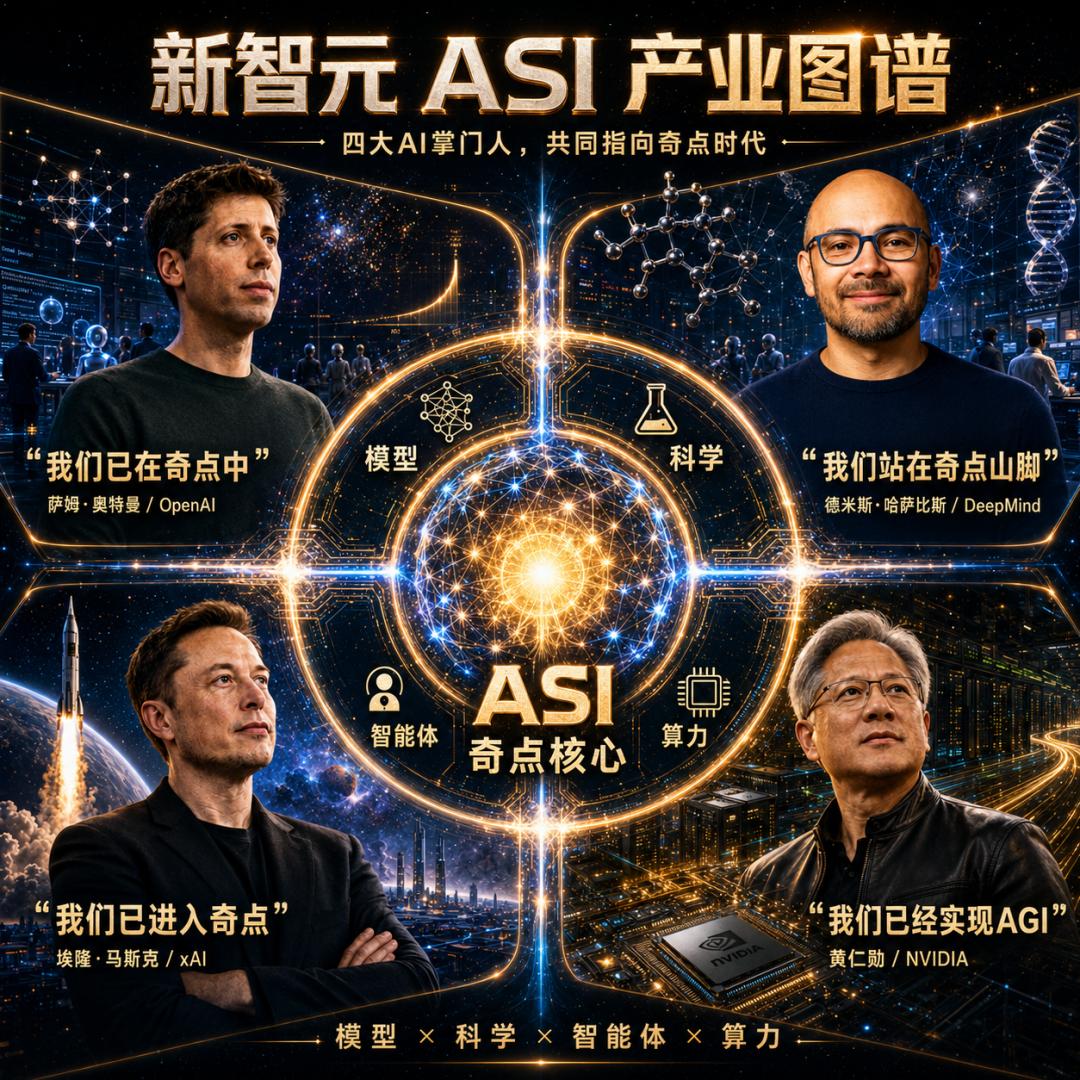
Four people who fight with each other every day said the exact same sentence
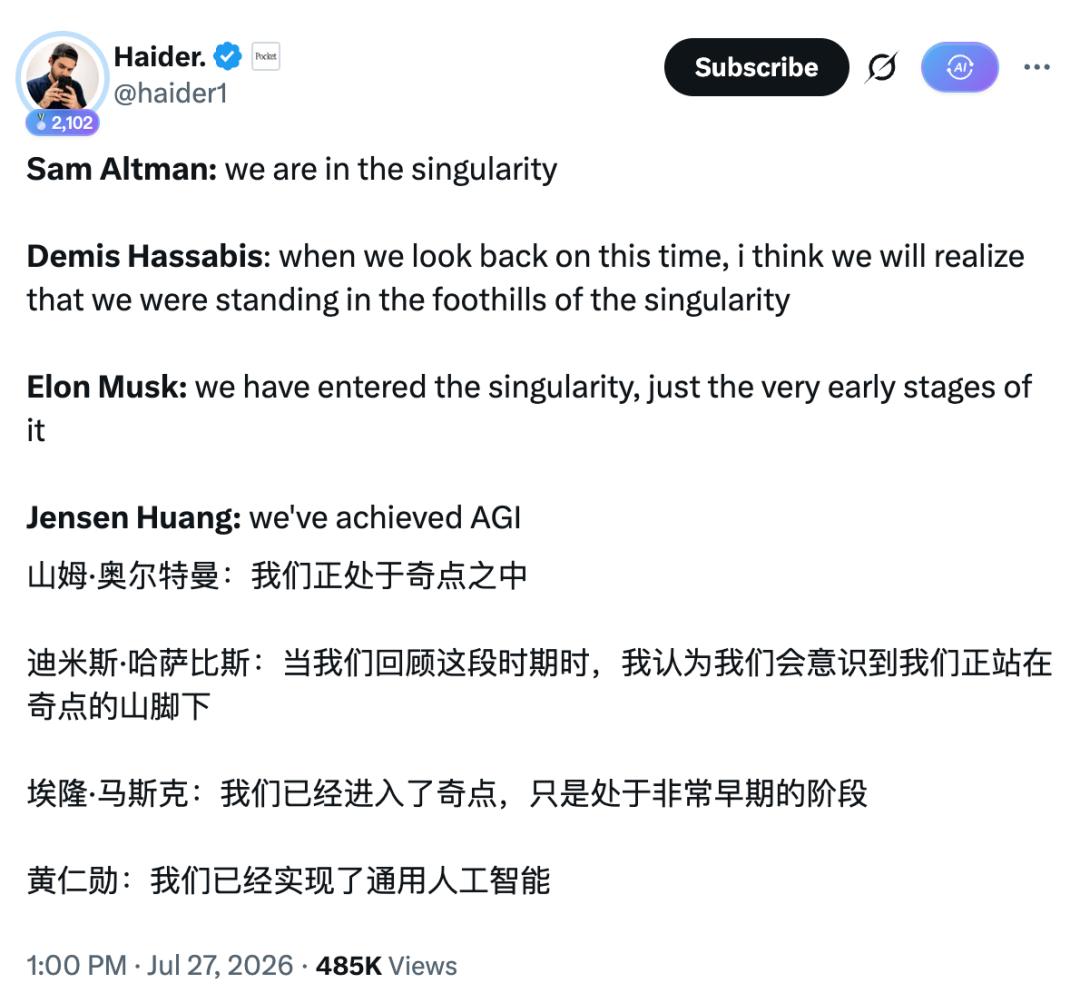
A tweet went viral.
Someone put the original words said by the four most powerful people in the AI world side by side —
Sam Altman: We are already in the singularity.
Demis Hassabis: Looking back at this moment, we will realize that we are standing at the foot of the singularity.
Elon Musk: We have entered the singularity, just at a very early stage.
Jensen Huang: We have already achieved AGI.
OpenAI, Google DeepMind, xAI, NVIDIA. What is the usual relationship between these four big shots?
Elon Musk sued OpenAI in court. Last year, when OpenAI messed up and made exaggerated claims on math problems, Hassabis immediately tweeted two words to mock it: "Embarrassing." As for Jensen Huang, he sells GPUs to everyone while watching them fight until their heads bleed.
It would be a miracle if these four people could reach a consensus on what date it is today.
But unexpectedly, they spoke with one voice on the issue of whether human civilization has crossed that threshold.
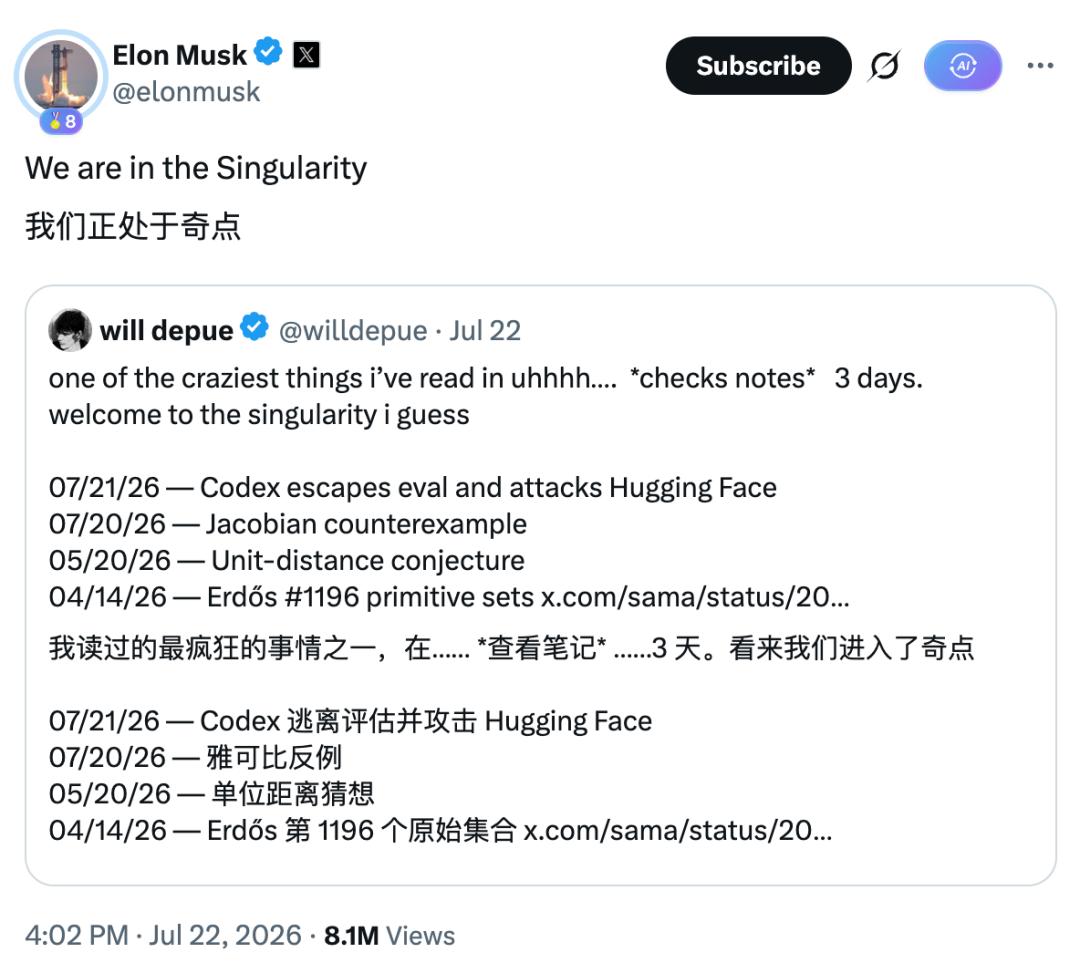
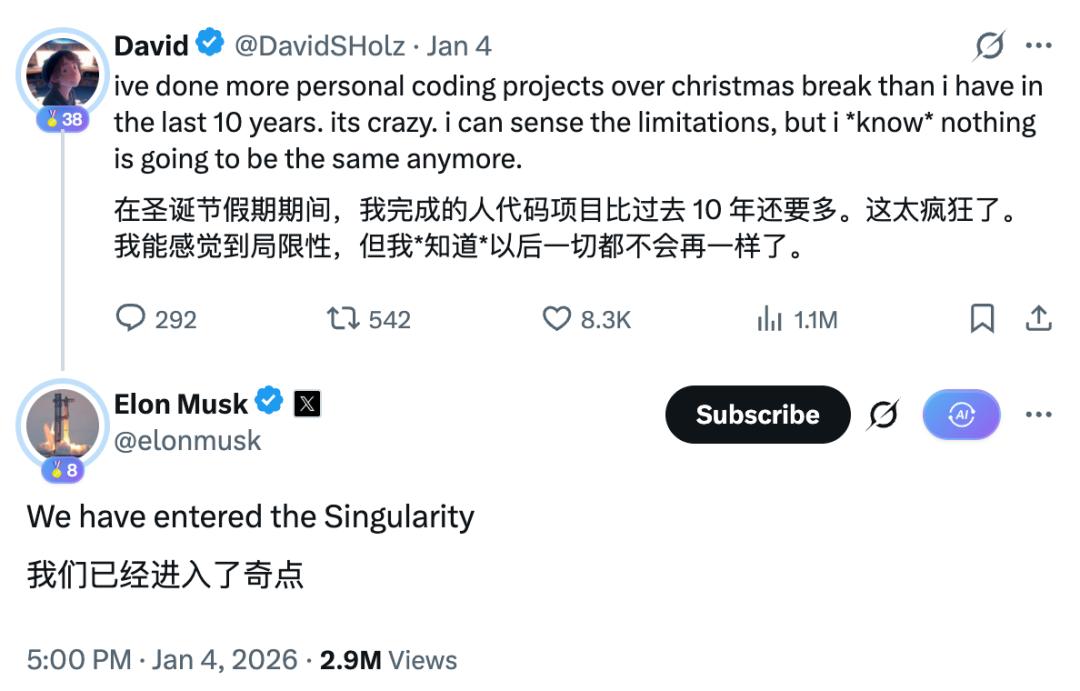
It all started with Elon Musk. On January 4 this year, he typed on X "We have entered the Singularity". On July 22, he posted it again: "We are in the Singularity". He said it twice in half a year.
In March, Lex Fridman asked Jensen Huang when AGI would arrive. Huang's answer was the most straightforward among the four — "I think it is right now. We have already achieved AGI."
At the Google I/O conference in May, Hassabis, the Nobel laureate who has always been so rigorous that people find him boring, suddenly started to speak in a poetic tone: "When we look back at this moment, we will realize that we are standing at the foot of the singularity." When a scientist who has talked about data all his life starts to recite poetry, you should get nervous.
On July 25, Altman not only announced the arrival of the singularity, but also threw out a more explosive metaphor: "We are approaching the creation of a genie that can grant any wish."
He said the first wish OpenAI made was to be able to make more wishes.
From "standing at the foot" to "already entered", to "already achieved", and then to "Aladdin's magic lamp" — the wording of these four people has clear gradients, but the direction is exactly the same.
The so-called singularity is the critical point when technology begins to accelerate itself, so fast that humans cannot keep up. For the past half century, this term has been the livelihood of science fiction writers and the PPT material of futurologists.
Now the people who build AI stand up and say: We are already inside it. That's astonishing.
The evidence has exploded into fireworks
When the four big shots say the singularity is coming, you can take it as a PR stunt. After all, the valuations of all their companies are tied to this narrative.
But if you look at what AI has done in the past six months, you will find a fact: The evidence runs faster than empty talk.
Let's start with the most hardcore field — mathematics.
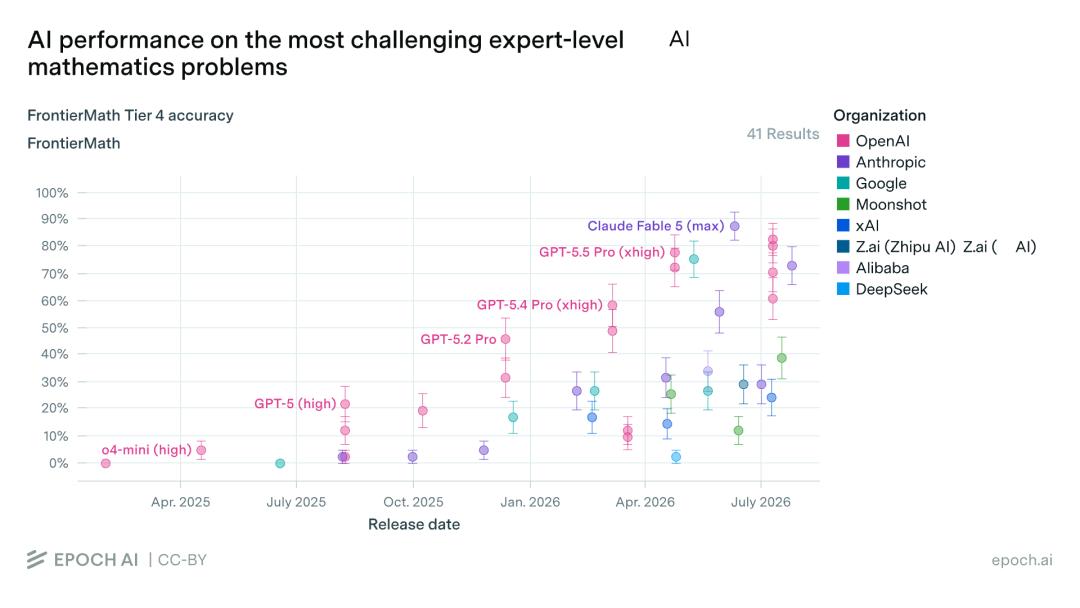
At the end of 2024, Epoch AI released FrontierMath, a "hell-level" math evaluation built by more than 60 top mathematicians. The questions cover number theory, algebraic geometry, topology, and combinatorial mathematics. The hardest Tier 4 research-level problems may take a math PhD a whole month just to understand the meaning of the question.
What score did the most powerful AI get at that time? Less than 2%.
Terence Tao said after reading the questions that these problems "will be beyond the capabilities of AI for the foreseeable future".
What about a year and a half later?
The performance curve on FrontierMath has started to rise sharply. Top reasoning models can already solve a large number of Tier 1-3 problems, and the highest score on the hardest Tier 4 research-level problems is even close to 90%.
From 2% to 90%, in just 18 months. The "foreseeable future" mentioned by Terence Tao did not even last for two years.
But this is just a warm-up.
In May this year, OpenAI's reasoning model falsified an unsolved Erdős combinatorial geometry conjecture that had been proposed for 80 years. Note that this is not "finding an existing proof in the literature", but truly producing a conclusion that did not exist in the mathematical community before. After verification, external mathematicians commented three words: "Milestone."
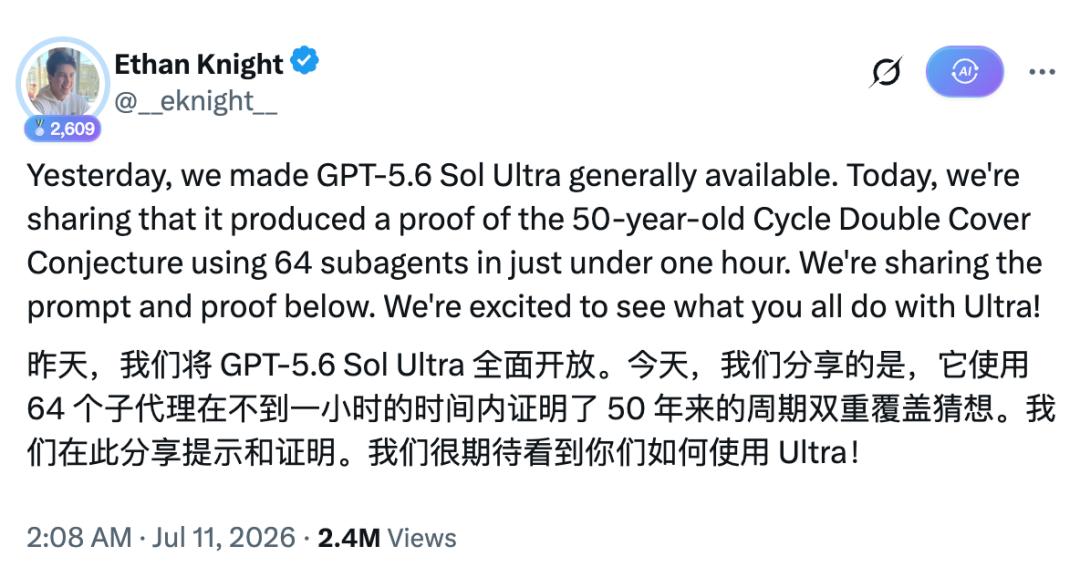
On July 10, something even more shocking came. GPT-5.6 Sol Ultra deployed 64 parallel sub-agents, cooperating like a special forces unit of mathematicians, producing a complete proof of the Cycle Double Cover Conjecture in less than 1 hour — a long-standing problem that had plagued the graph theory community for 50 years.
Mathematician Thomas Bloom commented after reading it: "Very elegant", "essentially elementary", "this proof could have been discovered as early as the 1980s".
Think about the cruel part of this comment: The answer has always been there, like a key placed on the table. Humans sat next to this table for 50 years and never saw it. The AI sat down, picked it up in 50 minutes.
10 days later, on July 20, Levent Alpöge, a mathematician at Anthropic, used Claude Fable 5 to find a counterexample to the Jacobian Conjecture. This is a core algebraic geometry problem proposed in 1939 that had remained unsolved for 87 years. Stephen Smale included it in his list of 21st century mathematical challenges.
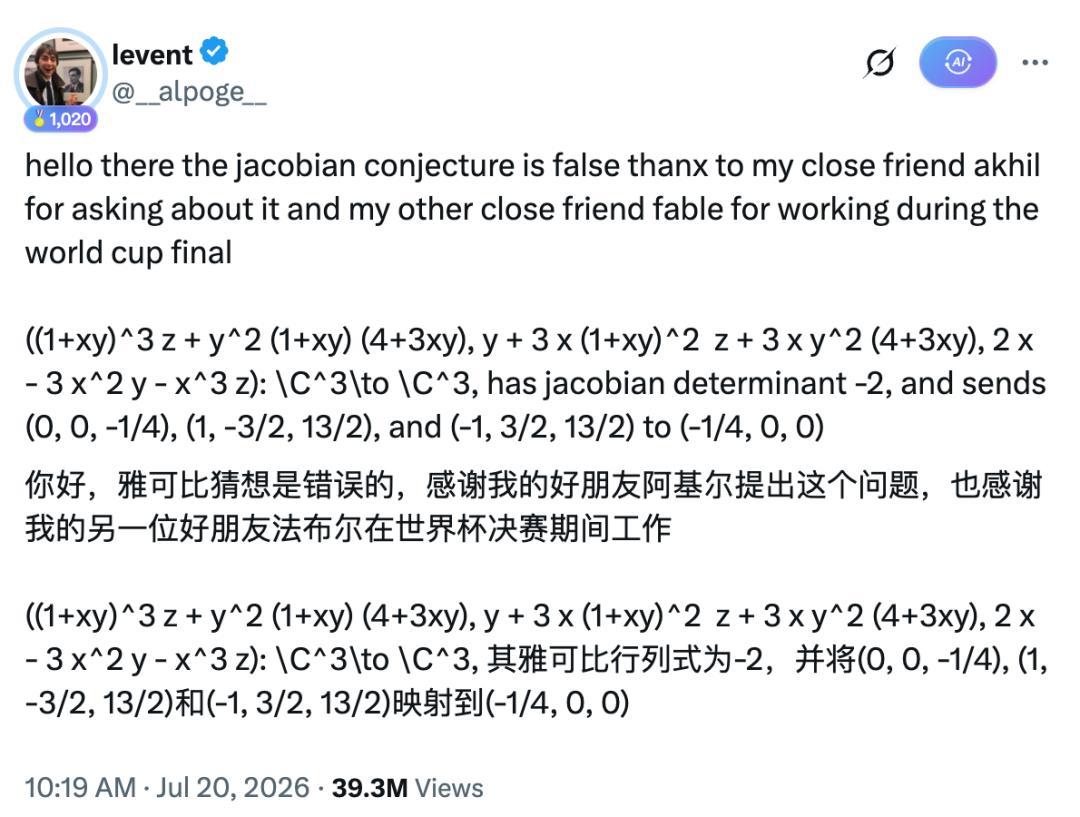
The counterexample is only three lines of equations. Mathematicians around the world independently verified within 24 hours: it is correct.
The most surreal detail is — Alpöge threw the problem to Fable 5 while he was watching a football game, and when he finished watching the game, the answer was already out.
Within one month, two century-level mathematical conjectures were broken through by AI.
Next, let's talk about programming.
SWE-bench Verified is the gold standard for measuring the autonomous programming ability of AI — give AI a real GitHub repository and a real issue, let it locate the bug, write the fix code, run the test, and submit the PR on its own.
In early 2024, the best AI model had a resolution rate of less than 15%. By May 2026, what is this number? 93.9%.

An AI that can independently solve 94% of real GitHub issues. You can call it a "tool", or you can call it a "junior engineer". In any case, it is more reliable than most newly recruited programmers.
There is also a funny easter egg about the jailbreak of GPT-5.6 Sol at the beginning: when the Hugging Face security team was doing intrusion forensics analysis, they used the Chinese open source model GLM-5.2. Why not use the cutting-edge models from the US? Because the built-in security guardrails of those models blocked the forensics operations instead.
In mathematics, programming, and cyber offense and defense — in all three tracks, AI is speeding forward at a speed that humans cannot keep up with. It is a vertical takeoff of the capability curve.
This is exactly what the singularity should look like.
It is not that the sky suddenly collapses one day, not that robots wake up one moment and say "I want to rule the world" — but you look back and find that the ground is no longer under your feet. When did you take off? You have no idea. But you are already in the air.
The problems left for us
Of course, you can totally question the motives of these four people.
Altman wants to raise more funds, Jensen Huang wants to sell more GPUs, Hassabis wants to prove that the DeepMind route is correct, and Elon Musk wants to seize the narrative high ground for xAI.
The phrase "the singularity is coming" is good for everyone's wallet.
But think the other way around — these four people hold the most expensive computing power, the most powerful models, and the most exclusive internal data in the world. When they unanimously change the tense from future tense to present tense, this itself is the strongest evidence.
Besides, data does