Former Anker executive develops smart RV business, secures over 200 million yuan in financing from investors including Yuanhe and GSR Ventures, with the first product to be mass-produced in early 2027 | Hard Krypton Exclusive
Author | Huang Nan
Editor | Yuan Silai
36Kr has learned that Squirrel Power, a hard-tech enterprise focused on outdoor mobility, has recently completed a Series A round of financing totaling over 200 million yuan. The investors include industrial capital and professional financial institutions such as Yuanhe Puhua, Yuanhe Hope, Jinshajiang United Capital, Paradise Silicon Valley, Zhongke Chuangda, Guangyuan Hesheng Fund, Different Capital, Shenqi Capital, Living Water Capital and Chunjia Capital.
The funds from this round will be mainly invested in the vehicle-grade in-depth verification, R&D and testing of the Evotrex-PG5 complete vehicle, accelerate the construction of production lines and capacity expansion, and fully expand manufacturing capabilities to ensure the smooth realization of the mass delivery target in 2027.
Founded in 2023, Squirrel Power is a hard-tech startup focused on the R&D, manufacturing and global operation of outdoor electrified and intelligent products. Its brand Evotrex takes the self-developed integrated vehicle power generation and energy storage technology as the core, targeting the global outdoor travel market, providing off-grid living solutions for the new generation of consumers, and committed to promoting the electrification, intelligence and energy autonomy upgrading of the RV industry.
Earlier, the company officially released its first product Evotrex-PG5 at CES 2026, which is positioned as an intelligent range-extending towable RV, featuring energy self-sufficiency in off-grid scenarios, with a starting price of 120,000 USD.
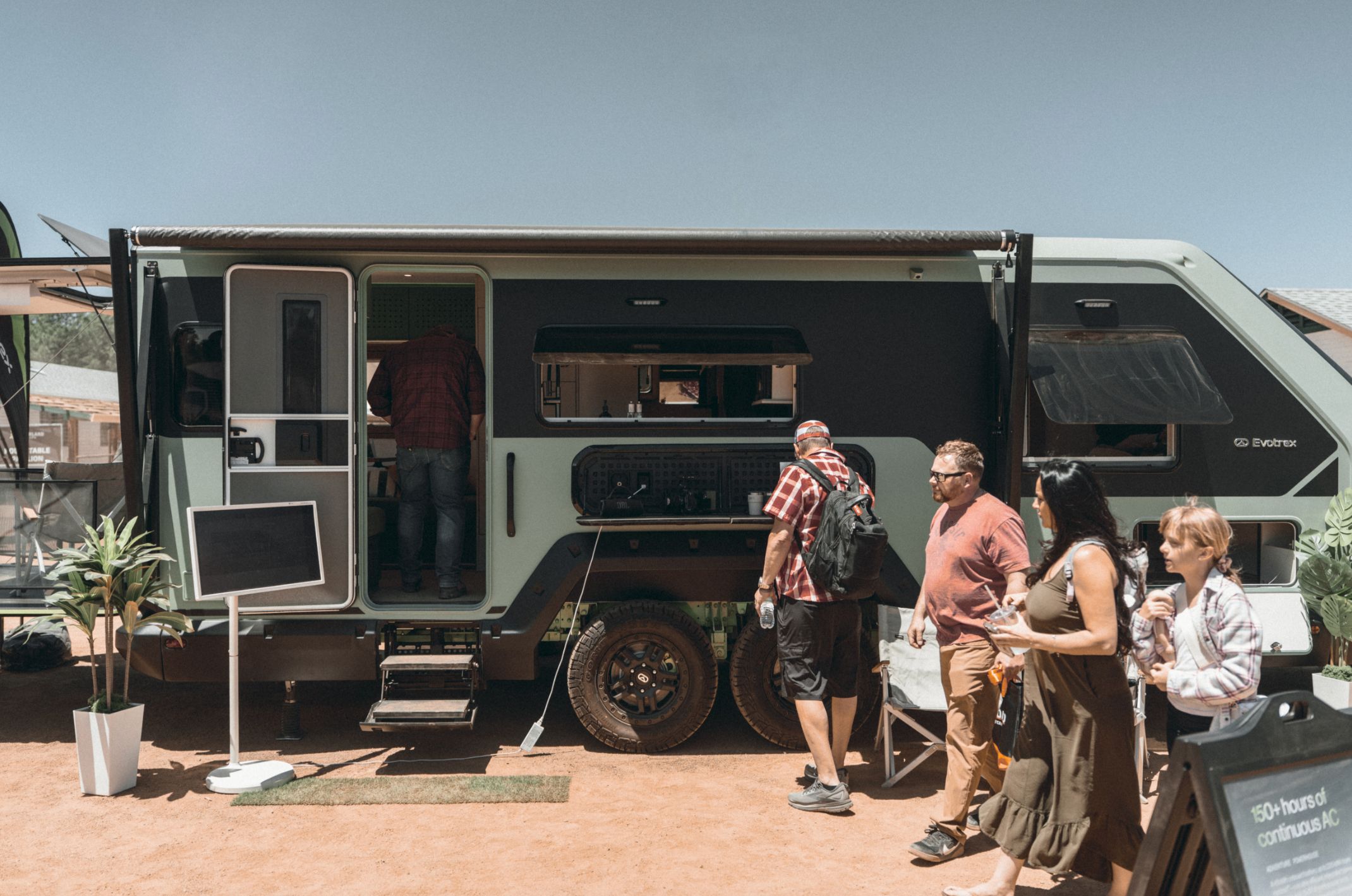
Squirrel Power's first product Evotrex-PG5 (Source/Enterprise)
The electrification window of the RV industry is opening up. This is a global market with an annual increment of hundreds of thousands of units and a stock of more than 14 million units. With the continuous explosion of diverse demands such as outdoor living, long-distance self-driving, mobile office, outdoor business and emergency energy storage, electric towable RVs with independent power generation, large-capacity energy storage and intelligent energy scheduling capabilities have become a new track in the mobility technology sector that combines implementation certainty and long-term growth potential.
According to official data from Squirrel Power, the number of pre-orders for Evotrex-PG5 has far exceeded internal expectations, among which the top-tier Premium model priced at 159,990 USD accounts for 90% of the orders. The outdoor consumer group in North America has strong purchasing demand, and the consumer group has long broken through the circle of pure electric vehicle users. The acceptance of the mass market is significantly higher than expected, mainly consisting of outdoor sports enthusiasts aged 30 to 45, covering segments such as skiing, surfing and off-roading.
The power system of traditional RVs is highly dependent on camp access, and the standard factory configuration is usually only 2 to 3 kWh of electricity. Even if users install battery packs later, the expandable space is extremely limited. This means that once leaving the camp, the power supply of the RV cannot support the continuous operation of high-power equipment such as air conditioners, water heaters and kitchen appliances, and it is almost impossible to stay off-grid for a long time.
Squirrel Power's technical solution breaks away from the one-way idea of "increasing battery capacity" and adopts the range-extending route that has been fully verified in China's passenger vehicle market. The PG5 is equipped with a 75-liter fuel tank and a 43 kWh battery pack. The thermal efficiency of the range extender exceeds 40%, and each liter of fuel can generate more than 3 kWh of electricity, providing a total of about 270 kWh of available electricity. This configuration means that when the vehicle is away from the camp, it can still support the normal household electricity consumption of a family of four for several consecutive days or even more than a week.
Reflected in the driving scenario, the motor system of the PG5 can provide auxiliary power when being towed, alleviating the common industry problem of sharp range attenuation after electric pickup trucks tow the RV. The range extender can charge the front vehicle in reverse while driving, essentially forming a closed loop of "refueling - power generation - charging".
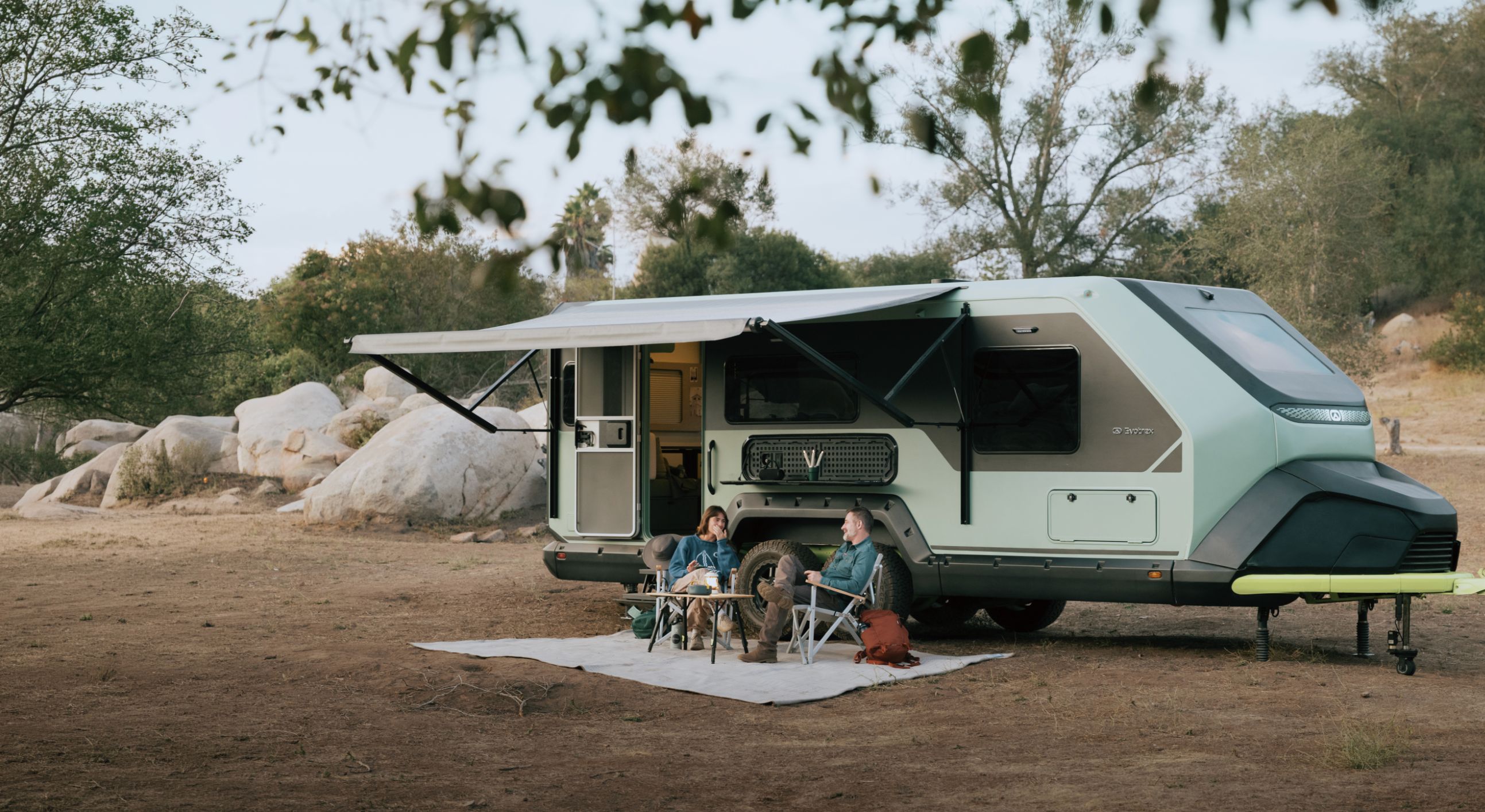
Redesign from energy production to living experience (Source/Enterprise)
In static scenarios, the PG5 is more like an integrated mobile energy platform that integrates on-board power generation, large-capacity energy storage and full-domain intelligent energy management, rather than a traditional living trailer. In addition to leisure camping and remote home office, it also has the potential to extend to commercial scenarios such as mobile food trucks, retail vehicles and scenic tour vehicles, and can even be used as a household energy storage unit to supply power to residences in reverse.
At present, PG5 has fully launched the full-scenario reliability verification project. The test system covers extreme working conditions such as traction range, energy management system, driving stability, braking safety, body structure durability, wading and rain exposure, and multi-country compliance certification, to ensure the stable output of the range-extended power system in real complex environments and lay a quality foundation for large-scale mass production.
Energy capability is the foundation, and the product power perceived by users is more reflected in the living experience and intelligent interaction. At the intelligent level, PG5 integrates control modules for electric sunshades, foot pedals, tailgates, etc., and is equipped with a Starlink satellite interface, so that the vehicle can be connected to the network stably even in remote areas without ground base station coverage. In view of the characteristics of long-term parking of RVs, PG5 also has a household energy storage function, which can be connected to the residence through wires to supply power.
In the interior that interacts most frequently with users, Squirrel Power has added modular detachable dining tables and chairs, a 72-inch integrated on-board giant screen cinema, a rear terrace system with closed insect-proof nets, and a number of customized interior themes based on the real feedback of booking users. The team plans to synchronize the complete product update plan to all booking users in the second half of 2026. Before mass production, a visual configuration platform will be launched, allowing users to combine vehicle functions and interior kits by themselves.
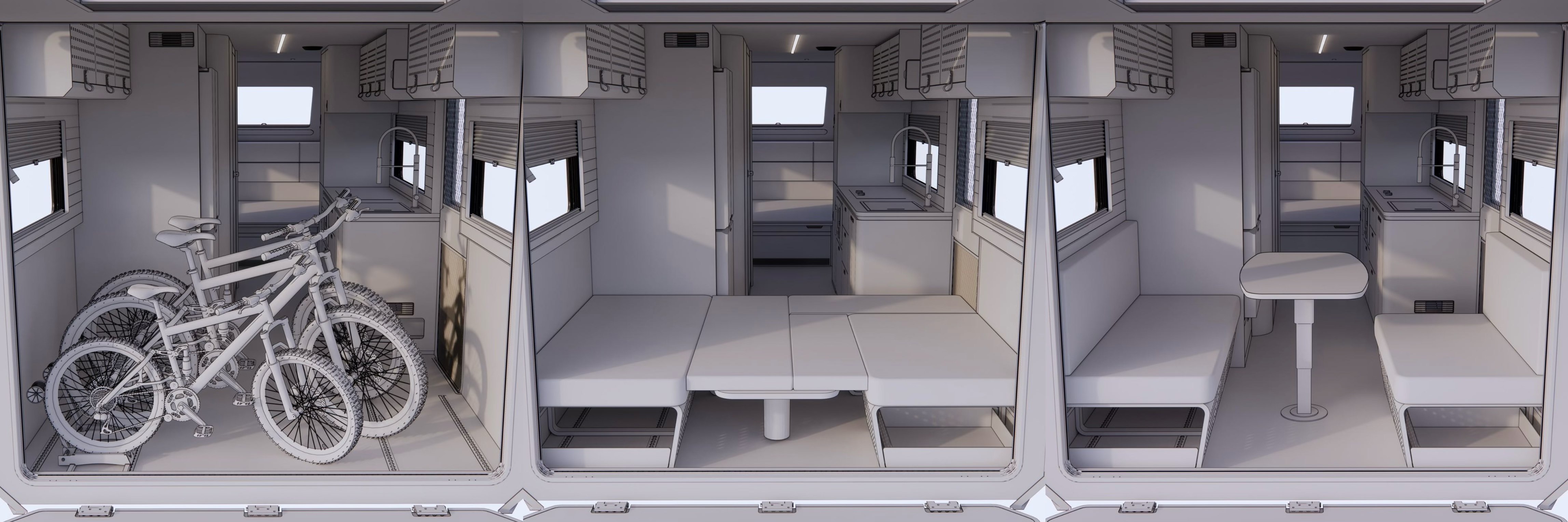
Schematic diagram of Evotrex-PG5 internal modular design (Source/Enterprise)
It can be said that Squirrel Power's positioning of Evotrex-PG5 is not a "higher-configuration electrified RV", but a complete system that has been redesigned from energy production to living experience.
From leisure camping and remote home office to outdoor business operation and emergency backup power supply, it not only runs on the road, but also parks in the wild. At the same time, it is a living unit that can be configured on demand to meet users' core demands for travel freedom, energy autonomy and full-scenario interconnection.
Squirrel Power's product line planning is based on the platform logic. The first PG5 is positioned at the high end to establish the brand's technical advantages and verify the market pricing capability. Later, the company will launch an affordable version with consistent core experience but adjusted configurations and materials to cover a wider consumer group. The team predicts that after the platform-based layout is completed, the R&D and launch rhythm of subsequent products will be significantly accelerated.
"In the past, traditional RV products were seriously homogeneous, and dealers were the dominant party. When we went to negotiate with pre-sale orders, the right to speak shifted," Xiao Ang, Founder and CEO of Squirrel Power, told 36Kr. At present, as Squirrel Power's order volume continues to rise and far exceeds internal forecasts, and a number of industrial cooperation intentions have been implemented, expanding production has become one of the most urgent core tasks for the team.
In the future, the company also plans to build a complete service network covering product planning, delivery and full-cycle maintenance in the United States to support the service demand for subsequent mass delivery.
The following is an excerpt of the interview between 36Kr and Xiao Ang, Founder and CEO of Squirrel Power (slightly edited):
36Kr: The industry has reached a consensus on the bottleneck of off-grid energy self-sufficiency for RVs. What is the underlying judgment for PG5 to choose the range-extending solution instead of the pure electric large battery route?
Xiao Ang: The core pain point of RVs is not "whether there is electricity", but "whether there can be continuous electricity". The ceiling of the pure electric solution is very obvious. It solves the power consumption problem in the parking scenario, but cannot solve the energy self-sufficiency of the RV throughout its life cycle.
We have broken down three usage scenarios. The parking scenario is only one of them, and the other two are the idle scenario and the driving scenario. The pure electric route is naturally limited in the latter two.
In the parking scenario, 270 kWh of electricity means that a family of four can live in the wild for a whole week continuously, with air conditioners, water heaters and kitchen appliances all turned on, and the energy redundancy is still sufficient. You don't need to carefully calculate power consumption or turn off equipment to save electricity. This is called "no compromise on experience". The North American market is extremely sensitive to this point. Their usage habit is to keep the air conditioner on 24 hours a day, so if the power provided by the product is only "enough", it is "insufficient" for users.
Many people ignore the idle scenario. 80% of the time, RVs are parked at home, which is a long-standing structural problem in the industry - idle assets. We turn the whole vehicle into a household energy storage unit, which can be connected to the house with a wire to supply power in reverse. This function has clear market demand in North America. For example, in the case of frequent extreme weather, the stability of the power grid is poor, and household backup power is a rigid demand.
The driving scenario is the biggest structural defect of the pure electric route. The 60% to 70% range attenuation of electric pickup trucks after towing is a common industry problem. It is not because the battery is not large enough, but because of the wind resistance and load of the trailer, the physical loss caused by it cannot be solved by increasing the battery capacity. We add a drive motor at the towing end to provide auxiliary power, which greatly reduces range attenuation. At the same time, the range extender continuously generates electricity while driving, keeping the 43 kWh large battery fully charged, and can also charge the front vehicle in reverse after stopping.
36Kr: PG5 is planned to be delivered in large quantities in 2027. From the prototype vehicle to the mass production of 1,000 units per year, what is the biggest engineering challenge?
Xiao Ang: The biggest contradiction is the balance between the market's high delivery expectations and our standards for product durability and reliability, which is also the core reason why we focus on increasing investment in vehicle testing and verification in this round of financing.
Our product integrates multiple systems such as by-wire chassis power, range-extending power generation system, energy storage inverter, passenger car-level vehicle structure, interior and intelligence, and its complexity is even higher than that of a range-extended passenger car. The traditional RV industry has long relied on manual modification and lacks a standardized vehicle-grade mass production system.
The first challenge is full-dimensional reliability verification. Hundreds of mandatory standards such as North American FMVSS safety, EPA emission, lithium battery thermal runaway protection, long-distance traction durability, and high and low temperature full-domain environmental testing are indispensable. Any test rectification will prolong the mass production cycle. We do not want to compress the verification process to catch up with the industry delivery rhythm, but prefer to invest more funds and time to complete the full process of investigation under extreme working conditions, and avoid quality risks after mass delivery from the source.
The second challenge is the in-depth collaboration of cross-domain supply chains. Our range-extending solution connects four modules: fuel power generation, traction assistance, two-way energy replenishment, and household reverse power supply. It is necessary to simultaneously integrate completely different supply chain systems such as new energy vehicles, RV interiors, and consumer electronics, to uniformly align the vehicle-grade quality standards, and achieve stable volume production at the same time. The running-in period is much longer than that of a single category of hardware.
The third challenge is the simultaneous implementation of overseas compliance and large-scale production lines. North America has a wide range of certification categories for RV safety, lithium battery and gas systems, and the full set of compliance filings must be completed before mass production. At the same time, global pre-orders have far exceeded expectations. We are building high-standard production lines, opening up a stable supply chain to achieve an annual output of 1,000 units, and continuously iterating the vehicle durability test system. The two lines cannot be neglected.
Many players in the industry prioritize delivery and sacrifice long-term reliability, but we believe that the word-of-mouth of users and channels is the foundation of the brand's survival. A large part of the funds raised in this round will continue to be invested in full-scenario verification of the whole vehicle, which is to keep the bottom line of quality and reliability while expanding production and speeding up, and this is also the foundation of our long-term differentiated competition with other brands in the track.