Ray Dalio of Bridgewater: A bubble has emerged in the AI sector, and the global economy is at the tail end of the 80-year great cycle recession.
Ray Dalio, the founder of Bridgewater, the world's largest hedge fund, recently warned: Typical characteristics of an AI asset bubble have emerged. Coupled with internal debt crises and external geopolitical conflicts, humanity is at the end of the 80-year "Big Cycle" recession.
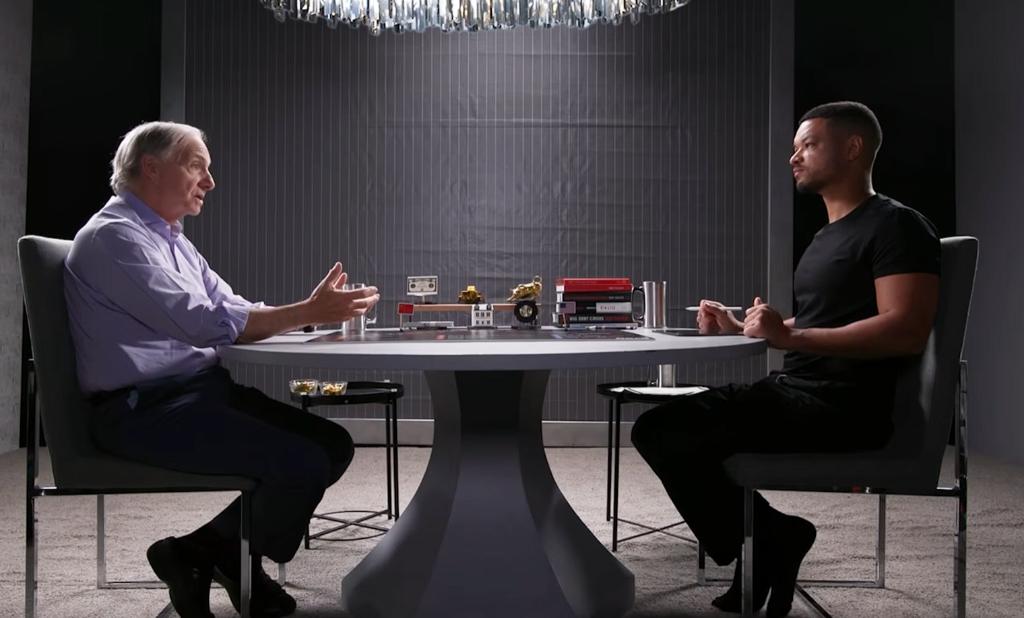
Dalio, founder of Bridgewater Associates, received an in-depth interview from host Steven Bartlett on the business interview podcast The Diary Of A CEO aired on July 30.
As a global macro investment master who accurately predicted the 2008 financial crisis and achieved a 9.5% positive return against the trend, Dalio delivered a highly incisive underlying logical analysis on the market's most concerned topics including the current AI technology mania, global asset allocation, geopolitical game and wealth class differentiation in the one-and-a-half-hour conversation.
The current market is caught up in mania over the productivity revolution brought by artificial intelligence, but in Dalio's view, a "textbook-style asset bubble" is brewing.
He clearly pointed out that the current market is not only facing the inevitable backlash brought by leveraged funds pushing up the valuation of AI assets, but also deeply trapped in the "decline period" of an 80-year historical macro big cycle. At the end of this cycle, extremely inflated debt, unprecedentedly widening wealth gap and intensifying global geopolitical conflicts are resonating with each other.
In terms of asset allocation, he said bluntly that "cash is the worst investment in the long run", and made it clear when choosing safe-haven assets that he "prefers gold bars to Bitcoin". For ordinary people, the large-scale substitution of human mind and labor force by AI will further tear apart the social wealth gap.
"With only 50 million invested, holding a 1 billion valuation": A typical bubble is emerging
At the beginning of the program, the host mentioned that legendary Wall Street investor Jeremy Grantham once asserted that the current period is the largest investment bubble in American history. Dalio expressed his agreement on this:
"He is right. We have already seen the typical signs of a bubble."
Dalio pointed out that the emergence of new technologies is always accompanied by mania. Today's AI, just like electrification in 1929 and the Internet in 2000, is a revolutionary technology. But the problem with the market is that it "does not pay attention to prices".
Dalio broke down in detail the micro mechanism of the bubble from expansion to burst:
"Now you can issue stocks. For example, you raise 50 million US dollars, and then value the company at 1 billion US dollars. In fact, only 50 million US dollars have been spent on this company, but because of the book value, you become a billionaire."
This kind of prosperity built up by book wealth is extremely fragile. Dalio warned that when the trigger conditions for the bubble burst appear — usually rising interest rates or investors needing cash to pay taxes and debts — the crisis will erupt.
"Wealth is not equal to currency. You cannot consume wealth directly, you have to sell assets in exchange for currency. When they need money for some reason, such as paying interest due to rising interest rates, the bubble will be punctured."
As AI companies sell off their stocks at high valuations one after another, the supply of stocks in the market increases significantly. Once leveraged investors face forced liquidation, "everything will become cheaper, people will start to cut spending, and a recession will follow."
The 80-year "Big Cycle" enters the decline period: The inevitable outcome of debt and conflicts
If the AI bubble is a short-term carnival, then the "The Big Cycle" in Dalio's words is the Sword of Damocles hanging over the global economy.
"This usually lasts for a person's lifetime, about 80 years on average. The last time we experienced the starting point of this big cycle was in 1945." Dalio believes that countries including the United States and the United Kingdom are currently in the "decline" stage of this big cycle.
He attributes the current recession to three interacting destructive forces:
Exhaustion of funds and debt: "The government does not have enough money. We have huge budget deficits, where are you going to get the money to pay the bills?" He took the UK as an example, "The UK has changed six prime ministers in the past seven years, precisely because the government does not have enough money to fulfill its promises."
Extreme internal division: While creating prosperity, capitalism has also created a huge wealth gap. "When the economy goes down, the left and the right will be at each other's throats."
Disintegration of the external geopolitical order: Dalio said bluntly that the United States' international control is fading, and it has even exposed its weaknesses in the Red Sea crisis and the Middle East conflicts. "People realize that the United States does not want to go to war... It is just like the UK during the Suez Canal Crisis back then. Previously, as long as the United States gave a little hint, other countries would follow suit, but that kind of power no longer exists."
Asset hedging guide: "Cash is the worst investment", gold outperforms Bitcoin
Faced with the inevitable economic cycle fluctuations, how should investors arrange their wealth? Dalio put forward a clear principle: de-cash allocation and extreme diversification.
"People keep their money in banks because it feels the safest. But it is not. For a long period of time, this is the worst investment because inflation will eat it away." Dalio did the math:
If the inflation rate is 3.5% to 4% per year, even if you get interest at the same level, after deducting taxes and fees, the long-term return is still appalling.
His suggestion is to make a diversified allocation, and he listed several types of assets on the table: stocks, cash, gold, bonds, real estate, Bitcoin.
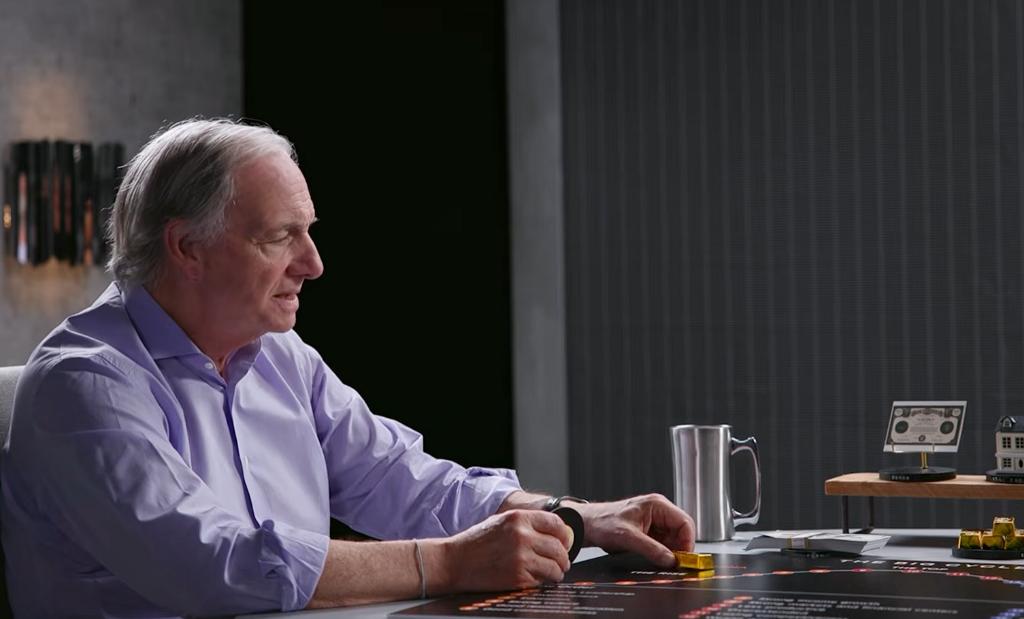
In terms of choosing hard currencies, even though cryptocurrencies are sought after by the market, Dalio still firmly stands by gold. "I hold about 1% of Bitcoin... It is a kind of currency that cannot be printed out, nor can it be cracked by technology." But he immediately pointed to the gold bars on the table and emphasized:
"But among the asset classes where I want to ensure I hold hard currency (this part should account for 5% to 15% of an ordinary person's investment portfolio), I prefer these gold bars to Bitcoin."
"When these assets (stocks and bonds) perform poorly, gold tends to perform well, which makes it a very effective hedging tool," said Dalio, "Gold was not officially removed from the currency list until 1971, but it remains the second largest reserve currency in the world. Central banks hold it, and it has unique traits that no other asset has."
He pointed out that the fatal weakness of Bitcoin lies in privacy and government regulation:
"When quantum computing emerges, Bitcoin may be monitored and taxed by the government. When the government says 'I don't want it', they have the power to do whatever they want with it. Central banks of various countries will not hold a large amount of Bitcoin. Look at the example of Russia's confiscated assets: their gold was not taken away. In times of conflict, people have a feeling that if I hold gold, no one can take it away from me."
The cruel division of AI: Either become the top 10% or be replaced
When technological explosion collides with economic downturn, the job market for ordinary people is undergoing drastic changes. Dalio compares the development of AI to the continuation of human evolution: Tractors have replaced human physical strength, while AI is replacing human thinking and reasoning.
In this process, the wealth gap between capitalists and workers will be further widened. "Looking at corporate revenue, the share distributed to workers is declining, while the share distributed to business owners (capitalists) is rising."
For young people's career planning, Dalio put forward a very practical prediction:
"You must become the small group of people who are proficient in using AI and at the cutting edge, accounting for about a few percent to 10% of the population. If you are engaged in a pure thinking job, you will face the risk of being replaced."
Faced with the unpredictable future, he suggested stopping predicting specific career prospects (such as whether to learn programming) and returning to the essence:
"History has proved that the most successful people are not the smartest, nor the hardest-working, but the most adaptable. Maximize your ability to learn, and use tools such as AI to improve your usefulness."
This article does not constitute personal investment advice, does not represent the position of the platform. The market is risky, and investment requires caution. Please make independent judgments and decisions.
This article is from the WeChat official account "Wall Street CN", author: Dong Jing, published with authorization from 36Kr.