The latest twist in Apple's lawsuit against OpenAI has just emerged: the so-called "mole" turns out to be none other than iCloud.
The ongoing legal drama of Apple suing OpenAI for stealing hardware trade secrets has seen new developments.
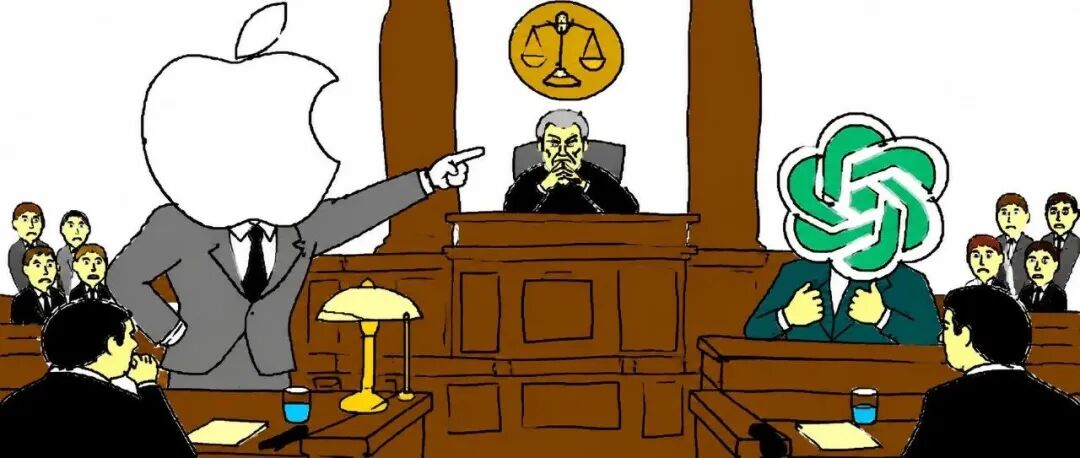
Last month, Apple filed a lawsuit against OpenAI, io Products, and two former employees at the federal court for the Northern District of California, U.S.A.
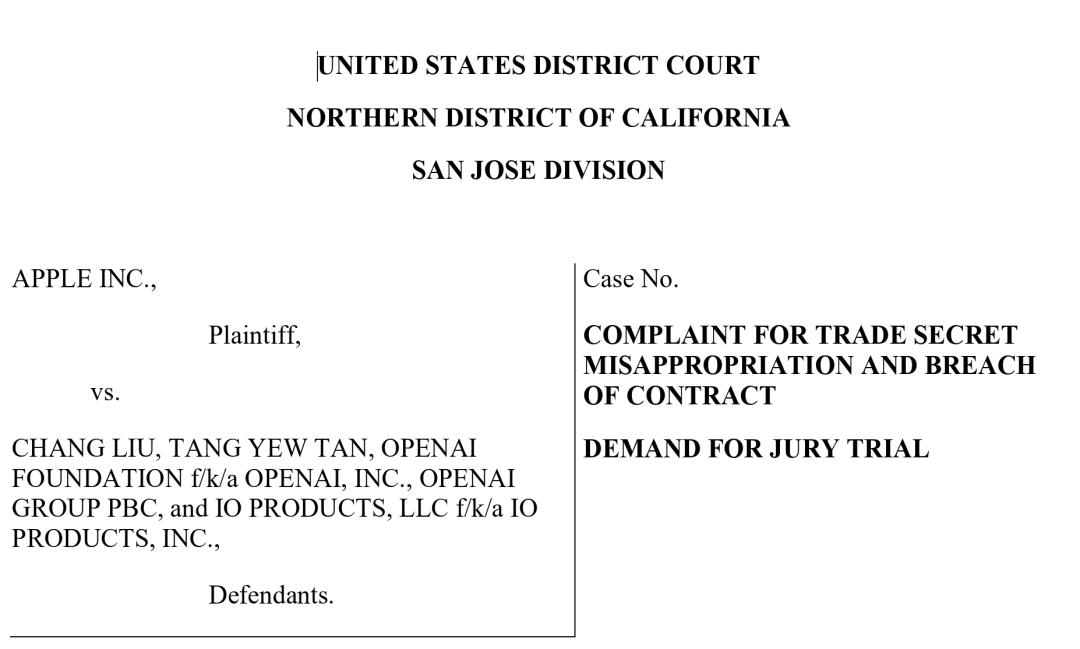
PDF 🔗 https://9to5mac.com/wp-content/uploads/sites/6/2026/07/Apple-Inc.-v.-Liu-et-al.pdf
Engineer Chang Liu worked at Apple for 8 years as a senior systems electrical engineer who participated in iPhone hardware R&D, before he moved to OpenAI in January this year. Apple called him to remind him of his non-disclosure agreement, arranged exit interviews, and urged him to return company devices, but he ignored all of these requests.
The lawsuit documents from Apple mention that after Chang Liu joined OpenAI, he discovered a previously unknown authentication bug in Apple's enterprise systems. Using this loophole, he continued to access the company's cloud storage through the unreturned laptop.
OpenAI even coached Apple employees to bypass exit security checks, asking candidates to bring batteries, logic boards and prototype devices of Apple products.
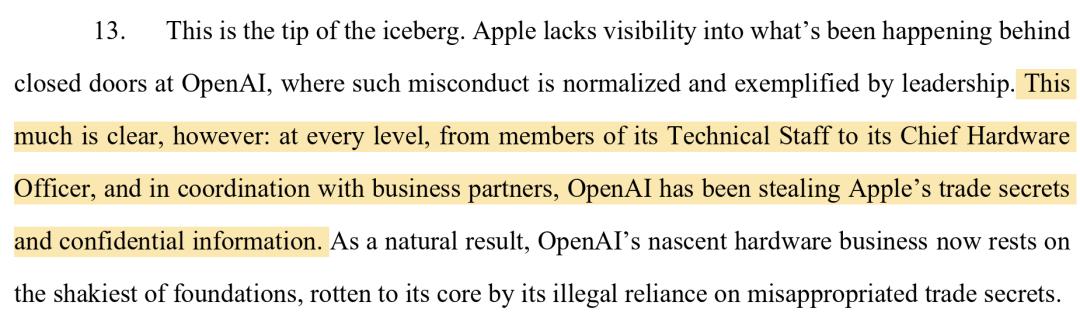
Apple stated bluntly in the complaint that OpenAI is rotten to the core:
"From members of the technical team to the chief hardware officer, and in collaborations with business partners, OpenAI is stealing Apple's trade secrets and confidential information at every level."
The intensity of the wording fully demonstrates how furious Apple is.
However, a twist has emerged. The Information stated in its latest report that the loophole that led to the leak of Apple's data was actually created by Apple itself.
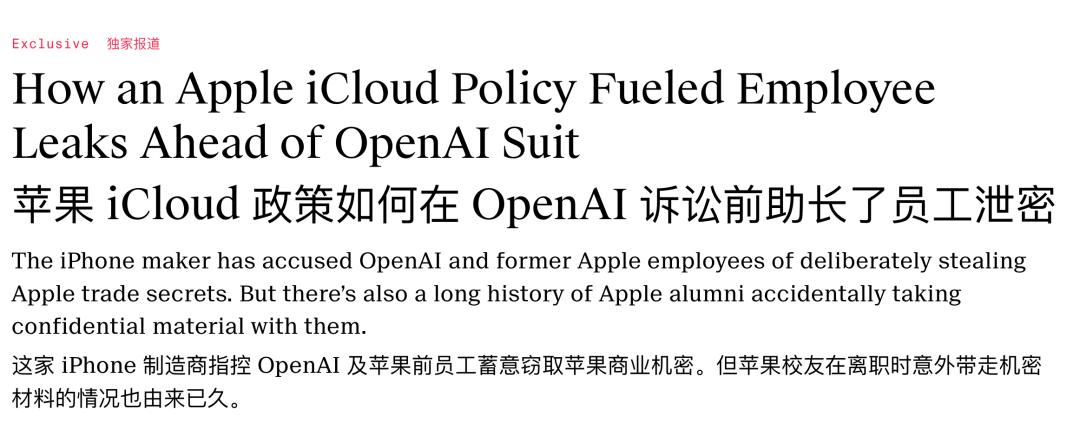
Several former Apple employees revealed that they did not actively search for or copy old data after leaving the company, but Apple's confidential documents still remained in their personal iCloud, and some files were even continuing to sync.
However, Apple has now responded that the behaviors mentioned in the complaint have nothing to do with files shared or stored on iCloud. The company will not sue former employees who accidentally retain internal files in their personal iCloud.
Did OpenAI get those confidential materials entirely through Apple's own negligence?
Apple previously claimed that more than 400 former employees had been poached by OpenAI.
They come from multiple departments including product design, display, antenna, supply chain management, and hardware procurement, which basically forms a fairly complete hardware R&D chain.
Why did these employees still hold Apple's confidential information after leaving the company?
When Apple terminates an employee, the person will be removed from most enterprise systems, but the files they obtained through sharing during their tenure still stay on their personal devices. What is more absurd is that these files continue to sync through iCloud, including planning documents for product launches.
Some people left the company years ago, but they still receive "document updated" notifications from iCloud.
For former employees, they dare not delete these documents easily, as this may draw Apple's attention. How can you prove you did not do it on purpose? They are caught in a dilemma of neither deleting nor keeping, holding the old employer's confidential files like a ticking time bomb.

You may wonder, as such a large company, Apple surely has clear rules requiring all work devices and accounts to be returned after an employee leaves, right? How could it dig such a big pit for itself?
The answer is rather ironic. Apple has always taken pride in "its own people using its own products". All internal collaboration relies on Pages, Keynote, iMessage, and iCloud as the entire Apple ecosystem for collaborative work.
When new employees join, the company provides 2TB of iCloud storage, and then kindly suggests: Would you like to merge this with your existing iCloud plan?
This is where the pit is laid. An iPhone can only log in to one primary Apple ID to unlock all iCloud features at a time. To completely separate work and personal use, you have to carry two iPhones with you at all times.
This is obviously a bit troublesome, so the vast majority of Apple employees simply use their personal Apple ID to log in to the company's iCloud. Personal accounts and company confidential information are thus mixed together.
Apple is not unaware of this problem. It once launched a company-managed "Apple Work" folder specifically for storing work files. When an employee returns their work ID after leaving, the folder disappears automatically, and access to the confidential materials stored in it is revoked.
However, shared files will not all automatically enter the Apple Work folder. A Pages document or a presentation draft, as long as it is saved to other locations, will remain in personal iCloud, mixed with photos, bills and personal life files.
According to reports, the strictness of Apple's exit checks varies from person to person. When an executive leaves, there are usually dedicated staff accompanying them to inspect devices, and confirm that all confidential files have been cleaned up item by item, while the exit process for ordinary employees may be more perfunctory.
This adds more variables to the lawsuit.
The fact that former Apple employees retain company files in their personal iCloud cannot independently prove that they actively stole the data. The files may have been mixed into personal accounts as early as their tenure, and were simply not retrieved by the system after they left.
A similar incident actually happened before. Rivos, a chip company founded in 2021, poached more than 40 employees from Apple.
Even though Rivos had taken precautions in advance, using encrypted Signal for job hopping discussions to bypass iMessage, and storing confidential files properly in the Apple Work folder or the company's Box account, it was still sued by Apple.

One of the employees accused by Apple copied the data to an external hard drive via Time Machine automatic backup, and never even opened those files. In the lawsuit, Rivos also pointed out that Apple's negligence led to the data leak, and they should not be held responsible for the consequences.
The Rivos case was settled in 2024, but the company was severely damaged, and it was never able to poach many people from Apple afterwards. At the end of last year, Meta acquired it for approximately 2 billion US dollars.
Can OpenAI become a rival to Apple?
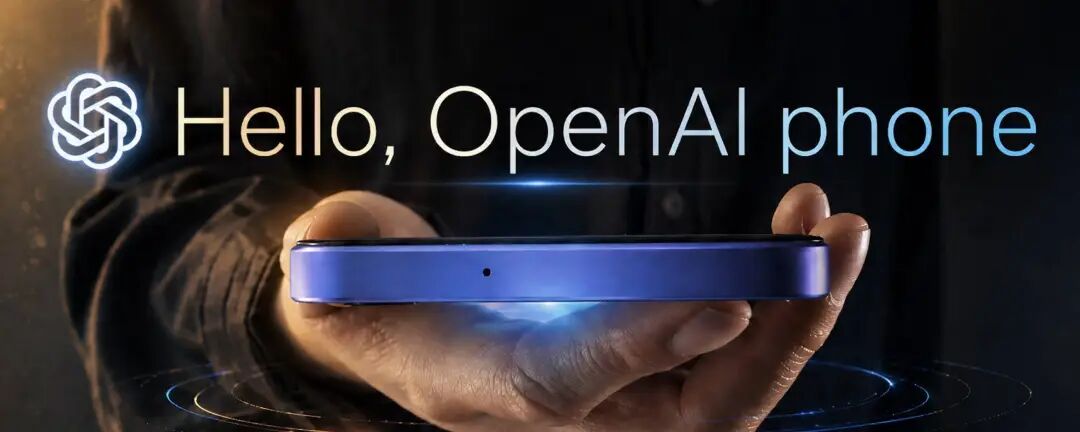
Both Apple and OpenAI are expected to launch a series of AI hardware products next year, including the OpenAI phone that aims to disrupt the App ecosystem.
At WWDC 2024, the two sides were still in a honeymoon period, as ChatGPT was officially integrated into Siri. Sam Altman sat in the audience, and Craig Federighi, Apple's senior vice president of Software Engineering, called OpenAI a "pioneer and market leader" in the AI field on the spot.
At that time, ChatGPT supplemented the large model capabilities that Apple Intelligence urgently needed, and reached more users through the iPhone.
After OpenAI decided to make hardware, its relationship with Apple also changed subtly.
Jony Ive joined OpenAI, Tang Tan left Apple, and io Products was acquired by OpenAI. Together with more than 400 former Apple employees, OpenAI gradually gained capabilities in product design, engineering, supply chain and procurement.

Previously, OpenAI only provided AI services within the iPhone. Now it is designing its own devices, aiming to use new hardware to carry AI assistants. This direction is very likely to directly collide with Apple's core business.
In the lawsuit, Apple demands that OpenAI compensate for losses, destroy all confidential materials, and apply for an injunction. Apple also hopes that OpenAI will redesign its unreleased hardware products to remove all parts that may involve Apple's confidential information.
Apple does not care about the amount of compensation, and directly disrupting OpenAI's hardware progress may be of greater value.
As for whether Apple's confidential data has finally entered OpenAI's product development, the court may not necessarily give an answer quickly. We may need to look for clues in the products released later, and it is expected that this dispute will not last forever.
The falling out between Apple and OpenAI also announces to the whole world that the battle for AI hardware has officially begun.
This article is from WeChat official account "APPSO", written by the team dedicated to discovering tomorrow's products, and published by 36Kr with authorization.