When AI lowers the entry threshold, what can creators count on to deliver that distinct human touch?
Open social media platforms such as Douyin, Bilibili, and Kuaishou, and a large number of AI-generated videos flood into recommendation feeds. Various themes including ancient-style xianxia fantasy, mythical creatures and supernatural tales, and sci-fi mecha are all booming, and the number of creators and content density are also rising rapidly.
But after scrolling for a long time, you can clearly feel that a lot of content has turned into a mass production mode that is "old wine in a new bottle". Similar camera movements and identical settings have already caused audience aesthetic fatigue.
But occasionally, you will be stopped in place by a video, and you will not swipe away even after you finish watching it. In this era of rapid technological development, those content that is not so "perfect" are more likely to make people stop.
For example, Beauty and Ugliness does not pursue extreme image quality, but has gained more than 7 million views with its unique perspective; The Phone has no complicated plot, but makes countless people miss their high school days in the comment section; and there is Beside the Water, its sense of reality even makes people wonder "Is this really shot by AI?"
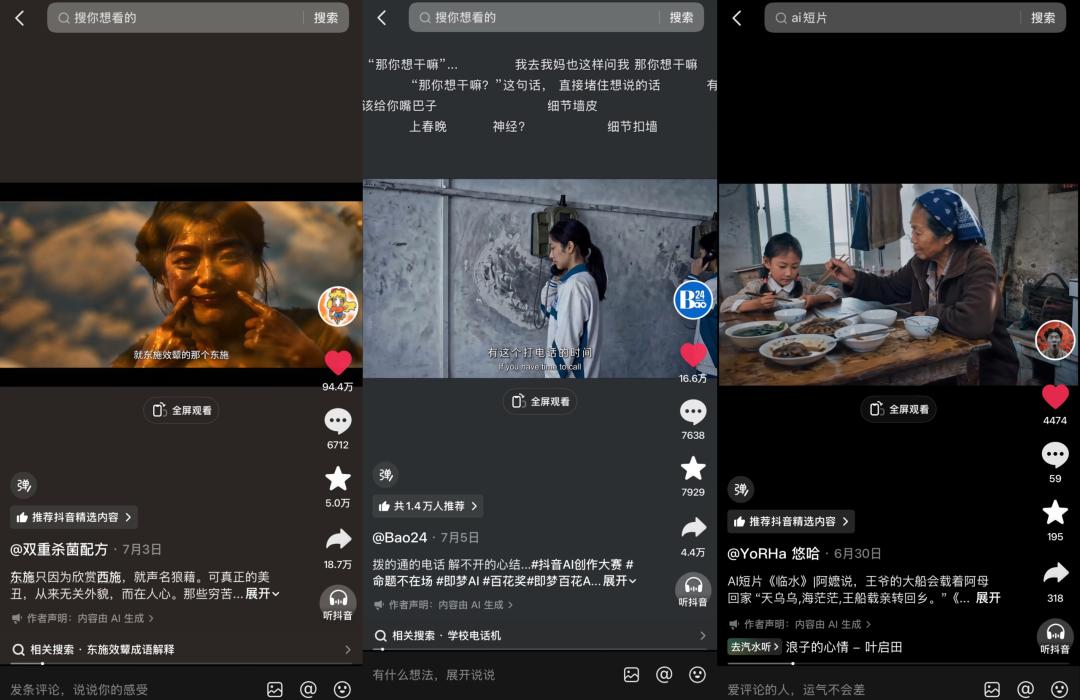
Image source from Douyin
These works may not be the top in technology, but they excel in being full of "human touch".
The threshold for AI creation is lowering, and the anxiety of homogenization is also rising. The real problem is never whether you can use AI, but whether you have something to express? Follow the perspective of "TopKlout" to take a look together.
More AI content brings more "obviously fake" works
AI has lowered the threshold for content creation.
In the past, if one wanted to make a high-quality short film, they either needed money, or a team, or both. Now one person, one computer, and a set of AI tools can generate the visuals that used to require the entire production team to complete.
The opening of this door is a remarkable thing in itself. But problems also follow: a large number of works begin to fall into the same template, with similar composition, filters, and emotional arcs, just like results generated in batches from the same prompt.
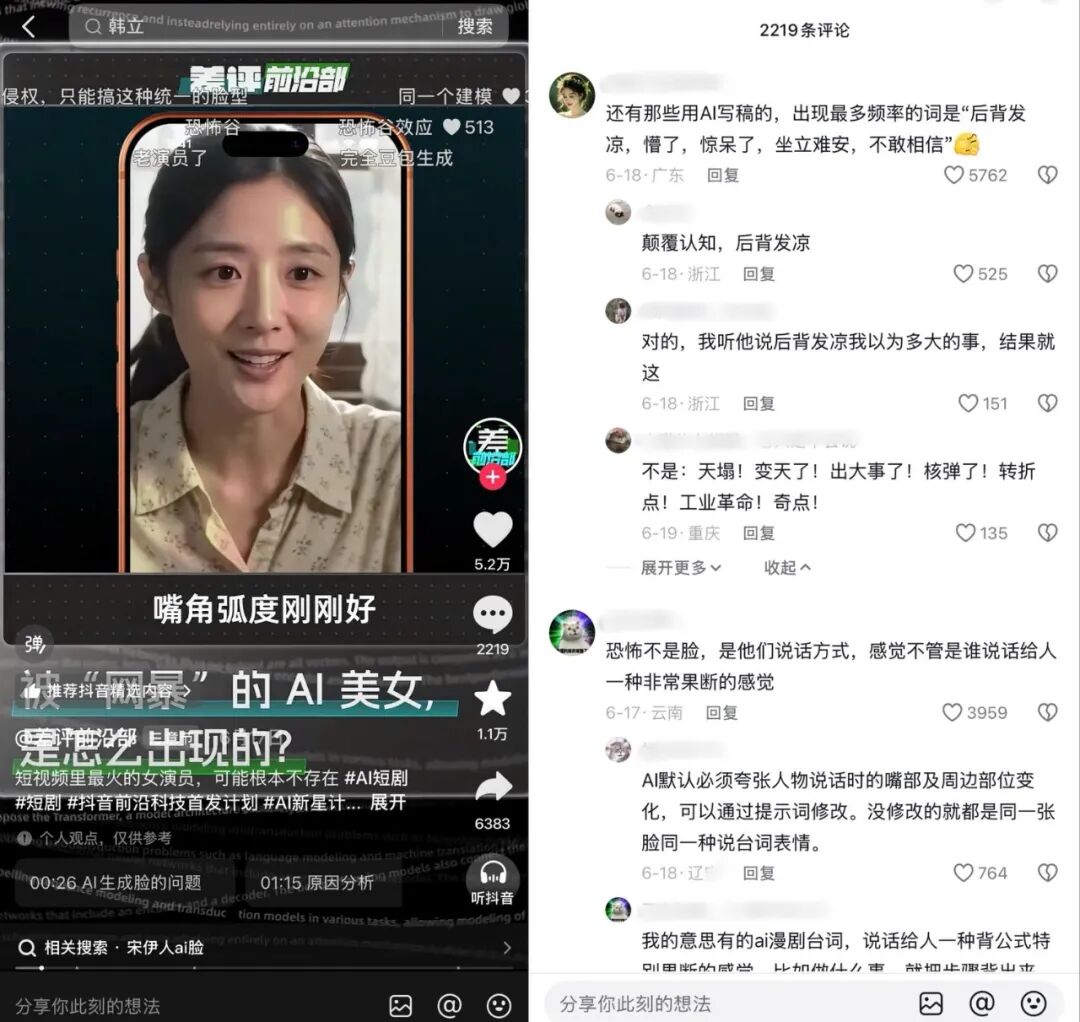
Image source from Douyin
It's not that these contents are not good-looking, after you watch too much of them, you will feel an indescribable sense of "fakeness". This fakeness is not a problem with image quality at all.
The accuracy of AI-generated images has long been up to standard, and the problem lies in the details. The characters in many works seem to have exquisite and flawless faces, but actually lack subtle expression transitions, and the seemingly grand and realistic scenes have no traces of life.
For example, oil stains on the table, folds on clothes, and the real absent-mindedness in the eyes, the lack of these details makes the audience feel subconsciously that the content is fake.
Technology can generate correct images, but it is difficult to generate real ones. Correctness is a matter of parameters, while reality comes from the creator's thoughts, experiences, and understanding.
This is the gap that AI creators need to take the initiative to fill, and it is also the real battlefield for human touch.
So what kind of AI works can be regarded as truly full of human touch? From the perspective of "TopKlout", at least the following conditions need to be met:
First, the visual details are acceptable. Character details, costumes, and scenes are realistic enough to not make the audience break the immersion at first glance;
Second, the emotional reality is credible. Characters have joys, sorrows, anger, and happiness, their personalities are naturally integrated with the plot, and do not look like forced acting;
Third, the emotion in the content is memorable. There is something left after watching, be it a question, an emotion, or a memory.
Only when these conditions are met can the work be regarded as having human touch.
When the story is right, the audience will naturally stay
We have seen some excellent AI short drama works recently, and found that their "human touch" comes from different sources, exerting efforts at three levels.
The first level is not only that the face looks real, but the whole work is truly "lifelike".
This is the most basic level, and many AI content gets stuck at the first step. True "lifelikeness" does not only refer to fine detail depiction and perfect facial proportion, but also has a sense of life, breaks the stereotyped "AI template face", and infinitely approaches the real person that exists in the audience's mind.
The work Beside the Water by @YoRHa Yoha performs very solidly at this level.
The story is set against the background of Minnan nursery rhymes, and the costumes of the characters, the light in the scenes, and the texture of the buildings all carry the rough feeling that exists in real life. There is no deliberate polishing to make everything shiny, and those imperfect details make the audience feel that this world has really existed.
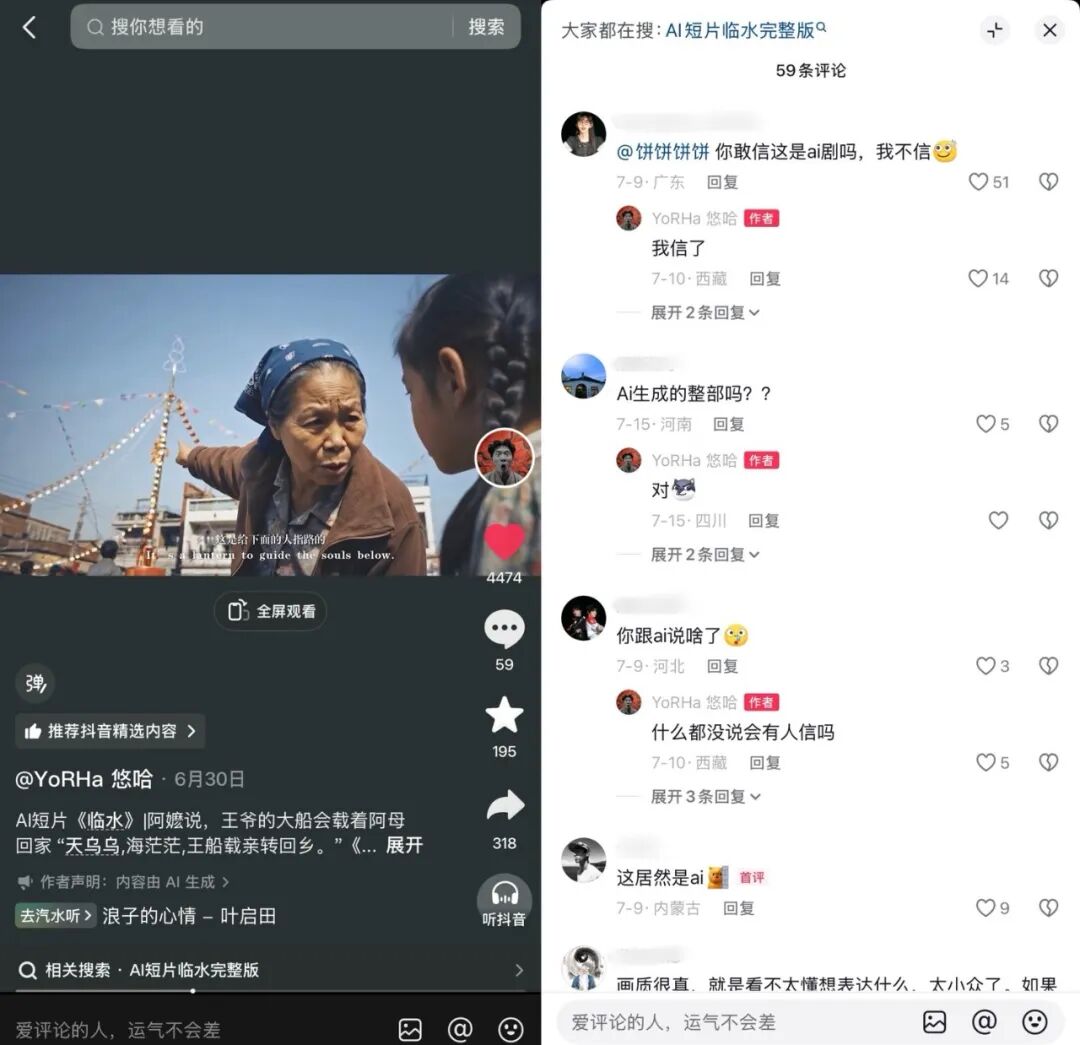
Image source from Douyin
With the comment "Can you believe this is an AI drama?" this work has passed the "lifelikeness" test.
The second level is emotional reality and depth.
What really makes people remember a video is whether the character's personality is integrated naturally with the plot, and whether the emotion is real enough.
The work The Phone by @Bao24 shows exquisite details. The light in the high school corridor, the way the desks are placed, the awkwardness of the character's body when speaking, these things are not generated by AI by default, but are real memories actively "fed" into it by the creator.
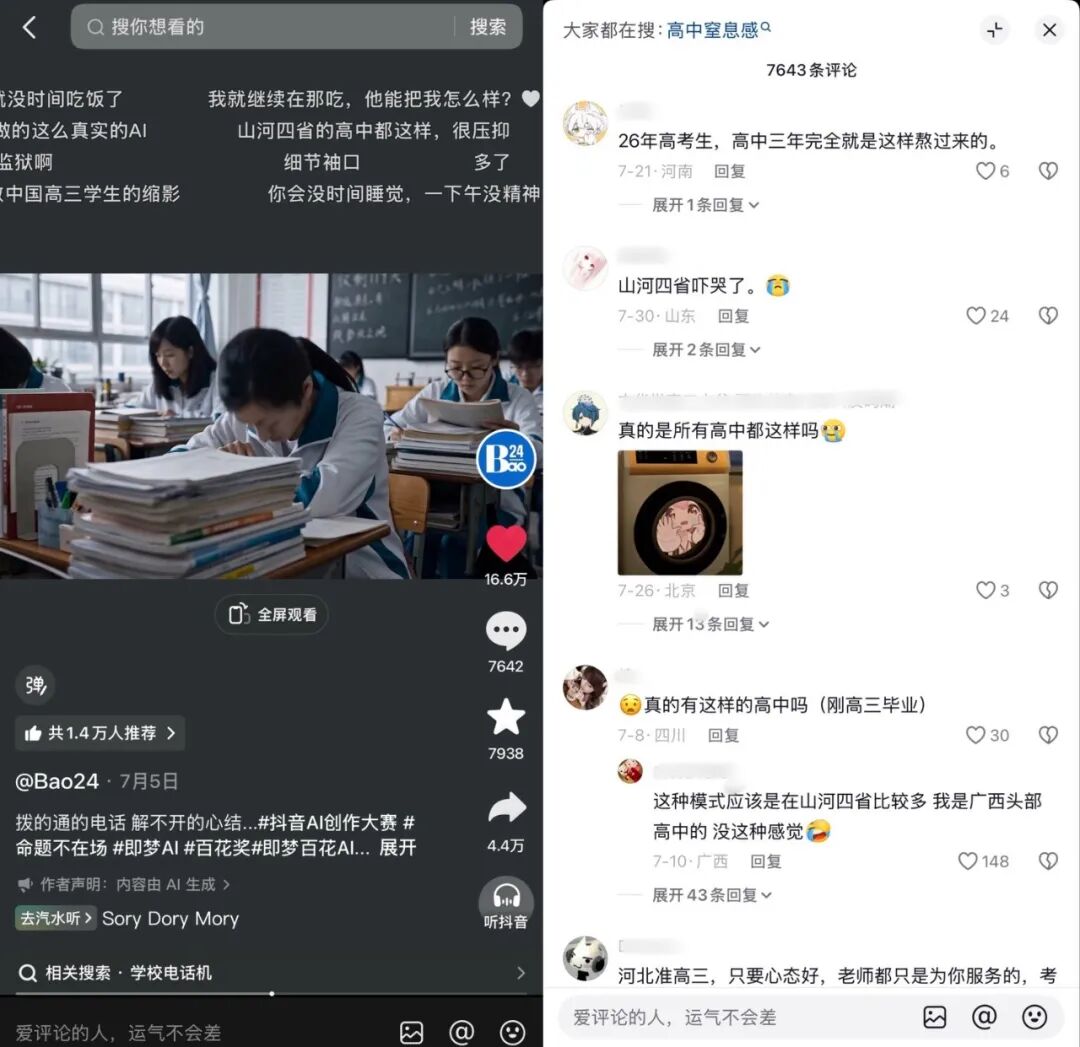
Image source from Douyin
Only when the scenes are accurate, can the audience recognize their own lives in them. Someone commented in the comment section "I went through exactly the same thing". This sentence is the highest recognition for this video.
The third level is that resonance is never triggered by technology, but by the question that strikes right at the heart of people.
The work Beauty and Ugliness by @Double Sterilization Formula leaves something in the audience's mind after they finish watching it.
It rewrites the allusion of "Dongshi imitates Xishi" with AI, but the content it presents is different from what you imagine. It does not stop at the surface story of Dongshi imitating Xishi, but turns the whole incident into a contemporary woman's dilemma of self-gazing.
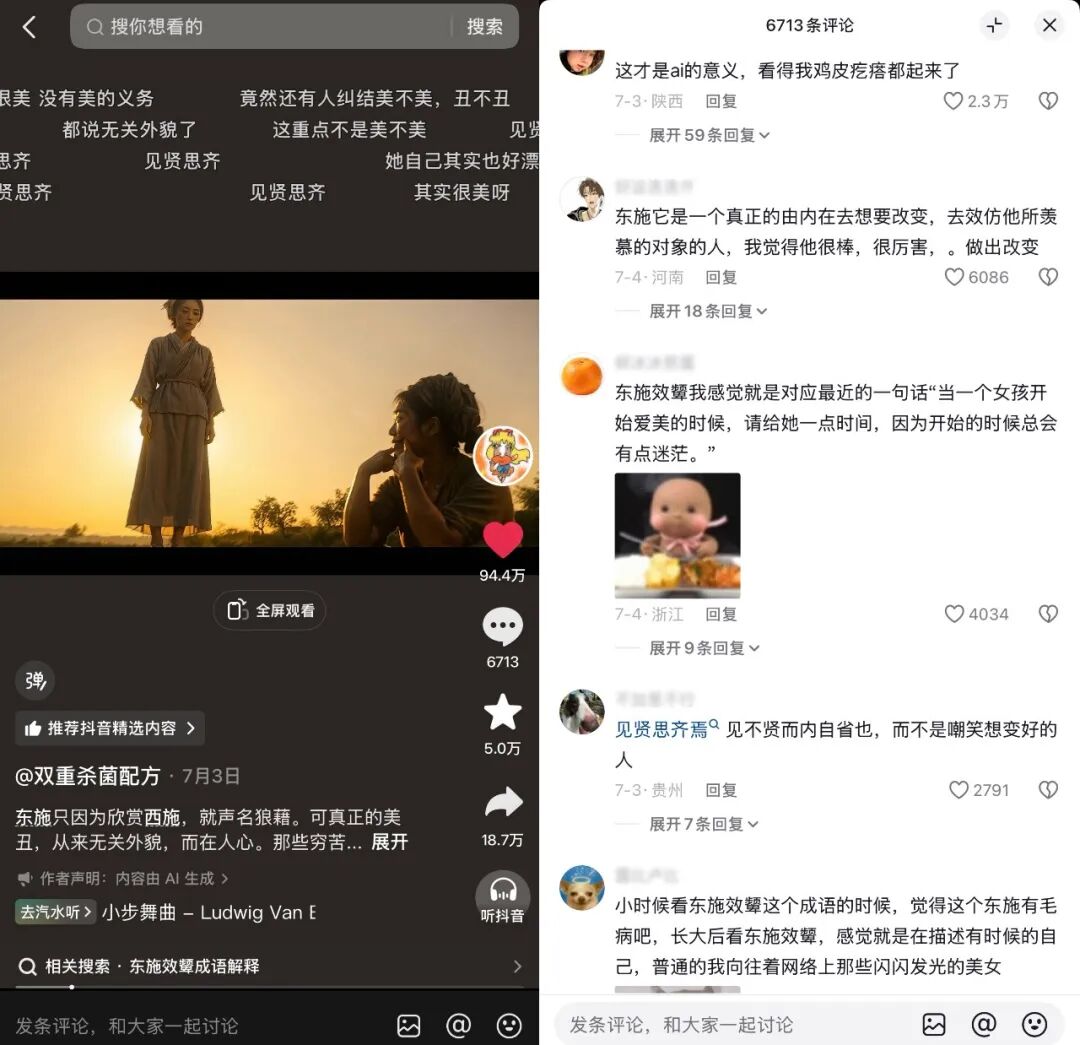
Image source from Douyin
The protagonist's emotions are not single: there is anger, grievance, a moment of wavering, and a certain kind of reconciliation in the end. This complexity is what a real person should be like.
AI is responsible for generating the images, but the layers of emotion are proposed by the creator himself. Behind more than 940,000 likes, the audience sees themselves or people around them in the video.
All truly human-touch AI works are doing the same thing: creators translate their real feelings and judgments into languages that AI can execute.
The tools are the same, but AI cannot replace that translation process.
"Human touch" is not a plus, it is the bottom line
Speaking of which, there is a problem worth discussing seriously: why is human touch so important?
Looking back at the history of content creation, no matter how the carrier changes, from text to movies, from TV to short videos, the common feature of works that can truly last is genuine emotions and real feelings.
What resonates with people is never how exquisite the technology is, but whether there are real people in the story.
This logic also applies to AI content.
The audience's acceptance of AI-generated content is increasing, but their perception of "fakeness" is also improving at the same time. Once the immersion is broken, all subsequent emotional buildup will collapse. Human touch solves exactly this problem of breaking immersion.
The problem for many creators now is that they are still using the thinking of generating content to do the work of creating content.
For example, the prompt is written as "generate a touching scene", and then there is no more information. Creators with real human touch will tell AI specific information such as "this person has been standing in the rain for a long time, his sole is wet, he is not holding an umbrella, and he feels he does not deserve to be taken care of".
The latter is the source of human touch, while the former can only be described as letting AI guess what you want.
Another finding is that a number of AI virtual characters have begun to appear on social platforms, with their own accounts, personal settings, and daily updates, and almost all the content is generated by large models.
AI virtual characters like @Yuri Youli have their own personality tendencies, their own attitudes towards things, and even interact with fans in the comment section, and the replies are also generated by the model.
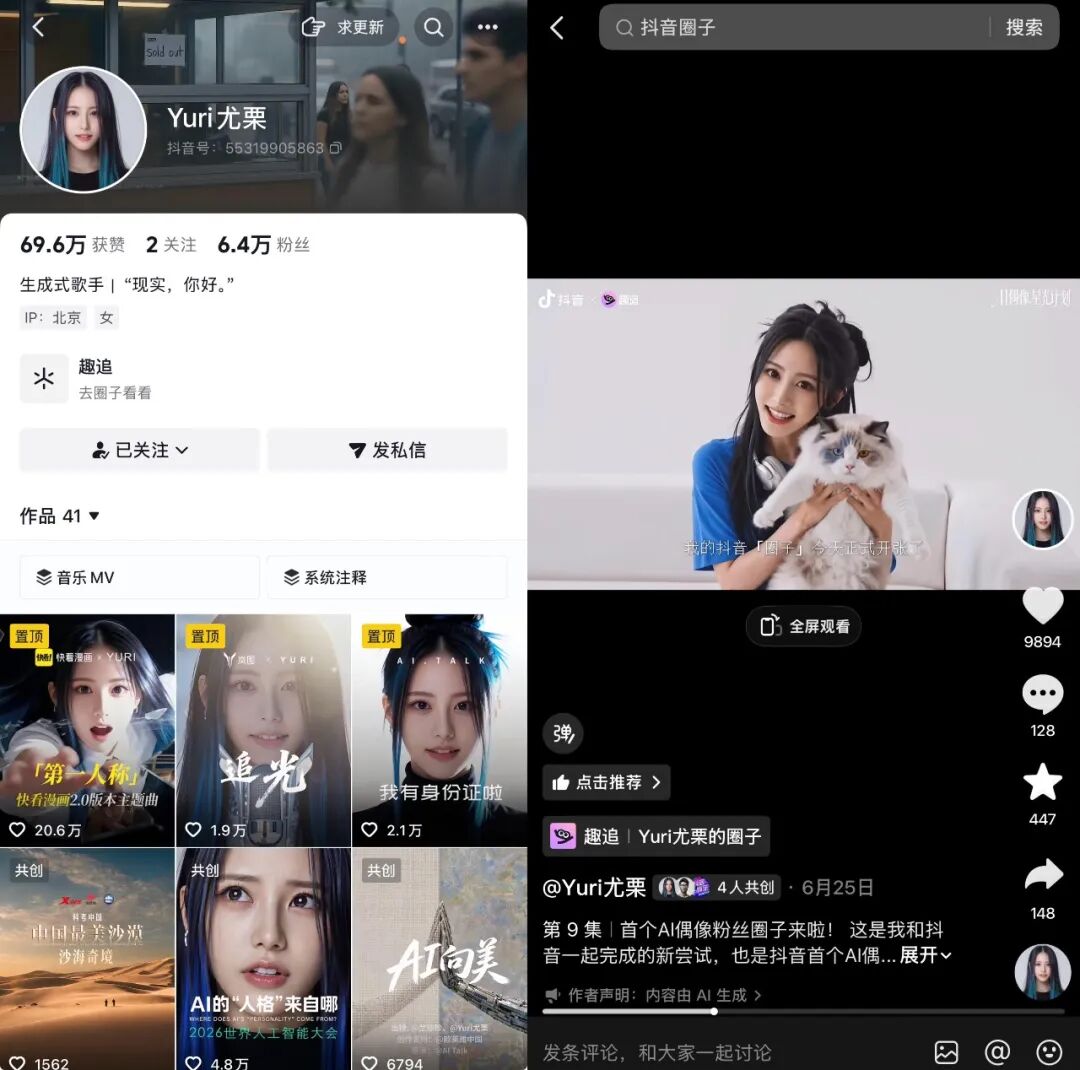
Image source from Douyin
AI is trying to develop "human touch" on its own, instead of waiting for creators to endow it.
As this path develops up to now, the audience's feedback is very honest. For AI virtual characters that can really retain audiences, there are still creators behind them doing the underlying construction of personal setting design and emotional logic. For content that is completely left to the model to generate on its own, people can still perceive the lack of human touch in most cases. Technology is catching up rapidly, but the matter of human touch cannot be completely outsourced at present.
AI is definitely the productivity of the future, this point is certain and definite. It is just the very beginning now, and human touch is the first threshold that must be crossed in the whole process. Only after crossing it can technology give full play to its value.
"Human touch" is the bottom line, not the upper limit. Only after passing this threshold can you be qualified to talk about other things.
Conclusion
AI brings all creators to the same starting line, but what can widen the gap is not whose model is newer, or whose prompt is longer.
The ultimate proposition of AI creation is always "human touch". In the future, those creators who not only understand the tools but also truly have something to express will be the most special existence in the content ecosystem.
What's the AI video you watched recently that made you stop? Welcome to tell us in the comment section~
This article is from WeChat Official Account "TopKlout" (ID: TopKlout), author: Xiaoyang, published by 36Kr with authorization.