How to build a long-term value investment institution
Chen Guangming
Founder of Ray Fund
Over a decade ago, when I first read this book, I felt like I had met a kindred spirit. Back then, we were thinking and exploring: how to build a respected asset management firm? Value investing works effectively in the long run, but it is far easier said than done. We hoped to establish matching mechanisms and culture to provide long-term guarantees for the practice of value investing.
Later, I stumbled upon this book and found that the philosophy of Capital Group in the United States coincided exactly with ours. What's more, they not only put it into practice but also achieved tremendous success. So I studied it repeatedly, recommended it to my colleagues on many occasions, and even held a special in-house reading sharing session for it.
Why build the company into such a system? This is not a random whim, but our long-held belief that the entire company should be built around value investing. Whether it is investment management, product issuance, customer service, talent development, organizational construction, or mechanism and culture, all should take the value investing philosophy as the core, and take maximizing the long-term interests of fund holders as the goal and the starting point of all work. The book Winning for the Long Run tells the full story of Capital Group's development, which is undoubtedly a precious sample.
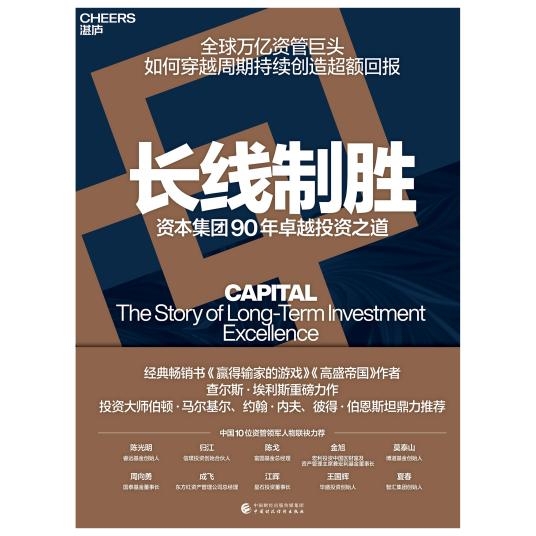
Author: [US] Charles D. Ellis
Translator: FAN Enjie
Publication Date: July 2026
Publisher: Cheers Publishing / China Financial & Economic Publishing House
Looking back, over the years, we have been working hard along this direction. Some goals have been achieved, some are still under exploration, and some have gained deeper understanding. The only reason and purpose for an enterprise to survive for a long time is to create value for customers and contribute to society, and asset management institutions are no exception.
The republication of the Chinese version of Winning for the Long Run comes at an opportune moment. Especially when the asset management industry is stepping into high-quality development, I believe this book can bring readers inspiration and gains, no matter in terms of organizational construction or the practice of long-termism.
The Essence of Enterprise: Achieve Self-success by Benefiting Others
The essence of an enterprise's existence is to achieve its own development by benefiting others. It does not depend on what the enterprise thinks of itself, but on whether customers need and recognize it, and whether the society needs it. If an enterprise is not beneficial to customers and the society, no matter how large it is, it will go bankrupt in a flash. A great enterprise should not only provide excellent products and services for customers, but also try its best to make the world a better place.
The origin of the asset management industry is "being entrusted by others to manage their wealth". These eight words carry a heavy fiduciary responsibility, as well as the ardent expectation of numerous families for a better life in the future.
The essence of financial investment is the process of wealth transferring its user across time. This process has two layers of connotation: first, investors entrust their funds to managers out of trust in their character and capabilities; second, managers invest funds in enterprises out of confidence in these enterprises. Investing in high-quality enterprises with reasonable valuation can not only share their long-term value creation, but also support the development and growth of enterprises, provide better products and services for the society, improve the efficiency of resource allocation, and promote the long-term development of the society.
Investment is a bet on the future. The future is full of uncertainties, and risks go hand in hand with it. Most of the time, past successful experiences are often the foreshadowing of future failures. Time is both a friend and an enemy. If you are on the right path, time is your friend; otherwise, it becomes your enemy. Time is an amplifier, for both good and bad outcomes.
In this process, trust runs through the whole journey. The funds entrusted to us by holders are some of their retirement support, some are reserves for their children's education... This trust is as heavy as a mountain. Therefore, in the asset management industry, fiduciary responsibility is above everything else and determines everything. As managers, we must let customers make real profits in the long run, otherwise we will lose the value of existence.
I have always believed that investing in high-quality enterprises through the philosophy and methods of value investing, helping ordinary people realize their wealth dreams, promoting economic development and social progress, is the meaning of our existence. If Security Analysis is the pioneering and foundational work of value investing philosophy and methods, which systematically explains the core capability of evaluating the intrinsic value of enterprises, then Winning for the Long Run tells the nearly 100-year development story of an asset management institution, fully showing how to carry out organizational construction including strategic selection, talent cultivation, capability building, culture creation, business judgment and mechanism innovation with the goal and starting point of the best interests of investors, so as to create excellent long-term value for numerous customers.
Evolution of Organization: Nurture Talents Internally, Maintain Trust Externally
As an asset management institution, the value of long-term existence is to create long-term returns for customers through its own professional capabilities. Focusing on this long-term goal, what path to choose, what kind of talents to gather, what kind of management to adopt, and what kind of mechanism to implement are undoubtedly the keys to long-term development.
How can an organization better practice value investing in the long run? From a practical perspective, at least four conditions need to be met: first, the professional ability to evaluate the intrinsic value of enterprises, which is the core capability of value investing; second, the belief in adhering to value investing and the courage to firmly implement value investment strategies; third, medium and long-term funds that recognize the value investing philosophy, no matter the regression of market price to value or the self-development of enterprises requires time to precipitate; fourth, the establishment of culture and incentive and restraint mechanisms suitable for value investing as guarantees.
For asset management institutions, the core of operation lies in "nurturing talents internally, maintaining trust externally".
From the law of enterprise development, success mainly comes from four aspects: the right path, excellent talents, appropriate management, and proper incentives.
Specifically, first, the right path. For long-term value investment institutions that choose the path of professional development, "long-term" and "value investing" complement each other and neither can be dispensed with. Value investing must be long-term, otherwise it cannot be fully implemented; long-term orientation is not only suitable for value investing, corporate strategy, talent reserve and other aspects all require long-term consideration and counter-cyclical layout, sowing seeds in the bear market and thinking about exit strategies in the bull market.
Second, excellent talents. As the most typical intelligence-intensive industry, talents are not the most important asset of an asset management company, but the only asset. Real outstanding talents must not only have good professional capabilities and inherent character, but also have values consistent with the company, continuously persist and accumulate experience, and finally become experts in various fields.
Third, appropriate management. It is easy to gather talents, but it is not easy to make these talents serve the whole-heartedly, especially where a large number of outstanding people gather. This is why there are very few companies that can replicate the Capital Group model so far, the reasons of which are partially mentioned in the book. To sum up, the core lies in the differences in values and culture.
As an institution that focuses on talent cultivation, its management model is completely different from the traditional factory assembly line. Capital Group has carried out many positive and useful explorations on how to organize talents effectively, such as decentralized decision-making, freedom of decision-making, equal rights and responsibilities, democratic centralism, openness and transparency, etc.
For example, why implement decentralized decision-making? Capital Group is huge in scale. If decision-making power is concentrated on one person, it is impossible to do a good job in investment, let alone the market is changing rapidly. Of course, decentralized decision-making should be matched with equal responsibilities at the same time. This actually puts forward relatively high requirements for both outstanding talents and management. The book talks about many details, such as talent introduction, talent cultivation, incentive and restraint, etc.
It is worth mentioning that Capital Group's unique multi-manager system is based on long-term accumulation and trust, which is a concentrated expression of this philosophy. Its essence is by no means simply that multiple people manage one fund together, but to generate collective wisdom through institutional design.
Finally, proper incentives. After outstanding talents are organized effectively, incentive and restraint are of vital importance. There is no good or bad incentive, the key is to be correct. All the systems, management and incentive mechanisms of Capital Group fully take into account the thoughts and demands of outstanding people, and the mechanisms are very sophisticated. The society is changing, technology is changing, but human nature remains unchanged. The establishment of mechanisms must fully insight into human nature, especially understand the thoughts and demands of outstanding talents, and empathy is an important principle.
At the same time, belief is also required. Asset management institutions manage the assets of customers, so they must put the interests of customers in the supreme position. Especially when there is a conflict with the interests of customers, they should always take maximizing the long-term interests of customers as the priority. With such a belief, they will truly focus on the long-term interests of customers, and do a good job in the long-term preservation and appreciation of customer assets.
Win in the Long Run: Strive for the Cause, Accept the Outcome as It Comes
How can an institution or an organization go through a long time cycle and continuously create excellent long-term value for customers? Winning for the Long Run tells the story of Capital Group, which reflects the common pursuit of numerous asset management institutions.
In the past hundred years, technological progress and social changes have profoundly changed the way and efficiency of investment, but the essence of business has not changed. Just like whether an enterprise can continuously create long-term value, it ultimately has to return to the fundamental issues such as business model, competition pattern, management, mechanism and culture.
The mission of the asset management industry has always been to create excellent long-term returns for investors. Only by adhering to values and original aspirations, maintaining kindness and altruism, sticking to professionalism and rationality, and keeping awe of the market, can we let customers and the society recognize our own value and significance.
In an era of drastic changes, how to face the uncertainties of the future? Strive for the cause, accept the outcome as it comes. Specifically, first, let go of your own desires, let go of the obsession with your own achievements and enterprise development, and return to the altruistic values and original aspirations. Second, find the direction on the "cause" side and strive for it with all your strength. Third, for short-term outcomes, unsatisfactory results are the norm. Continuous evolution in the long run means that slow is fast. We believe that as long as we work hard enough on the "cause" side, beautiful flowers will bloom for sure. Doing something great while maintaining kindness and altruism should be the original aspiration for all of us.