Is Japan learning from China's Unitree?
In July 2026, a humanoid robot fighting tournament was held in Akihabara, Tokyo.
The official website of the event states: The "Black Ship" of robot fighting is coming. Wake up, Japanese robotics engineers. Take action, Japanese humanoid robots.
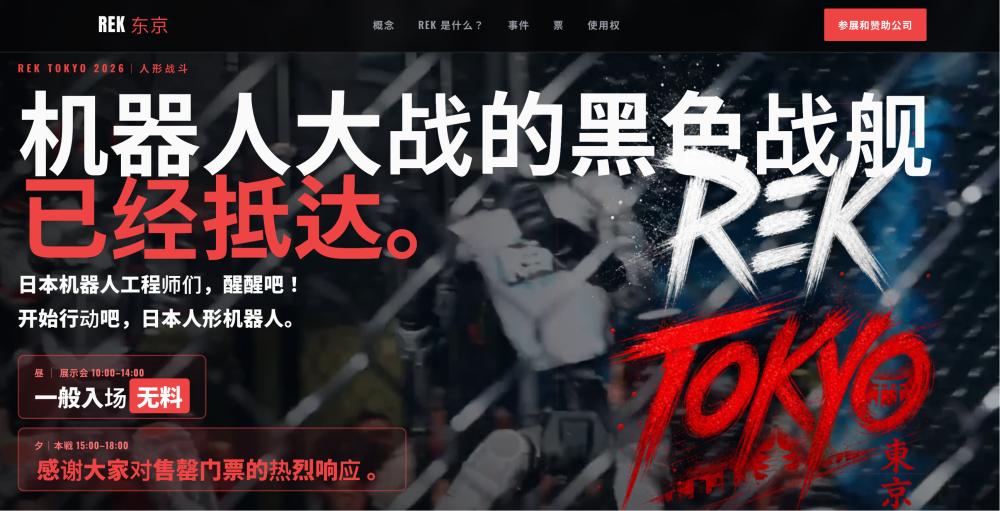
This seems like a call to revitalize Japan's humanoid robot industry, but the main models on the competition arena are not made in Japan, but Unitree G1 from China.
Almost at the same time, Nikkei Cross Tech, a Japanese professional technical media, also organized a systematic teardown of the Unitree G1. From joints, actuators to control systems, Japanese engineers are trying to re-understand the design and manufacturing of humanoid robots, and the research object is also from China.
This scene is somewhat thought-provoking.
Half a century ago, Japan was at the forefront of the humanoid robot wave. From WABOT at Waseda University to Honda ASIMO, Japan once defined the technical route of humanoid robots and sparked global imagination for future robots.
In sharp contrast, Japan, which once led the development of humanoid robots around the world, now uses Chinese robots to hold fighting tournaments and conduct technical teardowns. In the entire international market, Japanese humanoid robots have almost "lost their voice".
Have Japanese humanoid robots really disappeared? What have they been doing all these years?
01 Step out of the spotlight, shift of mindset
Speaking of the originator of humanoid robots, people may naturally think of Atlas from Boston Dynamics in the United States, but in the history of humanoid robots, Japan once occupied an important position.
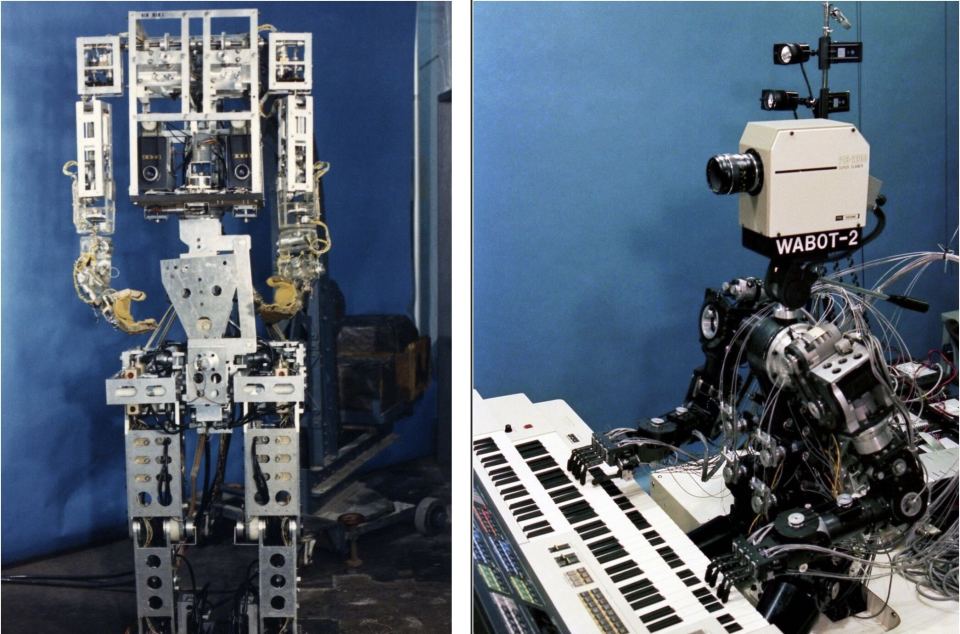
As early as 1973, Waseda University in Japan developed WABOT, the world's first humanoid robot. Later, WABOT-2 evolved to be able to play piano accompaniment with both hands, which once deeply impressed the Emperor Showa of Japan. Entering the 1990s, ASIMO under Honda and Pepper acquired by SoftBank even became the representative works of companion robots.
Regarding the advanced level of Japanese humanoid robots, a robotics industry practitioner recalled that he was deeply impressed when he first saw Toyota's THR-3 stand on one leg under real-time human control and complete a series of complex movements. Such movements not only test the robot's balance and motion control capabilities, but also require the joints of the whole body to respond to the operator's movements quickly and accurately. At that time, the THR-3 demonstrated Toyota's strong technical accumulation in the field of humanoid robots.
However, in today's booming humanoid robot industry, looking around the world, Optimus, Figure and 1X from the United States have become popular, and Unitree and Agibot from China have also risen to fame, while Japan, which set off the earliest, is still outside the spotlight.
The most intuitive feeling is that none of the currently popular humanoid robot models come from Japan, which has a half-century glorious history of humanoid robots. Even today, some of Japan's attempts to revitalize humanoid robots still rely on the presence of Unitree robots from China.
So in the years after the generative AI explosion, haven't Japanese humanoid robots made any moves at all?
The answer is just the opposite. Japan has been very active in recent years.
If we say that from 1973 to 2020, the main story of Japanese humanoid robots was "robots entering households" and "robots accompanying humans", then after 2022, the storyline of Japanese humanoid robots has changed significantly: Instead of depicting an all-powerful general-purpose robot, Japan is more concerned about whether robots can enter a real scenario first and undertake a specific task.
This change is particularly evident in the robots of Kawasaki Heavy Industries.
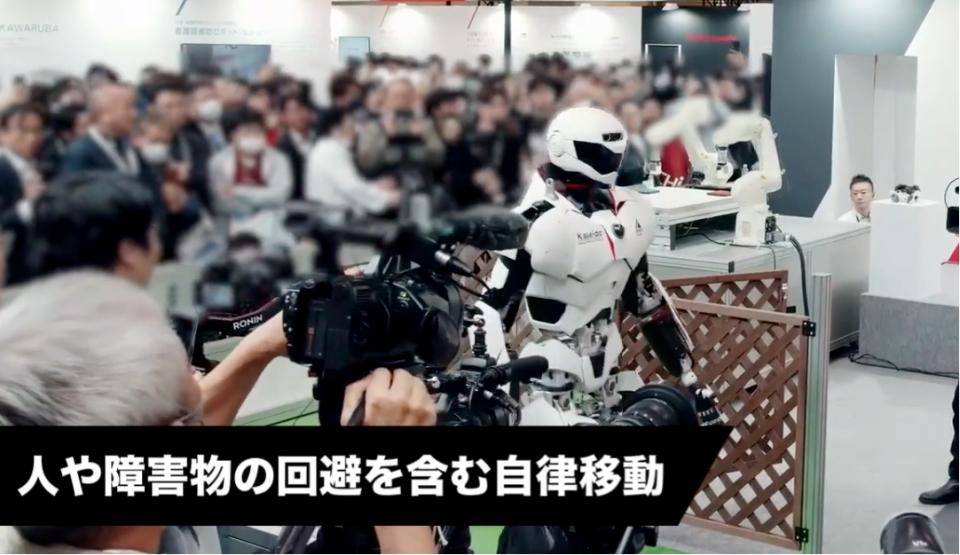
In 2022, Kawasaki launched the 7th-generation Kaleido at the International Robot Exhibition; later it continued to iterate to Kaleido 9. Different from early Japanese humanoid robots that were good at demonstrations of walking, running and interacting with people, the tasks Kawasaki set for Kaleido are very specific: enter disaster sites, clear rubble, transport the wounded, or replace humans to complete high-altitude, dangerous and high-load operations.
In 2026, Kawasaki Heavy Industries showcased its latest Kaleido 9, which can identify pedestrians, obstacles and steps, and adjust its travel route and stride according to the surrounding environment; when its autonomous capability is insufficient, operators can also observe the site in real time through a head-mounted display and take over the robot remotely.
This is very different from the "fully autonomous" and "general-purpose" stories that the global humanoid robot industry is keen on telling nowadays.
Whether it is the currently highly-discussed embodied large models in China, or the wildly popular Figure and 1X in the United States, they all believe that as long as the model is large enough and the data is sufficient, it is only a matter of time before humanoid robots become general-purpose.
But in the view of Kawasaki Heavy Industries, the move of robots to full autonomy should not be a leap, but a long transition. At this stage, Kaleido 9 still retains the remote control and human-machine hybrid operation mode, and operators can directly observe the environment where the robot is located through a head-mounted display and take over its movements in real time.
They have even formulated a 20-year plan: by around 2030, humanoid robots will still be mainly used in controlled environments such as factories, with remote operation as the main mode to assist humans in completing daily operations; by around 2040, it is expected to enter unstructured environments to achieve autonomous movement and continuous environmental understanding; until around 2050, it may truly adapt to various indoor and outdoor environments and flexibly complete different tasks.
This emphasis on scenarios and restraint on generalization capabilities is not limited to Kawasaki Heavy Industries. In 2025, Waseda University in Japan showcased the AI care robot AIREC, which can assist in turning over, nursing, folding clothes and other tasks, targeting Japan's aging market rather than being a general-purpose robot.
This scenario-first mindset has also extended to the field of embodied large models. In 2024, Toyota and Boston Dynamics announced a partnership to deploy Toyota's Large Behavior Model to Atlas, allowing the robot to complete integrated movement and manipulation tasks, which is Japan's most important public move in the humanoid robot AI direction in recent years.
Less than a year later, the two sides unveiled their first batch of achievements: Atlas began to use the same model to uniformly control its legs, torso and arms, continuously completing tasks such as walking, squatting, transporting and sorting, and can independently adjust its movements after the environment is temporarily changed.
Judging from these moves, after the rise of generative AI, Japan is also trying to combine AI to revitalize humanoid robots. However, Japan has learned lessons from the past half century, it does not tell the "general-purpose" story, but focuses more on combining its own national conditions to develop scenarios for disaster relief and elderly care.
Therefore, if we do not measure by public attention, but return to the essence of humanoid robots — what exactly can they do, and can they really be put into practical use — Japanese robotics companies are more accustomed to placing robots in specific scenarios to slowly verify their practical value.
02 Japanese robotics industry starts to catch up
In general, the style of Japanese humanoid robots appears more "conservative" in today's boom.
This caution may partly stem from the fact that Japan has experienced half a century of robot R&D and has its own judgment on technology maturity. How difficult it is for humanoid robots to move from the laboratory to the real world.
After 2010, the development of Japanese humanoid robots gradually cooled down. The most typical sign is that the two most representative Japanese humanoid robots have successively ceased mass production. In 2018, Honda ASIMO was discontinued, and two years later, SoftBank also stopped the production line of Pepper. In the same year, SoftBank sold its controlling stake in Boston Dynamics to the Hyundai Motor Group.
These projects that once pushed Japanese humanoid robots to the forefront of the world ultimately cannot avoid the same problem: after the robot is built, what exactly can it do? And this scenario problem essentially solves the challenge of how robot manufacturers can achieve sustainable profitability.
This problem still has no answer today. Times have changed, and AI has made humanoid robots more useful, adding more weight to their development.
And Japan's current caution has another more practical reason: the real competition of robots is no longer just mechanical capability, but AI capability.
Japan once led the robotics industry by virtue of structural design, materials, sensors and precision manufacturing, but at that time the intelligent bottleneck of robots had not really emerged.
The aforementioned robotics practitioner said, "Japan has been leading for a long time in the past, because at that time the intelligent bottleneck of robots had not really emerged, and its advantages in structural design, materials, sensors and precision manufacturing were sufficient to support competition. However, after 2010, with the rise of deep learning and neural networks, robot competition has gradually shifted to intelligence, and Japan has also begun to disconnect from the development of the industry."
The lag in intelligence is related to Japan's history. In the era of the Internet, cloud computing and software platforms, Japan has not grown enterprises comparable to American tech giants. There is no enterprise similar to China's Baidu, Alibaba, Tencent, or the United States' Amazon, Meta (Facebook), Google. In the year of the generative AI explosion, according to the national artificial intelligence strategy document "AI Strategy 2022" released by the Japanese government, a large number of traditional Japanese companies are still burdened with outdated information systems, and data is scattered in different departments, making it difficult to be directly used for model training.
In other words, due to the long-term lag in history, Japan did not have the infrastructure to support AI development when generative AI arrived, which also affected the development of Japanese humanoid robots.
Japanese robotics companies have realized this problem and begun to concentrate their efforts on catching up.
The first move to catch up is to invest heavily in resources to develop AI models. Noetra, which the government invested more than 380 billion yen in the first year and involves 44 companies including SoftBank, Honda and Sony, is gathering Japanese AI talents to develop basic models for physical AI and robotics; at the same time, the Japanese government is also supporting projects such as wafer foundry Rapidus, trying to make up for its advanced chip capabilities.
Japan's goal is to deploy 10 million AI robots in manufacturing, shipbuilding, nursing and other fields by 2040. In the view of Danba Nobuhiro, CEO of Noetra, this may be Japan's "last chance" to regain key technologies.
The second major move to catch up is to build momentum in the robotics field and learn from foreign countries. For example, in July this year, Japanese players and engineers used modified Unitree G1 for remote-controlled fighting. This has a symbolic meaning: Japan was once an exporter of entertainment and competitive humanoid robots, but now it is starting to use China's mass-produced platforms for secondary development and competitions.
In May this year, the Humanoids Summit came to Asia for the first time and was held in Tokyo. Japan showcased its robots intensively at this summit. At the same time, robots from China and the United States were also present. For Japan, this is not only a showcase, but also a close-up learning opportunity.
Japan is rekindling the robot boom, only this time part of the spark comes from China.
03 Conclusion
Half a century ago, Japan once defined humanoid robots; half a century later, Japan began to teardown humanoid robots from China.
Today, on the stage, is the Unitree G1 from China; under the stage, are Japanese engineers who come to observe, modify and learn. During the competition, they watch the Chinese robot punch, dodge, and stand up again after falling; outside the competition, they disassemble the Chinese robot layer by layer, studying how the joints rotate, how the actuators exert force, and how the control system keeps the body balanced.
This time, what Japan has to catch up with is not just a product, but an era that is about to be missed.
Japan's experience is also worthy of our reference. Half a century ago, it was the enthusiasm that temporarily ignored scenarios and returns that gave birth to WABOT and ASIMO, and brought humanoid robots to the world; but enthusiasm cannot replace practical use after all. When robots cannot find real demand for them for a long time, even the most dazzling start can hardly support a long industrial path alone.
*Reference: "A Brief History of Humanoid Robots" (China Machine Press, expected to be published in mid-August)
This article is from "Tencent Tech", author: Xiao Yan, editor: Xu Qingyang, published with authorization from 36Kr.