After capturing 40% of the user time share, ByteDance is poised to shift to a new monetization model.
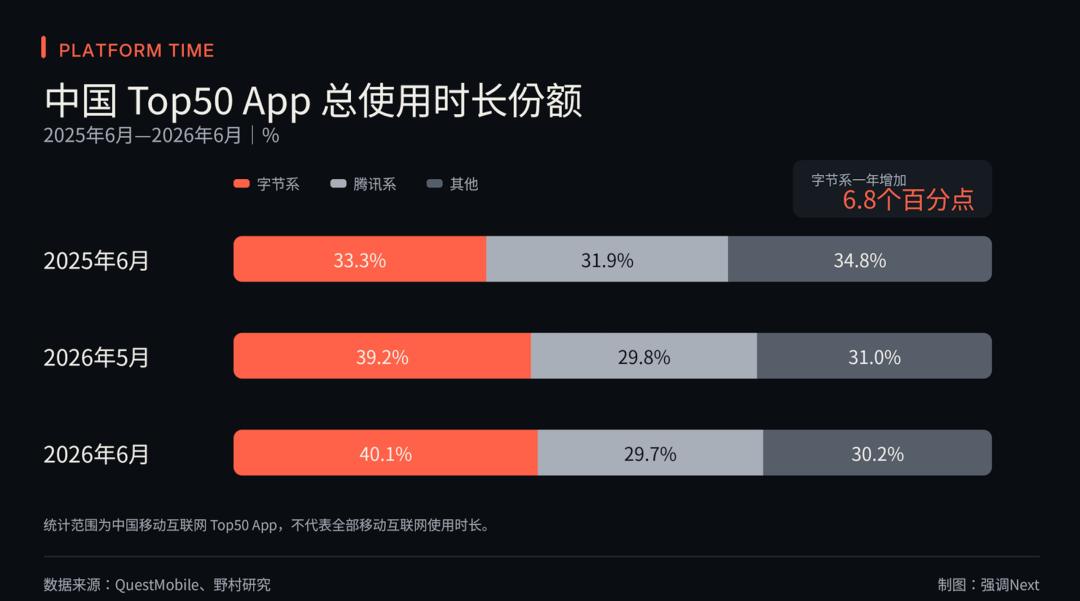
According to data from QuestMobile, in June 2026, the share of ByteDance ecosystem in the total usage time of China's top 50 apps rose to 40.1%, while that of Tencent ecosystem stood at 29.7%. A year earlier, the two figures were 33.3% and 31.9% respectively. ByteDance gained 6.8 percentage points in a year, while Tencent lost 2.2 percentage points, widening the gap from 1.4 percentage points to 10.4 percentage points.
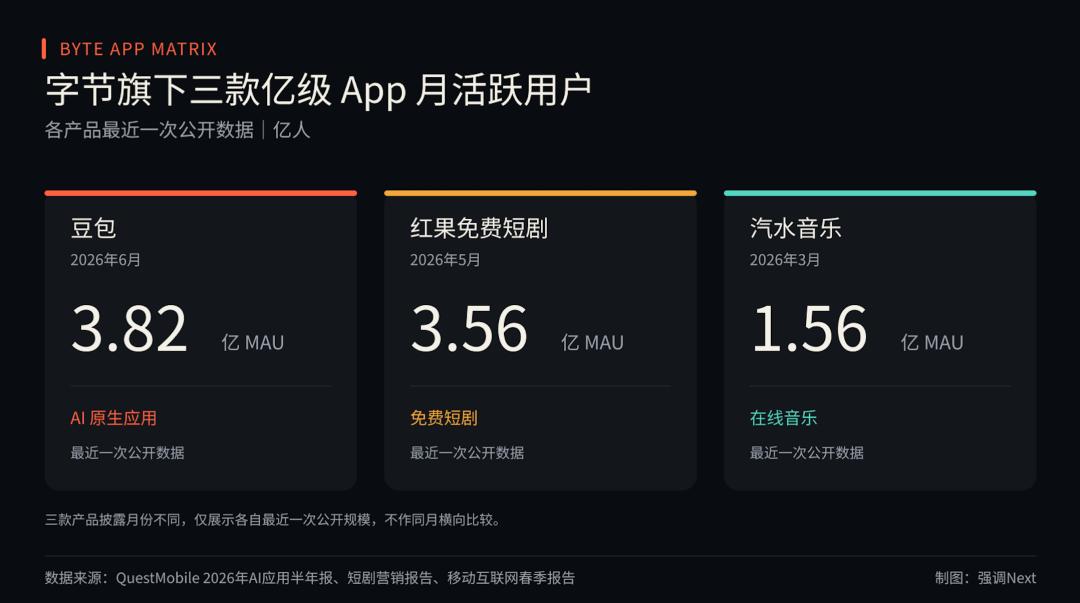
Besides Douyin, ByteDance already has three other apps with over 100 million monthly active users. Doubao hit 382 million MAUs in June, Hongguo Free Short Drama recorded 356 million MAUs in May, and Qishui Music reached 156 million MAUs in March, surpassing NetEase Cloud Music for the first time. All three products are expanding users' time spent on ByteDance's ecosystem, but they operate on completely different financial models.
Hongguo mainly relies on advertising, while Qishui Music generates revenue from both ads and memberships. Every extra episode users watch and every extra song they listen to brings the platform one more opportunity for ad display or membership conversion. Every time Doubao completes a Q&A, image generation or computer operation, it consumes computing power. It pursues task completion as quickly as possible, meaning the less time users stay on the product, the better the product may perform.
Doubao has changed ByteDance's previous revenue logic. Douyin, Hongguo and Qishui Music compete for users' time first, then sell ad inventory. Doubao needs to deliver results first before it can charge subscription fees, enterprise API call fees or transaction commissions.
01. Free content continues to drive usage time growth
The newly increased usage time of ByteDance mainly comes from the free content consumption trend.
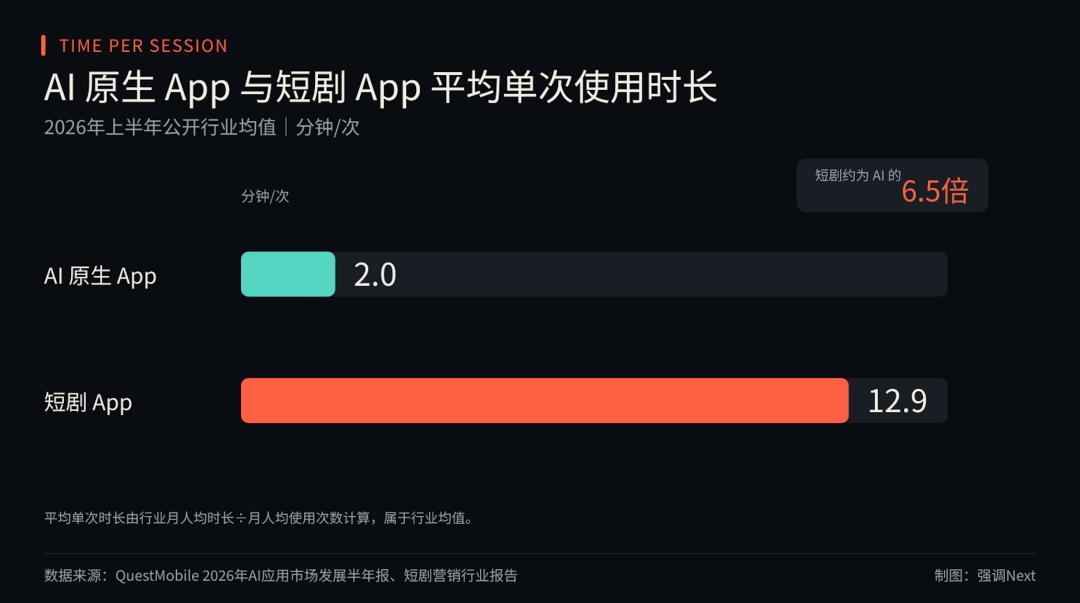
As of May 2026, the unique user scale of the short drama industry has reached 851 million, among which short drama apps have 402 million users, a year-on-year increase of 77.1%. Hongguo Free Short Drama has 356 million MAUs, up 79.1% year on year. Short drama apps see an average of 125.6 uses and 26.9 hours per user per month, with each use lasting about 12.9 minutes on average.
Hongguo has lowered the payment threshold for short dramas to nearly zero, and recoups content costs through recommendation feeds, incentive systems and advertisements. From January to May 2026, the top 5 newly launched short dramas all recorded over 290 million views, and the most popular one *Zhao Fengsheng in Old Street* reached 527 million views. Free access does not mean low-cost content. The platform still needs to cover copyright procurement costs, production revenue sharing and user incentives. Its advantage lies in the mature advertising system, which can quickly add commercial inventory after traffic scales up.
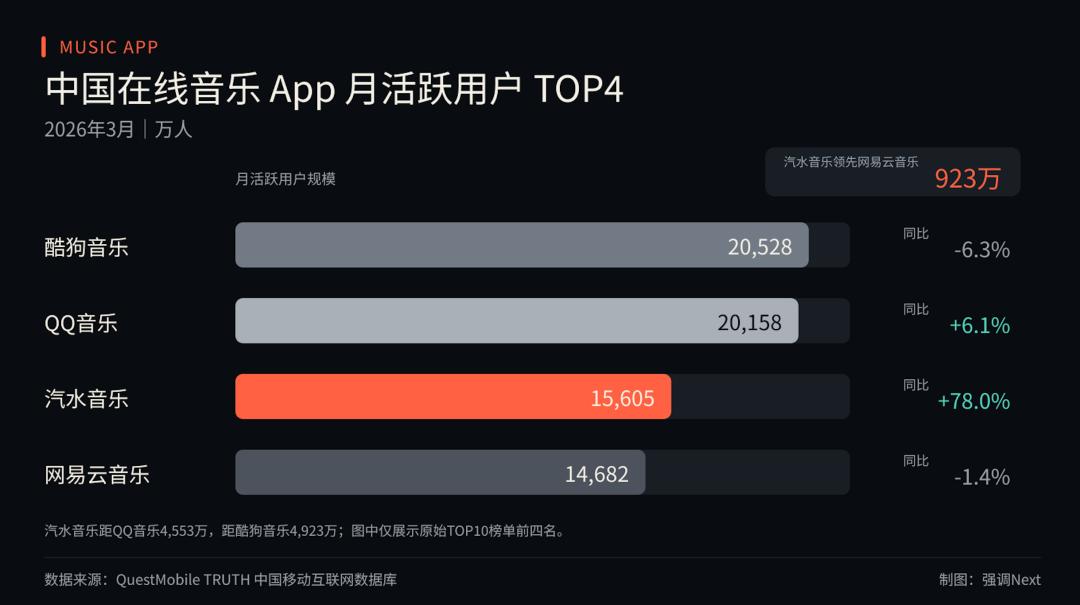
Qishui Music adopts a similar customer acquisition method, but retains membership revenue. In March 2026, its MAUs reached 156 million, up 78% year on year, surpassing NetEase Cloud Music's 147 million and ranking third in the industry. Over the same period, Kugou Music and QQ Music had 205 million and 201 million MAUs respectively, and the gap between Qishui Music and the top platforms has narrowed to about 50 million.
Hongguo and Qishui Music are operating in two different markets, but they share the same set of infrastructure: Douyin traffic diversion, algorithmic recommendation, ad sales, user acquisition, content moderation and creator settlement.
If existing platforms continue to increase membership revenue, they will lose price-sensitive users. If they expand free content offerings, they will have to sacrifice existing subscription revenue. ByteDance uses ad revenue to support free content supply, pulling long-form video and music platforms into the price range it is more familiar with.
02. Monetization efficiency does not necessarily grow synchronously
The 40.1% share is calculated based on the total usage time of China's top 50 apps, not the total time spent on all mobile internet. It does not distinguish between usage time for chatting, short dramas, music, shopping and AI Q&A. One minute is exactly the same in the statistical table, but not equivalent in financial statements.
The share of Tencent ecosystem in the top 50 app usage time dropped from 31.9% in June 2025 to 29.7% in June 2026. As of the latest disclosure for the first quarter of 2026, Tencent's marketing service revenue still increased by 20% year on year to 38.2 billion yuan. The company attributed the growth to improved ad recommendation efficiency, closed-loop marketing within WeChat and higher ad unit prices. Over the same period, the usage time of Video Account increased by more than 20% year on year, and the growth of transaction volume of WeChat Mini Stores also drove revenue from merchant technical service fees.
Tencent's data shows that total usage time and ad revenue will not change proportionally, and the core still depends on business model and monetization efficiency. Payments, mini-program transactions and ad clicks in WeChat, one short drama episode on Hongguo, and one free song on Qishui Music all contribute to usage time, but the corresponding ad prices, transaction commissions and willingness to pay may vary greatly.
ByteDance has not disclosed the revenue of Hongguo and Qishui Music, nor has it announced the ad revenue per unit of usage time for its domestic products. Existing data can only confirm the increase of inventory, but cannot confirm whether these newly added usage time has the same monetization efficiency as Douyin.
However, Hongguo has started to develop e-commerce business, which shows that it is not easy to monetize 356 million MAUs only through advertising. Too many ads will interrupt viewing, and integrating in-drama same-style products and a mall is to increase transaction revenue. However, Hongguo does not have the mature live-streaming e-commerce scenario of Douyin, and whether it can steadily convert users' interest in watching dramas into transactions still depends on repurchase rate and customer unit price.
The user structure of short drama apps is also different from that of mainstream video platforms: users born in the 1970s and 1980s account for 47.2%, and users from tier 2 to tier 4 cities account for 63.1%. This group of users expands Hongguo's coverage, and its ad value still depends on actual conversion rate and cost per thousand impressions.
To judge how much the 6.8 percentage points of usage time growth ByteDance achieved this year is worth, we need to see whether its domestic ad revenue, ad unit price and average revenue per user can keep up with the expansion of usage time.
03. Doubao sells quota first
Doubao can no longer use the pricing method of content apps.
QuestMobile's H1 report shows that in June 2026, the MAUs of native AI apps reached 499 million, up 85.4% year on year. Each user uses these apps 92.7 times for 183 minutes per month on average. Calculated based on the industry average, each use lasts for about 2 minutes, which is only 1/6 of that of short drama apps. The more time the AI assistant saves, the higher the product value may be. If ads are still sold based on users' dwell time, product efficiency will conflict with platform revenue.
Doubao's scale continues to expand. It had 382 million MAUs in June, an increase of 13.78 million from May and a year-on-year increase of 172.1%, ranking first among native AI apps in China. Its professional version was launched on June 24, and the app side still maintained month-on-month growth in the same month, with no obvious user loss observed at least for now. However, new users do not equal new paying users, and Doubao has not announced the number of subscribers, payment rate and renewal rate.
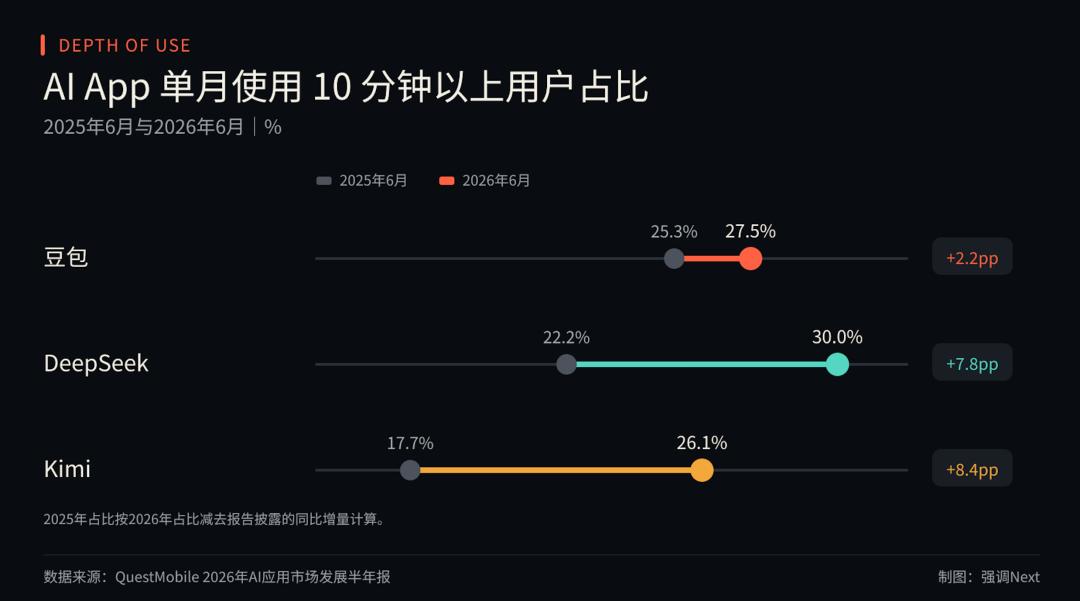
In-depth usage data can better illustrate the situation. In June, users who used Doubao for more than 10 minutes per month accounted for 27.5%, with a year-on-year increase of only 2.2 percentage points. The figures for DeepSeek and Kimi were 30.0% and 26.1% respectively, with a year-on-year increase of 7.8 and 8.4 percentage points. Doubao has the largest coverage, but its growth in user usage depth is weaker than its two competitors. For a product that has just started selling productivity quotas, this will directly affect subscription conversion.
Doubao Professional Edition has three tiers priced at 68 yuan, 200 yuan and 500 yuan respectively, with paid privileges mainly including higher access to expert mode and more office task quotas. Basic Q&A remains free, while complex tasks, long-time execution and high computing power consumption are reserved for paid users. The charging item has changed from dwell time to model calls and task delivery, and integrating Feishu into Doubao is exactly one of the moves under this logic.
Subscription business needs to improve renewal rates, enterprise services need to build sales and delivery teams, and e-commerce commission business needs to complete the process from question answering to order placement. All three revenue lines grow slower than adding feed stream ads, and Douyin's existing ad system cannot help Doubao complete these processes.
The formation speed of these revenues is slower than user growth. There were reports at the end of 2025 that ByteDance's preliminary capital expenditure plan for 2026 was 160 billion yuan. In May 2026, some media reported that the budget had been raised to over 200 billion yuan. Neither figure has been confirmed by ByteDance, but the investment direction is clear: Doubao's user scale requires more chips and data centers to support.
04. After 40% of total usage time
ByteDance ecosystem's share of usage time exceeding 40% means it is still expanding its control over users' time. Hongguo and Qishui Music also prove that the distribution, user acquisition and advertising capabilities accumulated by Douyin can be migrated to short drama and music businesses.
However, when migrating to Doubao, this set of methods begins to fail. Native AI apps have only 183 minutes of average monthly usage time per user, but they have to continuously bear inference costs. The larger the user scale, the higher the cost of free services. If Doubao cannot increase its payment rate, enterprise call revenue or transaction conversion rate, its 382 million MAUs will first turn into a larger computing power bill.
Integrating Feishu into Doubao means ByteDance is placing more revenue hopes on office and enterprise users.
To evaluate ByteDance's new products in the future, we need to analyze them separately. For Hongguo and Qishui Music, we focus on revenue per unit of usage time, content cost and ad price. For Doubao, we focus on payment rate, renewal rate, cost per single task and enterprise revenue. This is also the fundamental difference between internet products and native AI products.
ByteDance has already obtained the largest amount of users' time. Next, it needs to make users pay for the time they save.
This article is from WeChat Official Account "Emphasis Next" (ID: leo89203898), written by Qingyun, edited by Xiaobai, and authorized for release by 36Kr.