Books authored by AI have sneaked into offline bookstores, "the manuscripts are so flawlessly neat that it is somewhat startling"
Today's AI is no longer just a collaboration tool, it has even become a "ghostwriter". Not only in the field of online literature, but also a large number of content generated by AI has emerged in traditional publishing houses. Moreover, AI-generated content is "evolving" and not as easy to identify as before, which increases the difficulty of screening.
For readers, they don't want everything to be done by AI. "The involvement of AI may make the content of books more perfect, but at the same time it blurs the author's unique perception signals about the world."
"Make no attempt to hide traces of AI" "Who on earth allowed this kind of AI-generated rubbish to be published?"
Recently, the social science book Fandom Documentary: Love, Data and Power was criticized by readers for a large amount of AI-generated content. At present, the book's rating on Douban has dropped to 5.3 points, and a large number of negative reviews have flooded into the comment section.
Some readers pointed out that there are a large number of meaningless rhetoric and awkward expressions in the book that are suspected to be AI-generated, for example: "This cognitive gap is just like the conversation between deep-sea fish and flying birds — the former guards the faint light in high-pressure darkness, while the latter under the clear sky can never imagine the weight of that light" "Through three dimensions, they build a fortress to resist the alienated loneliness brick by brick in the gap where virtuality and reality are intertwined."
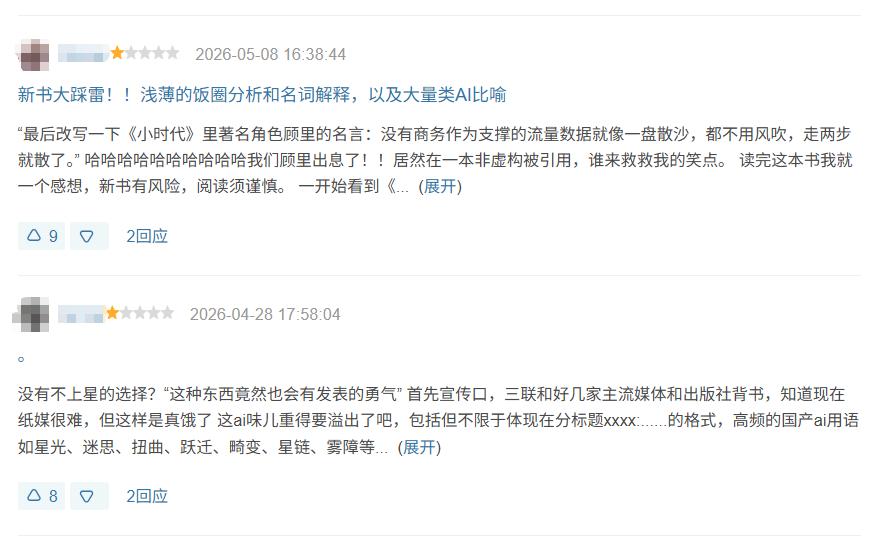
Screenshot of Douban comment section. (Image from Douban)
Facing the controversy, Ma Zhonghong, the first author of the book, replied to the media: "To be honest, we never used AI to write the book." She said different readers have different sensitivity to words, and if some readers think there are traces of AI, she does not deny readers' feelings, but there is no need to clarify the fact. "Our entire research took 5 years. We have done so many field investigations, and I believe that anyone who has read this book will have their own judgment."
But some people frankly admitted that they used AI in their writing. According to the report from Longgang Media of Shenzhen, science fiction writer Hao Jingfang said in an interview that AI writing accounts for half of her children's science fiction novel Galaxy Academy. She also said that the editors of the publishing house kept praising her for writing well this year, and readers could not tell which parts were written by AI at all. This incident has once again aroused widespread public discussion on AI-written books.
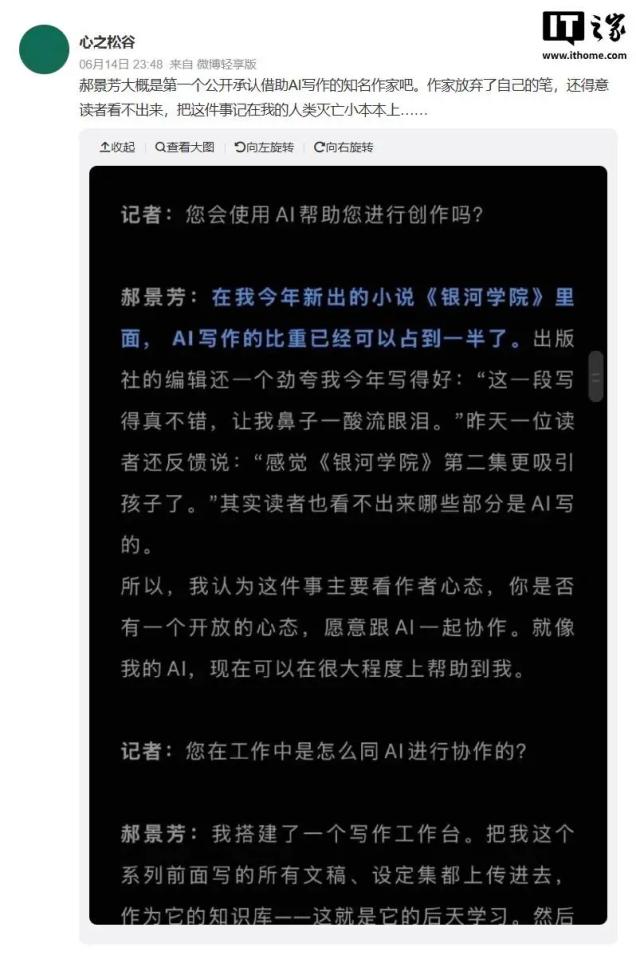
Hao Jingfang in an interview with the media, believing that AI can collaborate with authors. (Image from the Internet)
Some authors clearly pointed out the shortcomings of AI writing. Writer Liu Liangcheng once published an article pointing out that many AI-generated texts signed with his name are circulating on the Internet, and many readers can hardly identify them because AI refers to his language style. But Liu Liangcheng believes that the words produced by AI are fictions of fictions, separated from the real world by several layers. "My words come from the real world I have touched. AI has only touched my words."
Many readers said they cannot accept books created by AI. A netizen wrote that reality is more important than perfection. A book itself is the author's real feedback to the world, and the author's own limitations and shortcomings can also reflect a lot of things. "The involvement of AI may make the content of books more perfect, but at the same time it blurs the author's unique perception signals about the world."
With the increasing popularity of AI technology, it seems that there is not much point in arguing about whether AI is right or wrong. AI's intervention in the publishing industry has become an irreversible trend.
AI Makes Low-quality Manuscripts More Deceptive
When reviewing manuscripts submitted to the department, editor Wushan found a manuscript that made him feel rather strange. The first author of the manuscript is a professor from a top university, and the content is a research project led by the professor and his team. The whole manuscript has a complete framework and fluent writing. He read nearly half of it and found no typos or illogical sentences that can be spotted at a glance. "The manuscript is so neat that it is a little scary." Wushan believes that this situation is very rare.
In daily work, the vast majority of manuscripts Wushan contacts have different degrees of errors and deficiencies in the initial draft stage, and manuscripts with such high completion are rare. But apart from that, there are no impressive viewpoints, descriptions or even sentences in the manuscript, and the conclusions drawn are mostly universally applicable platitudes.
(Image from The Washington Post)
"The manuscript is very neat, but there is no uniqueness in terms of the research process and conclusions, no refreshing or eye-catching viewpoints, and this situation is extremely common." On the one hand, the sentences are rarely smooth, on the other hand, the viewpoints are commonly mediocre. The two characteristics appear in the same manuscript at the same time, which makes Wushan quite confused.
Confused, based on his previous work experience of handling similar manuscripts, Wushan put the manuscript into an online paper plagiarism checking system for detection. The test results showed that the total index of "suspected AI generation" reached 60%, and some individual paragraphs were even over 90%.
A plagiarism rate of less than 0.5% means that the author independently created more than 200,000 words of social science research content with almost no reference or citation of other literature and materials. Coupled with such high text accuracy and completion, these elements made him think of the most likely possibility: AI generation.

(Image from Genius)
Wushan found a reason to politely reject the manuscript. However, the impact of AI writing and submission on publishing houses does not end here.
He observed that self-published manuscripts, scientific research reports with multiple participants, and academic papers in journals are all heavily affected by AI. The emergence and application of AI makes low-quality manuscripts more deceptive, making it more difficult for editors to identify them.
Before AI became popular, Wushan could spot many wrong words, typos and ungrammatical parts in low-quality manuscripts with just a quick glance. Now, such low-level errors are rarely seen.
Editors have their own set of criteria for judging AI-generated texts. When Wushan reads the manuscript, he will not simply judge according to the AI expression patterns summarized by netizens, because the content written by AI based on large language models is often not that bad. He is still used to reading the manuscript through first to judge the overall quality, and then consider whether AI is used.

(Image from Stories of the Editorial Department)
In Wushan's view, AI can raise the lower limit of writing quality, but it is difficult to break through the upper limit. Combined with his editing experience, he still believes that emotional expression is the biggest obstacle that AI cannot replace human authors at present.
Some time ago, Wushan came across a post. The post said that before the emergence of AI chess players, human chess players had their own styles, such as aggressive, steady, and weird. But AI plays Go only based on algorithms and probabilities, so AI chess players have no personal style. The personal style of human chess players actually comes from the imperfect, flawed parts of their personality, which are choices beyond perfect solutions and standard answers.
He thinks the same applies to writing. The writing style of many writers precisely reflects the unstable, flawed parts of their personalities. Texts that deviate from standard expressions and carry personal imprints have instead become unique styles and highlights.

(Image from The Last Station)
However, AI's intervention in creation has become the general trend. Editors of publishing houses usually also use AI to deal with some mechanical work, such as proofreading and revising sentences. But for work such as topic planning and market forecasting, AI still cannot replace real human editors. Wushan believes that editors need to stand in the readers' shoes to grasp the real reading needs.
At present, the publishing industry does not have a 100% accurate detection method for AI-generated content. Someone put Preface to the Pavilion of Prince Teng into the detection tool, and the result showed that the classic article was judged to be AI-generated. Therefore, even if detection tools are used, they can only serve as auxiliary means.
(Image from Her)
People refer not only to objective standards, but also to their subjective feelings when reading. When talking about some social science books suspected of being AI-written by readers, Wushan's view is quite dialectical. He believes that on the surface, readers judge based on the writing characteristics and language style of AI, but in fact, to a large extent, they draw conclusions based on their own perception, which is mixed with many subjective factors, such as perception of emotions, past life experiences, readers' prior opinions (even stereotypes).
"Readers' judgments may not be accurate, but their feelings are real and well-founded," said Wushan.
"It's Okay, You Can Write It With AI"
Apart from traditional publishing houses, the proportion of AI-participated manuscripts on Internet platforms has also risen sharply.
"When polishing, reduce intensive modifiers such as 'extremely', 'fiercely', 'tragically', 'as if', and embed emotions into actions. Now output the first three chapters according to these requirements."
When Fu Yu, an online literature editor, finished reading the received novel manuscript carefully and saw this paragraph of AI instructions that the author forgot to delete at the end of the document, she felt a kind of perfunctory that showed no respect. What made her even more angry was that this author not only asked AI to help modify the article, but also attached a manuscript written by someone else for AI to integrate and learn from.
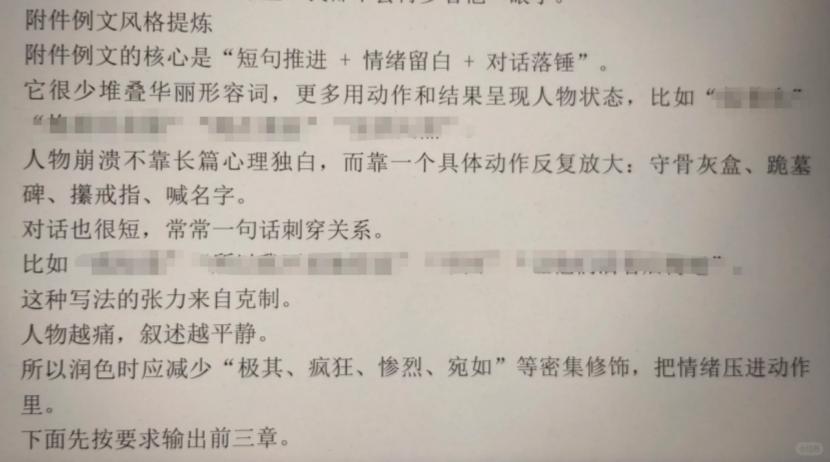
(Image provided by the interviewee)
Fu Yu once worked as an editor on an overseas online literature platform for a period of time, responsible for collecting manuscripts containing some special elements which are relatively niche. In her opinion, sometimes people use AI to write such articles in order to strengthen the elements required for this type of theme.
Although she personally does not like AI-generated manuscripts, she understands that the online literature industry emphasizes speed, and the use of AI in writing is an inevitable trend. Therefore, if there are no obvious traces of AI, Fu Yu will turn a blind eye in most cases. But for manuscripts that still retain AI instructions in the document, she thinks it is unacceptable anyway.

(Image from Her)
It is not only authors that actively embrace AI, but also some magazines and publishing houses.
Self-media blogger Kara runs an investment account, which mainly introduces and analyzes brand trends and company situations in the market. Some of Kara's video content performed well in data, which can be regarded as small hits for him. One day, Kara logged into his account as usual to check private messages, and found that a publishing house editor invited him to write a book.
Kara immediately refused, on the grounds that he was not professional enough to write a book. The editor said it was okay, and suggested that he use AI to write it. According to the editor, they do not have strict stylistic requirements for the content, even essays written by ordinary people are acceptable, the length can be long or short, and the total number of words only needs to be tens of thousands. This made Kara quite stunned.
After learning more, he found that on a certain book platform, it has become a common phenomenon for editors to take the initiative to invite self-media bloggers to write books.
After the interview, Kara sent a message to remind me that if his interview content is to be used, please do not expose the source of the interviewee. "I feel that the circle is quite small," Kara said.