Qualcomm: As the AI craze cools, when will the smartphone industry emerge from the doldrums?
Qualcomm (QCOM.O) released its fiscal 2026 third-quarter earnings report (covering the period ending June 2026) after U.S. stock market hours on the morning of July 30, 2026 Beijing time. The key points are as follows:
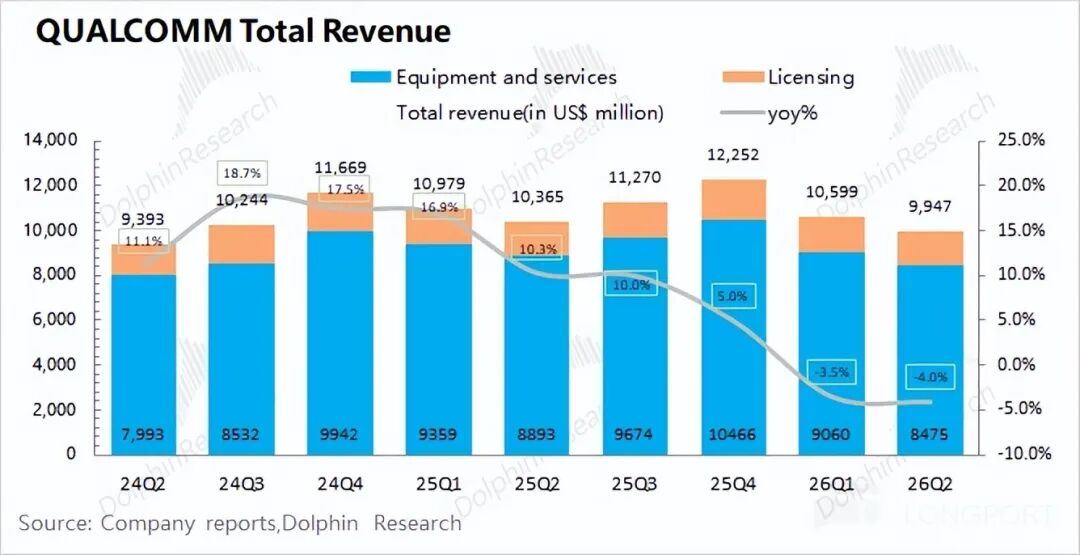
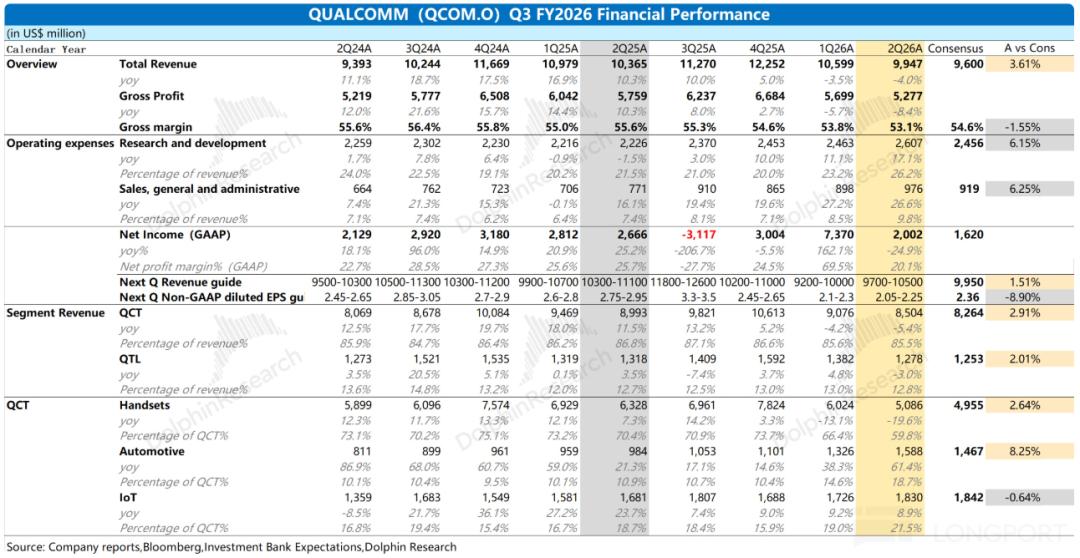
1. Core Metrics: Qualcomm posted $9.95 billion in revenue this quarter, down 4% year over year, beating market expectations of $9.6 billion. Despite strong growth in the automotive business, the top line was still dragged down by the decline in the handset business.
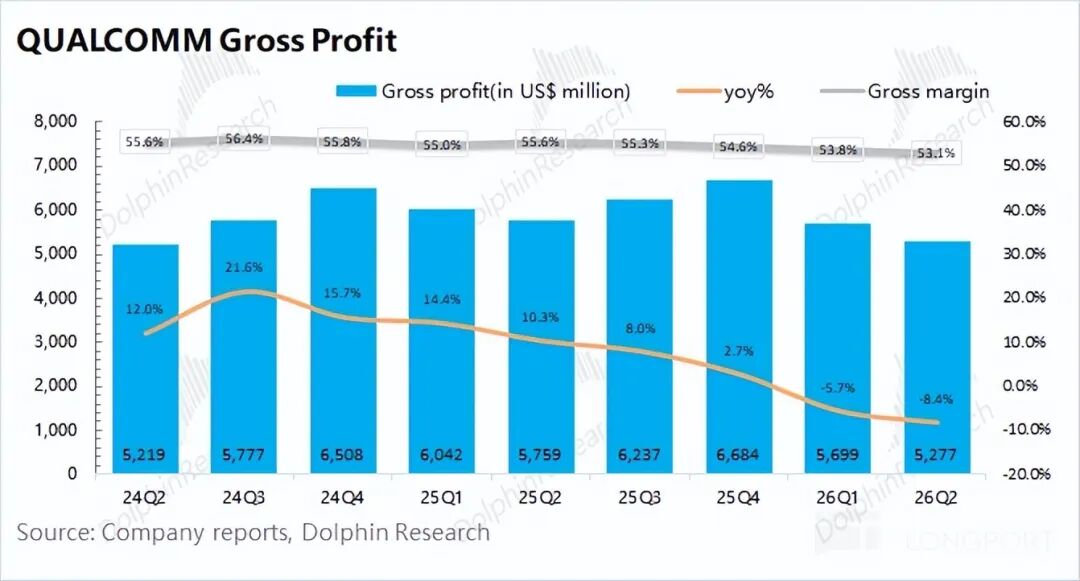
The company's gross margin for the quarter was 53.1%, down 2.5 percentage points year over year and below market expectations of 54.6%. Costs for wafer manufacturing, packaging, testing, advanced packaging, memory and other materials all rose across the board, putting significant pressure on the company's gross margin.
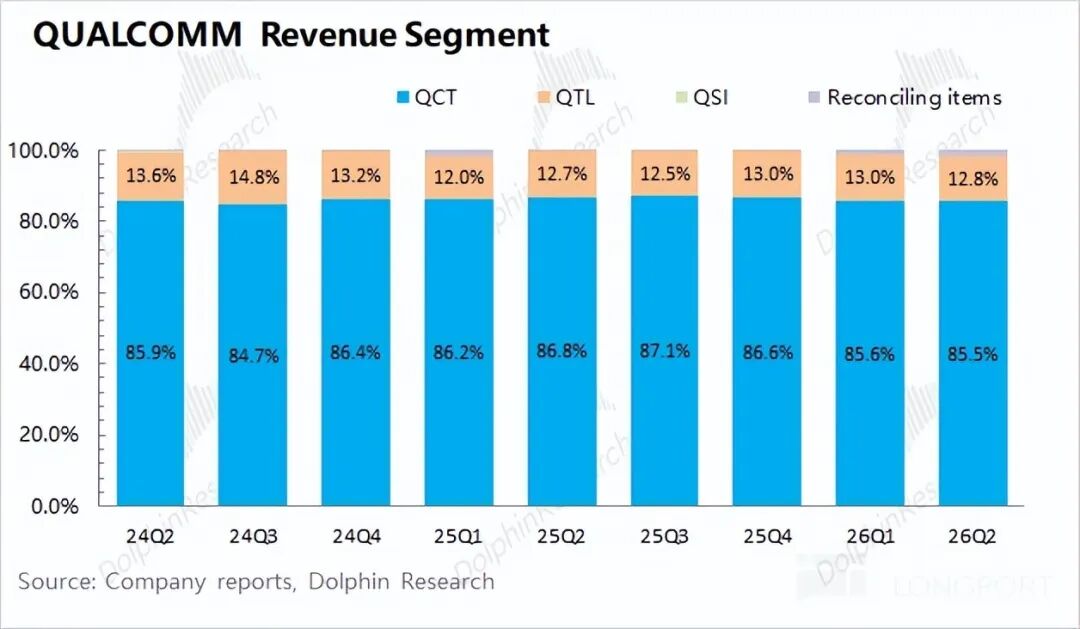
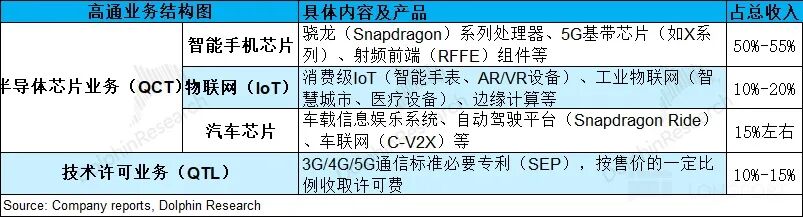
2. Segment Performance: The business of $Qualcomm(QCOM.US) is mainly divided into two parts: the semiconductor chip business (QCT) and the technology licensing business (QTL). The semiconductor chip business is the company's largest source of revenue, accounting for more than 80% of total revenue.
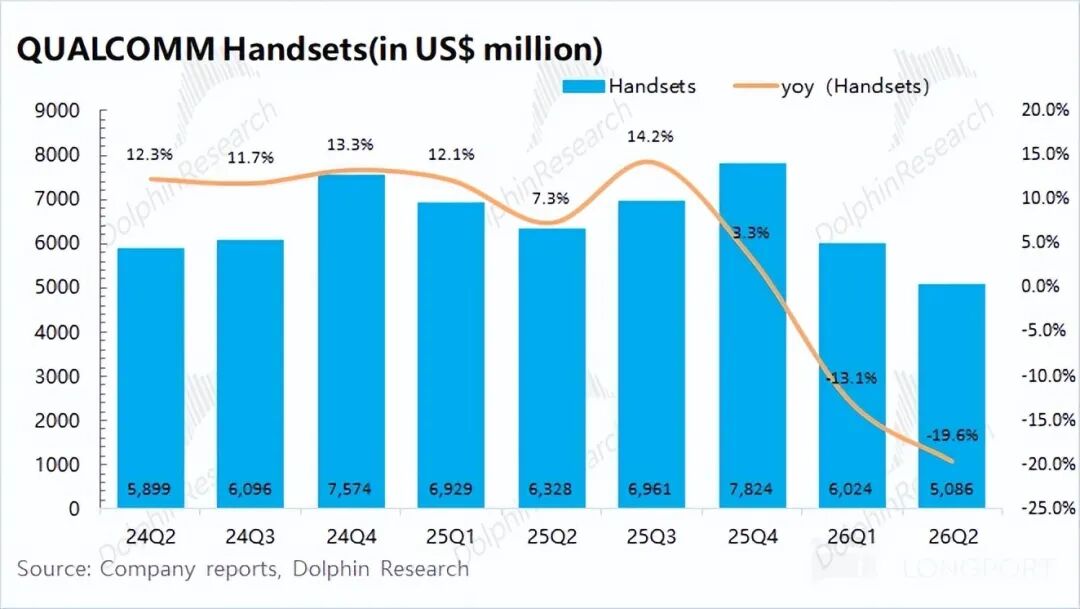
In the semiconductor chip business: ① Handset business revenue reached $5.09 billion this quarter, down 19.6% year over year. The decline in the company's handset business is mainly affected by two factors: the first is industry-wide factor: handset shipments excluding Apple declined 11% year over year this quarter; the second is the weakening internal structure of high-end models, as handset manufacturers tend to use the previous generation of platforms to reduce costs.
② Automotive business revenue hit $1.59 billion this quarter, up 61% year over year, driven by growing shipments of the 4th generation Snapdragon digital cockpit. The company's 5th generation Snapdragon Digital Chassis will see volume ramp-up in September, with a significant increase in per-vehicle value; ③ IoT business revenue was $1.83 billion this quarter, up 9% year over year, with growth driven by demand for consumer and industrial-grade products.
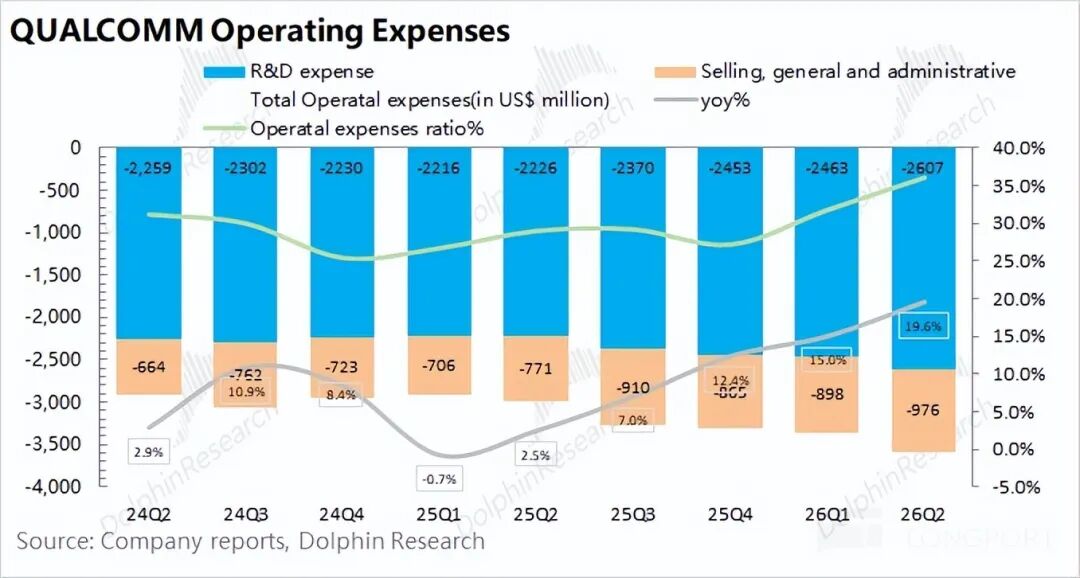
3. Operating Expenses: The company's core operating expenses increased to around $3.6 billion, of which R&D expenses rose to $2.6 billion this quarter, and quarterly sales expenses stood at $980 million.
The company disclosed that its net profit for the quarter reached $2 billion, while in the previous quarter the company released approximately $5.7 billion of previously accrued deferred tax asset valuation allowance. From an operational perspective, the company's core operating profit for the quarter was $1.63 billion, down 41% year over year, mainly affected by the decline in gross margin and the increase in expenses.
4. Next Quarter Guidance: Qualcomm expects fiscal 2026 fourth-quarter revenue to be between $9.7 billion and $10.5 billion, in line with market expectations of $9.95 billion; the company expects Non-GAAP earnings per share for the next quarter to be $2.05 to $2.25, below market expectations of $2.36.
Haitun Jun's overall view: Memory overhang weighs on handsets, data center business remains a "promise" yet to be fulfilled
Qualcomm's earnings performance this time remains unremarkable. While the top line met market expectations, it still posted a year-over-year decline. Gross margin continued to fall, mainly affected by factors such as memory price hikes and sluggish demand, which led to higher costs.
Judging from the next quarter guidance, the company expects revenue of $9.7 billion to $10.5 billion for the next quarter, showing no obvious signs of recovery; Non-GAAP EPS is expected to be $2.05 to $2.25, below market expectations of $2.36. Demand for end markets such as handsets remains weak, and factors such as memory price hikes will continue to put pressure on the company's costs.
Against the backdrop of sluggish traditional core business, the company is striving to make breakthroughs in the data center field. It will lay out four directions: custom chips, commercial CPUs, AI accelerators and connectivity products, which once pushed the company's stock price above $250. As market concerns over the sustainability of AI Capex rise, the company's stock price has fallen back below $160, almost erasing all the gains brought by the data center business.
Beyond this earnings report, the market is focusing on the following aspects of Qualcomm:
1) Traditional Sector: Core business under pressure from memory costs
The handset business is the largest segment of Qualcomm's business, accounting for more than half of total revenue. The overall sluggish performance of the handset market has put significant pressure on the company's performance. Global handset shipments remained at 290 million units this quarter, down 6% year over year.
The handset market is mainly divided into two camps: Apple and Android. In detail, Apple's handset shipments grew nearly 20% year over year this quarter, while shipments of other Android camp handsets declined 11% year over year, which directly affected Qualcomm's handset business performance this quarter.
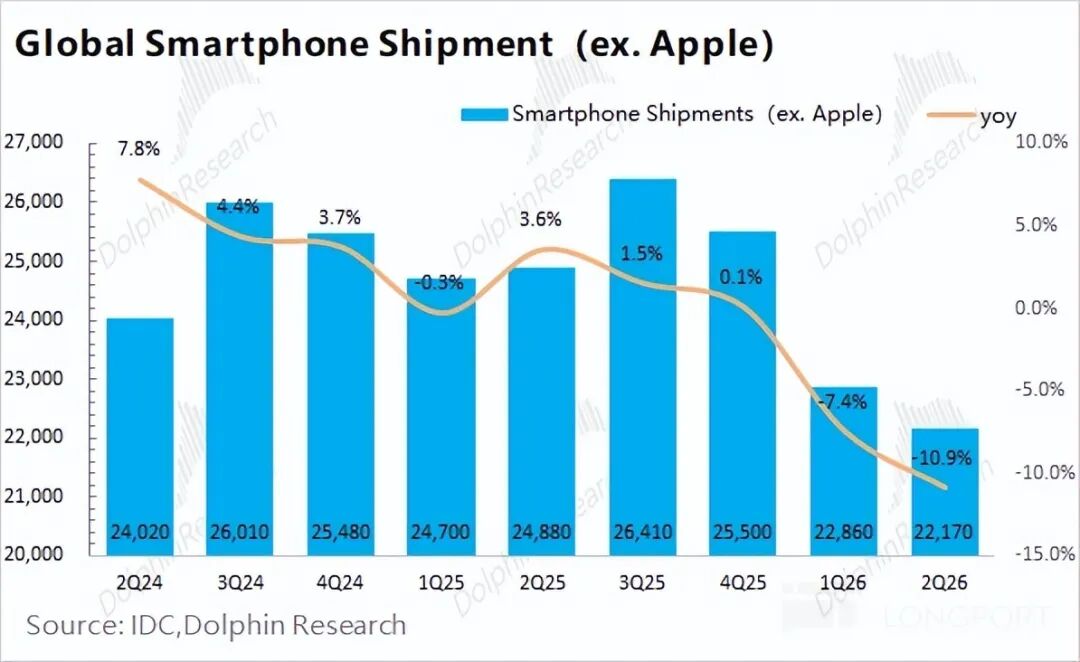
The company expects handset business revenue for the next quarter to be around $5.2 billion, down about 25% year over year, where the sequential growth of Android shipments is offset by the revenue decline of Apple products (the second half of the year is the traditional peak season with seasonal rebound).
The slope of recent memory price hikes has started to slow down. Judging from the fact that manufacturers such as OPPO and VIVO have rejected price increases from memory vendors, the "skyrocketing memory prices" have already caused market dissatisfaction. If the memory cycle enters a downward phase later, the pressure on the company's traditional core business is expected to be relieved.
2) AI Sector: On-device AI and data center are potential growth markets
Against the backdrop of sluggish traditional markets, the company is also striving to make layouts in the AI sector, looking forward to achieving new breakthroughs.
a) On-device AI: The company regards on-device AI as a core component of its Physical AI strategy, covering all end devices including smartphones, PCs, automobiles, XR, robots, and industrial IoT, and the company already has layouts in all these fields.
The two most important areas: ① The potential phone replacement cycle brought by AI Phones, which will be accompanied by AI Agent becoming the "new interface" of smartphones; ② In the AI PC field, the company launched the Snapdragon C platform for Windows laptops, whose core advantages lie in: Oryon CPU, low-power AI inference, heterogeneous computing (CPU+GPU+NPU collaboration, supporting on-device AI Agent operation).
b) AI Data Center: Qualcomm finally stepped into the main AI competition arena, which is also the most notable strategic plan in the company's AI layout.
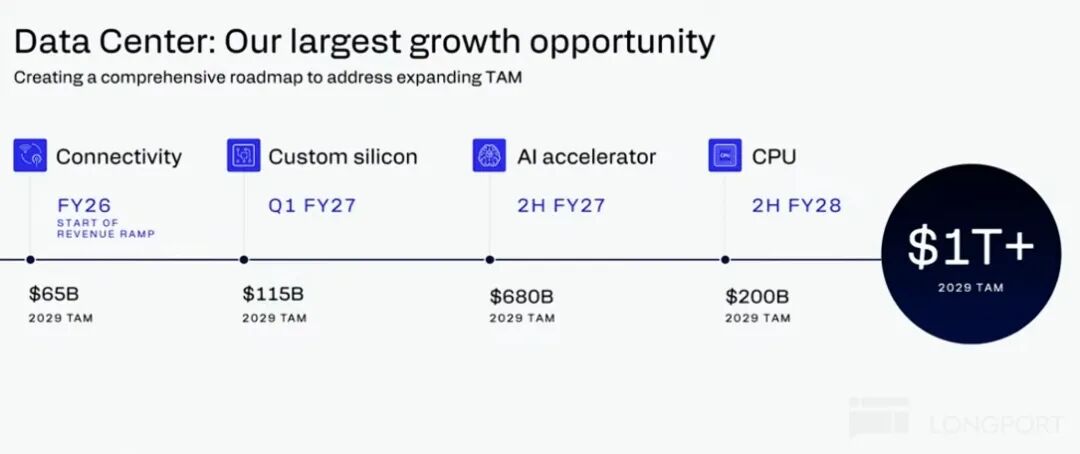
The company disclosed at its Investor Day on June 24, 2026 that Qualcomm's AI data center strategy will cover four major product lines:
① AI Accelerator (HBC): Microsoft has confirmed multi-generation partnership
Qualcomm's core differentiated technology realizes Processing Near Memory through LPDDR5X (vs HBM), which is optimized specifically for "memory capacity-intensive" AI inference workloads.
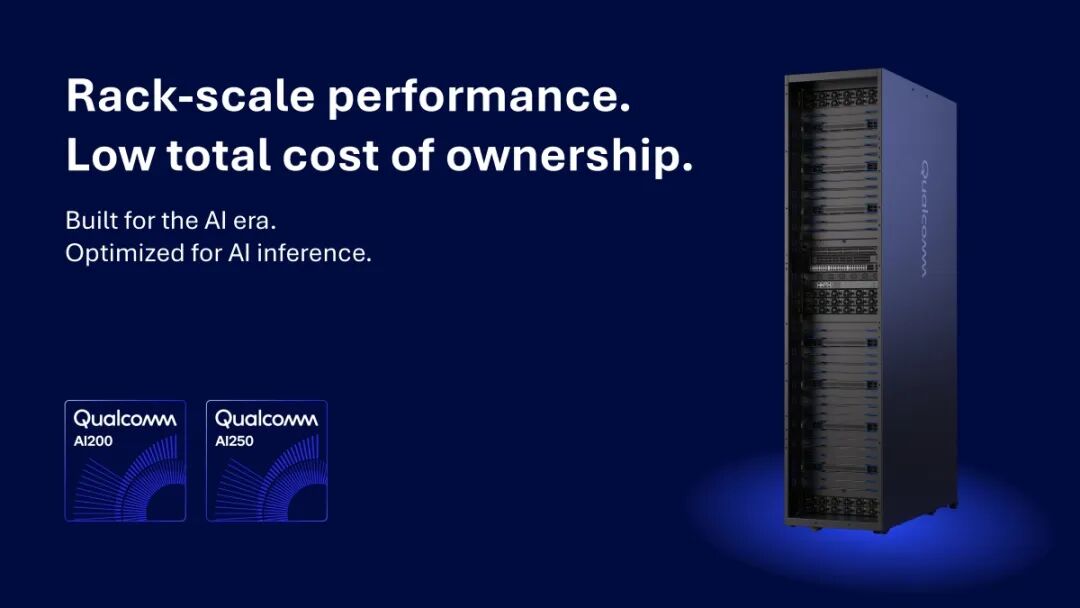
AI200 is currently in production ramp-up, and the next-generation AI250 is expected to be sampled in 2027. The subsequent AI300 will adopt UALink and ESUN for scale-up network interconnection, with effective bandwidth 54 times that of AI200.
② Commercial CPU (Dragonfly C1000): Meta has confirmed multi-generation partnership
This is mainly based on Qualcomm's Oryon CPU architecture for smartphones and PCs, which the company has extended to the data center. It is positioned as an "Agentic CPU", specifically for CPU-intensive workloads such as agent orchestration, multi-step inference, and tool calling.
③ Custom Silicon Business: 2 hyperscale customers have been confirmed (each contributing over $1 billion in revenue in fiscal 2027)
This capability is obtained from the acquisition of Alphawave Semi (SerDes, Die-to-Die, PCIe/CXL, HBM PHY) and Ventana (Veyron V2 RISC-V CPU), which mainly provides custom AI chip (XPU) design services for hyperscale customers.
④ Connectivity Business: The first hyperscale customer has been secured
Based on Alphawave's IP, it provides 800G/1.6T optical modules, AOC, AEC and other products. The company is currently producing 800G LR2 modules, 800G optical modules/AOC/AEC, and 1.6T optical modules/AOC/AEC are expected to be launched between 2026 and 2027.
Previously driven by the AI boom, the company's entry into the AI data center field once pushed its stock price above $250. Now under concerns over AI Capex, the company's stock price has fallen back to around $160, erasing all the growth expectations brought by the data center business.
Although the company estimates the total addressable market of the AI data center business to be $1 trillion, the data center business has not yet generated significant revenue for the company. Looking back at the company's traditional business, against the backdrop of sluggish end markets such as handsets, the company's current PE is still relatively high.
As for the data center business, although the company's management has set a revenue target of $15 billion for fiscal 2029, more attention should be paid to its near-term performance. Combined with the company's target of $5 billion in data center revenue for fiscal 2027, this segment is expected to contribute $1.2 billion in operating profit (referring to the company's historical operating profit margin).
In the current fragile market environment, it is more reasonable to find the relatively safe bottom range for Qualcomm's stock price. From the perspective of traditional business, a further pullback of the company's stock price is a more prudent scenario. In that case, the data center business of the company will be directly treated as "an option".
If the fiscal 2027 target set by the company can be achieved, it will inject valuation premium for the data center segment of the company.
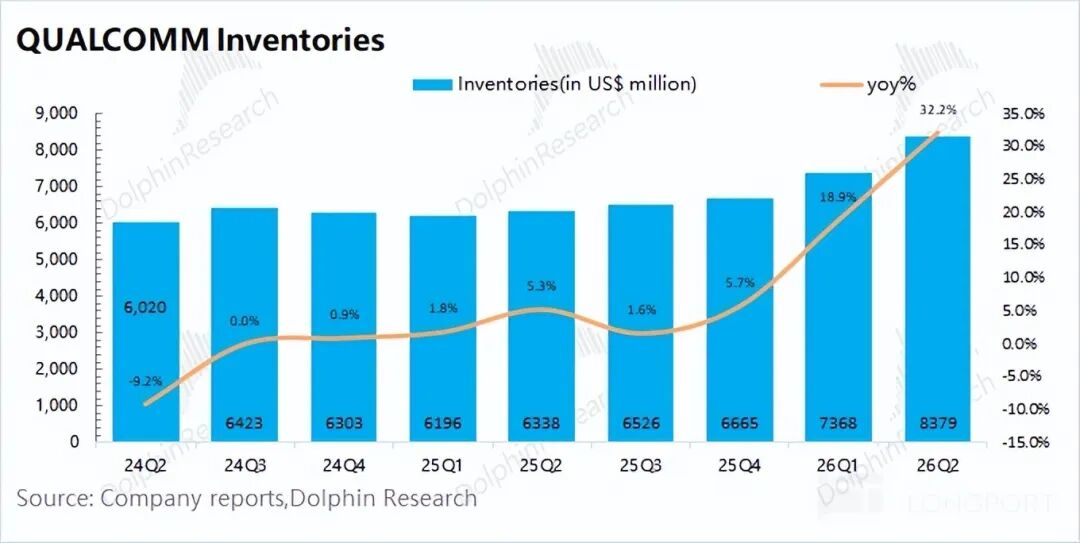
The following are relevant data charts of Qualcomm's earnings report from Haitun Investment Research: